Key takeaways
- Pro: Monitor quality matches more expensive rivals, giving reliable data for structured workouts.
- Pro: Folds compactly without requiring disassembly between uses.
- Con: Assembly takes longer than competitors at this price, with some users reporting unclear instructions.
What's inside
Rowing machines occupy a peculiar spot in home fitness: they promise a full-body workout in minimal square footage, but the market is flooded with units that feel flimsy, monitor inaccurate, or fold awkwardly. The real challenge for a buyer in 2026 is distinguishing between a machine that delivers consistent, adjustable resistance across thousands of strokes and one that wobbles on its rail after a month of use. Air rowers, in particular, offer resistance that scales with your effort, making them popular for interval training, but build quality and rail smoothness separate the worthwhile purchases from the disappointing ones.
This roundup compares eight machines across price points from under $200 to nearly $1,000, using published specifications and recurring patterns in owner feedback. We looked at resistance type, weight capacity, storage design, monitor quality, and how each unit handles the practical question of whether someone will actually keep using it. The result is a ranked set of picks that addresses different budgets, apartment sizes, and training goals.
As an Amazon Associate we earn from qualifying purchases at no extra cost to you. Product prices and availability are accurate as of the date shown and are subject to change.



Quick Picks
| Product | Best for | Price |
|---|---|---|
| Merach R50 Pro | Balanced performance and storage | $559.99 |
| GMWD Lava Flow | Mid-range air resistance with comfort | $389.99 |
| Generic Air Rower | Long rail for taller users | $339.99 |
| MAJOR FITNESS Drone R1 | Quieter rides with aluminum rail | $503.99 |
| Concept2 RowErg | Serious training and durability | $990 |
| Merach Q1S | Budget entry with app connectivity | $189.99 |
| YOSUDA Magnetic Rower | Silent home use on a tight budget | $189.99 |
| Merach RS3 Scull | Realistic rowing feel without air noise | $305.99 |
How We Picked
Four criteria drove these selections. First, resistance delivery: whether the machine provides meaningful, repeatable drag that scales with effort or maxes out too easily. Second, structural quality as reflected in weight capacity ratings and rail material, since these determine longevity under daily use. Third, storage and footprint, because the most capable rower is useless if it stays in the closet. Fourth, monitor functionality, which governs whether you can track progress and vary workouts rather than rowing by feel alone.
The 8 Best Air Rowing Machines in 2026
Merach R50 Pro
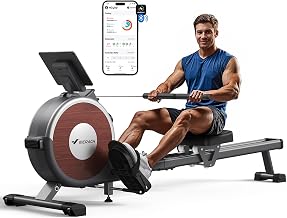
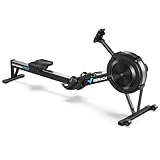
The R50 Pro sits in a strong middle ground for anyone who wants air-resistance feedback without the Concept2 price tag. Its professional-grade monitor gives stroke rate, time, distance, and calories in a clear readout, and the folding frame makes it realistic to store under a bed or against a wall between sessions. Owner reviews consistently praise the smooth flywheel engagement and the seat glide.
- Pro: Monitor quality matches more expensive rivals, giving reliable data for structured workouts.
- Pro: Folds compactly without requiring disassembly between uses.
- Con: Assembly takes longer than competitors at this price, with some users reporting unclear instructions.
Skip it if you already have a dedicated cardio corner with zero space constraints and want a fixed-position machine; the folding hinge adds a small wobble that non-folding units avoid.
GMWD Lava Flow Series
GMWD targets the buyer who wants ten adjustable resistance levels, a padded ergonomic seat, and a built-in tablet holder without spending more than $400. The Lava Flow name refers to its visual design language, but the practical appeal is the combination of adjustable fan resistance and a seat that owners describe as comfortable over thirty-plus minute sessions. The unit stores upright or flat, depending on your floor plan.
- Pro: Ten resistance levels provide enough range for both steady-state and high-intensity intervals.
- Pro: The device holder integrates cleanly, so your phone or tablet stays at eye level without a separate mount.
- Con: The performance monitor is basic compared to the R50 Pro, lacking advanced metrics like split pace per 500m.
Skip it if you train with structured programs that require precise interval timing and heart-rate zone tracking.
Rowing Machine with Extra Long Rail
This unit is specifically useful for anyone over six feet tall or with long legs who finds standard rails too short, cutting the stroke at full extension. The extra rail length accommodates a fuller range of motion, and the air resistance mechanism scales naturally with effort. The seat is wide and the device holder keeps your phone reachable. Storage is straightforward given the folding design.
- Pro: Extra-long rail removes the most common complaint from taller users on shorter machines.
- Pro: Simple folding mechanism with no tools required for storage transitions.
- Con: Brand identity is unclear across retailers, making warranty claims and replacement parts harder to source.
Skip it if you live in a shared apartment where you need support contacts and documented service records for long-term ownership.
MAJOR FITNESS Drone R1
The Drone R1 differentiates itself with an aluminum rail that reduces the scraping noise common on cheaper steel tracks. At 330 pounds rated capacity, it supports a wider user base than budget competitors. The ten-level resistance adjustment and foldable frame make it a practical pick for home gyms where neighbors live below. Owners note the quieter ride as the standout feature.
- Pro: Aluminum rail keeps stroke noise low, ideal for shared housing or early-morning use.
- Pro: 330-pound capacity provides a safety margin over lighter-rated machines in the same price band.
- Con: The resistance fan is smaller than what you will find on the Concept2, so peak drag caps out sooner for heavy pullers.
Skip it if you are a competitive athlete who needs the maximum drag load for power-endurance intervals.
Concept2 RowErg
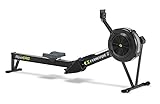
The RowErg remains the category benchmark for serious rowers. The PM5 monitor is the most trusted in the industry, with race comparisons, workout programs, and heart-rate strap compatibility built in. Adjustable air resistance handles everything from technique drills to full-power intervals. It stores by separating the monorail from the flywheel without tools. The price is the highest here, but the resale value and proven durability justify the premium for committed users.
- Pro: PM5 monitor ecosystem is unmatched for structured training, with online challenges and data export.
- Pro: Decades of mechanical simplicity mean replacement parts remain available and the frame lasts indefinitely.
- Con: At $990, the entry cost is double that of the next-best air rower on this list.
Skip it if you want a machine for casual thirty-minute sessions and do not care about split times or competitive leaderboards.
Merach Q1S Magnetic Rower
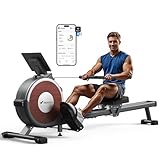
The Q1S is technically a magnetic rower, not air, but it earns its spot here as a budget-conscious alternative for buyers whose priority is silence rather than air-resistance feel. Sixteen levels of quiet magnetic resistance, dual slide rails, 350-pound capacity, and Bluetooth app connectivity make it feature-dense for under $190. The LCD monitor is simple but functional, and the app adds guided workout variety.
- Pro: Magnetic resistance produces nearly zero fan noise, making it the quietest option on this list.
- Pro: App compatibility at this price is unusual and adds workout structure without a subscription commitment.
- Con: Lacks the dynamic resistance scaling of true air rowers, so heavy pullers may feel capped at higher levels.
Skip it if you specifically want the self-regulating drag of an air flywheel for interval training.
YOSUDA Magnetic Rower
At the same $189.99 price point as the Q1S, the YOSUDA delivers sixteen magnetic resistance levels with a compact frame suited to tight spaces. It appeals to buyers who want the simplest possible setup: unbox, adjust the seat slider, row. No app, no monitor complexity, just a reliable quiet workout machine that folds for storage. Owner feedback highlights the sturdy frame relative to its cost.
- Pro: Minimalist design means fewer electronic components that can fail, keeping long-term ownership costs low.
- Pro: Compact folded footprint fits under most standard beds or behind a door.
- Con: No app connectivity or advanced metrics limits its utility for data-driven training.
Skip it if you already use a training platform and want your rower to sync with it automatically.
Merach RS3 Scull
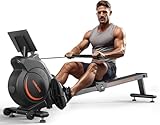
The RS3 takes a different approach by simulating the feel of on-water sculling through its resistance mechanism and seat geometry. The ergonomic seat is shaped to encourage proper hip rotation, and the handle path mimics the slight lateral pull of a real scull. For indoor rowers who want to maintain technique transfer to outdoor rowing without dealing with the whoosh of an air flywheel, the RS3 fills a specific niche at just over $300.
- Pro: Scull-style stroke path reinforces technique that transfers directly to on-water rowing.
- Pro: Ergonomic seat design reduces the pressure points that flat seats create over longer sessions.
- Con: The specialized stroke path feels awkward for users coming from traditional straight-pull rowers.
Skip it if your goal is general cardio rather than rowing technique refinement.
Buying Guide
Air Resistance vs. Magnetic Resistance
Air rowers use a flywheel that creates drag proportional to your pull force, meaning harder efforts produce more resistance automatically. This self-regulating feel suits interval training and mimics the sensation of moving through water. Magnetic rowers, like the Q1S and YOSUDA here, use fixed resistance levels controlled by a dial. They run quieter and cost less but do not scale dynamically with effort. If your workouts include sprint intervals where resistance should spike on each pull, air is the better mechanism. If noise reduction is your top constraint, magnetic wins.
Rail Material and Weight Capacity
Steel rails are standard and durable but can produce a scraping sound as the seat rollers pass over joints in the track. Aluminum rails, as found on the MAJOR FITNESS Drone R1, reduce friction noise and resist surface oxidation. Weight capacity is a safety indicator: anything rated below 300 pounds should be avoided by users near that threshold. A rated capacity with a 20- to 30-percent margin over your body weight gives confidence in long-term structural integrity under repeated loading.
Monitor Quality and Connectivity
The monitor determines whether you row by feel or by data. Basic LCD units display time, strokes, and estimated calories. Better monitors add split pace per 500 meters, heart-rate pairing, and programmable intervals. The PM5 on the Concept2 sets the standard with exportable data and an online workout library. For budget buyers, a device holder that positions your tablet at eye level lets you use third-party rowing apps to compensate for a limited built-in display.
Our Verdict
Top pick: The Concept2 RowErg is the definitive best air rowing machine for anyone training seriously, offering a monitor ecosystem and mechanical durability that no budget competitor approaches. Budget pick: The YOSUDA Magnetic Rower delivers silent, functional resistance at $189.99 with no unnecessary complexity. Condition for another winner: If you are over six feet tall and your current rower cuts your stroke short, the generic Extra Long Rail model at $339.99 solves a physical constraint that even premium machines do not address.
FAQ
Do air rowers get louder with use?
Air rowers produce a consistent whoosh proportional to effort, but a growing grinding or scraping sound indicates worn seat rollers or rail surface damage. Regular cleaning of the rail and occasional lubrication of the roller wheels keeps noise at baseline levels.
Is magnetic resistance better than air for apartments?
Yes, if noise is your primary concern. Magnetic rowers operate nearly silently because they use frictionless eddy-current resistance rather than a fan pushing air. The tradeoff is that magnetic units cannot self-adjust resistance to match your pull intensity.
What weight capacity do I need?
Choose a machine rated at least twenty percent above your body weight. This margin accounts for the dynamic loading of each stroke, which temporarily exceeds static weight. Most machines in this roundup range from 300 to 350 pounds, with the Concept2 supporting heavy users comfortably through its proven frame geometry.
Can I store an air rower under a bed?
Most folding models on this list stand vertically or lie flat with a footprint under two feet wide. Under-bed storage works only if your clearance exceeds the folded height, which typically measures ten to fourteen inches. The GMWD and Merach R50 Pro fold compactly enough for this application; the Concept2 separates into two pieces that store flat against a wall.