Key takeaways
- Choose it for: apartments, occasional sessions, and quick storage.
- Desk suitability: possible with a suitable standing desk, but use the handrail or safety arrangement recommended for your setup.
- Watch for: belt alignment and the temptation to store it immediately while the belt is still warm or damp.
The best treadmills for walking are the WalkingPad C2 for compact storage, the LifeSpan TR1000-Classic for regular under-desk use, the Egofit Walker Pro M1 for very small rooms, and the Horizon T101 for comfortable everyday walking with a real incline.
Walking treadmills are not simply slower versions of running machines. For this use, low-speed stability, a forgiving deck, quiet operation, easy storage, and controls that work at 1–4 mph matter more than a high top speed. The right choice also depends on whether you need a permanent walking station or a machine that disappears after each session.
Our top picks


As an Amazon Associate we earn from qualifying purchases at no extra cost to you. Ratings are shown as listed on Amazon.
Best treadmills for walking at a glance
| Model | Best for | Walking speed | Walking area | Incline | Approx. weight |
|---|---|---|---|---|---|
| WalkingPad C2 | Small rooms and occasional walking | About 0.5–3.7 mph | About 47 × 16 in | None | About 55 lb |
| LifeSpan TR1000-Classic | Under-desk walking during work | About 0.4–4.0 mph | About 40 × 20 in | None | About 90 lb |
| Egofit Walker Pro M1 | Very limited floor space | About 0.6–3.1 mph | About 40 × 16 in | Manual incline, model-dependent | About 55 lb |
| Horizon T101 | Comfortable daily walking and incline work | About 0.5–10 mph | About 20 × 55 in | Up to 10% | About 180 lb |
Dimensions and capacities can vary by production year and regional version. Confirm the current specification before buying, particularly if the treadmill must fit beneath a desk or through a narrow doorway.
Our picks by walking situation
Best compact folding option: WalkingPad C2
The WalkingPad C2 is a practical choice when storage footprint matters more than incline. Its deck folds at the center, allowing it to slide under a bed or sofa more easily than a conventional treadmill. The walking belt is short and relatively narrow, but that is acceptable for controlled, easy-paced walking if you stay centered.
Its low starting speed is useful for warm-ups and desk walking, while the upper walking speed is sufficient for brisk indoor walking rather than running. The main compromise is the lack of incline and the limited deck width. People with a long stride, frequent balance changes, or a preference for vigorous walking may find it restrictive.
- Choose it for: apartments, occasional sessions, and quick storage.
- Desk suitability: possible with a suitable standing desk, but use the handrail or safety arrangement recommended for your setup.
- Watch for: belt alignment and the temptation to store it immediately while the belt is still warm or damp.
Best dedicated under-desk treadmill: LifeSpan TR1000-Classic
The LifeSpan TR1000-Classic is designed around walking while standing at a desk. Its deck is wider than many ultra-compact walking pads, and its speed range is deliberately limited to walking pace. That makes it better suited to frequent, predictable use than a foldable pad intended mainly for occasional activity.
It does not provide incline, and its roughly 90-pound weight makes moving it less convenient. However, the heavier construction can reduce movement and vibration on a solid floor. If you plan to walk while reading, taking calls, or working at a height-adjustable desk several days per week, its dedicated design is more relevant than a high maximum speed.
- Choose it for: regular workday walking and a permanent standing-desk arrangement.
- Desk suitability: excellent, provided the desk has enough vertical adjustment for your height and monitor.
- Watch for: leaving enough rear clearance to step off safely and avoiding loose cables near the belt.
Best for the smallest room: Egofit Walker Pro M1
The Egofit Walker Pro M1 targets buyers who need a short treadmill in a bedroom, office, or studio apartment. Its compact deck and upright storage profile make it easier to place than a full-length home treadmill. Some versions include a small manual incline, which can add walking intensity without requiring a motorized incline system.
The short deck is also its defining limitation. It suits slower, deliberate walking better than a long-stride brisk walk. Before purchasing, measure the usable floor area with the handrail raised, not just the folded footprint. Check that a door, chair, or desk will not obstruct the rear of the machine.
- Choose it for: light-to-moderate walking in a genuinely tight space.
- Desk suitability: workable only if the handrail and desk arrangement leave adequate arm and screen clearance.
- Watch for: reduced stability if placed on thick carpet or an uneven floor.
Best for comfort and incline: Horizon T101
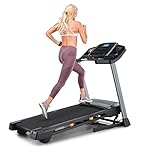
The Horizon T101 is the better choice when walking comfort matters more than storage convenience. Its approximately 20-by-55-inch deck gives most walkers substantially more room than an under-desk pad, and its cushioned running surface is more forgiving for longer sessions. The motorized incline, reaching about 10%, also creates useful variety without requiring a faster pace.
This is a full-size treadmill, not a discreet office accessory. It is heavy, occupies a large permanent footprint, and generally needs to remain assembled in one location. For a household where several people will walk regularly, however, its wider deck and conventional controls are often worth the space.
- Choose it for: daily walking, longer strides, multiple users, and incline sessions.
- Desk suitability: generally poor unless paired with a large, adjustable treadmill desk.
- Watch for: the need for a level, vibration-resistant floor and adequate ceiling clearance if using the incline.
Decision matrix: which one fits your situation?
| Your priority | Best direction | Why |
|---|---|---|
| Under about $500 and occasional use | Compact folding walking pad | Lower purchase cost and easier storage, though deck comfort and durability are usually more limited. |
| Walking while working four or more days weekly | LifeSpan TR1000-Classic or similar dedicated model | Walking-focused speed control and a more stable under-desk platform. |
| Bedroom or office with minimal floor area | Egofit Walker Pro M1 | Shorter footprint, but it requires more careful stride and placement checks. |
| Long sessions, higher comfort, or incline walking | Horizon T101 | Wider, longer deck and motorized incline; storage is the trade-off. |
| Need to store the treadmill after every session | WalkingPad C2 | Center folding makes it easier to move and slide beneath furniture. |
What to check before buying
Low-speed control
A treadmill for desk walking should begin smoothly below 1 mph and make small speed changes easy. A machine that jumps from a slow setting to a noticeably faster pace is inconvenient when you are typing or carrying a drink. Remote controls are useful, but a clear physical control panel is preferable for normal workouts.
Deck comfort and sizing
Measure your natural walking stride, then compare it with the belt length. A 40-inch deck can work for slow, compact steps but leaves less margin for error. A 55-inch deck is more comfortable for brisk walking and taller users. Width matters too: a 16-inch belt saves space, while a 20-inch belt gives more room for normal arm swing and small lateral corrections.
Noise and vibration
Manufacturers often emphasize motor noise, but foot impact, belt friction, and floor vibration can be more noticeable in an apartment. A firm level floor, a thin treadmill mat, and regular belt lubrication usually help. Thick soft carpet can make a compact treadmill rock or interfere with ventilation.
Incline
Incline adds intensity without requiring a high speed, but it also increases motor load and can make a treadmill less suitable under a desk. Choose a motorized incline if you want repeatable hill sessions. A manual incline is simpler and lighter but usually requires stopping to adjust it.
Ownership realities: maintenance and running cost
The belt and deck are the parts most likely to need attention. Dust, pet hair, and grit increase friction, making the motor work harder. Vacuum around the treadmill regularly, wipe the exposed belt edges, and lubricate the deck only according to the manual. Over-lubricating can cause slipping and attract debris.
Check belt alignment after moving a compact treadmill. If the belt consistently drifts to one side, stop using it and make the small rear-roller adjustment specified by the manufacturer. Continuing to walk on a badly misaligned belt can wear the edges and rollers prematurely.
For a simple ownership calculation, a $700 treadmill used four times per week for three years provides about 624 sessions. Before maintenance or electricity, that is approximately $1.12 per session. A $350 walking pad used once weekly for the same period provides only about 156 sessions, or $2.24 per session. The cheaper machine is not automatically the better value if it does not fit your routine.
Bottom line
Choose the WalkingPad C2 when storage is the deciding factor, the LifeSpan TR1000-Classic for frequent under-desk walking, the Egofit Walker Pro M1 for the smallest usable footprint, and the Horizon T101 when deck comfort and incline are more important than portability. Whichever model you select, measure the complete operating area, not only the folded dimensions, and leave a clear path for stepping off safely.