Key takeaways
- Vacuum around the deck and rollers regularly, especially with pets or carpet.
- Inspect whether the belt stays centered after several sessions.
- Use only the specified treadmill lubricant and apply it at the stated interval.
- Keep the machine level; an uneven floor can create tracking and noise problems.
- Allow the motor to cool after long sessions instead of immediately folding and covering it.
- Keep the remote, power cord, and any safety accessory together during storage.
The best walking pad treadmills for home walking are the WalkingPad C2 for most users, the WalkingPad A1 Pro for the smallest storage footprint, the UREVO 2S for a lower-cost everyday option, and the Egofit Walker Pro M1 when compact dimensions matter more than maximum walking speed.
A walking pad is best chosen by matching the belt to your stride, the motor to your intended speed, and the folded size to the place where it will actually be stored. A low price is less useful if the deck is too short, the machine cannot slide under your furniture, or its controls are inconvenient during desk work.
Our top picks
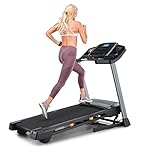
 Walking Pad Treadmill for Home
- Maximum Speed: 3.8 miles_per_hour
- Maximum Horsepower: 2.5 hp
- Maximum Incline Percentage: 4


As an Amazon Associate we earn from qualifying purchases at no extra cost to you. Ratings are shown as listed on Amazon.
Best walking pad treadmills at a glance
| Model or type | Walking speed | Approx. belt size | Weight capacity | Best suited to | Typical market range |
|---|---|---|---|---|---|
| WalkingPad C2 | 0.5–3.7 mph | 47.2 x 15.7 in | About 220 lb | General home walking and occasional under-desk use | $450–$650 |
| WalkingPad A1 Pro | 0.5–3.7 mph | 47.2 x 15.7 in | About 220 lb | Very limited storage space | $400–$600 |
| UREVO 2S | Up to about 3.8 mph | About 42.5 x 16.5 in | About 265 lb | Budget buyers who want a wider deck | $250–$450 |
| Egofit Walker Pro M1 | Up to about 3.7 mph | About 38.4 x 16.5 in | About 220 lb | Short storage length and light walking | $500–$700 |
Specifications can differ by generation, region, and retailer, so check the exact model number before buying. The figures above are useful comparison targets rather than a substitute for the current manufacturer specification.
Our picks by situation
Best overall: WalkingPad C2
The WalkingPad C2 is the most balanced choice for a household that wants a folding walking pad rather than a permanently installed treadmill. Its split-folding deck reduces storage length, while its roughly 47-inch belt gives more usable room than ultra-compact models. The top speed is sufficient for ordinary walking and light desk walking, but it is not intended for jogging.
Its main trade-off is width. A belt close to 16 inches wide requires more accurate foot placement than a conventional treadmill. The remote control is convenient for speed changes, although losing or damaging a small remote can be more troublesome than using a large console with physical buttons.
Best for the smallest storage area: WalkingPad A1 Pro
The A1 Pro makes sense when the machine must slide beneath a sofa, bed, or standing desk and be moved frequently. Its folding design and comparatively low profile are more important advantages than its maximum speed. It is a practical choice for short walking sessions, especially when an upright treadmill console would consume too much room.
Choose it with care if you have a long stride or expect to walk quickly. A belt around 47 inches can work well for relaxed walking, but users with a longer natural stride may feel constrained. Measure your available storage area and leave enough clearance to pull the unit out without lifting furniture.
Best budget-oriented option: UREVO 2S
The UREVO 2S is appealing when purchase price and weight capacity matter more than the flattest possible storage. Its belt is commonly listed as slightly shorter but wider than the WalkingPad C2’s, and its capacity is often higher. That wider surface can feel more forgiving for beginners.
The compromises are typical of lower-priced walking pads: a heavier, less elegant chassis, less sophisticated folding, and potentially more noticeable motor or belt noise. It is better suited to a dedicated corner than to a machine that must be lifted into a narrow cupboard after every use.
Best compact footprint: Egofit Walker Pro M1
The Egofit Walker Pro M1 has a particularly short deck and upright-style design. It is useful for an apartment or office where floor depth is the limiting factor. Some versions include a small front handle or console, which can make mounting and basic speed control easier than on a completely flat pad.
Its shorter walking surface is also its defining limitation. It suits controlled, moderate walking better than a long-stride gait. If you naturally walk with large steps, a 47-inch or longer belt is the safer choice.
How the important specifications affect your decision
Walking speed
Most walking pads reach approximately 3.5–4 mph, enough for relaxed walking and brisk walking for many people. Under-desk models often have a lower recommended speed when used while typing or concentrating. At higher speeds, arm movement, balance, and visual attention become more important.
Do not choose by maximum speed alone. A stable low-speed range, responsive remote, and smooth acceleration are more useful for desk work than an extra half-mile per hour. If you want to jog, look for a treadmill explicitly rated for jogging rather than treating a walking pad’s top speed as a running specification.
Belt dimensions
Belt length controls stride freedom; belt width controls how much side-to-side correction you can make. For relaxed walking, a belt around 40–45 inches long may be adequate. A 47–50-inch belt is more comfortable for frequent use or taller users. A width near 16 inches is common in compact models, while 18 inches or more feels less restrictive.
A useful sizing check is to measure the distance between your feet during normal walking, then add several inches on both sides for correction. If you cannot try the product, favor the longer belt when two people of different heights will share it.
Under-desk clearance and noise
Measure the distance from the floor to the lowest part of the desk, not merely the desktop height. Many flat walking pads are roughly 4–6 inches tall, but the power cord, rear roller, and any raised front housing can determine whether the unit really fits. Leave additional space for ventilation and for removing the pad.
Noise comes from the motor, rollers, belt friction, and the user’s footsteps. A walking pad on a hard floor can sound louder than its specifications suggest. A dense treadmill mat can reduce vibration and protect flooring, but it will not cure a poorly aligned or worn belt. For video calls, a slower pace and a quiet keyboard may matter as much as the treadmill’s advertised decibel figure.
Weight capacity and stability
Treat the published capacity as a ceiling, not a target. A user near that limit may experience more motor strain, slower acceleration, and greater belt wear. A model with a higher stated capacity is often physically heavier, so balance the extra stability against the need to move it.
Controls and portability
Remote controls are common because a flat pad has little room for a console. They are useful for starting, stopping, and making small speed changes, but they should not replace a safety key or a clearly accessible stop method. An app can add tracking, yet basic operation should remain possible without a phone.
Check the machine’s actual weight before ordering. A 50–60-pound pad may be portable for one person across a room but awkward to lift into a closet. Wheels, a folding hinge, and a built-in handle can matter more than a few pounds of difference.
Decision matrix: which type fits your routine?
| Your situation | Prioritize | Most suitable choice | What to avoid |
|---|---|---|---|
| Under $400 and occasional use | Warranty, basic remote, at least 16-inch belt width | Budget model such as UREVO 2S, if the current specification fits | Unknown capacity, no replacement belt, or unclear support |
| Daily walking for 30–60 minutes | 47-inch-or-longer belt, cooling, stable rollers | WalkingPad C2 or a comparable full-length folding pad | Very short decks designed only for occasional use |
| Small apartment or shared room | Folded depth, carry handles, storage weight | WalkingPad A1 Pro or another low-profile folding model | A heavy model that will remain unused because storage is difficult |
| Long stride or two users | At least 47–50 inches of belt length and generous capacity | Longer, wider walking pad rather than the smallest model | Ultra-compact decks under about 40 inches |
| Typing while walking | Low noise, gradual speed control, desk clearance | Flat walking pad with a reliable remote | High-speed use or a model whose stop control is difficult to reach |
Ownership costs and maintenance that listings often omit
The belt and deck are the parts most likely to need attention. Dust, hair, and floor debris can increase friction; a dry belt can make the motor work harder and produce a dragging sensation. Follow the manufacturer’s lubrication instructions rather than applying household oil. Too much lubricant can migrate onto the floor or cause belt slip.
- Vacuum around the deck and rollers regularly, especially with pets or carpet.
- Inspect whether the belt stays centered after several sessions.
- Use only the specified treadmill lubricant and apply it at the stated interval.
- Keep the machine level; an uneven floor can create tracking and noise problems.
- Allow the motor to cool after long sessions instead of immediately folding and covering it.
- Keep the remote, power cord, and any safety accessory together during storage.
For a simple value calculation, suppose a $500 walking pad is used five times per week for one year. That is about 260 sessions, or approximately $1.92 per session before electricity and maintenance. If it is used only once per week, the first-year equipment cost is roughly $9.62 per session. The cheaper machine is therefore not automatically the better bargain; ease of storage and reliable controls determine whether you will use it consistently.
What to check before ordering
- Measure your usable stride and compare it with the belt length, not the total machine length.
- Measure under-desk clearance with the desk at its lowest setting and account for the power cord.
- Confirm whether the listed capacity applies to walking-pad mode and whether incline is unavailable.
- Check the folded dimensions, machine weight, wheels, and carrying handles.
- Look for a stated warranty, replacement belt availability, and a service contact in your region.
- Confirm that the remote or app is not required for every basic function.
For most homes, the WalkingPad C2 is the strongest all-around choice because it combines a useful belt length with folding storage. Pick the A1 Pro when storage is the deciding constraint, the UREVO 2S when budget and capacity lead the decision, and the Egofit Walker Pro M1 when a short floor footprint outweighs stride comfort. Use the manufacturer’s current measurements and safety guidance before purchase, and consult a qualified health professional if you have a condition that affects balance, walking, or exercise tolerance.