Key takeaways
- The best indoor bike trainers for realistic at-home riding are usually direct-drive smart trainers—especially the Wahoo KICKR CORE, Garmin Tacx NEO 2T, or Elite Direto XR-T—while a wheel-on model makes more sense when low cost, quick storage, and broad bike…
The best indoor bike trainers for realistic at-home riding are usually direct-drive smart trainers—especially the Wahoo KICKR CORE, Garmin Tacx NEO 2T, or Elite Direto XR-T—while a wheel-on model makes more sense when low cost, quick storage, and broad bike compatibility matter more than maximum accuracy.
Our top picks


As an Amazon Associate we earn from qualifying purchases at no extra cost to you. Ratings are shown as listed on Amazon.
Direct-drive vs. wheel-on: the decision in one minute
A direct-drive trainer replaces your bicycle’s rear wheel with the trainer’s cassette or freehub body. It transfers your pedaling force directly into a larger resistance unit, which generally means quieter operation, better power measurement, stronger resistance, and a more natural climb feel.
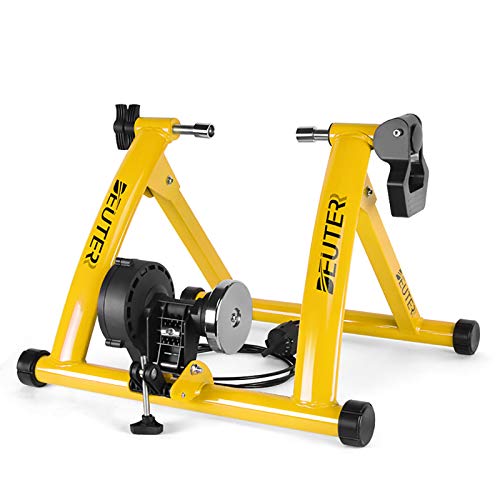
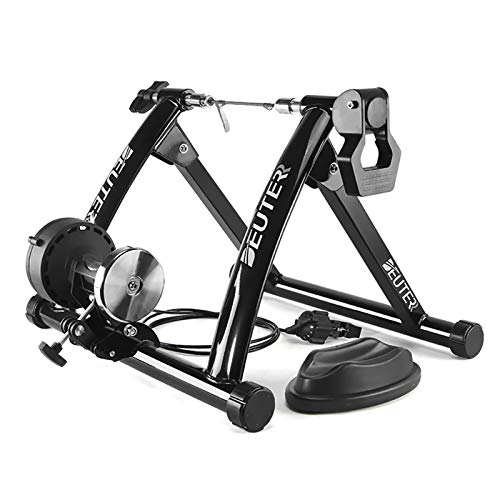
A wheel-on trainer keeps the rear wheel installed. A roller presses against the tire and creates resistance. These trainers are typically cheaper and faster to share between bikes, but the tire can slip, wear, or become noisy, and power readings are more affected by tire pressure and clamping force.
| Criterion | Direct-drive smart trainer | Wheel-on smart trainer | Best choice when |
|---|---|---|---|
| Typical market price | About $400–$1,400 | About $250–$600 | Choose wheel-on for a tighter budget |
| Typical measured accuracy | Approximately ±1% to ±2% | Approximately ±2% to ±5% | Choose direct-drive for structured training |
| Noise | Usually about 55–70 dB at a moderate effort | Often about 65–75 dB, depending on tire and pressure | Choose direct-drive for apartments or shared rooms |
| Resistance range | Commonly 1,800–2,500 watts; some models exceed 2,000 watts at a 20%–25% simulated grade | Commonly 1,000–1,500 watts; simulated grades often top out around 7%–10% | Choose direct-drive for steep virtual climbs |
| Setup time | About 10–25 minutes initially | About 3–10 minutes | Choose wheel-on for frequent removal |
| Common drivetrain issue | Correct cassette, freehub, axle adapters, and gearing required | Tire pressure, roller tension, and tire wear affect performance | Match the design to your maintenance tolerance |
Best direct-drive indoor bike trainers
Best overall value: Wahoo KICKR CORE
The Wahoo KICKR CORE is a strong middle-ground choice for most riders. It provides electronically controlled resistance, ANT+ and Bluetooth connectivity, a substantial maximum resistance level, and power accuracy around ±2% according to its published specifications. Its folding legs and relatively compact footprint make it easier to store than many premium units.
The main compatibility task is selecting the correct drivetrain setup. The trainer has commonly been sold with an 11-speed cassette or without a cassette, depending on the package. Riders using 12-speed road, SRAM XD/XDR, Campagnolo, or unusual gearing may need a different freehub body, cassette, or spacer arrangement. Check the exact cassette and axle requirements before buying.
Choose the KICKR CORE if you ride indoors several times per week, want reliable ERG-mode intervals, and do not need the premium road-feel features of the most expensive trainers.
Best for realistic ride feel: Garmin Tacx NEO 2T Smart
The Tacx NEO 2T Smart is designed for riders who value road simulation as much as numerical accuracy. It can reproduce changes in gradient, road-surface sensations in compatible software, and downhill simulation without relying on a traditional external power supply for every feature. Its published accuracy is approximately ±1%, and its resistance capacity is suitable for high-powered sprinting and steep virtual climbs.
It is also one of the heavier options, at roughly 21–22 kg, so it is stable but inconvenient to carry between rooms. The NEO 2T does not include every cassette type by default, and its electronic features can make the setup more involved than a basic trainer. It is the better pick for frequent indoor riders who leave the unit assembled and want a convincing, smooth ride rather than the lightest equipment.
Best for structured training value: Elite Direto XR-T
The Elite Direto XR-T offers a high resistance ceiling and approximately ±1.5% power accuracy, making it appealing for interval training and virtual racing without moving all the way to premium pricing. Its integrated optical torque measurement system is intended to improve power estimation, while the direct-drive layout avoids rear-tire wear.
Expect a little more initial setup than with a wheel-on trainer: install the appropriate cassette, fit the correct axle adapters, level the feet, and update firmware through the Elite app. As with any direct-drive unit, compatibility is determined by your cassette and axle standard—not simply by whether the bike physically fits between the legs.
When a wheel-on trainer is the smarter purchase
A wheel-on trainer is not automatically an inferior version of a direct-drive model. It can be the better tool when the bike must be ready for outdoor riding immediately after a session, when several bikes need to share one trainer, or when the equipment must be lifted into a closet after every use.
Models such as the Wahoo KICKR SNAP and Garmin Tacx Flow Smart represent this category. They provide app-controlled resistance and broad compatibility with standard bikes, although their maximum resistance and power accuracy are lower than those of serious direct-drive units. They also work best with a dedicated trainer tire or a durable rear tire designed for indoor use.
Do not judge a wheel-on trainer’s noise without considering the surface beneath it. A hard floor can transmit vibration into the room below. A dense trainer mat, consistent tire pressure, and correct roller tension can make a larger practical difference than a small difference in the trainer’s advertised specifications.
Decision matrix: which trainer fits your situation?
| Your situation | Recommended design | Why | What to compromise on |
|---|---|---|---|
| Indoor riding once a week, limited budget | Wheel-on smart trainer | Lower purchase cost and quick setup | More noise and less consistent power |
| Three or more sessions per week | Mid-range direct drive | Better comfort, accuracy, and tire-free operation | Higher initial cost |
| Apartment or shared-wall room | Quiet direct drive | Less tire and roller noise | Greater weight and storage difficulty |
| Two bikes with different wheel sizes | Wheel-on, or direct drive with extra freehub parts | Less drivetrain swapping | Wheel-on readings need careful setup |
| Virtual racing and steep climbs | Direct drive rated at 2,000 watts or more | More resistance headroom and stable power | Weight, price, and cassette installation |
| Bike uses SRAM XD/XDR or Campagnolo | Check freehub availability before purchase | Not every trainer supports every cassette standard | May require an additional freehub body |
Connectivity: ANT+, Bluetooth, and apps
Most current smart trainers communicate through Bluetooth and ANT+. Bluetooth is convenient for phones, tablets, and many computers. ANT+ is useful when connecting to a cycling computer, multiple training devices, or a computer with an ANT+ USB adapter.
For a trainer to control resistance in applications such as Zwift, TrainerRoad, MyWhoosh, or Rouvy, it must support the relevant controllable-trainer profile—not merely transmit power. A trainer may connect to multiple devices for data, but resistance control is often best assigned to one app at a time. If readings appear inconsistent, close duplicate cycling apps and remove old Bluetooth pairings before blaming the hardware.
Built-in Wi-Fi, available on some newer premium trainers, can simplify firmware updates and improve connectivity in a room far from the computer. It is useful, but not essential if your Bluetooth or ANT+ connection is already stable.
Setup steps that improve accuracy
- Confirm the drivetrain. Match the cassette speed, freehub body, axle type, and supplied spacers to the bicycle.
- Level the trainer. Adjust the feet so the bike does not rock. A stable frame produces more consistent pedaling and reduces floor vibration.
- Update firmware. Use the manufacturer’s app before pairing to a training platform. Updates can correct connection and calibration problems.
- Warm up for 10 minutes. Resistance and drivetrain temperature can change early power readings.
- Calibrate only as instructed. Direct-drive trainers may use a spin-down or electronic calibration. Wheel-on units need the roller tightened consistently against the tire, followed by calibration at the specified pressure.
- Pair the correct device. Select the trainer as both the power source and controllable trainer when the app offers separate fields.
For a wheel-on example, suppose a trainer costs $350 and you use it three times weekly for two years. That is about 312 sessions, or approximately $1.12 per session before tire replacement. A $700 direct-drive trainer used five times weekly for two years costs about $1.35 per session. The direct-drive option costs more upfront, but frequent use can make its quieter operation, stable power, and lack of trainer-tire wear worthwhile.
Ownership, maintenance, and common mistakes
Direct-drive trainers usually need little maintenance beyond wiping sweat from the frame, checking bolts, inspecting the cassette, and keeping firmware current. The cassette and chain are still wear items. Heavy indoor use can accelerate chain and cassette wear because sweat, dust, and high-load intervals create a harsh environment. Wipe the drivetrain after sweaty sessions and replace a stretched chain before it damages the cassette.
Wheel-on trainers add tire maintenance. Keep pressure consistent, use a dedicated trainer tire when appropriate, and release the roller after riding so the tire does not develop a flat spot. Too little roller tension can cause slipping; too much can rapidly wear the tire and increase noise.
The most common buying mistake is choosing a trainer based only on maximum watts. A powerful trainer that does not fit the bicycle’s axle or cassette is unusable without extra parts. The second is underestimating storage: a 21 kg direct-drive unit may be excellent on the floor but unpleasant to move daily. Measure the storage location, allow room for the bicycle’s handlebars, and confirm the manufacturer’s compatibility chart before ordering.
Final recommendation
For most regular indoor cyclists, choose a mid-range direct-drive model such as the Wahoo KICKR CORE. Choose the Garmin Tacx NEO 2T Smart when realistic road feel and premium accuracy justify its weight and price, or the Elite Direto XR-T when structured training value is the priority. Choose a wheel-on smart trainer when budget, portability, and rapid setup matter more than quiet operation and maximum precision.