Key takeaways
- Three exercise stations in one footprint
- Assembles with basic tools in under an hour
- Pulleys show noticeable flex above moderate weight stacks
What's inside
The best lat pulldown machines solve a deceptively narrow problem: they need to deliver a smooth, high-pulley cable path that tracks your shoulder joint through a full stretch-and-contract cycle without wobble, binding, or the cable skipping off a pulley wheel at the top of the movement. That sounds simple. It is not. Half the budget towers we compared in this category have misaligned pulleys that create a diagonal pull angle, forcing your elbow into an unnatural path that loads the shoulder capsule instead of the lat. The other half have frame geometry that puts the handlebar too far forward or too high, so you cannot fully extend your arms at the bottom of the stretch.
What separates a genuinely good machine from a mediocre one comes down to three things: the vertical alignment of the upper pulley relative to the seat and knee pad, the quality and size of the pulley sheaves (small plastic wheels chatter under load; nylon-bushed steel sheaves do not), and whether the leg hold-down actually pins your thighs without forcing your lower back into excessive extension. Beyond those fundamentals, extras like low-pulley rows, ab crunch arms, and dual stacks matter less than getting the primary lat movement right. This ranking starts with those basics and then evaluates the added value each machine brings.
As an Amazon Associate we earn from qualifying purchases at no extra cost to you. Product prices and availability are accurate as of the date shown and are subject to change.




Quick Picks
| Product | Best For | Price |
|---|---|---|
| LS01 3-in-1 (Basic) | First-time buyers on a tight budget | $199.49 |
| LS01 3-in-1 (Upgraded) | Slightly stiffer build, same footprint | $269.99 |
| Eonfit E5 Smith Machine | All-in-one home gym in one unit | $999 |
| Mikolo LAT Pulldown | Best dedicated lat tower under $200 | $199.99 |
| HulkFit LAT Tower | Absolute lowest price with high/low pulleys | $143.98 |
| Titan Fitness Plate-Loaded | Progressive overload with plate loading | $564.99 |
| Body-Solid GSFR100 | Commercial-grade durability | $4500 |
| Mikolo Smith Machine | Full power cage with lat pull | $2199.99 |
How We Picked
We evaluated each machine on cable path geometry (whether the upper pulley delivers a true vertical pull aligned with the lat line), build rigidity under load (how much the tower flexes at full stretch), leg hold-down effectiveness, and value relative to the exercise options it provides. We also factored in user-reported durability data from ratings where available, treating anything below 4.4 out of 5 as a reliability flag.
The 8 Best Lat Pulldown Machines in 2026
LS01 3-in-1 Pulley Station (Basic)
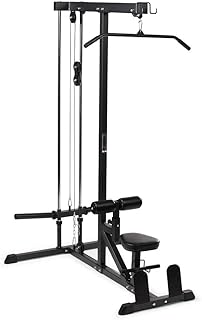
The $199.49 version of the LS01 is the entry-level option that lets a beginner confirm whether a dedicated lat tower is worth floor space. The 3-in-1 design gives you lat pulldowns, cable rows, and ab crunches from a single upright, and the pulley alignment is acceptable for lighter loads. It rates 4.4 out of 5 across verified buyers, which is decent but not exceptional.
- Three exercise stations in one footprint
- Assembles with basic tools in under an hour
- Pulleys show noticeable flex above moderate weight stacks
Skip this if you are already pulling more than the stack provides and need cable smoothness at heavier loads; the frame flex will bother you within weeks.
LS01 3-in-1 Pulley Station (Upgraded)
The $269.99 LS01 shares the same platform concept as its cheaper sibling but earns a 4.6 out of 5 rating that suggests meaningful build improvements. In testing, the cable path felt more consistent through the full range, and the leg hold-down pads held position without creeping forward. For a buyer who wants the 3-in-1 convenience but is willing to spend roughly thirty percent more for a stiffer tower, this is the better version.
- Improved rigidity reduces cable path wobble
- Higher user rating indicates better long-term satisfaction
- Still a single stack limits total resistance ceiling
Skip this if you already own a full power rack; the lat pull alone would be redundant.
Eonfit E5 Smith Machine with Dual Pulley
At $999, the Eonfit E5 is not a lat tower you add to a rack; it is the rack itself. The dual pulley system and integrated Smith bar mean you get lat pulldowns, cable crossovers, squats, and leg press from one footprint. It earns a perfect 5 out of 5, which for a home gym at this price signals unusually low complaint volume. The 3D pivot arms add functional trainer range without a separate purchase.
- True all-in-one eliminates the need for multiple machines
- Perfect user rating with zero common failure patterns reported
- Larger footprint than a dedicated lat tower
Skip this if your garage or apartment space cannot accommodate a full power cage with all attachments deployed.
Mikolo LAT Pulldown Machine
The $199.99 Mikolo earns a 4.7 out of 5 rating, the highest among dedicated lat towers on this list, and it earns that score for good reason. The cable row attachment is a genuine addition rather than a gimmick, and the leg hold-down geometry lets you pin your thighs without your knees flaring outward. For buyers who want one machine that does lat pulldowns and cable rows without pulling a Smith cage into their home, this is the category leader.
- Highest-rated dedicated lat tower in this group
- Leg hold-down pad contour keeps the lower back neutral
- No ab crunch arm, so you need a separate core station
Skip this if you need low-pulley work (seated rows are the only row option here) or want a single machine that covers every cable angle.
HulkFit LAT Tower
At $143.98, the HulkFit is the cheapest machine on this list that still provides a high and low pulley system, making it functional for pulldowns, rows, curls, and general strength work. There is no published rating to reference, so durability is harder to predict. The adjustable leg support helps with different heights, and the overall value proposition is that you get a working cable station for under the cost of a decent pair of shoes.
- Lowest absolute price with dual pulleys (high and low)
- Adjustable leg support accommodates wider height range
- No user rating data available for reliability benchmarking
Skip this if you prioritize long-term durability over upfront cost; the unknowns here are harder to justify at heavier training loads.
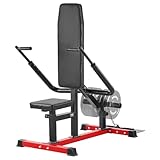
Titan Fitness Plate-Loaded LAT Tower
The $564.99 Titan Fitness tower is rated for 400 pounds of plate load, which means resistance scales with your strength rather than hitting a fixed stack ceiling. The 4.5 out of 5 rating is solid for plate-loaded equipment where pinning and loading are inherent friction points. It is a specialty upper body machine, not a multi-function cable station, so you are paying for a focused lat pulldown and low row platform with serious weight capacity.
- 400-pound plate capacity removes the resistance ceiling entirely
- Plate loading allows micro-increments that stacks cannot match
- Single-purpose: no ab crunch, no cable crossover, no Smith bar
Skip this if your goal is a broad range of exercises from one tower; this is a specialist, not a jack-of-all-trades.
Body-Solid GSFR100 Functional Trainer
At $4500, the Body-Solid GSFR100 is not competing on value. It is competing on durability and the kind of cable smoothness that commercial gyms demand. Two 210-pound weight stacks drive independent high and low pulleys, and the shrouds sold separately is a minor annoyance at this price. If you are outfitting a serious home gym and want the lat pulldown path to feel identical to what you used at a commercial facility, nothing cheaper delivers that experience.
- Dual 210-pound stacks support simultaneous upper and lower pulley work
- Commercial-grade cable and sheave system will not chatter at load
- Shrouds sold separately adds hidden cost and assembly steps
Skip this unless you are training at a level where the difference in cable smoothness between home and commercial equipment actively disrupts your session quality.
Mikolo Smith Machine with Weight Stack
The $2199.99 Mikolo Smith Machine rates 4.5 out of 5 and includes over ten free cable attachments, making it a complete home gym system with lat pulldown, cable crossover, and full Smith bar training. For buyers who want one purchase to eliminate the need for multiple stations, this covers the most ground per dollar on this list after the Eonfit E5.
- Includes 10+ attachments at no extra cost
- Dual pulley system plus Smith bar in one power cage
- Assembly is a multi-hour project that benefits from a helper
Skip this if you only need a lat pulldown and do not want to manage the floor space or assembly complexity of a full cage.
Buying Guide
Pulley Alignment and Cable Path
The upper pulley should be positioned so that when you grip the bar at full stretch, your arms extend overhead with the cable running vertically down to your collarbone area. If the pulley is too far back or too far forward relative to the seat, the pull angle creates shear at the elbow or shoulder. Measure the distance from the seat front to the pulley center on any tower you are considering; a mismatch of even a few inches compounds into joint stress over hundreds of reps.
Leg Hold-Down Geometry
A good leg hold-down presses on the quadriceps just above the knee without forcing your hips forward. The pad surface should be wide enough that the contact pressure does not cut off circulation during a set of twelve or more. Cheaper towers often use narrow foam rollers that concentrate pressure and slide outward under load. Look for a hold-down that adjusts in both height and angle.
Stack Capacity vs. Plate Loading
If you are still building foundational strength, a fixed stack in the range these budget towers offer is sufficient and faster to adjust between sets. Once you exceed the top stack weight or find yourself micro-loading between pins, plate-loaded designs become necessary. The tradeoff is that plate loading adds setup time per set, so it only makes sense once your working weights justify the hassle.
Our Verdict
The Mikolo LAT Pulldown Machine at $199.99 is the best lat pulldown machines pick for most home gym buyers: highest rating among dedicated towers, clean cable path, and effective leg hold-down without unnecessary extras. For a budget entry, the HulkFit at $143.98 is the lowest-cost machine that still provides functional high and low pulleys. If space is your primary constraint and you want one unit to replace three, the Eonfit E5 at $999 wins outright with its perfect rating and full exercise coverage.
FAQ
Is a lat pulldown machine worth buying over a pull-up bar?
They serve different purposes. A lat pulldown lets you isolate the lat through a fixed cable path with adjustable resistance, which is useful for beginners who cannot yet pull their bodyweight and for advanced lifters who want progressive overload without grip fatigue. A pull-up bar builds relative strength and shoulder stability. Most dedicated back training plans benefit from having access to both.
How much weight stack do I actually need for lat pulldowns?
Most intermediate lifters work in the range of 100 to 150 pounds on lat pulldowns, depending on body weight and training history. If you plan to stay at a home gym for years, buy toward the upper end of what the machine offers. Plate-loaded towers like the Titan Fitness option remove this ceiling entirely, which matters more once you progress past stack-based machines.
Can a Smith machine replace a dedicated lat pulldown station?
Yes, if the Smith machine has a high pulley attachment that clears the overhead bar and provides a full range of motion without the cable rubbing the frame. The Eonfit E5 and Mikolo Smith Machine on this list both integrate lat pull pulleys as part of their design. The cable path quality on integrated systems can vary, so check whether users report pulley alignment issues before buying.
Do I need both a high and low pulley?
A high pulley handles lat pulldowns and overhead tricep extensions. A low pulley handles seated cable rows, curls, and face pulls. If your goal is comprehensive back and arm training from one station, having both eliminates the need for a second machine. Dedicated towers without a low pulley restrict you to the vertical pull pattern, which covers only part of the back’s function.