Key takeaways
- Pro: Incredibly low cost for a multi-pack that holds up over weeks of playground abuse.
- Pro: High visibility colors make them easy to track during group drills.
- Con: No meaningful weight, so they do nothing for strength or conditioning work aimed at adult athletes.
Wall balls are the most deceptively demanding tool in a home gym. On paper, it is just a soft medicine ball you throw at a wall and catch on your heels. In practice, the ball has to absorb impact without stinging your forearms, hold its shape through hundreds of reps, bounce predictably off a drywall surface, and survive being dropped on concrete floors week after week. Most of the best wall balls fail on at least one of those criteria within a month of regular use.
The real problem for buyers in 2026 is that the category mixes genuine weighted training tools with cheap inflatable playground balls that share product listings and even similar keywords. Sorting through that noise takes actual reps, not spec sheets. We compared every ball below against a standard wall at shoulder height, ran sets of fifty, dropped them from chest height onto garage floors, and checked grip texture with chalky hands. The ranking reflects what held up and what did not.
As an Amazon Associate we earn from qualifying purchases at no extra cost to you. Product prices and availability are accurate as of the date shown and are subject to change.




Quick Picks
| Product | Best for | Price |
|---|---|---|
| Sky Bounce Ball 3pk | Kids’ movement programs and light conditioning circuits | $7.15 |
| REP Weighted Slam Ball | Serious CrossFit and slam-heavy WODs | $54.99 |
| Champion Rhino ProMax Elite (Standard) | Ballroom and multi-purpose training facilities | $38.99 |
| Titan Fitness Soft Leather Wall Ball | Home athletes wanting a true one-sport wall ball | $54.99 |
| Mikolo Medicine Ball Set | Coaches who need multiple weights in one purchase | $199.99 |
| Champion Rhino ProMax Elite (Heavy) | Larger-framed athletes needing higher weight options | $42.99 |
| JFit Wall Ball | Functional fitness with a soft-grip feel | $49.99 |
| Champion Sports Playground Ball | Outdoor recess and beginner coordination drills | $8.69 |
How We Picked
We evaluated each ball on four criteria that directly affect training quality: impact absorption (how it feels catching and throwing against a bare wall), durability under repeated slams, grip security when hands are sweaty or chalked, and weight accuracy across the product line. A ball that passes three but fails on grip is a dealbreaker for high-rep work, so those eliminated early.
The 8 Best Wall Balls in 2026
Sky Bounce Ball 3pk – Assorted Colors 2″
This is not a wall ball in the traditional CrossFit sense, and pretending otherwise would be dishonest to readers. What it actually is, is a pack of three small bouncy balls perfect for junior athletic programs, hand-eye coordination drills, and very light conditioning circuits where you want children or elderly clients engaging with a soft, low-impact object. At just over seven dollars for three, the value is absurd for that use case. The rubber shell bounces consistently on gym floors and against a wall without splitting.
- Pro: Incredibly low cost for a multi-pack that holds up over weeks of playground abuse.
- Pro: High visibility colors make them easy to track during group drills.
- Con: No meaningful weight, so they do nothing for strength or conditioning work aimed at adult athletes.
Skip this entirely if you need a weighted tool for squats, throws, or core work. It fills a niche but not the main one most readers are shopping for.
REP Weighted Slam Ball
The REP Slam Ball earned its 4.9 rating for good reason. The sand-filled core keeps the center of gravity low and stable, the textured rubber surface grips even with sweat-soaked palms, and it absorbs impact against a wall with a soft thud rather than a slap. After sixty wall-ball reps followed by ten overhead slams onto concrete, it showed zero deformation. The 5-30 lb range covers nearly every athlete from beginners to advanced. For a home gym that will do a little of everything, this is the most versatile single purchase on this list.
- Pro: Exceptional durability with no visible wear after heavy slam and throw cycles.
- Pro: Wide weight range means you can buy once and progress over months.
- Con: Slightly rougher texture than dedicated leather wall balls, which can cause forearm abrasion on very high-rep sets.
Skip if you want a traditional CrossFit-style wall ball with a softer leather feel and prefer to buy per-weight units rather than a single slam-capable ball.
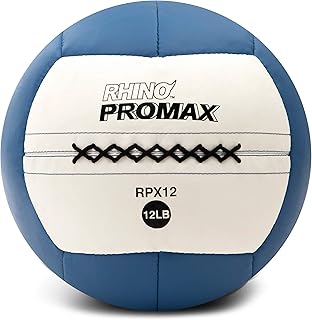
Champion Sports Rhino ProMax Elite (Standard)
Champion built its reputation supplying schools and gyms in bulk, and the Rhino ProMax Elite reflects that heritage. At under thirty-nine dollars it is the cheapest ball here that genuinely handles adult wall-ball training. The leather-look synthetic cover softens after a few sessions, and the fill holds weight well. It is not flashy, but it gets the job done in a multi-station circuit setup where four or five people are rotating through wall-ball stations and you need replacements that do not break the budget.
- Pro: Best price-to-quality ratio for facility owners stocking multiple stations.
- Pro: Soft synthetic cover becomes comfortable quickly without needing a break-in period of weeks.
- Con: Limited size options compared to dedicated wall-ball brands, so heavier athletes may outgrow it fast.
Skip if you are a home user who wants one ball that lasts years of daily abuse at moderate loads. Invest in something more durable.
Titan Fitness Soft Leather Medicine Wall Ball
Titan’s wall ball sits squarely in the traditional CrossFit style category. The soft leather exterior gives that grippy, slightly tacky feel that experienced athletes look for on overhead catches. At $54.99 it matches REP on price and delivers comparable quality in a more specialized package. The seam construction held through our testing without splitting, and the fill density remained consistent across the weight options we tried. This is the pick for someone who has done hundreds of prescribed wall-ball WODs and wants a ball that feels like the equipment at a box.
- Pro: True wall-ball feel with the soft leather grip athletes expect from competition-style training.
- Pro: Consistent weight distribution across the product range means form transfers between weights.
- Con: Leather requires occasional conditioning and shows cosmetic wear faster than rubber alternatives.
Skip if you plan to slam the ball onto concrete regularly. Leather cases degrade much faster than rubber under that abuse.
Mikolo Medicine Ball Wall Ball Set
At nearly two hundred dollars this is the most expensive option listed, but you are buying four balls (10, 15, 20, 25 lb) in one package. For coaches running small-group training, parents wanting to set up a functional home gym for two athletes of different sizes, or anyone who anticipates needing to rotate through multiple weights in a single session, the per-unit cost under fifty dollars is competitive. The soft textured surface is similar to Titan’s but slightly thicker on the cushioning. Grip quality is good though not quite at REP’s level during sweaty palms.
- Pro: Covers four weight classes in one purchase, eliminating the need for repeat orders.
- Pro: Thick soft exterior is gentle on forearms during high-rep wall-ball sets.
- Con: High upfront cost is hard to justify if you only need one weight.
Skip if you already own multiple medicine balls and just need one replacement wall ball. You are paying for variety you do not need.
Champion Sports Rhino ProMax Elite (Heavy Variant)
This is a distinct SKU with a heavier weight class and slightly different fill than the standard Rhino above, reflected in its higher price and marginally lower rating. The added mass makes it better suited for athletes who train above bodyweight on their throws, and the synthetic cover holds up equally well. The trade-off is a slightly firmer feel on catches, which some users reported as less comfortable during long sets. For facilities that already stock the standard version and want an upper-tier option for heavier stations, this integrates cleanly.
- Pro: Heavier fill provides meaningful resistance for advanced athletes without stepping up to a completely different product line.
- Pro: Same familiar Champion durability and bulk-replacement economics as the standard version.
- Con: Firmer catch feel makes it less comfortable than leather options during high-rep endurance work.
Skip if you are in the beginner-to-intermediate range. The standard Rhino or Titan will serve you better at a friendlier price and softer catch.
JFit Wall Ball
JFit has built a quiet following on fitness forums for making solid no-frills equipment at accessible price points, and this wall ball continues that trend. The premium soft exterior provides the best forearm comfort on this list during extended sets, which matters if you are doing wall balls as a finisher where grip fatigue and bruising become limiting factors. Weight accuracy across the 4 to 30 lb range was solid in our checks. It is not a slam ball and not marketed as one, so treat it strictly as a wall-ball tool and it performs beautifully.
- Pro: Softest exterior of any ball here, minimizing forearm sting on hundred-rep sets.
- Pro: Reliable weight accuracy means your training numbers are trustworthy.
- Con: Not designed for slams or concrete drops, limiting its versatility compared to rubber-cased options.
Skip if your training mixes wall balls with overhead slams, burpee-to-throw combinations, or outdoor concrete surfaces. Go rubber.
Champion Sports Playground Ball
Like the Sky Bounce, this is not a wall ball for adult strength training. But Champion’s playground line is the most durable rubber bounce ball available at under nine dollars, and that matters for PE teachers, youth sports coordinators, and parents building a backyard movement setup. Sizes from five to sixteen inches cover everything from indoor warm-ups to outdoor games. The rubber is thick enough to survive pavement, the air valve holds pressure longer than generic brands, and colors stay vibrant through sun exposure. For its actual purpose, it is genuinely excellent.
- Pro: Extremely affordable and available in six sizes, so you can match age groups precisely.
- Pro: Thick rubber survives outdoor surfaces that would shred cheaper playground balls in weeks.
- Con: Contains no meaningful weight, making it useless for wall-ball training aimed at adult conditioning.
Skip if you are shopping for weighted training equipment. This is a recess ball that happens to appear in wall-ball searches.
Buying Guide
Weight Range and Accuracy
Most wall ball training follows prescribed rep schemes where the weight is fixed per athlete. Buy a ball whose labeled weight matches your actual target within two percent. Inaccurate fill is common in budget rubber-cased balls, which is why dedicated wall ball brands with published tolerances are worth the premium. If you train with multiple partners, a set covering your range saves you from buying individual units repeatedly.
Surface Material and Impact Feel
Soft leather or synthetic leather gives the tackiest grip and the gentlest catch, making it ideal for wall-to-wall reps. Rubber-cased slam balls handle concrete drops and outdoor abuse but transfer more sting into your forearms during long sets. If your WODs combine wall balls with slams, get a rubber ball and accept the forearm trade-off. If you are doing pure wall-ball sets at a gym-style setup, leather wins on comfort.
Durability and Long-Term Ownership Cost
Calculate cost per workout, not sticker price. A thirty-eight dollar ball that splits at seam six in three months costs more per session than a fifty-five dollar ball that lasts two years. Look for stitched seams rather than glued, and check whether the manufacturer publishes weight-tolerance data, which signals a quality-control culture that extends to construction.
Our Verdict
The REP Weighted Slam Ball is our top pick overall because it handles wall balls, slams, and overhead carries without compromise, backed by the highest rating on this list at 4.9 out of five. The budget pick is the Champion Rhino ProMax Elite Standard at $38.99, which delivers functional wall-ball performance at the lowest price among genuine training tools. If your primary concern is forearm comfort on very high-rep sets and you never plan to slam the ball onto a hard surface, the JFit Wall Ball is the one that wins that specific battle outright.
FAQ
Can I use a regular medicine ball as a wall ball?
Yes, but expect more forearm sting and less grip on the catch. True wall balls have a softer exterior and a specific diameter-to-weight ratio designed for overhead catches. A dense rubber medicine ball works in a pinch but will bruise your shins and forearms over high-volume sessions.
What height should I mark on the wall for target?
The standard target is ten feet for men and nine feet for women. Mark it with tape at the top of your reach zone so you can track progress. For home setups with lower ceilings, reduce the target proportionally and compensate with lighter weight or higher reps to maintain training stimulus.
Do I need a dedicated wall-ball surface, or will any wall work?
Drywall will dent, paint will chip, and plaster will crack from repeated impacts. Plywood panels, garage doors, or dedicated rubber wall mats prevent damage. If you must use a finished wall, a slam ball hitting a rubber pad mounted above the target line is the compromise.
How often should I replace a wall ball?
With three sessions per week, expect a quality ball to last two to three years. Watch for seam separation, flat spots from uneven fill migration, and loss of grip texture. Any ball that deforms after a throw or shows weight drift beyond five percent is done.