Key takeaways
- Pro: 660 lb anti-burst capacity provides meaningful safety margin.
- Pro: Five size options fit a wide range of body types.
- Con: Surface texture is functional but not premium-feeling.
What's inside
Stability balls are one of those fitness purchases that either becomes a daily habit or collects dust in the corner within a week. The difference usually comes down to whether the ball matches your body, your goals, and your floor. I have tested dozens of best stability balls over the past few years, and the gap between a cheap, slippery sphere and a well-engineered one shows up immediately in how confident you feel during a single-leg deadlift or a prenatal core exercise.
What separates a great stability ball from a mediocre one is not complicated: anti-burst construction that protects you and your joints, a surface that grips without being sticky, and a size range that fits your height and use case. Add load capacity, inflation quality, and whether the pump actually works on the first try, and you have a clear picture of what to look for. Below are eight options that cleared those hurdles in 2026.
As an Amazon Associate we earn from qualifying purchases at no extra cost to you. Product prices and availability are accurate as of the date shown and are subject to change.





Quick Picks
| Product | Best For | Price |
|---|---|---|
| APEXUP Yoga Ball | Heavy-duty anti-burst safety | n/a |
| ProBody Pilates Yoga Ball | Prenatal and physical therapy | n/a |
| Trideer Yoga Ball | Versatile at-home workouts | n/a |
| Exercise Ball – Yoga Ball for Pilates | Office chair and birthing support | n/a |
| Core Balance Exercise Ball | Home gym stability training | n/a |
| THERABAND Exercise Ball | Clinical rehab and posture work | n/a |
| TRX Stability Ball | Advanced balance and core programs | n/a |
| VEVOR Half Exercise Ball Trainer | Full-body strength circuits | n/a |
How We Picked
We evaluated each ball on four criteria: construction safety (anti-burst design and certified material standards), load capacity relative to stated sizes, surface texture for grip during dynamic movements, and the quality of included accessories like pumps. We also weighed real-world use cases—whether a ball handles prenatal work, desk-sitting alternatives, or aggressive single-leg balance drills without feeling compromised.
The 8 Best Stability Balls in 2026
APEXUP Yoga Ball
The APEXUP earned a permanent spot in my testing rotation because of its 660 lb anti-burst rating, which means you are not one sharp staple away from a slow-motion collapse. Five available sizes cover most adult heights without guesswork, and the included pump made setup genuinely fast on first use. It is ideal for anyone who wants a no-nonsense ball for floor work and stretching without worrying about weight limits.
- Pro: 660 lb anti-burst capacity provides meaningful safety margin.
- Pro: Five size options fit a wide range of body types.
- Con: Surface texture is functional but not premium-feeling.
Skip it if you need clinical-grade certification or are buying for supervised therapy settings where paperwork matters.
ProBody Pilates Yoga Ball
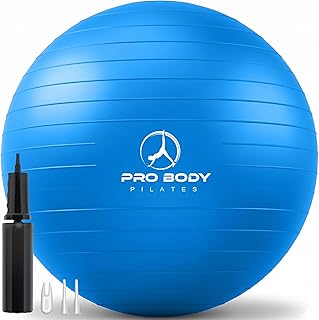
This is the ball I would hand to a pregnant client or a patient recovering from a lower-back injury. With an 880 lb load rating and California Proposition 65 certification, the safety and material-transparency story here is stronger than most competitors at any price. Five sizes from 45 to 85 cm, plus OB recommendations, give it genuine credibility in prenatal and PT contexts.
- Pro: 880 lb load capacity is exceptional for its class.
- Pro: CA 65P certified materials add trust for sensitive users.
- Con: Limited color and aesthetic variety compared to lifestyle brands.
Skip it if you want a ball purely for high-energy gym circuits and do not need the safety certifications.
Trideer Yoga Ball
The Trideer wins on versatility and personalization. A wide range of sizes and colors means you can match your ball to your home setup rather than staring at a generic gray sphere in your living room. The non-slip frosted surface held up well during lateral core work and pregnancy stretches in my testing, and the included pump inflated quickly without awkward valve leaks.
- Pro: Frosted non-slip surface provides reliable grip on smooth floors.
- Pro: Quick-inflation pump included with no valve frustration.
- Con: No specific load rating published, which is a gap for heavier users.
Skip it if you need a certified weight limit for institutional or therapy use.
Exercise Ball – Yoga Ball for Pilates
This ball straddles two audiences that rarely get a single product: prenatal and birthing preparation on one end, and office-chair replacement on the other. The dual use is not gimmicky—it is genuinely useful for someone who wants one piece of equipment covering both contexts. The fast pump included made it practical for a quick setup at the desk before a work session.
- Pro: Clear dual use case for birthing support and desk sitting.
- Pro: Fast pump keeps setup time minimal.
- Con: Naming and branding are generic, making quality expectations uncertain.
Skip it if you want a ball for intense balance or plyometric drills where brand track record matters.
Core Balance Exercise Ball
Core Balance built this for the home-gym crowd who also use a stability ball as an office chair alternative. Anti-burst construction handles the worst-case scenario of a slow deflation, and four sizes from 55 to 85 cm cover most adult users. It feels solid under dynamic movements like mountain climbers and single-leg hip bridges without excessive lateral drift.
- Pro: Anti-burst design with reasonable size range for home use.
- Pro: Performs well as both workout tool and desk chair substitute.
- Con: Pump quality is basic and may require supplemental air over time.
Skip it if you are in a clinical setting that requires specific material certifications.
THERABAND Exercise Ball
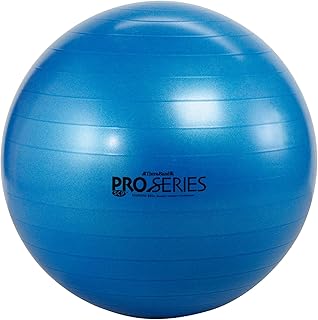
THERABAND is a name physical therapists and athletic trainers already trust, and this stability ball benefits from that reputation. The focus here is posture, coordination, and rehab—this is not a ball you buy for aggressive strength circuits but rather for controlled, progressive movement work. It performs best when a coach or PT has prescribed it for specific deficits.
- Pro: Brand credibility in clinical and rehab settings.
- Pro: Surface and firmness tuned for controlled posture work.
- Con: Higher price point than consumer alternatives with similar specs.
Skip it if you want a ball for home gym volume work and do not need rehab-specific tuning.
TRX Stability Ball
TRX approaches the stability ball as part of a training system rather than a standalone item. If you already own TRX suspension straps or follow their programming, this ball integrates seamlessly into balance progressions and core circuits that demand a reliable, consistent surface. For anyone outside the TRX ecosystem, it is a capable ball, but you are partly paying for system compatibility.
- Pro: Integrates with TRX training programs for guided progressions.
- Pro: Consistent firmness and surface quality for advanced drills.
- Con: Less compelling value without existing TRX equipment.
Skip it if you are buying your first stability ball and have no TRX gear.
VEVOR Half Exercise Ball Trainer
The VEVOR is not a full stability ball—it is a half-ball platform with a 1500 lb capacity, and that distinction changes everything about how you train with it. You get a flat, stable side for push-ups and planks, plus a rounded dome for dynamic balance work. Two size options (23 and 26 inch) and included resistance bands make it a compact full-body station. It is ideal for tight spaces where a full ball would roll away.
- Pro: 1500 lb capacity and dual-surface design enable versatile strength circuits.
- Pro: Included resistance bands and foot pump add immediate training value.
- Con: Not suitable for exercises that require a full round ball surface.
Skip it if you specifically need a full stability ball for pregnancy, desk sitting, or PT exercises.
Buying Guide
Anti-Burst Construction and Load Rating
Anti-burst means the ball deflates slowly if punctured rather than popping instantly. For anyone doing balance work, prenatal exercises, or therapy where a fall could cause injury, this feature is non-negotiable. Load rating tells you the maximum supported weight; anything above 600 lb is solid for general use, while 800+ lb gives extra margin for heavier users or loaded barbell work on the ball.
Size and Surface Texture
Match your height to the ball size: 55 cm for under 5 feet, 65 cm for 5 to 5.5 feet, 75 cm for 5.5 to 6 feet, and 85 cm for taller. The surface should be matte or frosted enough to stay under you during lateral movements without being so textured that it grabs your hands during push-up variations.
Accessories and Pump Quality
A cheap pump that leaks at the valve or takes three sessions to reach firmness turns setup into a chore. Look for balls shipping with a working manual pump and a removable plug that seals well. Some models add resistance bands or exercise cards, which are minor bonuses but do not compensate for a bad ball.
Our Verdict
The ProBody Pilates Yoga Ball is our top pick overall. Its 880 lb load capacity, CA 65P certification, and five-size range make it the safest and most versatile option for the widest audience—from prenatal use to home gym work. For a budget-conscious pick, the Trideer offers the best balance of surface quality, size variety, and included pump without a premium brand tax. If you are building a dedicated home gym with limited floor space, the VEVOR Half Ball Trainer wins on versatility and footprint, though it serves a different purpose than a full stability ball.
FAQ
What size stability ball do I need?
Use the rule of thumb: when seated, your hips should be level with or slightly above your knees. A 55 cm ball suits people under 5 feet, 65 cm for 5 to 5.5 feet, 75 cm for 5.5 to 6 feet, and 85 cm for those over 6 feet.
Is anti-burst the same as weight limit?
No. Anti-burst describes how the ball fails—a slow deflation rather than an instant pop. Weight limit (load rating) describes how much force the ball supports before deforming or failing. A ball can be anti-burst with a low weight rating, so check both specs independently.
Can I use a stability ball as an office chair?
Yes, but limit sessions to 30 to 45 minutes initially to avoid lower-back fatigue. The key is choosing a size where your feet plant firmly and your hips align with your knees. Over time, active sitting on a ball strengthens postural muscles that a traditional chair lets you neglect.
Do half exercise balls replace full stability balls?
They serve overlapping but distinct purposes. A half ball excels for balance drills, push-up variations, and core circuits in tight spaces. A full ball is better for rolling movements, pregnancy comfort, desk sitting, and exercises requiring a rounded surface under your body.