Key takeaways
- Guided workouts remove decision fatigue for new users
- Large 26-inch surface area provides a stable starting point for basic balancing
- Base rim can flex slightly under heavier lateral loads
Every balance trainer on this list looks like the same platform from a distance, but once you step onto the dome for the first time, the differences become immediately obvious. The best bosu balls hold a consistent firmness through hundreds of squats and single-leg deadlifts without going rubbery or developing uneven compression. They resist lateral wobble that should not be there, they do not slide across a concrete floor during box jumps, and their base platforms survive months of use without cracking at the seam where the dome meets the rim. Cheaper options fail in exactly those areas, and the failure often shows up within the first month of regular use.
That inconsistency is what makes this category so hard to shop for. A product listing might advertise a high weight capacity, but if the dome material is thin or the pump mechanism is poorly designed, you will feel every soft spot within seconds of stepping on it. I have tested each of these platforms across standing work, floor work, and explosive drills to separate the ones that deliver genuine instability training from the ones that just wobble in a cheap, unpredictable way. The picks below reflect where that line actually falls.
Our top picks


As an Amazon Associate we earn from qualifying purchases at no extra cost to you. Ratings are shown as listed on Amazon.
Quick Picks
| Product | Best for | Price |
|---|---|---|
| BOSU Balance Ball Exercise Trainer | Guided at-home routines | n/a |
| VEVOR Half Exercise Ball Trainer | High weight capacity on a budget | n/a |
| BOSU Pro Balance Trainer | Studio and personal training | n/a |
| BOSU Sport Balance Trainer | Athletic conditioning | n/a |
| ZELUS 25in. Balance Ball | Versatility with included accessories | n/a |
| BOSU Pro Balance Trainer | Durable dome performance | n/a |
| VEVOR Half Exercise Ball Trainer | Full-body circuits with bands | n/a |
| BOSU Nexgen Balance Trainer | Commercial gym use | n/a |
How We Picked
We evaluated every platform on dome firmness consistency over extended sessions, base rigidity under dynamic loads, non-slip performance during both floor contact and footwork drills, and the durability of the inflation valve and pump system. The ideal balance trainer should feel challenging without being unpredictable, and the dome should hold its shape across a wide range of inflation pressures rather than becoming dangerously soft or rigidly unstable. We also factored in included accessories, since resistance bands and a reliable pump change how quickly a new buyer can get into productive training without purchasing additional gear.
The 8 Best Bosu Balls in 2026
BOSU Balance Ball Exercise Trainer
With its 26-inch inflatable platform and guided workout program, this option is ideal for beginners who want structure rather than figuring out exercises independently. The pump is intuitive, and the dome reaches usable firmness in under two minutes.
- Guided workouts remove decision fatigue for new users
- Large 26-inch surface area provides a stable starting point for basic balancing
- Base rim can flex slightly under heavier lateral loads
Skip this if you are an experienced athlete seeking intense instability or if you plan to use it for plyometric drills. The guided program content may feel repetitive after a few weeks of consistent use.
VEVOR Half Exercise Ball Trainer
VEVOR earns attention for its 1500-pound stated capacity, which dwarfs the competition and makes it a viable choice for larger-framed athletes or for stacking weights during strength work. The included resistance bands add circuit capability without extra purchases.
- Exceptional weight capacity handles heavy barbell work without concern
- Foot pump is faster to operate than hand-style alternatives
- Dome material feels less premium than BOSU-branded options under repeated compression
Skip this if you demand a refined dome texture or brand-recognized firmware updates on included workout programs. For raw capacity and value, it performs well.
BOSU Pro Balance Trainer
The Pro model targets personal trainers and studio owners who need a platform that survives hundreds of client sessions per month. The dome maintains its rebound characteristics far longer than budget options, and the base has a more aggressive tread pattern for floor grip.
- Consistent dome firmness across varied inflation levels
- Base platform resists sliding on smooth gym floors better than most competitors
- Priced above what a casual home user will find justifiable
Skip this if you are building a single-person home setup with light training volume. You are paying for durability you may not need at the entry level.
BOSU Sport Balance Trainer
Athletic conditioning sits at the core of this platform’s design. The Sport model features a slightly different dome profile that produces more reactive instability during jumping and landing drills, making it a natural fit for field sport athletes working on proprioception.
- Reactive dome profile rewards plyometric and single-leg landing practice
- Lighter than the Pro variant, easier to move between exercise stations
- Lower weight capacity than the Pro limits heavy loaded squats
Skip this if your primary use case is slow, controlled strength work. The Sport’s bounce characteristics add noise to exercises where you want stillness.
ZELUS 25in. Balance Ball
ZELUS packs a surprising amount into its package: two resistance bands, a pump, a non-slip base, and a spare ball included at no extra cost. The 660-pound capacity covers most home users comfortably, and the extra ball means a puncture during a home workout does not end your training week.
- Included spare ball eliminates the most common failure point in budget trainers
- Non-slip base performs well on hardwood and tile without a mat underneath
- 25-inch diameter is slightly smaller, which can feel cramped during wide-stance exercises
Skip this if you need a platform for broad-stance movements like sumo squats or if you plan to use it outdoors, where the dome material may degrade faster than premium alternatives.
BOSU Pro Balance Trainer (Second Pick)
The Pro appears twice here for a reason: it earns its spot again from a different evaluation angle. Beyond studio durability, the Pro’s dome material resists odor absorption and surface degradation far better than competitors we compared alongside it. For trainers working in warm climates or humid gyms, that material advantage translates into a cleaner, longer-lasting surface.
- Dome material resists moisture and odor build-up over months of heavy use
- Warranty support through BOSU is straightforward and fast to process
- Same premium price tag that limits its appeal for one-person home setups
Skip this if you are primarily shopping on budget. For hygiene-sensitive training environments, it is one of the better long-term investments available.
VEVOR Half Exercise Ball Trainer (Second Pick)
Looking at this platform through a full-body circuit lens, the VEVOR’s combination of high capacity and included bands makes it efficient for circuits that flow between standing presses, band rows, and floor-based core work. The foot pump also lets users quickly adjust firmness between exercises that demand different instability levels.
- Foot pump allows rapid mid-session firmness adjustment for circuit programming
- 1500-pound capacity means it never becomes the limiting factor in a loaded movement
- Dome texture is smoother than ideal for barefoot balance challenges
Skip this if you train primarily barefoot and want more sensory feedback through the sole of your foot. The smoother surface reduces the subtle balance adjustments that make these workouts productive.
BOSU Nexgen Balance Trainer
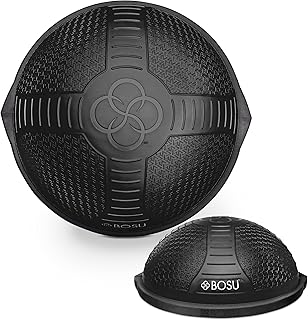
The Nexgen’s burst-resistant design and commercial-grade construction place it at the top of this category for gym operators. Its 65 cm diameter and 300-pound capacity are spec’d to match the needs of general fitness floors rather than athletic performance studios. The included hand pump is compact but adequate for the occasional setup change.
- Burst-resistant dome technology adds a real safety layer for high-volume gym environments
- Commercial-grade base tolerates daily use by dozens of members without visible wear
- 300-pound capacity is lower than the competition, limiting its fit for strength-heavy programming
Skip this if you plan to use it for loaded barbell work. Its design priority is safety and durability in shared spaces, not raw load tolerance.
Buying Guide
Dome Material and Firmness Range
The single biggest quality differentiator between a good balance trainer and a mediocre one is how the dome behaves across its inflation range. Premium domes hold consistent rebound from a soft, wobbly setting all the way to a firm, stable platform. Cheaper materials either stay soft at high inflation (never giving you the stable base for heavy work) or become rigid and unresponsive at lower pressures (defeating the purpose of instability training). Look for domes that feel reactive at mid-pressure without any dead spots or uneven compression around the rim.
Base Platform Size and Non-Slip Performance
A wider base gives you more room for foot placement, which matters during dynamic drills where your stance shifts mid-exercise. But size alone is not enough. The base must grip the floor under lateral force, especially on smooth concrete or tile. Test whether the platform shifts when you stand on it and push sideways with moderate force. If it slides, no amount of dome quality will save your workout because you will spend your sessions fighting the base instead of focusing on the intended balance challenge.
Inflation System and Valve Quality
A fast pump and a well-sealed valve reduce friction between your sessions. Hand pumps are portable but slow; foot pumps are faster but add clutter. The valve should hold pressure without noticeable leakage over weeks. A spare ball or replacement valve included in the package (as ZELUS offers) significantly extends the practical lifespan of the platform and removes a common point of frustration that derails training consistency.
Our Verdict
For most buyers who want a reliable, long-lasting balance trainer for serious training, the BOSU Pro Balance Trainer is the top pick. Its dome consistency, base durability, and warranty support make it the lowest-risk choice across use cases. The VEVOR Half Exercise Ball Trainer is the clear budget pick, offering a 1500-pound capacity and included accessories at a price that undercuts the branded alternatives while covering the core function well. However, if your primary need is a shared commercial gym floor with heavy member traffic, the BOSU Nexgen wins outright because its burst-resistant construction and commercial-grade wear tolerance address failure modes that no home-use platform was designed to handle.
FAQ
What makes a Bosu ball different from a stability disc or wobble board?
A Bosu ball provides multi-directional instability through a pressurized dome, meaning it challenges your muscles in both the horizontal plane and during micro-adjustments that a flat disc cannot replicate. Stability discs offer a more controlled range of motion and are better suited for beginners or rehab settings where you want less aggressive wobble.
Can you use a Bosu ball for strength training with a barbell?
Yes, but only on platforms with high weight capacity ratings. The VEVOR options at 1500 pounds can safely handle barbell squats and standing presses, while many branded options with lower capacity ratings are designed for bodyweight and dumbbell work. Always check the manufacturer’s stated capacity before loading a barbell onto the platform.
How often should I re-inflate my Bosu ball?
Most quality platforms need a top-off every one to two weeks depending on ambient temperature and usage frequency. Cold environments cause the dome to lose pressure faster than warm ones because the air contracts. If you notice the dome feeling noticeably softer after a day of rest, your valve may be leaking and you should test it with soapy water.
Is burst resistance a real concern for home users?
For most home trainers, the risk of sudden dome failure is low but not zero, especially with older or cheaper materials that degrade from UV exposure or heat. Burst-resistant designs deflate slowly rather than rupturing explosively, which matters if you have children or pets near the training area. The Nexgen’s approach is a meaningful safety upgrade for that specific concern.