Key takeaways
- When choosing between loop bands vs tube bands for glutes, the real decision is not simply which band creates more resistance. It is which setup fits your space, workout style, comfort preferences, and tolerance for storing or replacing small pieces…
What's inside
When choosing between loop bands vs tube bands for glutes, the real decision is not simply which band creates more resistance. It is which setup fits your space, workout style, comfort preferences, and tolerance for storing or replacing small pieces of equipment. Loop bands are compact, quick to use, and especially convenient for hip-focused movements such as glute bridges, lateral walks, and squats. Tube bands usually offer more versatility because handles, ankle straps, and door anchors can turn one kit into a full-body system.
For a home glute routine, either style can work well. The better choice depends on whether you want a minimal tool that stays around your thighs or a more adjustable system that lets you pull from different angles. Here is how the two compare for everyday home use in 2026.
As an Amazon Associate we earn from qualifying purchases at no extra cost to you. Product prices and availability are accurate as of the date shown and are subject to change.


Quick Verdict
Choose loop bands if your priority is glute activation, portability, low cost, and fast setup. They are usually the easiest option for banded hip thrusts, clamshells, kickbacks, monster walks, and abductions. A set with several resistance levels also makes it easy to progress without adding bulky equipment.
Choose tube bands for glutes if you want more exercise variety, adjustable anchoring, or a system that can also train your back, arms, shoulders, and legs. Tube bands work particularly well for standing kickbacks and pull-through-style movements when paired with ankle straps or a door anchor. They can provide a longer range of motion, but the handles and attachments require more storage and setup.
Side by Side
| Factor | Loop bands | Tube bands |
|---|---|---|
| Glute comfort | Soft fabric or wide latex loops can feel stable around the thighs; narrow latex may roll or pinch. | Ankle cuffs can be comfortable, but poorly padded cuffs may rub during kickbacks. |
| Durability | Typically one continuous piece, so there are fewer connection points to fail. | Strong tubes can last well, but clips, handles, anchors, and stitching add potential wear points. |
| Typical price range | About $10-$40 for a basic set; premium fabric sets may cost more. | About $15-$60 for a basic kit; larger kits with anchors and several tubes may cost $80 or more. |
| Maintenance | Wipe clean and keep dry; inspect for cracks, thinning, or sticky latex. | Wipe tubes and cuffs; check clips, stitching, handles, and anchor points before use. |
| Space needed | Often 6-13 inches long when relaxed and small enough for a drawer or pouch. | Around 12-48 inches per tube, plus handles, cuffs, and possibly a door anchor. |
| Look | Simple, discreet, and available in neutral or colorful fabric and latex finishes. | More visibly like workout equipment, with cords, handles, and metal or plastic hardware. |
| Resale | Low resale value, especially once stretched or used. | Complete kits in clean condition may be easier to resell, though missing attachments reduce value. |
| Best for | Glute activation, lower-body circuits, travel, and small spaces. | Multi-angle glute work, full-body training, and users who want handles or ankle straps. |
| Learning curve | Very low; step in, position the band, and move. | Moderate; users must select attachments, manage slack, and understand safe anchoring. |
Where Loop Bands Wins
Loop bands are the most direct choice for glute-focused training. The band sits around the thighs, just above the knees, or around the ankles, depending on the exercise and the band’s length. That positioning creates outward tension during squats, bridges, and walks, encouraging the gluteus medius and other hip stabilizers to work.
They are also fast. A loop band takes only a few seconds to position, making it practical for short workouts or warmups before strength training. You do not need a door anchor, handles, or a place to clip anything. That matters in a bedroom, living room, or shared home where equipment must be put away after every session.
Basic loop sets are usually inexpensive. For example, the Fit Simplify Resistance Loop Exercise Bands set with an instruction guide and carry bag is listed at $9.98. A five-band set can cover light activation work through heavier squats and bridges, although resistance labels are not perfectly standardized between brands. A set of five-level pull-up assistance bands at $16.99 can also be used for lower-body exercises, but their longer dimensions are less convenient for exercises that require a short loop around the thighs.
Loop bands are easy to travel with, too. A set generally weighs only a few ounces to about 1 pound, depending on the number and material of the bands. There is no hardware to rattle around in a suitcase. Fabric loops can feel more secure than thin latex during lateral walks, while latex loops usually provide more stretch and are often easier to clean.
The main limitation is exercise angle. A loop around the legs is excellent for outward pressure, but it is less useful for pulling the leg backward against a fixed anchor. It can also roll, pinch, or dig into the skin if the size, width, or material is wrong. People with larger thighs should check the loop’s relaxed circumference and stretch range rather than relying only on a “light,” “medium,” or “heavy” label.
Where Tube Bands for Glutes Wins
Tube bands offer more ways to direct resistance. Add ankle cuffs for standing kickbacks, side leg lifts, and hip extensions. Use handles for squats, deadlift variations, or resisted good mornings. With a suitable door anchor, you can pull from behind, in front, or from the side, creating a more targeted challenge than a simple thigh loop.
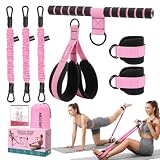
That versatility is the strongest argument for tube bands for glutes. Instead of buying one tool only for hip activation, you can use a tube kit for rows, chest presses, biceps curls, triceps work, shoulder exercises, and lower-body movements. The MEDETAYI Pedal Resistance Band, listed at $8.99, combines a pedal-style setup with handles and ankle straps. A product such as this may appeal to someone who wants a compact, low-cost system with multiple ways to hold or attach the band.
Tube systems can also feel more comfortable for users who dislike pressure around the thighs. An ankle cuff shifts the contact point to the lower leg, while handles keep the resistance in the hands for standing exercises. However, cuffs should fit securely without cutting into the ankle, and every clip should be checked before a hard pull.
The tradeoff is more technique and more hardware. A tube band can snap toward the body if it is overextended, damaged, or attached to an unsuitable anchor. Never close a door on a band unless the anchor is designed for that use and the door closes securely. Inspect tubes for cuts, flat spots, discoloration, or exposed inner material. Hardware should not be bent, loose, or partially attached.
Cost Over 5 Years
Loop bands generally have the lower five-year ownership cost. A basic set may cost $10-$25, while a more substantial fabric or mixed-material collection may cost $25-$50. If a latex band cracks or loses its elasticity after two or three years, replacing a set once could put the total at roughly $20-$80 over five years. Fabric bands may last longer in some homes, but they can still stretch out, fray, or retain sweat if they are not cleaned and dried properly.
Tube bands typically cost $15-$60 initially, with larger systems reaching $80 or more. If the tubes and attachments remain in good condition, one kit may last the full five years. A realistic ownership range is about $30-$150, allowing for a replacement tube, worn ankle cuff, missing clip, or a second resistance level. The cheapest kit is not automatically the best value if its handles are uncomfortable or its attachments are difficult to replace.
For either type, store bands away from direct sunlight, heaters, sharp edges, and prolonged moisture. Do not leave latex stretched around furniture between workouts. Proper storage is more likely to extend useful life than buying the heaviest resistance available.
Which One for Your Home
Small apartment
Choose loop bands for the smallest footprint. A set can fit in a drawer measuring roughly 12 by 8 inches, and workouts do not require a clear line to a door or heavy furniture. They are especially practical when you need quiet exercise with little setup. If you want full-body capability, select a compact tube kit only if you have a reliable storage spot for tubes, handles, cuffs, and an anchor.
Family with kids or pets
Loop bands have fewer loose parts and fewer attachment points, which simplifies cleanup. Keep them in a closed bin because small bands can look like toys to children or pets. Tube bands need additional care: store clips and handles out of reach, and do not leave a band anchored where a child or pet could pull it unexpectedly. A quick inspection before each session is particularly important in a busy household.
Rental
Loop bands are the safer default because they do not require wall mounting or a permanent fixture. Tube bands can still work in a rental when used with handles, ankle cuffs, or a properly designed over-the-door anchor. Avoid attaching a band to cabinet handles, stair rails, or furniture that could shift or suffer cosmetic damage. Renters who want minimal risk should use tube bands without an anchor or choose loops.
Long-term home
A tube system makes more sense if you expect your home workout area to serve several people or support full-body training for years. You can add different tube strengths, a stable anchor, and better cuffs over time. Choose loop bands instead if your routine will remain primarily glute and lower-body focused. The best long-term purchase is the one that matches the exercises you will actually perform consistently.
FAQ
Are loop bands or tube bands better for glutes?
Neither is universally better. Loop bands are usually better for seated or floor-based glute activation, lateral walks, squats, bridges, and abductions. Tube bands are better for standing kickbacks, resisted hip extensions, and exercises that benefit from a door anchor or ankle cuff.
Can tube bands replace loop bands?
Often, but not perfectly. A tube with ankle straps can reproduce many kickback and abduction exercises, but it may not feel as stable around the thighs during bridges or lateral walks. If glute activation is your main goal, a loop is usually simpler. If you want one kit for the whole body, tubes offer greater range.
What resistance should a beginner use?
Start with a resistance that allows 10-15 controlled repetitions without the knees collapsing inward, the pelvis twisting, or the band losing contact. For loop bands, begin with light or medium resistance. For tube bands, start with a lighter tube and maintain at least a small amount of tension throughout the movement. Progress by adding repetitions, slowing the tempo, or moving to a stronger band.
How often should resistance bands be replaced?
There is no fixed replacement date. Replace a band immediately if you see cracks, tears, severe thinning, fraying, sticky sections, exposed cord, damaged clips, or failing stitching. With indoor storage and regular inspection, a quality band may remain useful for several years, but frequency of use, sunlight, sweat, and how far it is stretched all affect its lifespan.