Key takeaways
- Choosing between a mini massage gun and a full-size massage gun is less about which one is “better” and more about how you will use it at home. The real decision is whether you value portability, easy storage, and a…
What's inside
Choosing between a mini massage gun and a full-size massage gun is less about which one is “better” and more about how you will use it at home. The real decision is whether you value portability, easy storage, and a lighter feel—or stronger output, longer sessions, and a larger treatment area. A compact device can be convenient enough to use every day, while a full-size model may be more satisfying for dense muscle groups such as the glutes, hamstrings, back, and thighs.
Both types use percussive pressure to help relax tight muscles and support post-workout recovery. However, size affects reach, battery capacity, grip comfort, noise, and price. The best choice depends on your space, household, budget, and whether you are treating occasional stiffness or regularly working through athletic soreness.
As an Amazon Associate we earn from qualifying purchases at no extra cost to you. Product prices and availability are accurate as of the date shown and are subject to change.


Quick Verdict
A mini massage gun is the better choice for most casual home users who want a small, affordable device for neck tension, forearms, calves, travel, or occasional post-workout use. Minis commonly weigh about 0.5 to 1 pound, measure roughly 5 to 7 inches long, and cost about $20 to $100.
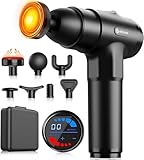
A full-size massage gun is the better choice for frequent use, larger muscle groups, and people who want more attachment options and a stronger-feeling treatment. Typical models weigh about 1.5 to 3 pounds, measure approximately 8 to 11 inches long, and cost about $40 to $250, with premium versions costing more.
For a small apartment or a drawer-friendly wellness kit, choose a mini. For a family that shares one device, an active household, or a long-term home gym, full size usually offers better versatility.
Side by Side
| Factor | Mini Massage Gun | Full-Size Massage Gun |
|---|---|---|
| Comfort | Lightweight and easy to hold with one hand; less tiring for short sessions | Can provide steadier pressure, but may fatigue the wrist during long sessions |
| Durability | Often has fewer moving parts and attachments; casing quality varies by price | Usually built for more frequent use, though hinges, buttons, and batteries still need care |
| Price range | About $20-$100 | About $40-$250 |
| Maintenance | Wipe the body and attachments; charging is usually simple | Requires the same cleaning, plus more attachments and a larger storage case to manage |
| Space needed | About 5-7 inches of drawer or shelf space; many fit in a small pouch | About 8-11 inches for the device, with extra room for a case and attachments |
| Look | Minimal, discreet, and often designed to resemble a handheld tech accessory | More substantial and gym-oriented, with a larger display or control panel on some models |
| Resale | Lower dollar value, but affordable models may be easier to replace than resell | Recognized premium brands may retain more value if clean and complete |
| Best for | Travel, desk workers, beginners, small spaces, and targeted relief | Athletes, couples, families, large muscle groups, and frequent sessions |
| Typical power | Roughly 10-25 watts, with moderate stall resistance | Roughly 20-60 watts, often with more sustained pressure |
Where Mini Massage Gun Wins
Portability is the clearest advantage. A mini can fit in a nightstand drawer, work bag, carry-on, or gym locker. At roughly 0.5 to 1 pound, it is less cumbersome when you are treating your forearm, shoulder, calf, or the front of your thigh. It is also easier to hold at awkward angles, although you may still need help reaching the middle of your back.
Minis are easier for beginners. Their smaller motors and shorter treatment heads can feel less intimidating than a powerful full-size device. For light muscle tension, a low-speed setting may be enough. Start with the lowest setting and keep the device moving rather than pressing hard in one place.
They are often the economical entry point. Budget mini massage guns can cost around $20 to $40, while more feature-rich models with heat, a display, or multiple speeds can reach $50 to $100. For example, the LEERCON Massage Gun Deep Tissue Mini Muscle Massager for Pain Relief, Blue, is listed at $19.49, while the RENPHO Mini Thermal Massage Gun with Heat, Color Silicone Casing, 4 Speeds, is listed at $49.97. Those prices illustrate the broad mini category rather than a guarantee of performance or longevity.
Storage and cleanup are simple. Fewer attachments mean fewer pieces to misplace, and the compact body is quick to wipe with a slightly damp cloth. A mini can be a good fit when the massage gun needs to share space with kitchen appliances, children’s items, or other bathroom and bedroom essentials.
The tradeoff is limited leverage. A small grip and lighter motor may not feel satisfying on dense glutes or large thighs, especially for someone who prefers firm pressure. Battery capacity can also be lower, so check the stated runtime and charging method before buying.
Where Full Size Massage Gun Wins
Full-size models are better for broad muscle groups. Their longer handles, larger treatment heads, and higher-power motors can make it easier to work across the quadriceps, hamstrings, glutes, and calves. The extra mass can also help the device stay planted without requiring you to push as firmly.
They offer more control for shared use. A household may need a gentle speed for one person and a stronger setting for another. Full-size massage guns commonly include three to six speed levels and several attachments, such as a soft ball, flat head, fork, and small pointed head. More attachments do not automatically mean better results, but they can make the device more adaptable.
Full-size models can also be a better match for active users who massage before or after exercise several times per week. The TOLOCO Massage Gun, Deep Tissue Back Massage for Athletes, with 10 massage heads and a silent brushless motor, is listed at $39.99. A “Massage Gun with Heat Massager Deep Tissue Muscle Massager Gifts for Men” is listed at $44.99. These examples show that some full-size options are priced close to midrange minis, so size alone does not determine cost.
The disadvantages are weight, storage, and reach. A 2-pound device held away from your body can feel surprisingly heavy, especially when treating your back or shoulders. A full-size model may also take up 1 to 2 feet of shelf or cabinet room once its case and attachments are included. Noise varies widely, so look for a stated decibel rating when quiet use matters.
Cost Over 5 Years
The purchase price is only part of the calculation. Suppose a mini costs $35 to $70 and lasts five years with ordinary home use. Its annualized cost is about $7 to $14, before electricity. A full-size model costing $60 to $150 works out to approximately $12 to $30 per year over the same period.
Charging costs are usually minor because these devices commonly use rechargeable batteries in the roughly 10- to 30-watt range. The more important long-term issue is the battery. After several years, capacity may decline, and many sealed battery packs are not designed for easy replacement. A $25 mini that needs replacing after two years may cost more over five years than a $60 model that remains usable for the full period.
To compare value, consider frequency. If you use a mini twice a month, a $40 purchase may be all you need. If several people use the device four times a week, a sturdier full-size model with a warranty and replacement attachments may provide better value even at a higher upfront price.
Which One for Your Home
Small apartment
Choose a mini unless you regularly train hard or need firm treatment for large muscle groups. A device under 7 inches can live in a drawer, and its lower weight is convenient in a bedroom or living room. A mini also reduces visual clutter in open-plan spaces where a large case would remain on a shelf.
Family with kids or pets
A full-size model is usually more versatile if multiple adults will use it. Select one with a sturdy case, simple controls, and attachments that can be cleaned easily. Store it out of reach and never leave loose attachments, charging cords, or the device where children or pets can access them.
Rental home
Either size works, but a mini is easier to store without adding furniture or permanent organization. If noise could disturb roommates or neighbors, prioritize a model with multiple low-speed settings and a published noise specification. Use it on a stable surface and avoid dropping it, since repairs may not be practical in a rental.
Long-term home
Choose full size if you expect regular use for exercise recovery, household muscle tension, or several users. Pay attention to warranty length, charging design, attachment storage, and replacement availability. If your needs are limited to occasional neck or calf tension, a mini remains the more sensible purchase even in a large home.
FAQ
Is a mini massage gun strong enough?
Yes, for light to moderate tension and smaller areas. Minis may be less effective when you want sustained, deep pressure on dense muscles. Power ratings, stall force, speed range, and attachment design matter more than size alone, so compare specifications rather than relying on marketing terms such as “deep tissue.”
Can I use a full-size massage gun on my back?
You can use it on reachable muscle areas, but avoid pressing directly on the spine, front of the neck, joints, bones, or areas with numbness. A full-size device does not automatically make the middle of your back easy to reach. Ask another adult for help or use a smaller device if you cannot maintain a comfortable position.
How long should a massage gun session last?
Use a low setting for a short trial, generally about 30 seconds to 2 minutes per muscle group. Keep the device moving and stop if you feel sharp pain, unusual tingling, bruising, or worsening soreness. Follow the manufacturer’s instructions, and consult a health professional if you have an injury, circulation condition, or medical concern.
Which is better for most buyers in 2026?
A mini is the better default for occasional home use, limited storage, and portability. Choose full size when multiple people will share the device, you have substantial muscle mass to treat, or you want more attachments and stronger pressure. The right fit is the one you will store safely and use consistently.