Key takeaways
- Convenient at home. You do not need an appointment, massage table, or special setup. A two- to five-minute session can fit into a busy routine.
- Useful for common soreness. Gentle treatment may help with the sensation of tight calves, glutes, hamstrings, upper back muscles, and shoulders after activity or prolonged sitting.
- More targeted than a foam roller. Small attachments can reach around the shoulder blades, along the calves, or into the glutes without requiring you to support your body on the floor.
- Reusable value. Even a $40 to $80 gun can pay for itself quickly if it replaces occasional low-cost massage appointments or disposable heat patches.
- Adjustable intensity. Multiple speeds let you begin with light stimulation and increase gradually. This is more adaptable than a single-speed vibrating cushion.
- Portable enough for many routines. A compact model can travel to a gym, office, or hotel, provided you remember to charge it and the added weight is acceptable.
What's inside
The Short Answer
Yes, a massage gun is worth it if you want a convenient way to temporarily ease everyday muscle soreness and tightness—and you are willing to use it gently and consistently. It is not a cure for injuries, chronic pain, or poor movement habits. Think of it as a reusable recovery tool, not a replacement for a physical therapist, medical treatment, stretching, sleep, or strength training.
For many shoppers, the value comes from convenience. A massage gun takes less than a minute to set up, works while you are watching television, and can target areas that are difficult to reach with a foam roller. In 2026, basic models are widely available for roughly $40 to $100, while quieter, more powerful versions commonly cost $120 to $250 or more.
As an Amazon Associate we earn from qualifying purchases at no extra cost to you. Product prices and availability are accurate as of the date shown and are subject to change.

What You Actually Get
A massage gun is a handheld percussion massager with a motor that rapidly moves an attachment back and forth against the body. Most models include several speed settings and interchangeable heads designed for broad muscles, smaller areas, or more focused pressure.
Typical entry-level guns weigh about 1.5 to 2.5 pounds and measure approximately 7 to 10 inches long. That is manageable for short sessions, but the weight can become tiring if you are trying to massage your back, shoulders, or legs for 15 minutes at a time. Battery life varies significantly. Budget products may provide a few hours of intermittent use per charge, while premium models often advertise longer runtimes. Actual use depends on speed, pressure, and battery condition.
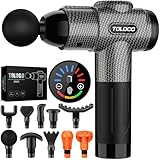
The inexpensive TOLOCO models listed at $39.99 are representative of the budget category. Both include 10 massage heads and a brushless motor, with one offered in black and the other in carbon. The extra heads may sound impressive, but the number matters less than whether the attachments are comfortable, easy to clean, and useful for the parts of your body you plan to treat.
Massage guns generally use anywhere from roughly 20 to 60 watts, although wattage alone does not tell you how effective or comfortable a model will feel. A higher number can indicate motor capacity, but speed range, stall resistance, noise, grip design, amplitude, and control quality are just as important. Budget models can provide useful vibration, yet they may feel louder, less refined, or less consistent under pressure than a more expensive gun.
Used correctly, percussion can make muscles feel temporarily looser and may help you feel more comfortable after exercise or a long day at a desk. The effect is usually short term. You should not expect a massage gun to lengthen muscles permanently, break up scar tissue, remove cellulite, or heal a strained tendon.
Pros
- Convenient at home. You do not need an appointment, massage table, or special setup. A two- to five-minute session can fit into a busy routine.
- Useful for common soreness. Gentle treatment may help with the sensation of tight calves, glutes, hamstrings, upper back muscles, and shoulders after activity or prolonged sitting.
- More targeted than a foam roller. Small attachments can reach around the shoulder blades, along the calves, or into the glutes without requiring you to support your body on the floor.
- Reusable value. Even a $40 to $80 gun can pay for itself quickly if it replaces occasional low-cost massage appointments or disposable heat patches.
- Adjustable intensity. Multiple speeds let you begin with light stimulation and increase gradually. This is more adaptable than a single-speed vibrating cushion.
- Portable enough for many routines. A compact model can travel to a gym, office, or hotel, provided you remember to charge it and the added weight is acceptable.
Cons
- Results are temporary. A massage gun may make an area feel better without addressing the reason it became tight or painful.
- It is easy to overdo. More pressure and more time do not necessarily produce better results. Aggressive use can increase soreness, cause bruising, or irritate already sensitive tissue.
- Noise varies. “Quiet” is relative. A budget motor may be fine in a home gym but distracting in a bedroom, shared office, or while someone else is sleeping.
- Hard-to-reach areas remain hard to reach. You may need another person to treat the middle of your back safely and comfortably. Holding a heavy device overhead can also fatigue your arms.
- Battery and charging are additional chores. A dead battery makes the device useless when you need it, and proprietary charging cables can be inconvenient to replace.
- Attachment kits can create clutter. Ten heads are not automatically better than four well-designed attachments. Unused pieces can end up scattered in a drawer.
- There are safety limitations. You should not use a massage gun directly over the spine, front of the neck, head, joints, open wounds, varicose veins, or areas with reduced sensation.
Who Should Buy It
A massage gun is a sensible purchase for active adults who regularly experience ordinary post-workout soreness and want a quick recovery ritual. It can also suit people who spend hours sitting at a desk and prefer a handheld tool to a floor-based foam roller. Runners, cyclists, weightlifters, and recreational athletes may appreciate the ability to use light pressure on large muscle groups before or after activity.
It is also a reasonable choice if you know what kind of sensation you like. If you already enjoy massage, foam rolling, or vibration therapy, a massage gun is more likely to become a habit rather than an expensive novelty. Choose a model with a comfortable handle, several low-speed settings, a battery indicator, and a return policy. For most first-time buyers, a $40 to $100 model is enough to determine whether percussion therapy fits their routine.
Use it for short periods: about 30 seconds to two minutes per muscle group, starting at the lowest comfortable speed. Keep the device moving instead of pressing hard on one spot. It should feel like firm pressure or vibration, not sharp pain, numbness, burning, or electric tingling.
Who Should Skip It
Skip a massage gun if you are shopping for a treatment for unexplained, severe, or persistent pain. Pain that follows an injury, worsens at night, causes weakness or numbness, or limits normal movement deserves medical guidance rather than self-massage.
You should also ask a clinician before using one if you have a bleeding disorder, take blood thinners, have a history of blood clots, significant osteoporosis, neuropathy, pregnancy-related concerns, or a recent surgery. Never use percussion directly over a suspected fracture, sprain, swollen joint, infection, tumor, or freshly injured area. Children should not use one without close adult supervision.
Cheaper Alternatives
| Option | Cost | Trade-off |
|---|---|---|
| Foam roller | $15–$40 | Much cheaper and effective for large muscle groups, but it takes more floor space and body effort. |
| Lacrosse or massage ball | $5–$20 | Excellent for controlled pressure against a wall or floor; less convenient for broad, fast treatment. |
| Manual massage stick | $10–$30 | Lightweight, quiet, and battery-free, though it requires more arm strength and cannot vibrate. |
| Heating pad | $20–$50 | Comfortable for general stiffness and relaxation, but it does not provide targeted mechanical pressure. |
| Basic massage gun | $40–$80 | Offers the most convenience for the price, but may be louder, heavier, and less durable than premium models. |
FAQ
How often should you use a massage gun?
For general soreness, one short session per day or several sessions per week is usually sufficient. Begin with 30 seconds on a muscle and increase only if the area feels comfortable afterward. If you are noticeably more tender the next day, reduce the pressure, speed, or duration. Daily use is not automatically better.
Is a massage gun better than a foam roller?
Neither is universally better. A foam roller is inexpensive and effective for large areas such as the thighs, calves, and back of the legs. A massage gun is more portable and precise, and it does not require getting down on the floor. If cost is your main concern, start with a roller or massage ball. If convenience determines whether you will actually use the tool, the gun may be the better buy.
Can a massage gun help with back pain?
It may temporarily ease tension in the muscles beside the spine, especially after sitting or exercising. Do not run it directly over the spine, kidneys, front of the abdomen, or a painful bony area. For recurring or intense back pain, seek professional advice before using percussion as a self-treatment.
What should you look for in a massage gun?
Prioritize a comfortable grip, a low starting speed, clear controls, reasonable weight, and a battery that lasts through several sessions. A stall-resistant motor and a return policy are more valuable than a large attachment count. For most shoppers, spending about $40 to $150 is enough. Pay more only if you specifically want quieter operation, lighter construction, stronger performance under pressure, or better warranty support.
Bottom line: A massage gun is worth it when convenience helps you manage normal muscle tightness and soreness safely. Buy a modestly priced model first, use it lightly, and view it as one small part of recovery—not a cure-all.