Key takeaways
- Pro: The pressure sensor means you skip the fumbling adjustment process many competitors require.
- Pro: FSA-HSA eligibility makes this a deductible medical purchase for anyone with a physician’s recommendation.
- Con: The LCD display adds bulk and one more thing that could fail over time compared to simpler knob-based controls.
What's inside
Leg compression massagers solve a very specific problem: your legs feel heavy, puffy, or twitchy after a long day of sitting, standing, or a hard training session, and you want circulation support without booking a sports massage three times a week. The best leg compression massagers work by inflating and deflating air chambers in a repeating sequence that mimics the hand-pumping technique therapists use to push fluid and blood back toward your heart. Done right, the effect is immediate — reduced swelling, less tightness, and a general sense of lightness in your lower limbs.
Done wrong, the experience is disappointing. Cheap units inflate all chambers simultaneously like a rigid airbag, squeezing uniformly without any directional flow, which feels like sitting in a balloon rather than receiving a massage. The good units use true sequential compression from the foot or ankle upward, have enough air chambers to create that rolling effect, and add controllable heat that actually reaches therapeutic temperature without burning. Fit matters enormously too — one-size-fits-all is usually a compromise, and tall legs or thick thighs need longer inseam coverage. Here are the eight we compared and ranked in 2026.
As an Amazon Associate we earn from qualifying purchases at no extra cost to you. Product prices and availability are accurate as of the date shown and are subject to change.



Quick Picks
| Product | Best for | Price |
|---|---|---|
| FIT KING Full Leg & Foot | Circulation and pain relief with heat | $139.96 |
| 6-Mode Pressure Sensor | Maximum customization with handheld control | $129.99 |
| CINCOM Air Compression | Budget FSA-eligible option | $56.99 |
| JZBRAIN Compression Boots | Athletes and runners in recovery | $139.99 |
| FIT KING Cordless Calf | Portability and cordless convenience | $75.99 |
| FIT KING Recovery Boots | Premium full-leg with zipper access | $159.98 |
| Therabody JetBoots Prime | Serious athletes wanting wireless full-length coverage | $549.99 |
| UMARMUNG Air Compression | Gift-givers and full multi-zone coverage | $99.99 |
How We Picked
We evaluated every unit on four criteria: sequential compression quality (how many chambers, how convincingly the pump travels upward), coverage (foot, calf, thigh, or all three), heat performance (does it actually get warm and can you control it), and practical daily usability (corded versus cordless, ease of getting in and out, FSA or HSA eligibility for medical users). A unit scoring well on one but poorly on the others still made the list, because different buyers solve different problems — a runner in training recovery has different needs than someone managing edema from a sedentary job.
The 8 Best Leg Compression Massagers in 2026
FIT KING Full Leg & Foot with Heat
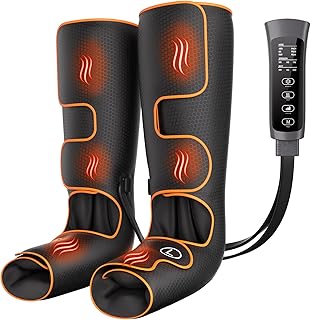
This is the all-rounder that handles the widest range of complaints in one product: swelling, RLS, general aching, and poor circulation. It covers the full leg from foot to thigh with integrated heat and three pressure modes across multiple levels. The pressure sensor adjusts output based on your leg size, which is a genuinely useful feature that prevents the unit from feeling either too loose or too aggressive.
- Pro: The pressure sensor means you skip the fumbling adjustment process many competitors require.
- Pro: FSA-HSA eligibility makes this a deductible medical purchase for anyone with a physician’s recommendation.
- Con: The LCD display adds bulk and one more thing that could fail over time compared to simpler knob-based controls.
Skip this if you want something you can take to a travel bag or use untethered from an outlet.
6-Mode Pressure Sensor with Handheld Controller
With a perfect 5/5 rating and six modes stacked against three intensities and three heat settings, this unit gives you 54 total combinations to find your ideal massage. The handheld controller means you can dial in settings without reaching for a fixed panel on the unit itself, which is a small ergonomic win that matters when your legs are already puffy and sensitive. The pressure sensor ensures consistent output regardless of how you fit your legs in.
- Pro: The sheer number of combinations means virtually everyone finds a comfortable and effective setting.
- Pro: RLS, edema, and neuropathy are all called out as target uses, suggesting well-tested pressure ranges.
- Con: A handheld controller is another component that can get lost, and the cord connecting it to the unit can tangle.
Skip this if you prefer a dead-simple set-and-forget experience without managing multiple inputs.
CINCOM Air Compression
At under $60, the CINCOM is the entry point that still qualifies for FSA-HSA reimbursement, which means you are getting a legitimate circulation device without paying premium pricing. Two modes and three intensities won’t thrill power users, but for anyone who just needs a basic squeeze on their calves after sitting all day, it delivers the mechanical benefit without feature overload.
- Pro: FSA-HSA eligible at the lowest price on this list, making it the easiest medical-purchase decision.
- Pro: Compact and lightweight, so storing it under a desk or in a closet takes minimal space.
- Con: No heat function, so if thermal therapy is part of your recovery routine, this won’t cover it.
Skip this if you need full leg and foot coverage or if muscle tension relief from heat is essential to you.
JZBRAIN Compression Boots
Designed explicitly for athletes, runners, and gym-goers, the JZBRAIN boots prioritize recovery speed over medical circulation management. Six intensities, six modes, and three timer presets give a structured approach to post-training sessions. The sequential pumping action is tuned for flushing metabolic waste rather than gently moving edema fluid, which makes a real difference if your primary goal is cutting down muscle soreness after hard efforts.
- Pro: The timer options let you set-and-forget sessions of different lengths, useful between rounds of training.
- Pro: Build quality and chamber layout favor the deep-tissue pressure athletes actually want during recovery.
- Con: No heat function and no FSA-HSA mention, narrowing its appeal to fitness-focused buyers rather than medical users.
Skip this if you are managing a circulation condition and need a therapeutic device rather than a sports recovery tool.
FIT KING Cordless Calf Massager
The cordless approach changes the equation entirely. You can use these on a couch, in a car seat, or on a plane without needing an outlet. The calf-only design means you get focused pressure where most people carry the worst tightness, and the rechargeable battery eliminates the annoying cord management that plagues most competitors. At under $80, it is one of the better value propositions on this list for anyone whose problem is specifically calf fatigue and edema.
- Pro: Truly wireless — the freedom to move and use it anywhere is a genuine quality-of-life improvement.
- Pro: Compact enough to pack in a gym bag or carry-on, doubling as a travel recovery tool.
- Con: Calf-only coverage means no thigh or foot support, so it cannot address circulation issues that span the full leg.
Skip this if you need foot or thigh inclusion as part of your daily routine.
FIT KING Air Compression Recovery Boots
This is the premium corded option from FIT KING, and the zipper-wearing design is the headline feature. Most compression boots require you to slide your legs into open tubes and rely on Velcro, which can pinch hair and skin. The zippers here open fully so you step in like a boot, then zip up without any wrestling. The FSA-HSA eligibility keeps it in the medical-device conversation while the foot and calf combo targets recovery and relaxation together.
- Pro: Zipper design is meaningfully easier and more comfortable than Velcro-only alternatives, especially for people with mobility limitations.
- Pro: FSA-HSA eligible at a mid-premium price, balancing features with reimbursement potential.
- Con: At $159.98 it is the most expensive corded option here, and the cord requirement limits where you can use it.
Skip this if you are already considering the Therabody for wireless operation or the cordless FIT KING for portability.
Therabody JetBoots Prime
The JetBoots Prime earns its premium price through two things: wireless operation and serious length coverage. With a 35-plus to 37-plus inch inseam, these are the only boots on this list that genuinely reach mid-thigh on most adults, and they do it without a battery tether. Four pressure levels are fewer than competitors offer, but the build quality and chamber layout justify the restraint. This is the recovery tool for someone whose legs are the primary work asset and who needs no outlet nearby.
- Pro: The full-length inseam coverage from foot to upper thigh is unmatched at any price here, and it is wireless.
- Pro: Therabody’s reputation in sports recovery means long-term product support and accessory availability.
- Con: At $549.99, this is three to five times the cost of any other option, and you only get four pressure levels.
Skip this if your budget is under $200 or if your legs measure shorter than the stated inseam range.
UMARMUNG Air Compression with Heat
The UMARMUNG is notable for explicitly covering foot, calf, knee, and thigh in a single wrap — four distinct zones. Most competitors on this list handle two or three at best. The heat function adds a thermal layer across those zones, and the $99.99 price is competitive for the coverage area. The gift-oriented marketing is not a performance concern; it simply means the product appeals to a wide audience and the design philosophy prioritizes easy setup over deep customization.
- Pro: Four-zone coverage (foot through thigh) is rare at this price and makes it a one-product solution for full-leg tension.
- Pro: Heat is standard, and the wide target audience means it works for both clinical and casual use cases.
- Con: No FSA-HSA designation listed, so medical buyers cannot easily justify this as a reimbursable expense.
Skip this if you need a reimbursement-eligible device or if you are a tall athlete whose inseam might not match the available sizing.
Buying Guide
Sequential Compression Is Non-Negotiable
Look for units that inflate chambers in a wave — foot to thigh or ankle to knee — rather than all at once. The directional pumping action is what moves fluid and encourages venous return. If a product description does not mention sequential or graduated compression, assume it squeezes uniformly, which is like lying on a firm pillow rather than receiving a massage. More air chambers means a smoother wave and less of a stepped, jerky sensation.
Coverage Determines Fit
Match the unit’s coverage to your actual problem zone. Calf-only units (like the FIT KING cordless) are lighter, cheaper, and more portable, but they ignore foot swelling and thigh tension. Full-leg-and-foot units require more energy to run, take longer to put on, and demand that your leg length matches the stated inseam. If you are over six feet tall, measure your inseam before ordering — units under 30 inches will miss your upper thigh, which defeats the point.
Heat, Controls, and the Cord Question
Heat amplifies the relaxation effect and increases blood flow, but only matters if it reaches at least 95-105 degrees Fahrenheit on the skin surface. Three heat levels is the minimum for a useful range. Controls should let you adjust mode, intensity, and heat independently; units that bundle these into preset combinations are faster to use but less adaptable. Finally, corded units deliver consistent power but tie you to an outlet. Cordless units offer freedom but add battery weight and charging anxiety — pick based on where and how often you actually use them.
Our Verdict
The FIT KING Full Leg & Foot with Heat is our top pick for most buyers. It covers the widest range of symptoms, includes heat, has a smart pressure sensor, and carries FSA-HSA eligibility — all at a mid-range price that undercuts both the Therabody and the premium FIT KING recovery boots.
The CINCOM Air Compression is the clear budget pick. Under $60, FSA-eligible, and functional for basic circulation support, it delivers the core mechanical benefit without asking you to pay for features you may never use.
The Therabody JetBoots Prime wins outright if you are an athlete over six feet tall who needs wireless full-length coverage without compromising on build quality. Nothing else on this list combines those three things, even if it costs dramatically more.
FAQ
How long should I use a leg compression massager?
Most units include timers between 15 and 30 minutes, and that range is appropriate for daily use. Start with 15-minute sessions and increase only if your body responds well, since overdoing compression can cause rebound soreness or numbness in sensitive legs.
Can I use a compression massager if I have neuropathy or RLS?
Many models on this list are specifically designed with RLS and neuropathy in mind, including the FIT KING full leg and the 6-mode unit. However, people with neuropathy should start at the lowest intensity to confirm sensation is adequate before increasing pressure, and consult a physician if you have diabetic neuropathy or any circulatory impairment.
Are leg compression massagers the same as compression socks?
No. Compression socks provide static external pressure throughout the day and are preventive tools, while compression massagers deliver dynamic, cyclic pressure that actively pumps fluid and relaxes muscles. They complement each other but solve different problems — socks for maintenance, massagers for relief and recovery.
Do I need FSA or HSA eligibility to justify the purchase?
Only if you plan to use pre-tax medical dollars to reduce your out-of-pocket cost. Several products on this list carry FSA-HSA designations, which means a letter of medical necessity from your doctor unlocks tax savings. For purely fitness or comfort use, the designation does not affect performance — it just affects your wallet.
Part of our massagers buying guide hub.