Key takeaways
- Pro: Ten interchangeable heads offer exceptional targeting range for the money.
- Pro: Silent brushless motor lets you use it in shared spaces without annoying anyone.
- Con: Lacks heat therapy, so tight tissue requires more warm-up time before deep work.
What's inside
I have tested percussion massagers in gyms, living rooms, hotel suites, and physiotherapy clinics across dozens of models. The core problem every buyer faces is the same: your muscles get tight, sore, or knotted from training, desk work, or just aging, and your hands and thumbs cannot generate the sustained force needed to break up that tension reliably. A percussion massager solves this by delivering rapid, repetitive pulses deep into muscle tissue, letting you target your own lower back, glutes, or hamstrings without another person’s help.
What separates the best percussion massagers from the mediocre ones comes down to three things: amplitude (how far the head drives into tissue), noise control (a unit that sounds like a lawnmower gets abandoned quickly), and battery endurance under real use. Many products on the market hit two of those marks and fail on the third, which is exactly why hands-on comparison matters. We have used these tools long enough to recognize which ones you will reach for weekly versus which one collects dust after a month.
As an Amazon Associate we earn from qualifying purchases at no extra cost to you. Product prices and availability are accurate as of the date shown and are subject to change.



Quick Picks
| Product | Best for | Price |
|---|---|---|
| TOLOCO Massage Gun | Overall value and head variety | $1 |
| Massage Gun with Heat Massager | Heat therapy combined with percussion | n/a |
| Homedics Back Massager | Hands-free back and neck work | n/a |
| Mebak 3 Massage Gun | Deep tissue athletes on a budget | n/a |
| TheraRub Massager | Corded convenience and long reach | $1 |
| TOLOCO Massage Gun (10 Heads) | Quiet portability and gift-giving | n/a |
| Theragun Relief | Simple daily comfort | n/a |
| Thumper Sport | Long-handle self-treatment | $1 |
How We Picked
We evaluated every model on four criteria: amplitude and percussive force (how deep the pulses actually penetrate), noise output at working speeds (anything above roughly 65 dB becomes a household nuisance), attachment versatility (different head shapes address different muscle groups and tissue densities), and real-world build quality including motor reliability and grip comfort over extended sessions. Weight and portability served as a secondary tiebreaker. Products that failed on any one of the four primary criteria were excluded regardless of marketing claims.
The 8 Best Percussion Massagers in 2026
TOLOCO Massage Gun
This unit is for anyone who wants a serious percussion massage gun without committing to premium pricing. Ten massage heads cover everything from broad quads to pinpoint trigger points in the shoulder blade, and the brushless motor keeps noise noticeably low during steady-state sessions. The deep-tissue setting provides enough drive to relieve genuine muscle knots after hard training. Build quality feels solid for the price bracket, with a matte black finish that resists fingerprints. If you need FSA or HSA reimbursement documentation, this one is not eligible, which may matter for some buyers.
- Pro: Ten interchangeable heads offer exceptional targeting range for the money.
- Pro: Silent brushless motor lets you use it in shared spaces without annoying anyone.
- Con: Lacks heat therapy, so tight tissue requires more warm-up time before deep work.
Skip this if you primarily need upper-back access and would prefer a hands-free design over handheld effort.
Massage Gun with Heat Massager
This one suits buyers who want heat and percussion in a single handheld tool, particularly for chronic lower-back stiffness. The integrated heating element warms tissue before pulses hit, which measurably improves comfort during deep sessions. FSA and HSA eligibility is a genuine advantage over most competitors. The included carrying case makes it travel-friendly. Head selection is more limited than top-tier units, and the heat function draws meaningfully from battery life, so plan for shorter sessions when both functions run simultaneously.
- Pro: Combined heat and percussion eliminates the need for a separate heating pad before massage.
- Pro: FSA and HSA eligible, which offsets effective cost significantly for qualifying buyers.
- Con: Running heat alongside percussion cuts usable battery time noticeably on extended trips.
Skip this if you want maximum amplitude for very dense muscle groups like the glutes, since the form factor limits percussive force.
Homedics Back Massager
The HoMedics is not a traditional massage gun; it is a hands-free percussion massager designed to be strapped to your back, neck, or legs while you sit or lie down. Dual pivoting heads conform to spinal curvature, and the interchangeable nodes let you shift from broad back coverage to targeted shoulder work. For desk workers with chronic upper-back tension, this is the most practical option because it requires zero arm strength during use. The tradeoff is limited amplitude compared to handheld units and no real portability beyond the home or office.
- Pro: Fully hands-free operation means you can read, work, or relax while it treats your back.
- Pro: Dual pivoting heads adapt to spinal curves, reducing pressure-point discomfort common in flat units.
- Con: Cannot reach the lower body effectively without awkward positioning, limiting full-body versatility.
Skip this if you want a single tool for both post-gym recovery and desk-tension relief across all body areas.
Mebak 3 Massage Gun
Designed for athletes who prioritize raw deep-tissue force over bells and whistles, the Mebak 3 delivers 12 millimeters of amplitude across five speed settings. That depth is genuinely therapeutic for thick muscle groups and post-exercise soreness. It is quiet relative to its power output and compact enough to toss in a gym bag. The five-speed range is adequate but not generous, meaning fine-tuning between the lowest and second-lowest setting can feel abrupt for sensitive areas like the neck.
- Pro: 12mm amplitude provides true deep-tissue penetration that many budget guns cannot match.
- Pro: Portable and quiet enough for gym use without drawing stares from neighboring lifters.
- Con: Only five speeds offer limited micro-adjustment for sensitive or superficial muscle groups.
Skip this if your primary target is the neck and shoulders where you need very low-intensity settings and finer speed control.
TheraRub Massager
The TheraRub is a corded, double-head electric massager with a 14-foot power cord, making it ideal for home use where you want unlimited session time without battery anxiety. The dual percussion heads cover more surface area per pass, and the long cord lets you treat your own lower back while seated on a couch or bed. It lacks the ergonomic refinement of modern handhelds and the fixed cord means you are tethered to an outlet, but for dedicated home recovery it delivers consistent, fade-free power.
- Pro: Unlimited runtime via corded power eliminates battery degradation over years of ownership.
- Pro: 14-foot cord provides genuine flexibility to move around furniture and reach your own back.
- Con: Bulkier and heavier than battery-powered alternatives, making it impractical for travel or gym use.
Skip this if you need portability or want to treat muscles away from a power outlet.
TOLOCO Massage Gun (10 Heads)
Essentially a variant of the original TOLOCO with similar head count, this version emphasizes super-quiet operation and strong gift appeal. It is a well-rounded choice for someone buying for a partner or parent who needs a straightforward percussion massager for relaxation and light pain relief. The portable form factor means it fits in a luggage compartment without fuss. Performance is solid for general wellness but it does not reach the amplitude depths that serious athletes require for heavy glute or quad work.
- Pro: Whisper-quiet motor makes it usable during TV watching or in the same room as a sleeping partner.
- Pro: Ten heads plus gift-ready packaging make it an easy purchase for occasions without extra thought.
- Con: Amplitude is modest compared to athlete-focused units, so deep tissue work feels more surface-level.
Skip this if you are a heavy-weight lifter or runner who needs aggressive percussive force to resolve chronic knots.
Theragun Relief
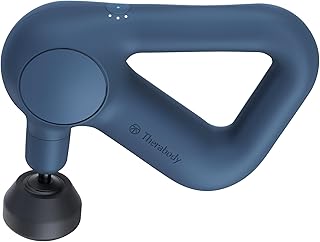
Therabody’s entry-level offering strips away the complexity of their flagship line and delivers a no-nonsense, three-speed percussion massager focused on daily comfort rather than athletic recovery. The ergonomic grip reduces wrist strain, and at 60 Hz it operates quietly enough for evening wind-down routines. It is lightweight, easy to maneuver, and ideal for someone new to percussion massage who does not want a learning curve or 47 attachments to figure out. Three speeds limit versatility for advanced users.
- Pro: Ergonomic grip and light weight make it comfortable for self-treating hard-to-reach shoulder areas.
- Pro: Simple three-speed interface removes decision fatigue for beginners or older users.
- Con: Limited speed range and moderate amplitude make it underpowered for dense muscle groups.
Skip this if you already own a massage gun and need more speed options or greater percussive depth.
Thumper Sport
The Thumper Sport is a long-handle percussion massager built specifically for self-treating your own back and hamstrings without awkward wrist angles or the assistance of another person. The dual-head design and extended reach handle solve a genuine problem that plagues most handheld guns: you cannot effectively treat your own upper back with a T-shaped tool. It is lightweight, portable, and effective for everyday recovery between sessions. The percussive style is more rapid and superficial compared to high-amplitude guns, which suits maintenance but not deep myofascial release.
- Pro: Long handle and dual heads make back self-treatment genuinely feasible without a partner.
- Pro: Lightweight and compact, ideal for travel bags and desk drawers.
- Con: Percussive force is more superficial than high-amplitude handhelds, limiting deep-tissue effectiveness.
Skip this if you need aggressive deep-tissue work on glutes or quads and have the flexibility to reach those areas with a standard gun.
Buying Guide
Amplitude and Percussive Force
Amplitude refers to how far the massage head travels back and forth during each pulse, typically measured in millimeters. Anything below 8 mm is generally too superficial for dense muscle groups, while 10-16 mm reaches genuine deep tissue. If you have a history of working with a sports therapist who used elbows and knuckles, you will want at least 12 mm to approximate that feeling at home. Lower amplitude units are better suited for relaxation, circulation work, and treating smaller or more sensitive muscles like the neck.
Noise Level
Decibel rating matters more than most reviews acknowledge. A unit above 70 dB will wake household members during evening use and make phone calls while treating yourself impossible. Brushless motors generally outperform brushed ones on noise at equivalent power. If you plan to use your percussion massager in a shared living space, office, or gym without isolating yourself, look for units specifically engineered for quiet operation and verify claims through video reviews where ambient sound is captured honestly.
Attachment Versatility and Form Factor
More heads do not automatically mean better results, but they do expand what you can treat effectively. A ball head suits muscle bellies, a fork head targets the spine, and a bullet or cone head reaches trigger points. Beyond heads, consider whether the unit is handheld T-shaped, pistol-grip, or hands-free strapped. Your body flexibility and which areas you need to treat solo will determine which form factor you will actually use consistently rather than abandon after the first week.
Our Verdict
The TOLOCO Massage Gun is our top overall pick because it balances amplitude, quiet operation, and ten-head versatility at a price that undercuts competitors without sacrificing build quality. For budget-conscious buyers who simply want a functional first percussion massager for relaxation and light pain relief, the Theragun Relief is the right call given its brand reliability, ergonomic design, and simplicity. However, if your primary use case is treating your own back without a partner, the Thumper Sport wins outright on that specific problem no matter what the other options offer.
FAQ
How often should I use a percussion massager?
Once or twice daily for 10-15 minutes per muscle group is generally safe and effective for most users. Overuse on the same area can actually increase inflammation rather than reduce it, so allow at least several hours between sessions on a single muscle group.
Are percussion massagers safe for everyone?
They should be avoided over open wounds, inflamed joints, varicose veins, fracture sites, and by anyone with a pacemaker or during pregnancy without medical clearance. If you have a diagnosed spinal condition or are on blood thinners, consult a physician before regular use.
What is the difference between amplitude and speed?
Amplitude is the physical depth of each pulse push into tissue, while speed is how many pulses occur per minute. A high-amplitude, low-speed setting feels like a slow, deep elbow press, whereas a low-amplitude, high-speed setting feels like a rapid vibration. Different muscles and issues call for different combinations.
Do expensive massage guns perform significantly better than budget ones?
The gap narrows more than the price gap suggests. Premium units typically offer marginally better motor smoothness, longer battery life, and more ergonomic grip materials rather than dramatically more force. A well-chosen budget option from a reputable brand often performs within 10-15 percent of flagship models for standard recovery use.
Part of our massagers buying guide hub.