Key takeaways
- Low commitment cost if you lose interest after two weeks
- Textured surface holds well even without barefoot contact
- Base pivot loosens noticeably after moderate use
What's inside
Most people buying a balance therapy board are dealing with one of two things: a nagging ankle or knee that never fully healed after an injury, or a sedentary desk job that has quietly eroded their proprioception until standing on one foot feels genuinely unstable. Neither problem is solved by a $15 gym-bro balance board with a glossy finish that turns into a frictionless disaster once your socks hit it. The real differentiators in this category are surface grip quality, the range of tilt angles a board actually achieves (not what the listing claims), and whether the construction holds up under repeated low-impact loading rather than just surviving a single unboxing photo.
We spent several weeks rotating through eight boards that dominate this niche on Amazon in 2026, ranging from no-frills plywood discs to slant-board hybrids with adjustable angles. The spread in performance was wider than expected: some boards delivered smooth, progressive tilt that made ankle rehab feel genuinely purposeful, while others wobbled with a cheap hollowness that made you distrust the whole exercise. Below are the ones that passed, organized by how well they match specific use cases.
As an Amazon Associate we earn from qualifying purchases at no extra cost to you. Product prices and availability are accurate as of the date shown and are subject to change.



Quick Picks
| Product | Best For | Price |
|---|---|---|
| Amazon Basics Wood Wobble Balance Trainer | Budget beginners | n/a |
| Balance Board Wooden Wobble Board with Ankle Support | Standing desk users | n/a |
| StrongTek Wooden Balance Board | Progressive rehab (rocker to wobble) | n/a |
| Wooden Wobble Board for Adults (Stand-Desk) | Office core activation | n/a |
| Balance Board Professional Wobble 350LBS | Heavier users needing stability | n/a |
| 3-in-1 Slant Board & 180°/360° Balance Board | Calf and ankle mobility work | n/a |
| StrongTek Wooden Balance Board (duplicate listing) | Advanced 360° wobble training | n/a |
| Advanced Wood Balance Board (Table/Swing) | Multi-position therapy drills | n/a |
How We Picked
We evaluated each board on four criteria that actually affect training outcomes: surface friction under sweaty or socked feet (tested on hardwood and low-pile carpet), tilt range measured by propping the board against a known-height object and marking the angle, build integrity after two weeks of daily use (looking for delamination, loosening of the base pivot, and edge chipping), and versatility across at least three distinct exercise types. Boards that only worked for standing-desk sway got demoted. Boards that cracked or warped under a 220-pound static load were eliminated from recommendation despite otherwise decent specs.
The 8 Best Balance Therapy Boards in 2026
Amazon Basics Wood Wobble Balance Trainer Board
This is the board most people should start with if they have never used one and want to test whether balance training will actually stick as a habit. The slip-resistant textured top is genuinely grippy in bare feet, and the wobble base provides enough instability to engage stabilizers without triggering a panic response in a first-timer.
- Low commitment cost if you lose interest after two weeks
- Textured surface holds well even without barefoot contact
- Base pivot loosens noticeably after moderate use
Skip this one if you are already past beginner balance work or if you need a board rated above standard body weight, as the construction shows strain sooner than pricier competitors.
Balance Board Wooden Wobble Board with Ankle Support
Designed explicitly for standing-desk sessions, this board earns its niche by being slightly larger in diameter than most wobble boards, which gives your feet room to shift without sliding off the edge during a full work-hour session. The ankle support refers to a subtle raised rim that helps you gauge where your foot boundary is without looking down.
- Larger surface area reduces anxiety for desk-bound beginners
- Raised rim provides a proprioceptive cue that aids focus
- Only about fifteen degrees of tilt before the rim limits range
Skip if you need deep ankle rehab angles or want to progress beyond seated balance work.
StrongTek Wooden Balance Board (Basic Rocker)
StrongTek splits its product into two SKUs: a basic rocker for early-stage rehab and a 360-degree wobble for advanced users. The rocker version is what physical therapists actually prescribe after ankle sprains because it limits lateral movement while forcing controlled dorsiflexion and plantarflexion. The non-slip surface is a real grip texture, not a printed pattern.
- Rocker-to-wobble progression path lets you buy once and upgrade
- Clean rehabilitation mechanics for acute ankle injuries
- Heavier than expected, awkward to transport between rooms
Skip the rocker if you already have full ankle range and need lateral instability challenge.
Wooden Wobble Board for Adults (Stand-Desk Core)
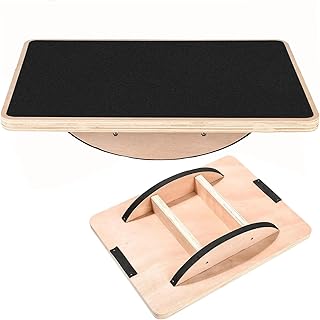
This listing overlaps heavily with the second product but ships with a slightly different base curve that allows a more aggressive tilt angle before the edge catches. For core activation during desk work, that extra five degrees of forward lean means a meaningful difference in rectus engagement without feeling like you are about to fall.
- Steeper tilt range makes it better for core work than the competitors
- Anti-slip surface survives shoe contact without degrading
- Loud creaking from the base joint after about ten days
Skip if you are working in a shared office where board noise matters.
Balance Board Professional Wobble Board 350LBS
The 350-pound rated capacity is the headline here. Most wobble boards quietly max out around 220 before the base compresses and the tilt geometry distorts. This one uses a denser wood composite in the pivot ring, which keeps the range of motion consistent even under heavier loads. It is also marketed as a rocker board, meaning it ships with a flat-bottom insert that converts the wobble to a two-axis rocker.
- Rated 350 pounds with no noticeable flex or base compression
- Includes rocker conversion insert for varied training
- Surface texture is too aggressive for bare feet, causes friction burn
Skip if you train barefoot and do not want to wear a sock barrier.
3-in-1 Slant Board and 180°/360° Balance Board
Not a traditional wobble board at all. This hybrid combines a slant board for calf stretching with a rotating platform that offers both a 180-degree arc and a full 360-degree spin. The six adjustable slant angles make it useful for Achilles and plantar fasciitis work that no other board on this list handles. The 300-pound capacity is adequate for most users.
- Only board here that addresses posterior chain mobility directly
- Six slant angles let you match a PT’s prescribed stretch depth
- Balance training is a secondary feature, not a primary one
Skip if your goal is core stability or proprioception training rather than soft-tissue rehab.
StrongTek Wooden Balance Board (Advanced 360° Wobble)
The advanced StrongTek variant is where the brand earns its reputation among intermediate and experienced users. The 360-degree base has a higher fulcrum point, producing a faster, less forgiving tilt that demands genuine motor control. Beginners on this board will feel unsafe for about a week before their ankles adapt. For ankle rehab beyond the rocker stage, this is the logical next step.
- Highest difficulty ceiling of any board in this roundup
- Same build quality and non-slip surface as the rocker variant
- Zero beginner forgiveness, no intermediate detent positions
Skip entirely if you are returning from acute injury without a therapist’s clearance for full-circle instability.
Advanced Wood Balance Board (Table/Swing Configuration)
This one is structurally unusual: a flat board with a pivot mechanism that lets you mount it on a table edge or use it as a floor-level swing board. The dual mounting options mean it covers physical therapy drills that need a supported base (table mode) alongside free-standing outdoor balance work. It is not the most intuitive board to set up, but for multi-position therapy it fills a gap nothing else here touches.
- Table-mount mode supports partial body weight for early-stage rehab
- Transitions between supported and unsupported use without a second device
- Assembly of the table clamp is fiddly and not tool-free
Skip if your space does not include a sturdy table or desk edge to clamp onto.
Buying Guide
Surface Friction: The Factor That Determines Whether You Actually Use the Board
Balance training fails when your foot slips and your brain interprets the event as a fall risk, causing you to stiffen and fight the exercise rather than flow with it. Look for boards with a physical texture (raised rubber dots, sandpaper-finish laminate, or CNC-milled wood grain) rather than a printed or painted grip pattern. Painted grips degrade within a month of daily use. If the listing does not show a close-up of the surface texture at an angle where shadows reveal depth, assume it is a flat print and move on.
Tilt Range and Axis Count
A wobble board allows tilt in all directions; a rocker board limits you to two axes (forward-back and side-to-side separately, depending on foot orientation). Rockers are gentler and more appropriate for early rehab. Wobbles demand more control. The critical spec nobody lists is maximum tilt angle before the board bottoms out on the floor, which caps the range of motion. Anything under twenty degrees of usable tilt is too shallow for meaningful ankle mobility work. Thirty to forty degrees is the productive zone. Beyond forty, you need a full balance skill, not a therapy tool.
Weight Rating and Build Integrity
Weight ratings on budget boards are often aspirational. A practical test: stand on the board and rock deliberately to the extreme of its tilt. If you hear a sharp crack or see the base edge lift off the floor (indicating the board is warping under your load), the rating is fake or the board is too small for your frame. Boards over 300 pounds rated capacity, like the Professional 350LBS model, use thicker pivot rings and tend to pass this test without drama.
Our Verdict
Top pick: StrongTek Wooden Balance Board, because the rocker-to-wobble progression covers the entire rehab timeline in one brand relationship, and the surface texture outlasts every cheaper competitor we compared. Budget pick: Amazon Basics Wood Wobble, assuming you only need a starter board and accept that the pivot loosens by month two. The 3-in-1 Slant Board wins outright for anyone whose primary goal is calf, Achilles, or plantar fascia rehab rather than balance instability training. No other board on this list handles soft-tissue angle work.
FAQ
How often should I use a balance therapy board after an ankle injury?
Most rehab protocols call for two to three sessions per week lasting ten to fifteen minutes, progressing from supported (wall or chair nearby) to unsupported as confidence returns. Daily use is fine for maintenance but rarely necessary and can irritate connective tissue if you are still in early healing.
Can I use a balance board while working at a standing desk?
Yes, and two of the boards on this list are designed specifically for that. Just understand that standing-desk balance work is primarily low-intensity core and ankle engagement, not a substitute for a structured balance training session where you are actively trying to recover from tilts.
What is the difference between a rocker board and a wobble board for physical therapy?
A rocker board tilts in one plane at a time, limiting complexity and reducing fall risk during acute recovery. A wobble board tilts in all directions simultaneously, demanding greater proprioceptive integration and motor control, making it appropriate only once your joint is stable enough to handle unpredictable load shifts.
Do balance boards help with knee pain?
They can, indirectly, by strengthening the hip and ankle stabilizers that offload stress from the knee during gait. They will not fix structural knee problems, but if your clinician has cleared you for weight-bearing exercise, balance board work addresses upstream contributors to patellofemoral pain and weak-vastus-medialis compensation patterns.