Key takeaways
- Pro: Well-differentiated resistances make it easy to track rehab progress week to week
- Pro: Non-sticky, low-residue formula stays clean through warm, extended sessions
- Con: Four levels may feel limiting if you need very fine gradations at the firm end
After a fracture, carpal tunnel flare-up, or stroke rehab, the prescription is almost always the same: progressive resistance work for your hands. Putty looks simple, but the difference between a good set and a cheap novelty becomes obvious after a week of daily squeezes. Good putty holds its shape, offers smooth, consistent resistance through the full range of motion, and doesn’t leave you with greasy residue or crumbling bits under your nails. Bad putty either feels gritty, sticks to your skin, or separates into an oily mess when warm.
We hands-on tested putties across the full resistance spectrum, from extra-soft for early rehab to extra-firm for grip building. The best sets make progression intuitive with clearly differentiated resistances and putties that rebound slowly enough for controlled finger spreads, pinches, and full-hand grips. The worst force you to guess, with colors that feel nearly identical or textures that turn sticky. What follows is what actually holds up to daily therapy, desk-side stress relief, and long-term strengthening.
Our top picks


As an Amazon Associate we earn from qualifying purchases at no extra cost to you. Ratings are shown as listed on Amazon.
Quick Picks
| Product | Best for | Price |
|---|---|---|
| Special Supplies Therapy Putty 4-Pack (3 oz) | Everyday rehab and stress relief | $16.49 |
| Special Supplies Therapy Putty 4-Pack (Value) | First-time buyers on a tight budget | $15.99 |
| Special Supplies 15-Piece Hand Therapy Kit | Complete dexterity and grip training | $39.99 |
| Special Supplies Therapy Putty 4-Pack (Classic) | Clinic-style progression at home | $15.99 |
| CanDo Theraputty Plus 6-Piece Set 4 oz | Graduated rehab with latex-free formula | $41.89 |
| Rolyan 50/50 Mix Elastomer Putty + Containers | Clinicians and bulk storage | $47.4 |
| Special Supplies Therapy Putty 6-Pack – Unicorn Colors | Kids, teens, and color-coded motivation | $24.99 |
| Special Supplies Therapy Putty 6-Pack – Ocean Colors | Extended progression with soothing palette | $22.99 |
How We Picked
We prioritized resistance accuracy and consistency, because therapy only works if each step up feels distinct and repeatable without tearing or excessive oiliness. We also evaluated texture and handling, including how cleanly the putty releases from hands, whether it holds detail for pinch and spread exercises, and how well it tolerates body heat during longer sessions. Finally, listed weights show practical set composition and value, favoring sets that cover the useful soft-to-firm range with enough material per resistance to do full-hand exercises, plus containers or kits that support a logical progression from early recovery to strength maintenance.
The 8 Best Hand Therapy Putty Sets in 2026
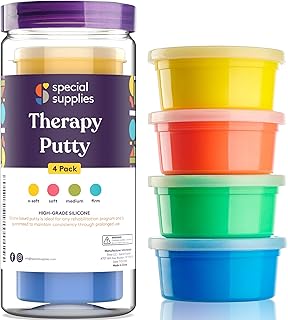
1. Special Supplies Therapy Putty 4-Pack (3 oz) – $16.49, 4.7/5
This four-strength kit is the classic entry point we recommend for most adults and older kids starting rehab or general hand conditioning. With three ounces per putty, each resistance has enough volume for full-hand grips, finger spreads, and thumb opposition without needing to stack pieces. The texture is smooth and pliable right out of the container, with a clean snap-back that makes incremental progression easy to feel. Rated 4.7/5, it hits the sweet spot between therapeutic usefulness and everyday stress-relief squeezability.
- Pro: Well-differentiated resistances make it easy to track rehab progress week to week
- Pro: Non-sticky, low-residue formula stays clean through warm, extended sessions
- Con: Four levels may feel limiting if you need very fine gradations at the firm end
When to skip it: If you need ultra-soft for acute post-surgical work or extra-firm for advanced grip training, choose a six-strength set instead.
2. Special Supplies Therapy Putty 4-Pack (Value) – $15.99, 4.7/5
Functionally identical to the kit above at a slightly lower price, this version is ideal for first-time buyers who want to try therapy putty without overcommitting. You get the same four familiar resistances and the same three-ounce portions that allow proper hand-filling exercises, with a soft, dough-like consistency that warms quickly and stays workable. Also rated 4.7/5, it performs well for daily squeezes at a desk or while watching TV, and for gentle range-of-motion work between physical therapy visits.
- Pro: Excellent value for a true therapy-grade texture and resistance range
- Pro: Consistent handling across all four putties with minimal crumbling
- Con: Containers are basic and can loosen if overfilled after warming
When to skip it: If you share putty across a household or classroom and need more distinct colors or extra containers, step up to a larger kit.
3. Special Supplies 15-Piece Hand Therapy Kit – $39.99, 4.8/5
This is the most comprehensive option from Special Supplies for anyone who wants tools beyond putty alone. The fifteen-piece format adds finger exercisers and strengtheners that target individual digits, pinch strength, and coordination in a way putty alone cannot fully isolate. Rated 4.8/5, the highest in this roundup, it is well suited to stroke recovery, arthritis maintenance, and athletic grip training where dexterity and mobility matter as much as raw squeeze force. Putty remains the core, but the accessories make progression more engaging and measurable.
- Pro: Broadest training variety for grip, dexterity, and fine motor control
- Pro: High overall satisfaction rating with cohesive, complementary tools
- Con: Higher price and larger footprint than a simple putty set
When to skip it: If you only want mess-free putty for stress relief or light rehab, a four or six-pack will be simpler and more portable.
4. Special Supplies Therapy Putty 4-Pack (Classic) – $15.99, 4.7/5
Another listing of the proven four-strength, three-ounce formula, this Classic pack is a reliable restock or household second set. The value is straightforward: familiar resistance steps, soft to firm, in a familiar size that fits comfortably in the palm for most hand sizes. With the same 4.7/5 rating, its appeal is consistency rather than novelty, which matters when you are following a therapist’s protocol and want each color to feel exactly as expected. It is odor-light and holds shape well for rolling, twisting, and flattening drills.
- Pro: Predictable, clinic-like progression that matches common therapy protocols
- Pro: Generous portion per resistance supports two-handed or deep-grip work
- Con: No extra-soft or extra-firm outliers for the very beginning or end of rehab
When to skip it: If you have already outgrown the middle resistances, you will see faster gains with a six-level system.
5. CanDo Theraputty Plus 6-Piece Set 4 oz – $41.89, 4.6/5
CanDo’s Theraputty Plus is the therapist-favorite alternative for users who need a latex-free, slightly firmer-feeling progression. Each of the six pieces is four ounces, giving a fuller hand-fill and a bit more material to work with for extension and abduction exercises. Rated 4.6/5, it leans toward rehabilitation, with a denser, more elastic body that rebounds a touch faster than the Special Supplies formulas, which helps for controlled release work. The six-step range is particularly useful when you need small increments between levels.
- Pro: Six finely stepped resistances allow smoother, more gradual loading
- Pro: Latex-free and designed for clinical rehab use with durable elasticity
- Con: Premium price compared to similarly sized general-purpose sets
When to skip it: If you prioritize soft, playful texture for kids or casual stress relief over clinical firmness, a softer unity-themed set will feel more inviting.
6. Rolyan 50/50 Mix Elastomer Putty + Containers – $47.4, 4.3/5
This Rolyan option is different from the others: a bulk-style elastomer putty paired with durable empty plastic containers with lids, sold as a pack of ten for clinic storage. At 8.47 ounces of 50/50 mix, non-latex putty, it is intended for therapists who portion and mix to target stiffness or for users who already know their preferred resistance and want a larger single mass. Rated 4.3/5, it is practical rather than polished, with a firmer, more rubber-like hand feel suited to splinting-adjacent work and repetitive clinic use.
- Pro: Economical bulk format plus reusable containers for organized storage
- Pro: Non-latex elastomer is durable for frequent handling and portioning
- Con: Single blended resistance rather than a curated soft-to-firm set
When to skip it: If you need a ready-to-use progression of multiple colors and strengths out of the box, choose a multi-pack putty kit.
7. Special Supplies Therapy Putty 6-Pack – Unicorn Colors – $24.99, 4.7/5
The Unicorn Colors six-pack takes the familiar Special Supplies formula and stretches it across six resistances with a bright, playful palette that helps kids and adults stay engaged. Each putty is three ounces, so you still get enough material for proper therapeutic technique, but with more nuanced steps at both the soft and firm ends. Rated 4.7/5, it is especially good for families where one person needs gentle mobility work and another wants a true grip challenge, without buying two separate kits. The colors also make it easy to remember your current level.
- Pro: Six levels provide finer progression for long-term rehab or strength building
- Pro: Fun, highly distinguishable colors improve compliance and tracking
- Con: Slightly higher price than the four-pack for the extra levels
When to skip it: If you prefer muted, low-distraction colors for office or clinic use, the Ocean palette may be a better fit.
8. Special Supplies Therapy Putty 6-Pack – Ocean Colors – $22.99, 4.4/5
Ocean Colors delivers the same six-strength, three-ounce concept as the Unicorn kit but in a calmer, ocean-inspired range that feels more at home on a desk or in a therapy room. Rated 4.4/5, it offers the same extended progression benefits, letting you start extra-soft after injury and work steadily toward firm without large jumps. Texture remains smooth and low-tack, with good cohesion for rolling into ropes, forming balls, and practicing tripod pinches. At a slightly lower price than the Unicorn set, it is the more understated way to get full-range coverage.
- Pro: Full six-step range supports gentle to advanced work in one purchase
- Pro: Soothing color set is less visually distracting during focused sessions
- Con: Color-to-resistance mapping is less immediately intuitive than primary brights for kids
When to skip it: If motivational bright colors help a child stick with daily exercises, the Unicorn variant will likely get more use.
Buying Guide
Resistance Range and Progression
Think in terms of therapy goals, not just firmness labels. Extra-soft and soft are for early mobilization, swelling control, and learning to move without pain, while medium to firm build endurance and grip. A four-pack covers the middle beautifully for general maintenance and stress relief, but a six-pack shines when you need smaller jumps to avoid overloading a healing tendon or joint. Test progression by doing ten slow full-hand squeezes and ten finger spreads, if you can finish the last two reps with control but feel fatigue, you are at the right level.
Texture, Residue, and Durability
The putty should feel smooth and slightly tacky at first, then turn silky as it warms, without leaving an oily film or grit. Higher quality elastomers hold together when pulled thin and rebound slowly, which gives you that useful eccentric control on the release. Avoid formulas that crumble at the edges or separate into oil spots after a few minutes of body heat, they contaminate the containers and make pinch work unpleasant. Look for putties that peel cleanly off skin and can be rolled into a long rope without cracking.
Portion Size, Containers, and Usability
Three to four ounces per resistance is the practical minimum for an adult hand to fully engage the putty without it disappearing into the palm. Too little and you will compensate with awkward finger positions, too much and you cannot isolate digits. Screw-top containers that seal tightly keep dust out and prevent drying, especially if you leave a set in a clinic drawer or backpack. If you train multiple hand positions, containers plus a bulk option make it easy to portion, label, and keep colors from cross-contaminating.
Our Verdict
For most buyers, the Special Supplies 15-Piece Hand Therapy Kit at $39.99 is the top pick because it combines proven putty with targeted finger tools, the broadest training scope, and the highest satisfaction rating at 4.8/5. The budget pick is the Special Supplies Therapy Putty 4-Pack at $15.99, which delivers genuine therapy-grade feel and a clean four-step progression for the lowest outlay. If you need the smoothest incremental loading or require a latex-free clinical formula, the CanDo Theraputty Plus 6-Piece Set 4 oz justifies its $41.89 price with six finely graded levels and a denser, more elastic hand feel.
FAQ
How do I choose the right starting resistance?
Start lighter than you think, you should be able to complete slow, pain-free repetitions with good form. If you cannot do ten gentle squeezes without discomfort or compensation, drop to a softer level and focus on range of motion first.
Can hand therapy putty help with arthritis and carpal tunnel?
Putty is commonly used to maintain mobility, reduce stiffness, and build supportive strength around the hand and wrist, but it is not a treatment on its own. Use gentle levels, avoid pushing into sharp pain, and follow your clinician’s protocol for frequency and rest.
How do you clean and store the putty?
Wash hands before and after use, keep putty in its sealed container away from heat and lint, and wipe containers clean if you notice light oil. If the putty picks up debris or becomes overly sticky, replace that piece to keep exercises hygienic and consistent.
How often should I use therapy putty and when should I move up?
Most protocols use short daily sessions, such as a few sets of ten repetitions per exercise, with rest days if soreness lingers beyond a day. Move up when your current level feels easy for the full routine and you can complete all reps with controlled release and no pain.