Key takeaways
- Consumables to budget for: one spare battery, a spare control cable, and an extra quick-release plate. Together these usually run $80–$200 depending on the model.
- Cleaning: wipe the body and handles with a dry microfibre cloth, and use a barely damp cloth on the arms. Never spray solvent or lubricant into the motor housings — it carries dust into the bearings. Compressed air at low pressure is fine around the joints.
- Storage: lock the axes for transport as the manufacturer specifies, and store the gimbal in its case rather than loose in a bag where the arms can be knocked.
- Common mistakes: balancing without the battery installed, then adding it and wondering why the rig drifts; leaving the gimbal powered on while you balance it; mounting a camera with the lens hood extended when you balanced without it; and running at 100% of rated payload for every shoot.
The best steadicam for most shooters in 2026 is a three-axis electronic gimbal in the DJI RS 4 class — roughly 3 kg of rated payload, about 1.2 kg of gimbal, and a battery grip that covers a full shooting day — while the DJI RS 4 Pro is the right step up if you fly cine zooms, matte boxes, or a full cage. If you want a battery-free rig that mechanically balances for long walking shots, the Glidecam HD-2000 class is still the reference point. The single spec that decides whether you’ll actually enjoy the rig is payload headroom: aim for about 25% more rated capacity than your camera, lens, and accessories weigh together.
Our top picks
 DJI RS 4 Mini Combo
- Ready in 1 s - No more fumbling…
- Intelligent Tracking - RS Intelligent Tracking Module keeps…
- Teflon Enhanced Balancing - DJI RS 4 Mini…
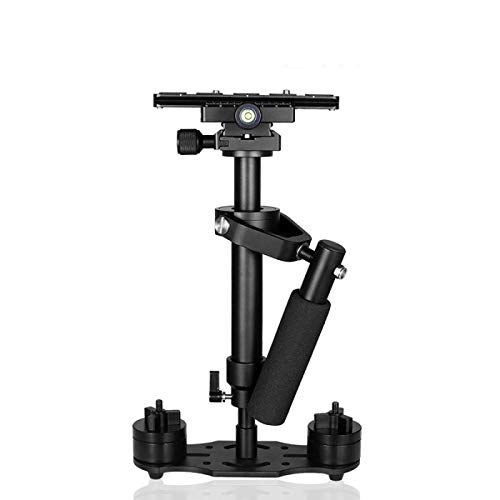 Wondalu S40 15.8'/40CM Handheld Steadycam Camera Stabilizer
- Supports GoPro and all other action cameras weight…
- This handheld gimbal stabilizer with quick release Plate…
- As video stabilizer also allows high and low…
As an Amazon Associate we earn from qualifying purchases at no extra cost to you.
Quick comparison: best steadicams at a glance
Payload and weight figures below come from manufacturer spec sheets for the current generation of each model; ratings shift with firmware and revisions, so confirm current numbers before you buy. Prices are general market ranges for the gimbal or sled only, without accessories.
| Pick | Best for | Rated payload | Weight / battery | Typical price range |
|---|---|---|---|---|
| DJI RS 4 Pro | Best overall for pro mirrorless and small cinema rigs | ~4.5 kg (10 lb) | ~1.3 kg gimbal; grip battery rated for a full day | ~$900–$1,100 |
| DJI RS 4 | Best for most mirrorless shooters | ~3 kg (6.6 lb) | ~1.2 kg gimbal; ~12 h rated | ~$600–$800 |
| DJI RS 3 Mini | Best budget / travel pick | ~2 kg (4.4 lb) | ~795 g gimbal; ~10 h rated | ~$300–$400 |
| Zhiyun Crane 3S | Best for heavy cinema rigs on a budget | ~6.5 kg (14.3 lb) | ~2.5 kg gimbal; ~12 h rated | ~$600–$800 |
| Glidecam HD-2000 class (mechanical) | Best battery-free rig for walking shots | ~1–3 kg (2–6 lb) | ~1.4 kg sled; no battery | ~$500–$700 |
| DJI Osmo Mobile class | Best for phones and run-and-gun fitness content | Up to ~0.3 kg | ~350 g; ~6–7 h rated | ~$120–$170 |
Best overall: DJI RS 4 Pro
The RS 4 Pro is the pick when your rig is genuinely heavy — a full-frame body with a 24–70 mm f/2.8, a cage, a monitor, and a wireless transmitter can easily land near 2.5 kg, and the RS 4 Pro’s roughly 4.5 kg rating leaves comfortable headroom. Per the manufacturer’s spec sheet, it also adds automated axis locks, a colour touchscreen, and support for a LiDAR focusing module, which matters if you shoot solo and can’t pull focus by hand while walking.
Who it suits: commercial and documentary shooters, or fitness-content creators who need to track a moving subject while carrying a real camera rather than a phone.
Main trade-off: weight and price. The gimbal alone is around 1.3 kg before you mount anything, so a full day of one-handed work is not realistic — plan on two hands or a support system.
Best for most mirrorless rigs: DJI RS 4
For the majority of buyers, the RS 4 is the sweet spot. Around 3 kg of payload covers a mirrorless body with a standard zoom or a fast prime, plus a monitor and a small transmitter, and the gimbal itself stays near 1.2 kg so it’s still manageable on a long shoot. Battery life is rated at roughly 12 hours, which in practice means a full day with charge to spare on lighter rigs.
Who it suits: solo creators, wedding and event shooters, and anyone upgrading from a phone gimbal who wants one tool that covers several years of gear changes.
Main trade-off: no LiDAR focusing module support in the same way as the Pro, and the 3 kg ceiling rules out most cinema zooms and heavy matte-box builds.
Best budget pick: DJI RS 3 Mini
The RS 3 Mini is the one to buy if your camera is small and you’re shooting travel, vlogs, or gym-floor content. It weighs under 800 g, folds down for a bag, and carries about 2 kg — enough for a compact full-frame body with a light zoom, or an APS-C camera with room to spare. It also supports native vertical mounting without extra accessories, which is useful if you publish short-form video.
Who it suits: beginners, second-camera owners, and anyone who has to carry the rig for hours at a time.
Main trade-off: no room to grow. Add a cage, a monitor, and a wireless transmitter and you’ll be at or over the limit, which shows up as motor whine, vibration, and axis drift.
Best for heavy cinema rigs: Zhiyun Crane 3S
If your build is genuinely heavy — a cinema camera with a large zoom, or a full-frame body with a matte box and follow-focus motor — the Crane 3S is one of the few sub-$1,000 options rated near 6.5 kg. It uses a modular handle design that lets you reconfigure between a one-handed grip and a two-handed setup, which helps with comfort once the rig passes 4 kg.
Who it suits: small production crews, rental houses, and owner-operators with a heavy A-camera.
Main trade-off: it’s a heavy, older-feeling design at around 2.5 kg bare, and its app and axis-lock workflow are less polished than the current DJI generation. Setup takes longer because there’s more mass to balance.
Best mechanical steadicam: Glidecam HD-2000 class
A true mechanical steadicam — a weighted sled on a gimbal bearing, supported by your hand or a vest and arm — produces a different look from an electronic gimbal. Because there are no motors correcting for you, camera movement reads as smooth, continuous float rather than a locked, robotic line. There’s no battery to charge and nothing to calibrate electronically, but balancing is entirely manual and takes practice.
Who it suits: shooters who want long, unbroken walking shots, and anyone working in situations where power or motor failure isn’t an option.
Main trade-off: a real learning curve, and heavier payloads generally require a vest and arm. The Steadicam Aero class sits above this for rigs in the 10–13 kg range and costs several thousand dollars.
Best for phones and travel: DJI Osmo Mobile class
For phone-first creators, a pocket gimbal in the Osmo Mobile class does everything a full-size steadicam does at a fraction of the weight: roughly 350 g, 6–7 hours of rated runtime, and magnetic mounting that takes seconds. It’s the right answer for filming workouts, coaching clips, and social content where the phone is the camera.
Who it suits: fitness instructors, coaches, and anyone publishing vertical video.
Main trade-off: payload is measured in grams, not kilograms. You cannot grow into it, and thick phone cases often need to come off to balance properly.
How to choose a steadicam: payload math, setup time, comfort
Do the payload math before anything else
Manufacturer payload ratings are a ceiling, not a target. Working at the limit makes motors run hot, drains batteries faster, and produces micro-jitter you’ll see in the footage. Most experienced operators aim for roughly 25% headroom above the actual rig weight. Here’s what that looks like for a typical full-frame mirrorless build:
| Component | Typical weight |
|---|---|
| Full-frame mirrorless body | ~650 g |
| 24–70 mm f/2.8 zoom | ~700 g |
| Half cage and top handle | ~150 g |
| 5-inch monitor plus HDMI cable | ~200 g |
| Wireless video transmitter | ~100 g |
| Spare battery, plate, cables | ~150 g |
| Rig subtotal | ~1.95 kg |
| Plus 25% headroom | ~2.4 kg needed |
That calculation says a 3 kg gimbal such as the RS 4 is the correct match, and a 2 kg travel gimbal such as the RS 3 Mini is not — even though the Mini would technically lift the camera and lens alone. Weigh your own rig on a kitchen scale rather than adding up spec sheets; cables, plates, and lens hoods are consistently underestimated.
Setup time is mostly a balancing problem
Balance in order: tilt first (front-to-back), then roll (side-to-side), then pan (vertical rotation). The reason for that sequence is that adjusting one axis shifts the others, so balancing out of order means repeating work. Expect 10–25 minutes the first time you mount a new camera, and 2–4 minutes once you’ve marked the axis positions with tape or saved them on a memory quick-release plate. Tool-free axis locks and a sliding plate are the two features that cut setup time most, and they’re worth paying for if you change lenses often.
Comfort over a 10-hour day
As a working rule rather than a manufacturer spec, most operators keep a one-handed system under about 2.5 kg total (gimbal plus rig) for sustained shooting, move to a two-handed grip between 2.5 and 4 kg, and switch to a vest-and-arm or support system above roughly 4.5 kg. Grip material, handle diameter, and whether the battery sits in the handle all affect how the weight feels after hour six. If you regularly shoot long days and experience persistent shoulder, wrist, or back pain, treat it as a clinical issue and see a physiotherapist rather than pushing through.
Camera compatibility checks
Before buying, confirm four things: that your camera body’s width fits between the arms, that the gimbal’s control cable supports your specific model for record and focus control, that a lens support is available for long zooms, and that the mounting plate clears your cage’s base. Compatibility lists are model-specific and change with firmware, so check the manufacturer’s current list for your exact camera rather than a general brand claim.
Which steadicam fits your situation
| Your situation | Pick | Why |
|---|---|---|
| Phone only, vertical video, daily posting | Osmo Mobile class | Under 400 g, magnetic mount, cheapest entry point |
| Beginner, compact camera, tight budget | RS 3 Mini | 2 kg payload covers small rigs without overbuying |
| Mirrorless shooter, occasional paid work | RS 4 | 3 kg payload, ~12 h battery, fits most growth paths |
| Heavy rig, weekly professional use | RS 4 Pro or Crane 3S | 4.5–6.5 kg payload, better balance for cine glass |
| Long walking shots, no power available | Mechanical Glidecam class | No battery, no motors, distinctive floating motion |
| Frequent lens changes on set | Any pick with memory quick-release and tool-free locks | Cuts rebalance time from minutes to seconds |
Durability and ownership: what wears out first
The parts that fail first on a gimbal are rarely the motors. In order of frequency, expect batteries to lose capacity after roughly 300–500 charge cycles, thumbscrews and quick-release plates to strip or loosen, USB-C and control ports to wear from repeated cable swaps, and rubber dampers or gaskets to harden with age. On mechanical sleds, the gimbal bearing and the telescoping post are the wear points, and the counterweight plates are the parts most often lost.
- Consumables to budget for: one spare battery, a spare control cable, and an extra quick-release plate. Together these usually run $80–$200 depending on the model.
- Cleaning: wipe the body and handles with a dry microfibre cloth, and use a barely damp cloth on the arms. Never spray solvent or lubricant into the motor housings — it carries dust into the bearings. Compressed air at low pressure is fine around the joints.
- Storage: lock the axes for transport as the manufacturer specifies, and store the gimbal in its case rather than loose in a bag where the arms can be knocked.
- Common mistakes: balancing without the battery installed, then adding it and wondering why the rig drifts; leaving the gimbal powered on while you balance it; mounting a camera with the lens hood extended when you balanced without it; and running at 100% of rated payload for every shoot.
Frequently Asked Questions
What’s the difference between a steadicam and a gimbal?
A steadicam is a mechanically balanced sled — counterweights, a gimbal bearing, and often a vest and arm — with no electronics. A gimbal uses motorised axes and sensors to hold the camera level electronically. Mechanical rigs give a floating, organic look and never run out of power; electronic gimbals are faster to set up, easier to learn, and hold a horizon more precisely.
How much payload do I actually need?
Weigh your complete rig — camera, lens, cage, monitor, transmitter, battery, and plate — then add about 25%. If your rig weighs 2 kg, buy a gimbal rated around 2.5 kg or higher. Buying at or just above your current weight leaves no margin for a heavier lens later and makes the motors work harder in the meantime.
How long does a gimbal battery really last?
Manufacturers typically rate batteries at around 10–12 hours, and those figures assume a light payload at room temperature. In cold weather, with a heavy rig, and with frequent motor corrections, expect roughly half to two-thirds of the rated figure. Carrying a spare battery is standard practice for any full-day shoot.
Can one gimbal handle both my phone and my camera?
No — the classes don’t overlap. Phone gimbals balance payloads measured in grams and clamp to a phone body, while camera gimbals start at around 2 kg of capacity and use a tripod-style plate. Trying to mount a camera on a phone gimbal overloads the motors, and mounting a phone on a camera gimbal usually means it’s too light to balance correctly without added weight.
Is a mechanical steadicam better than a gimbal for walking shots?
For long, continuous walking shots, many operators prefer mechanical rigs because the motion reads as smooth float rather than a locked horizon. Electronic gimbals win on setup speed, horizon accuracy, and versatility across different shot types. If you shoot mostly short takes and varied angles, a gimbal is the more practical tool.
How often do I need to rebalance the gimbal?
Every time you change lens, add or remove a monitor, swap the battery, or move between very different temperatures. A correctly balanced gimbal holds its position when powered off; if it tips on its own, rebalance before shooting. Marking your axis positions with tape makes the routine take a couple of minutes instead of twenty.