Key takeaways
- Processor and graphics card: Match them to the target resolution and the games you play. For high frame rates in competitive games, CPU performance matters; for 4K, GPU capability is usually the priority.
- Memory: 32GB is a comfortable gaming baseline in 2026. Confirm the system uses two matched modules when possible, rather than one module that can limit memory bandwidth. Check the motherboard’s supported capacity before planning an upgrade.
- Storage: Choose a PCIe NVMe SSD, ideally 1TB or more. Game installations vary widely in size, so look for an additional M.2 slot or another straightforward way to add storage.
- Upgrade access: Standard ATX or microATX motherboards, conventional power supplies, and non-proprietary connectors generally make repairs and upgrades easier. Ask whether the case uses standard parts if the listing is unclear.
- Cooling and noise: Look for unobstructed front or side intakes, exhaust fans, and a CPU cooler appropriate to the processor. A glass-fronted case with limited ventilation may run warmer than a mesh-front design.
- Warranty and support: Check the warranty term, what it covers, and whether opening the case for routine upgrades affects coverage. Save the exact configuration and component model numbers.
Best Gaming PCs for Smooth, High-FPS Play
The best gaming PCs match the graphics card to your monitor’s resolution, pair it with a processor that can keep frame rates steady, and leave enough memory, storage, and cooling headroom for the games you play. For most buyers, a desktop with an AMD Ryzen 5 or Intel Core i5 processor, 32GB of memory, a 1TB NVMe SSD, and a graphics card suited to 1080p or 1440p is the most practical starting point.
There is no single best configuration for everyone. A compact prebuilt may suit a small desk, while a standard mid-tower is usually easier to cool and upgrade. Use the guide below to narrow down the right class of system before comparing specific configurations.
Our top picks
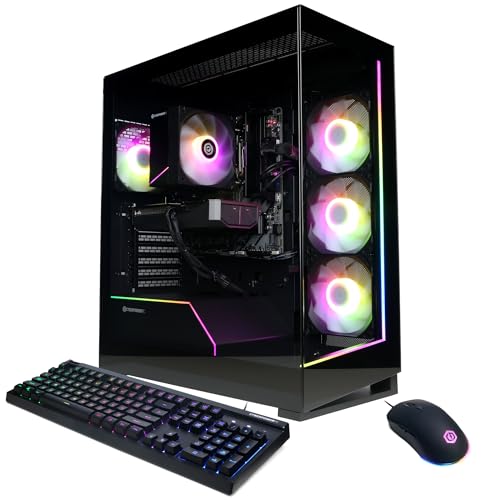


As an Amazon Associate we earn from qualifying purchases at no extra cost to you. Ratings are shown as listed on Amazon.
Choose by resolution and gaming situation
| Your situation | Practical starting specs | What to expect |
|---|---|---|
| 1080p, esports, or tighter budget | Ryzen 5 or Core i5; GeForce RTX 5060 or Radeon RX 9060 XT; 16–32GB RAM; 1TB NVMe SSD | Strong fit for high-refresh esports and many demanding games at sensible settings. Choose 32GB if you multitask or want more headroom. |
| 1440p, mixed games, regular use | Ryzen 5/7 or Core i5/i7; GeForce RTX 5070 or Radeon RX 9070; 32GB RAM; 1–2TB NVMe SSD | A balanced target for sharp visuals and high frame rates. Heavier games may need reduced settings or upscaling to maintain a display’s maximum refresh rate. |
| 4K, demanding single-player games | Ryzen 7 or Core i7; GeForce RTX 5080-class or Radeon RX 9070 XT-class graphics; 32GB RAM; 2TB NVMe SSD | Better suited to high-resolution gaming, but demanding effects can still lower frame rates. Upscaling and settings adjustments remain useful. |
These are configuration targets, not guarantees: performance varies by game, settings, cooling, and the exact power limits used by a prebuilt manufacturer. Check independent benchmarks for the specific graphics card and games you care about. A high-refresh 1080p monitor also makes processor performance more important than it is at 4K, where the graphics card usually does more of the work.
Best gaming PC configurations by buyer
Best for 1080p value: a balanced entry-level tower
Look for a current-generation Ryzen 5 or Core i5 paired with an RTX 5060- or RX 9060 XT-class card. This combination makes sense for competitive games, mainstream gaming, and buyers who would rather spend less than pay for performance their monitor cannot show. A 1TB SSD is a sensible minimum for a games library, and 32GB of RAM is preferable if the price difference is modest.
Before choosing a cheaper model, check whether its graphics card has adequate cooling and whether the power supply is a standard, replaceable unit. A low price can come with a small SSD, one memory stick, or a cramped case that makes later upgrades harder.
Best for 1440p: the all-rounder
For many players, this is the most flexible target. A Ryzen 5 or 7, or Core i5 or i7, with an RTX 5070- or RX 9070-class card and 32GB of RAM offers room for demanding games without paying the premium required by top-tier 4K hardware. Pick a 2TB SSD if you regularly keep several large games installed; otherwise, confirm that a second M.2 slot or a free drive bay is available.
At this level, compare the whole build rather than judging by the GPU name alone. Two prebuilts with the same graphics card can differ in processor cooling, case airflow, power-supply quality, memory configuration, and noise.
Best for 4K: prioritize graphics and airflow
For 4K, put a larger share of the budget toward the graphics card. An RTX 5080-class or RX 9070 XT-class system is a more appropriate starting point than a 1080p-focused build, especially for visually demanding games. A Ryzen 7 or Core i7 and 32GB of RAM are suitable companions; spending heavily on a flagship processor while settling for a weaker GPU is usually a poor trade if gaming is the main use.
Check the card’s length and thickness against the case, and make sure the cooling layout can exhaust its heat. A compact case may look tidy, but it can restrict GPU choices or require smaller, louder fans.
What to check before you buy
- Processor and graphics card: Match them to the target resolution and the games you play. For high frame rates in competitive games, CPU performance matters; for 4K, GPU capability is usually the priority.
- Memory: 32GB is a comfortable gaming baseline in 2026. Confirm the system uses two matched modules when possible, rather than one module that can limit memory bandwidth. Check the motherboard’s supported capacity before planning an upgrade.
- Storage: Choose a PCIe NVMe SSD, ideally 1TB or more. Game installations vary widely in size, so look for an additional M.2 slot or another straightforward way to add storage.
- Upgrade access: Standard ATX or microATX motherboards, conventional power supplies, and non-proprietary connectors generally make repairs and upgrades easier. Ask whether the case uses standard parts if the listing is unclear.
- Cooling and noise: Look for unobstructed front or side intakes, exhaust fans, and a CPU cooler appropriate to the processor. A glass-fronted case with limited ventilation may run warmer than a mesh-front design.
- Warranty and support: Check the warranty term, what it covers, and whether opening the case for routine upgrades affects coverage. Save the exact configuration and component model numbers.
Budget for the complete setup
General market ranges for tower PCs can help set expectations, though prices vary with sales, region, and component availability. Entry-level 1080p systems commonly fall around $800–$1,200; balanced 1440p systems around $1,200–$2,000; and higher-end 4K systems often start near $2,000 and can exceed $3,000. These are broad ranges, not price quotes, and typically exclude a monitor and peripherals.
For example, a $1,500 tower plus a $300 1440p high-refresh monitor brings the core gaming setup to about $1,800 before tax, keyboard, mouse, or headset. If you already own a suitable monitor, putting that money toward a stronger GPU or larger SSD may be more useful than buying a new display.
Ownership realities: heat, dust, and upgrades
Dust buildup on filters and heatsinks is a common reason a desktop gradually gets louder or runs hotter. Check and clean removable filters every few months, more often in dusty rooms or homes with pets. Power the PC off and unplug it first; use gentle, electronics-safe cleaning methods and avoid forcing fans to spin with compressed air.
Storage often fills before a gaming PC feels outdated, so an extra SSD slot can be more valuable than a small processor upgrade. Graphics cards are also the most demanding component to replace: verify case clearance, power-supply capacity, and the required power connectors before buying a larger card. For memory upgrades, use compatible modules and consult the motherboard manual rather than mixing kits at random.
Bottom line
For 1080p, choose a value-focused processor and midrange graphics card; for 1440p, prioritize a stronger GPU, 32GB of RAM, and an upgrade-friendly case; for 4K, spend most carefully on graphics performance and cooling. Among the best gaming PCs, the right choice is the one that fits your monitor and leaves a practical path to add storage or memory—not simply the one with the biggest processor number.