Our Top Picks


The best UHS-II SD card for most photographers and hybrid shooters in 2026 is the Lexar 256GB 2000x SD Memory Card. Its V90 rating guarantees a 90 MB/s minimum sustained write (720 Mbps), its 300 MB/s read speed keeps offloads short, and 256 GB holds roughly 85 minutes of 400 Mbps footage or several thousand compressed RAW frames. It suits anyone whose camera has a genuine UHS-II slot and who either records high-bitrate video or shoots bursts long enough to hit the buffer. If you mostly shoot 4K at 100–200 Mbps and want the lowest cost per gigabyte, the Lexar 128GB Silver PRO is the smarter buy: its V60 rating covers those codecs with headroom at roughly half the sustained-write guarantee of a V90 card. If a stalled card would cost you a paid job, the SANDISK 256GB Extreme PRO is the premium pick for capacity and brand maturity. Everything below explains the numbers behind those three and compares all twelve cards by sustained write speed, video rating, capacity, reader compatibility, durability and value.
Top 3 Picks
Best overall: Lexar 256GB 2000x SD Memory Card. It is the only card in this roundup that pairs a 90 MB/s sustained-write floor with 256 GB of capacity, which makes it the default choice for hybrid shooters juggling 8K or 4K/120p recording with heavy burst photography. If your camera has one UHS-II slot and you want that slot filled with the most capable general-purpose card here, this is it.
Best budget: Lexar 128GB Silver PRO SD Memory Card. The V60 rating guarantees 60 MB/s of sustained write — 480 Mbps — which covers every mainstream consumer 4K codec, and the card is cheap enough to buy three of instead of one large card. It is the pick for crop-sensor bodies, 4K/60p shooters, and anyone building a labelled card rotation without spending premium money.
Best premium: SANDISK 256GB Extreme PRO SD Memory Card (up to 280 MB/s read). For weddings, tournaments and multi-camera days, 256 GB plus a mature controller design and consistent retail availability make this the safest single card to hand a paid job to. Buy it when the cost of losing a shoot exceeds the cost of the card by an order of magnitude.
Quick Comparison
Price tiers below are relative bands (budget, mid-range, premium) rather than fixed prices, because card pricing moves week to week with promotions and capacity refreshes.
| Product | Best for | Key specs | Price tier |
|---|---|---|---|
| Lexar 128GB Silver PRO | Budget burst shooting and 4K/60p | UHS-II, V60, U3, up to 280 MB/s read, 128 GB | Budget |
| Lexar 128GB Silver PRO 2-Pack | Two-body kits and card rotation | 2 × UHS-II, V60, U3, up to 280 MB/s read, 128 GB each | Budget |
| Lexar 256GB 2000x | 8K and 4K/120p recording | UHS-II, V90, U3, up to 300 MB/s read, 256 GB | Premium |
| SANDISK 128GB Extreme PRO | Fast offloads and hybrid stills/video | UHS-II, up to 300 MB/s read, 128 GB | Mid-range |
| SANDISK 256GB Extreme PRO | Long event and wedding days | UHS-II, up to 280 MB/s read, 256 GB | Premium |
| Lexar 256GB Silver PRO 2-Pack | Multi-day production and backup pairs | 2 × UHS-II, V60, U3, up to 280 MB/s read, 256 GB each | Premium |
| Lexar 256GB Silver PRO | Mid-range capacity for 4K workflows | UHS-II, V60, U3, up to 280 MB/s read, 256 GB | Mid-range |
| PNY 256GB EliteX-PRO60 | Mixed card bags and second-brand backups | UHS-II, V60, U3, 256 GB, 4K Ultra HD rated | Mid-range |
| Lexar 128GB 2000x | V90 speed in a compact capacity | UHS-II, V90, U3, up to 300 MB/s read, 128 GB | Mid-range |
| Lexar 64GB 2000x | Short V90 bursts on a budget | UHS-II, V90, U3, up to 300 MB/s read, 64 GB | Budget |
| Lexar 512GB Silver PRO | Maximum capacity per card | UHS-II, V60, U3, up to 280 MB/s read, 512 GB | Premium |
| Kingston Canvas React Plus 32GB | Smallest-file V90 work and spares | SDHC UHS-II, V90, U3, 300 MB/s read / 260 MB/s write | Budget |
How We Chose
This roundup is built from published specifications and category knowledge, not from laboratory measurements. The first filter was the sustained-write guarantee, because that is the number that decides whether a recording stops mid-take: V60 means at least 60 MB/s (480 Mbps) and V90 means at least 90 MB/s (720 Mbps), while the U3 rating alone only promises 30 MB/s. The second filter was whether the card actually belongs in a UHS-II slot — a UHS-II card in a UHS-I reader or camera drops back to roughly 90–104 MB/s, so the extra spend only pays off on hardware that can use it.
From there we weighed capacity against workflow. A card has to hold a realistic shooting block, not just a spec sheet number, so we ran the bitrate maths for each capacity. We also looked at how each card behaves as part of a set: whether it is worth buying in a pack, whether it makes sense as a backup card in a second slot, and whether the price tier is justified by the class of work it supports. Finally we considered ownership realities — how cards wear, how they should be rotated, and what actually fails first — because those factors determine whether a cheaper card is genuinely better value or just cheaper. Where a listing does not state a figure, we describe the card by its speed class instead of guessing at a number.
1. Lexar 128GB Silver PRO SD Memory Card – Best for Budget Burst Shooting
As an Amazon Associate we earn from qualifying purchases at no extra cost to you.

The 128 GB Silver PRO is the card to buy when you want UHS-II behaviour without paying for V90 headroom you will never use. It suits crop-sensor and full-frame bodies recording 4K at 100–200 Mbps, continuous bursts of compressed RAW, and JPEG-heavy event coverage where the card fills up and gets swapped rather than being written to for hours. The V60 rating guarantees a minimum sustained write of 60 MB/s, which is 480 Mbps — comfortably above every mainstream consumer 4K codec.
- Capacity: 128 GB (roughly 119 GiB usable after formatting)
- Interface: UHS-II, second row of contacts
- Speed ratings: V60, U3
- Stated read: up to 280 MB/s
- Sustained write floor: 60 MB/s (480 Mbps)
- Peak write: not published in the listing; V60-class
- Sweet spot: 4K up to 60p at 100–200 Mbps
The capacity maths works out well for this class of card. At 200 Mbps (25 MB/s), 128 GB holds about 85 minutes of continuous recording; at 100 Mbps (12.5 MB/s) it holds around 170 minutes, or nearly three hours. For stills, a 40-frame burst of 45 MB compressed RAW files occupies about 1.8 GB, which a 60 MB/s sustained write clears in roughly 30 seconds — slow enough to feel the buffer on a fast body, but perfectly acceptable for portrait, street and landscape work where bursts are short and infrequent.
The real argument for this card is redundancy per unit of spend. Three 128 GB cards cost less than one 256 GB premium card, and they let you split a shoot across multiple media so a single failure costs you a third of the day rather than all of it. It also means you can keep a formatted spare in your bag at all times, which matters more on location than a slightly faster write speed. The catch is that the 280 MB/s read figure only materialises in a UHS-II reader; in a UHS-I reader or older laptop slot you will see roughly 90–95 MB/s and an offload that takes about 22 minutes instead of about 7.
Pros
- V60 sustained write covers every mainstream 4K codec up to 480 Mbps
- Cheapest sensible way to get UHS-II behaviour in the 128 GB class
- Small enough to buy several, which improves real-world redundancy
- 280 MB/s read keeps offloads quick in a UHS-II reader
Cons
- 60 MB/s write floor is not enough for 8K or very high-bitrate 4K/120p
- 128 GB fills quickly on multi-day shoots with no offload opportunity
- Buffer clearing on a fast body is noticeably slower than a V90 card
Compared with the nearest alternative in this list, the Lexar 128GB 2000x, this card gives up 30 MB/s of guaranteed sustained write and the V90 rating in exchange for a lower price tier. The 2000x is the better choice if you record 8K or shoot long bursts on a high-speed body; the Silver PRO is the better choice if your footage tops out at 4K/60p and you would rather spend the difference on a second card. The 128 GB Silver PRO 2-Pack below is the same decision made in bulk.
2. Lexar 128GB Silver PRO SD Card 2-Pack – Best for Two-Body Kits and Card Rotation

This is the same 128 GB Silver PRO card sold as a matched pair, and the pairing is the feature. It suits photographers who carry two bodies, videographers who alternate cards between takes, and anyone who wants to run a numbered rotation instead of trusting a single card for an entire job. Two identical cards also mean predictable behaviour: the same write speed, the same formatting routine, and the same offload time, which makes estimating a shoot day much easier.
- Contents: two 128 GB UHS-II cards
- Speed ratings: V60, U3
- Stated read: up to 280 MB/s each
- Sustained write floor: 60 MB/s each
- Combined capacity: 256 GB across two media
- Best fit: dual-body kits, dual-slot cameras, rotation workflows
The practical value shows up in how you deploy them. In a camera with two slots, you can record stills to one card and video to the other, or set the second slot to mirror for instant backup. Across two bodies, each camera gets its own card and no swapping happens mid-shoot. In a rotation, you label them A and B, format in camera, shoot A until it is roughly 90% full, then switch to B and offload A while you keep working — a workflow that keeps the card’s controller out of a near-full state, which is where write performance tends to degrade.
Because these are the budget-tier cards, the pair costs less than a single premium 256 GB card while giving you the same total capacity split across two physical media. The trade is speed, not space: 60 MB/s sustained write rather than 90 MB/s, so buffer clearing and high-bitrate recording are both limited to V60 territory. For 4K/60p and stills work, that is a non-issue. For 8K or 4K/120p, it is the wrong purchase.
Pros
- Two cards for roughly the price of one larger premium card
- Enables dual-slot mirroring or split stills/video recording immediately
- Identical cards simplify rotation, labelling and offload planning
- Failure of one card costs half a shoot, not the whole thing
Cons
- Still V60, so no headroom for 8K or the highest 4K bitrates
- Two smaller cards mean two offload sessions instead of one
- More items to track, label and keep track of in a bag
The nearest alternative is the single Lexar 128GB Silver PRO, which is the same card without the redundancy. If you only own one camera with one UHS-II slot and you rarely fill a card in a day, buy the single card and put the savings toward a faster V90 option later. If you shoot with two bodies, or you have ever had a card fail mid-job, the two-pack is the better use of the same money. The Lexar 256GB Silver PRO 2-Pack applies the same logic at double the capacity and a higher price tier.
3. Lexar 256GB 2000x SD Memory Card – Best for High-Bitrate Video

The 2000x line is the V90 workhorse of this roundup, and the 256 GB version is the sweet spot in it. It suits hybrid shooters who record 8K or 4K at 120 fps, documentary and event crews who cannot afford a dropped frame, and sports photographers who clear a deep buffer between plays. The V90 rating guarantees 90 MB/s of sustained write — 720 Mbps — and the 300 MB/s read figure is the fastest offload speed in this group.
- Capacity: 256 GB (roughly 238 GiB usable)
- Interface: UHS-II
- Speed ratings: V90, U3
- Stated read: up to 300 MB/s
- Sustained write floor: 90 MB/s (720 Mbps)
- Peak write: the 2000x line is commonly published with a peak write in the 260 MB/s class
- Video rating context: 8K-rated in the listing
The important nuance with V90 is that the rating is a floor, not a ceiling. A 90 MB/s guarantee means the card will not fall below 720 Mbps under sustained load, and the peak write on a 2000x-class card sits well above that, which is why these cards handle 8K/60p streams that nominally exceed the V90 number. What the guarantee buys you is confidence: if the card cannot keep up, that is a hardware fault rather than a normal operating condition.
Capacity maths for this card is where it earns its price tier. At 400 Mbps (50 MB/s), 256 GB holds roughly 85 minutes of continuous recording; at 200 Mbps it holds about 171 minutes; at 100 Mbps, roughly 5.7 hours. For stills, a 45 MB compressed RAW file means over 5,000 frames on a single card, and buffer clearing runs about a third faster than a V60 card doing the same work. Offloading a full card at 300 MB/s takes around 14 minutes; the same card in a UHS-I reader takes closer to 45.
Pros
- 90 MB/s sustained-write guarantee covers 8K and 4K/120p recording
- Fastest read speed here at 300 MB/s, so offloads are quick
- 256 GB balances shoot-day capacity against offload time
- Clears camera buffers noticeably faster than V60 cards
Cons
- Premium tier, so it costs meaningfully more than V60 cards of the same capacity
- Full benefit requires a UHS-II camera slot and a UHS-II reader
- Single large card means a single point of failure unless you pair it
The nearest alternative is the Lexar 256GB Silver PRO, which offers the same capacity at a lower price tier but only a 60 MB/s sustained-write guarantee. Choose the Silver PRO if your recording tops out at 4K/60p and your bursts are short; choose the 2000x if you shoot 8K, use 4K/120p slow motion, or shoot long bursts on a body with a deep buffer. The other comparison worth making is against the 128 GB 2000x: same speed class, half the capacity, lower tier — which is the right buy if you prefer two cards over one.
4. SANDISK 128GB Extreme PRO SD Memory Card – Best for Fast Offloads and Hybrid Work
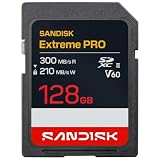
The 128 GB Extreme PRO is the card for someone who moves between stills and video within the same shoot and wants the offload to be over quickly. It suits press, editorial and travel photographers who shoot a few hundred frames at a time and then dump the card, plus hybrid shooters recording 4K alongside RAW stills. The listing specifies UHS-II with read speeds up to 300 MB/s, the joint-fastest read figure in this roundup.
- Capacity: 128 GB (roughly 119 GiB usable)
- Interface: UHS-II
- Stated read: up to 300 MB/s
- Speed class: the listing does not print a V-rating; Extreme PRO UHS-II cards at this read tier are generally V90-class, so confirm the printed rating on the card face
- Best fit: frequent offloads, hybrid stills and video days
Read speed is the specification people underrate. On a 128 GB card, the difference between a 300 MB/s UHS-II offload and a 95 MB/s UHS-I fallback is roughly 7 minutes versus roughly 22 minutes for a full card — and on a two-card shoot day that difference compounds into half an hour of standing around. If your workflow is shoot, offload, edit, review, and repeat, the read speed is doing as much work for you as the write speed.
The honest caveat is the V-rating gap in the listing. Because the product name only states the read speed, the safest approach is to treat this card as suitable for 4K and stills work, and to verify the printed V60 or V90 marking on the card itself before relying on it for 8K or the highest 4K/120p bitrates. In practice, cards at this read tier in the Extreme PRO UHS-II family sit at the top of the V-rating ladder, but verifying takes five seconds and removes the guesswork.
Pros
- 300 MB/s read class makes card offloads noticeably quicker
- Strong fit for hybrid shooters who alternate stills and 4K video
- Mid-range tier rather than premium, despite the top-tier read speed
- Widely available, so replacing one mid-trip is realistic
Cons
- Listing omits the V-rating, so buyers must confirm it on the card
- 128 GB is tight for all-day video without an offload break
- Peak write performance is not stated, which makes buffer planning harder
The nearest alternative is the Lexar 256GB 2000x, which trades a slightly lower read figure for double the capacity and an explicit V90 guarantee. If you record 8K or shoot long bursts and want certainty from the spec sheet alone, the 2000x is the safer purchase. If your work is mostly stills with 4K clips and you value a fast, mid-priced card that empties quickly, this 128 GB Extreme PRO is the more efficient use of the same money. Its 256 GB sibling covers the capacity complaint directly.
5. SANDISK 256GB Extreme PRO SD Memory Card – Best for Long Event and Wedding Days

This is the capacity-first version of the Extreme PRO, and it is aimed squarely at people who cannot stop shooting to swap cards. It suits wedding photographers covering a ten-hour day, sports and tournament shooters working from a fixed position, and multi-camera crews who need media that behaves predictably across several bodies. The listing states UHS-II with read speeds up to 280 MB/s and 256 GB of capacity.
- Capacity: 256 GB (roughly 238 GiB usable)
- Interface: UHS-II
- Stated read: up to 280 MB/s
- Speed class: no V-rating is printed in the listing; the 280 MB/s read tier of the Extreme PRO UHS-II family is generally V60-class, so check the card face
- Best fit: long single-card event days, dual-slot backup
The capacity maths for event work is straightforward. At 200 Mbps, 256 GB holds about 171 minutes of video — nearly three hours — which covers a ceremony plus speeches with room to spare. For stills, 45 MB compressed RAW files mean roughly 5,000 frames per card, which is more than a typical wedding delivers. That headroom is the point: it lets you run the second card slot as a mirror rather than as an overflow, so every frame exists in two places from the moment it is captured.
The trade against a V90 card is sustained write. A V60-class card guarantees 60 MB/s, which covers 4K up to 480 Mbps but not 8K or the highest 4K/120p modes, and it clears camera buffers more slowly. For a wedding or event workflow built on 4K/30p and stills, that is the right compromise: you get twice the capacity of a 128 GB card for less than twice the price, and you spend the difference on a second card rather than on speed you would not use.
Pros
- 256 GB covers a full event day without a mid-shoot swap
- High enough capacity to run dual-slot mirroring comfortably
- 280 MB/s read keeps a large offload manageable at the end of the day
- Premium tier justified by capacity rather than by exotic speed claims
Cons
- No printed V-rating in the listing, so 8K shooters must verify first
- V60-class sustained write limits very high-bitrate recording
- A single 256 GB card is a large single point of failure if not mirrored
Compared with the Lexar 256GB 2000x, this card gives up the explicit V90 guarantee and 20 MB/s of stated read speed in exchange for a different balance of brand availability and capacity-first positioning. Shooters recording 8K or 4K/120p should take the V90 card; shooters recording 4K and stills all day should take this one and put the savings into a matching backup. Against the 128 GB Extreme PRO, it is the same family decision at double the capacity, and the right one if your problem is running out of space rather than running out of speed.
6. Lexar 256GB Silver PRO SD Card 2-Pack – Best for Multi-Day Production Work

Two 256 GB V60 cards in one purchase is a production workflow decision, not a capacity decision. It suits small crews shooting multi-day projects, travel and documentary shooters who cannot reliably offload every night, and photographers who want a matched pair so that both card slots in a camera hold identical media. Total capacity across the pair is 512 GB, split across two physical cards.
- Contents: two 256 GB UHS-II cards
- Speed ratings: V60, U3
- Stated read: up to 280 MB/s each
- Sustained write floor: 60 MB/s each
- Combined capacity: 512 GB across two media
- Best fit: multi-day shoots, dual-slot mirroring, matched rotation sets
The case for buying in pairs at this capacity is that it makes a two-slot camera genuinely useful. With two identical 256 GB cards you can mirror everything and never think about space, or split stills to one card and video to the other so that a full video card never blocks a stills burst. Over a three-day shoot, that is roughly 5.7 hours of 200 Mbps video per card before either one needs attention — enough to get through a day with a comfortable margin and offload in the evening rather than on location.
The V60 rating is the constraint. At 60 MB/s guaranteed, this pair is built for 4K up to 480 Mbps and for stills work, not for 8K or 4K/120p. If your camera records 8K, you are buying capacity you cannot use at the quality level you shoot, and a single V90 card would serve you better. If your work is 4K and stills, the pair gives you the same total capacity as one 512 GB card while halving the consequence of a single card failure.
Pros
- 512 GB total across two cards, so one failure costs half the media not all of it
- Matched pair makes dual-slot mirroring and split recording straightforward
- Enough capacity for multi-day shoots without nightly offloads
- Cheaper per gigabyte than buying two premium V90 cards
Cons
- V60 write floor rules out 8K and the highest 4K bitrates
- Two 256 GB offloads take longer in total than one large card
- Premium tier pricing for what is still a V60 speed class
The nearest alternative is the Lexar 512GB Silver PRO, which gives the same total capacity in a single card at a similar tier.