Key takeaways
- Zoom and focus ring rubber is the first cosmetic failure on any lens kept in a hot car. It stretches and comes loose before the optics show any problem.
- Lens hood bayonets crack or loosen with repeated mounting. Hoods are consumables; budget a replacement every few years on a working lens.
- Optical stabilization units are the most common internal repair on older OSS zooms such as the 24-105mm f/4 G and the first-generation 70-200mm. Symptoms are a rattle that never settles or an image that drifts in the viewfinder.
- Dust on the rear element is a bigger image-quality risk than dust on the front. Always cap the rear of a detached lens, and change lenses with the body facing down.
- Filter threads strip when a filter is over-tightened onto an aluminium-alloy thread. Thread it on snug, never cranked.
- Focus-by-wire motors are generally reliable, but AF on a lens that has been dropped often fails before the glass does. A drop that leaves the barrel looking fine can still shear the motor assembly.
The best Sony camera lenses for most photographers are the Sony FE 24-70mm f/2.8 GM II for full-frame all-round work and the Sony E 16-55mm f/2.8 G for APS-C bodies. If you shoot only one kind of subject, a prime beats any zoom at the same price: the FE 85mm f/1.8 for portraits, the FE 20mm f/1.8 G for landscapes, and the FE PZ 16-35mm f/4 G for video. Everything below is Sony E-mount — the single mount every Sony mirrorless body has used since 2010 — where “FE” lenses cover a full-frame sensor and “E” lenses are APS-C designs that also mount on full-frame bodies in crop mode.
Our top picks

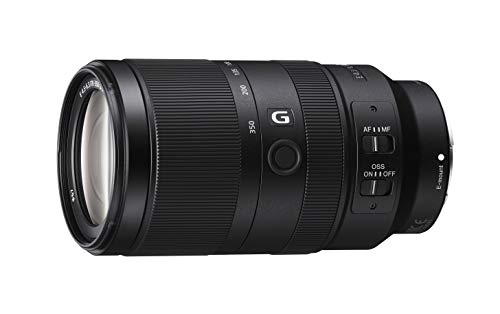


As an Amazon Associate we earn from qualifying purchases at no extra cost to you.
Quick comparison of the picks
Weights and filter sizes below are from each manufacturer’s published spec sheet. Prices are typical new-condition market ranges, not sale prices.
| Pick | Best for | Format / mount | Key specs | Weight | Typical market range |
|---|---|---|---|---|---|
| Sony FE 24-70mm f/2.8 GM II | Best overall (full-frame) | Full-frame, E-mount | f/2.8 constant, 82mm filter, no OSS (relies on IBIS), 0.21m min focus at 24mm | 695 g | $2,000–$2,400 |
| Sony E 16-55mm f/2.8 G | Best overall (APS-C) | APS-C, E-mount | f/2.8 constant, 67mm filter, 24-82.5mm equivalent, no OSS | 494 g | $1,200–$1,500 |
| Sony FE 85mm f/1.8 | Best value portrait lens | Full-frame, E-mount | f/1.8, 67mm filter, 0.8m min focus, no OSS | 371 g | $550–$650 |
| Sony FE 85mm f/1.4 GM II | Best premium portrait lens | Full-frame, E-mount | f/1.4, 77mm filter, 11-blade aperture, XD linear AF motors | 642 g | $1,700–$2,000 |
| Sony FE 20mm f/1.8 G | Best landscape prime | Full-frame, E-mount | f/1.8, 67mm filter, 0.19m min focus, 373 g — light enough for hiking | 373 g | $850–$1,000 |
| Sony FE PZ 16-35mm f/4 G | Best for video | Full-frame, E-mount | Power zoom, 72mm filter, internal zoom, clickless aperture ring | 353 g | $1,100–$1,300 |
| Sony FE 200-600mm f/5.6-6.3 G OSS | Best for wildlife and sport | Full-frame, E-mount | Internal zoom, 95mm filter, OSS, 240-720mm equivalent on APS-C | 2,115 g | $1,800–$2,100 |
Best overall: Sony FE 24-70mm f/2.8 GM II
This is the lens most full-frame Sony owners should buy first. A 24-70mm f/2.8 covers weddings, events, environmental portraits, product work and most travel photography, and the Mark II version dropped the weight to 695 g — roughly 20 percent lighter than the original GM — while adding a closer 0.21m minimum focus distance at the wide end.
Who it suits: anyone with one body who needs to be ready for anything indoors, in low light, or on a deadline. Main trade-off: there is no optical stabilization in the lens. On a body with in-body image stabilization (IBIS) that is rarely an issue; on older bodies without IBIS, handheld video will be noticeably shakier than with an OSS lens.
Best portrait lens: FE 85mm f/1.8 or FE 85mm f/1.4 GM II
The 85mm focal length compresses facial features flatteringly at a working distance of about 1.5–2.5 metres, which is why it dominates portrait work. The FE 85mm f/1.8 at 371 g and roughly $600 is the value pick: light, discreet, and sharp enough that most clients cannot tell it apart from the GM in a normally lit studio.
The FE 85mm f/1.4 GM II buys you one extra stop of light, a rounder 11-blade out-of-focus rendering, and faster XD linear autofocus motors for eye-tracking at f/1.4. Trade-off: 642 g and roughly triple the price, plus a 77mm filter thread that costs more for every filter you buy.
Best for landscapes: Sony FE 20mm f/1.8 G and FE 16-35mm f/2.8 GM II
Landscape shooters face a weight-versus-flexibility decision more than any other group, because the lens is only part of a pack that already holds a tripod and filters. The FE 20mm f/1.8 G weighs 373 g, takes 67mm filters, and its fast aperture is genuinely useful for night skies and star fields.
If you need a zoom, the FE 16-35mm f/2.8 GM II at 547 g and an 82mm thread is the current reference. The 82mm filter size is the hidden cost: a good 82mm polarizer or 10-stop neutral density filter typically runs $100–$250, versus $60–$150 for 67mm. Two lenses sharing a 67mm thread — the 20mm f/1.8 G and the 85mm f/1.8 — let you buy one filter set for both.
Best for video: Sony FE PZ 16-35mm f/4 G
Video has different priorities from stills: smooth zoom, no focus breathing, no clicking aperture ring, and minimal weight on a gimbal. The PZ 16-35mm f/4 G answers all four with a powered zoom rocker, an internal zoom mechanism that does not change length or balance as you zoom, and 353 g of weight.
Trade-off: f/4 instead of f/2.8, and power zoom drains the battery faster than a manual zoom. For talking-head and vlog work this is the lens that keeps a gimbal balanced; for dim event coverage, the 24-70mm f/2.8 GM II is the better call even though it lacks a power zoom.
Best on a budget: Sony FE 50mm f/1.8 and Tamron 28-75mm f/2.8 G2
The FE 50mm f/1.8 is the cheapest way into full-frame Sony shooting at roughly $200–$300, with a 49mm filter thread and a plastic build that is honest about its price. It is soft wide open at the edges and its autofocus is slow, but stopped down to f/2.8 it is a genuinely good lens.
For a zoom on a budget, the third-party Tamron 28-75mm f/2.8 G2 covers most of the 24-70mm range at 540 g and roughly $800–$950, with a 67mm thread. Trade-off: you lose 4mm at the wide end, which matters in tight interiors, and third-party lenses occasionally lag behind Sony bodies on the newest autofocus features after a camera firmware release.
Best for reach: Sony FE 200-600mm f/5.6-6.3 G OSS
Wildlife and field sports need focal length more than aperture. The 200-600mm G uses an internal zoom — the barrel does not extend — which keeps the balance point stable on a gimbal head and reduces dust ingress. On an APS-C body it behaves like a 300-900mm lens. At 2,115 g it is a tripod or monopod lens, not a walkaround lens.
How to choose: a decision matrix
Match your situation to the pick, then budget for the accessories the spec sheet does not mention.
| Your situation | Choose | Why |
|---|---|---|
| One lens, one full-frame body, mixed paid work | FE 24-70mm f/2.8 GM II | Only lens that covers wide interiors to tight headshots at f/2.8 |
| APS-C body (A6700, FX30, A6000-series) | E 16-55mm f/2.8 G | Full-frame FE glass wastes its image circle and adds weight for no gain |
| Budget under $700 total | FE 50mm f/1.8 + a used body | Fastest route to full-frame image quality |
| Mostly video, gimbal or handheld | FE PZ 16-35mm f/4 G | Power zoom and internal zoom keep balance constant |
| Hiking and travel, weight is the constraint | FE 20mm f/1.8 G + FE 85mm f/1.8 | 744 g combined, one shared 67mm filter set |
| Wildlife, sport, airshows | FE 200-600mm f/5.6-6.3 G OSS | Internal zoom, OSS, 600mm reach |
Do the bag math before you buy. An A7 IV body weighs 658 g. Add the 24-70mm f/2.8 GM II (695 g) and you are at 1,353 g — comfortable for a full day. Add the 70-200mm f/2.8 GM OSS II (1,045 g) and the kit hits 2,398 g, which is the point where most people stop carrying the second lens “just in case.”
Do the cost-per-use math too. A $2,200 zoom used on 40 paid shoots a year for five years costs about $11 per shoot. A $600 prime used twice a month for five years costs about $5 per shoot. The expensive lens is usually the better value — but only if you actually shoot that many frames with it.
Ownership realities: what wears out first
- Zoom and focus ring rubber is the first cosmetic failure on any lens kept in a hot car. It stretches and comes loose before the optics show any problem.
- Lens hood bayonets crack or loosen with repeated mounting. Hoods are consumables; budget a replacement every few years on a working lens.
- Optical stabilization units are the most common internal repair on older OSS zooms such as the 24-105mm f/4 G and the first-generation 70-200mm. Symptoms are a rattle that never settles or an image that drifts in the viewfinder.
- Dust on the rear element is a bigger image-quality risk than dust on the front. Always cap the rear of a detached lens, and change lenses with the body facing down.
- Filter threads strip when a filter is over-tightened onto an aluminium-alloy thread. Thread it on snug, never cranked.
- Focus-by-wire motors are generally reliable, but AF on a lens that has been dropped often fails before the glass does. A drop that leaves the barrel looking fine can still shear the motor assembly.
Cleaning sequence that does not scratch coatings: blower first to remove grit, then a microfibre cloth with a drop of lens cleaner, wiping in one direction and rotating the cloth. Never use a shirt, never use solvent, and never clean a lens that has visible sand on it without blowing it off first. Sony’s GM lenses carry a fluorine coating on the front element that makes fingerprints easy to lift, but the coating wears with aggressive rubbing, so a light touch pays off over years.
Frequently Asked Questions
Do Sony FE lenses fit APS-C cameras?
Yes. FE and E lenses share the same E-mount, so a full-frame FE lens mounts and autofocuses normally on an APS-C body such as the A6700 or FX30. The camera simply uses the centre of the image circle, which gives a 1.5x tighter field of view — a 24-70mm behaves like a 36-105mm. You gain reach but carry more glass and weight than you need.
Do E-mount APS-C lenses work on full-frame Sony bodies?
They mount, but the camera automatically switches to APS-C crop mode. On a 33MP body that leaves roughly 14MP of usable resolution; on a 61MP body, about 26MP. That is fine as a stopgap, but if you own a full-frame body, buying full-frame FE glass is the better long-term spend.
Do I need optical stabilization (OSS) if my camera has IBIS?
Usually not for stills. Sony’s in-body stabilization handles most handheld shooting, and several top lenses — the 24-70mm f/2.8 GM II and the 85mm f/1.8 — have no OSS at all. For handheld video at longer focal lengths, in-lens OSS plus IBIS together is measurably steadier, which is why telephotos like the 200-600mm keep OSS.
What is the difference between Sony G and GM lenses?
GM (G Master) is Sony’s top tier: the fastest apertures, the most exotic glass, the best build sealing and the highest prices. G lenses sit one step below, offering excellent optics with slower apertures or lighter construction — the 20mm f/1.8 G and 200-600mm G are both G-series and both superb at their jobs. The gap is largest in rendering and autofocus speed, smallest in raw sharpness.
Is f/2.8 worth the price over f/4?
For paid work in dim venues, yes — one stop is the difference between ISO 6400 and ISO 12800. For travel and landscape shooting in daylight, f/4 lenses are lighter, cheaper and usually just as sharp stopped down, and the 24-105mm f/4 G OSS adds 35mm of extra reach in the same bag slot. Buy the faster aperture only if you genuinely shoot in low light.
How much should I budget beyond the lens itself?
Plan for roughly 10 to 20 percent of the lens price in accessories: a UV or protective filter, a polarizer or ND if you shoot landscape or video, a spare rear cap, and a replacement hood over the life of the lens. On 82mm-thread zooms those filters cost noticeably more than on 67mm primes, so standardising your kit on one filter size is a real, recurring saving.