Key takeaways
- Choosing the lightest model automatically: Very small devices can have shorter handles and less stable positioning. The lightest option is not always the easiest to control.
- Ignoring balance: A front-heavy motor can strain the wrist even when the listed total weight appears reasonable. Look for a centered handle and a battery that does not make the rear or front unusually heavy.
- Counting only the bare device: Attachments, a battery, and the protective case add both weight and storage volume.
- Buying by speed count: More speed levels do not guarantee a better fit. A model with fewer, clearly spaced settings may be easier to operate.
- Overlooking handle thickness: A wide handle can be uncomfortable for smaller hands, while an extremely narrow handle may require a tight grip.
- Using maximum force everywhere: Larger or more powerful devices are not automatically appropriate for the neck, joints, bones, or sensitive areas. Use the lowest comfortable setting and follow the manufacturer’s instructions.
What's inside
The Short Answer
For most people, the best massage gun weight for comfortable use is between 1.5 and 2.0 pounds (0.68 and 0.91 kilograms), including the battery and massage attachment. This range usually provides enough pressure for calves, thighs, shoulders, and lower back without making your wrist and forearm work too hard.
Choose a lighter model from 1.0 to 1.4 pounds (0.45 to 0.64 kilograms) if you have smaller hands, limited grip strength, arthritis, or plan to use the device on your arms and shoulders. A heavier massage gun weighing 2.1 to 3.0 pounds (0.95 to 1.36 kilograms) may feel more substantial for large muscle groups, but it can become tiring during a long session or when you hold it overhead.
As an Amazon Associate we earn from qualifying purchases at no extra cost to you. Product prices and availability are accurate as of the date shown and are subject to change.

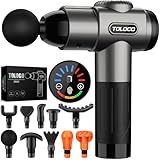


In addition to weight, check the handle diameter, body length, balance, stall force, battery position, and attachment size. A well-balanced 1.8-pound gun can feel easier to control than a poorly balanced 1.4-pound model. For a practical 2026 buying guide, think of weight as one part of overall hand comfort rather than a stand-alone specification.
Standard Sizes
Massage guns generally fall into three size categories. The measurements below describe common retail formats and useful shopping ranges. Dimensions are listed as length by width by height, with the massage head removed.
| Massage gun type | Typical dimensions | Typical weight | Best for |
|---|---|---|---|
| Mini or travel | 5.0–6.5 in × 2.0–2.8 in × 1.3–2.0 in (12.7–16.5 × 5.1–7.1 × 3.3–5.1 cm) |
0.5–1.0 lb (0.23–0.45 kg) |
Travel, hands, forearms, light recovery |
| Compact standard | 7.0–8.5 in × 3.5–5.0 in × 2.0–3.0 in (17.8–21.6 × 8.9–12.7 × 5.1–7.6 cm) |
1.0–1.7 lb (0.45–0.77 kg) |
General home use and smaller users |
| Full-size standard | 8.5–10.5 in × 4.5–6.5 in × 2.5–4.0 in (21.6–26.7 × 11.4–16.5 × 6.4–10.2 cm) |
1.7–2.5 lb (0.77–1.13 kg) |
Thighs, glutes, back, and frequent use |
| Heavy-duty | 9.0–12.0 in × 5.0–7.0 in × 3.0–4.5 in (22.9–30.5 × 12.7–17.8 × 7.6–11.4 cm) |
2.5–3.5 lb (1.13–1.59 kg) |
High-force use and large muscle groups |
Many budget massage guns sell for approximately $25 to $45. The listed cotsoco, TOLOCO, and APHERMA examples fall within that range, with example prices from $26.99 to $39.99. Devices in this price bracket commonly include several interchangeable heads, multiple speed levels, a rechargeable battery, and a brushless motor. Features such as “30 speed levels” do not necessarily mean the unit is more comfortable; grip shape and total weight still matter.
Motor power is commonly listed in watts, although manufacturers do not always measure or report it in the same way. A useful shopping range is about 20 to 35 watts for compact and standard home models, while heavier-duty units may list approximately 40 to 60 watts. Do not select a device by wattage alone. Higher power can increase noise, vibration, heat, and battery drain.
How to Measure Your Space
- Measure the storage location. Use a tape measure to record the shelf, drawer, gym bag, or cabinet opening. Measure width, depth, and vertical clearance in inches and centimeters.
- Allow room for the attachment. A massage gun stored with its head installed may need 1 to 2 additional inches (2.5 to 5.1 cm) of length. A case can require even more space.
- Check the charging area. Leave space for the charging cable or adapter. A drawer that barely fits the device may be inconvenient if you must remove other items to charge it.
- Measure your grip. Wrap a flexible measuring tape around the part of the handle you naturally hold. A handle circumference of about 4.5 to 5.5 inches (11.4 to 14.0 cm) suits many adults, while smaller hands may prefer a narrower grip.
- Test the reach you need. Hold an object with a similar length and weight at arm’s length. If your wrist bends or your shoulder lifts, choose a lighter or shorter model for self-treatment.
- Account for movement. Do not measure only the storage footprint. You need enough open space to move the gun across a thigh, calf, or shoulder without hitting furniture or walls.
By Room or Use Case
Bedroom and bedside storage
A compact or standard massage gun is usually easiest to keep in a nightstand, dresser drawer, or closet basket. Look for a stored length of 8 inches (20.3 cm) or less if drawer space is limited. A weight between 1.0 and 1.8 pounds (0.45 and 0.82 kilograms) is practical for evening use because it can treat calves, feet, and shoulders without feeling cumbersome. Store the device where it can be charged safely and where attachments will not be lost.
Home gym
For a home gym, full-size models weighing 1.7 to 2.5 pounds (0.77 to 1.13 kilograms) offer a useful balance of reach and pressure. Their larger batteries and motors may be more suitable for thighs, hamstrings, glutes, and back muscles. A case measuring roughly 12 by 10 by 4 inches (30.5 by 25.4 by 10.2 cm) can accommodate the gun, charger, and several heads, though actual case sizes vary.
Office or work bag
Choose a mini model if portability is the priority. Devices around 5 to 7 inches (12.7 to 17.8 cm) long and under 1.2 pounds (0.54 kilograms) are less likely to dominate a laptop bag. A compact gun is suitable for short sessions on the forearms, hands, neck-side muscles, and calves. Check the case dimensions before buying, since a molded case can take up considerably more space than the device itself.
Travel and hotel use
A travel-friendly massage gun should fit in a carry-on compartment without forcing the case shut. A total packed size of about 10 by 8 by 4 inches (25.4 by 20.3 by 10.2 cm) is a manageable target. Battery-powered models eliminate the need to use the device beside an outlet, but you should still follow airline and battery-carriage rules. For travel, favor a light body, USB charging, and a protective case over maximum motor strength.
Use by older adults or people with limited strength
Prioritize a device from 0.8 to 1.5 pounds (0.36 to 0.68 kilograms), a nonslip handle, and simple controls. A pistol-style grip or multi-grip design can reduce the need to pinch tightly. Choose lower speed settings first, and avoid holding a heavy unit in one position for an extended period. If reaching the back is difficult, a lighter device is generally safer and easier to position.
Common Sizing Mistakes
- Choosing the lightest model automatically: Very small devices can have shorter handles and less stable positioning. The lightest option is not always the easiest to control.
- Ignoring balance: A front-heavy motor can strain the wrist even when the listed total weight appears reasonable. Look for a centered handle and a battery that does not make the rear or front unusually heavy.
- Counting only the bare device: Attachments, a battery, and the protective case add both weight and storage volume.
- Buying by speed count: More speed levels do not guarantee a better fit. A model with fewer, clearly spaced settings may be easier to operate.
- Overlooking handle thickness: A wide handle can be uncomfortable for smaller hands, while an extremely narrow handle may require a tight grip.
- Using maximum force everywhere: Larger or more powerful devices are not automatically appropriate for the neck, joints, bones, or sensitive areas. Use the lowest comfortable setting and follow the manufacturer’s instructions.
FAQ
What is the ideal massage gun weight for comfortable use?
For general home use, aim for 1.5 to 2.0 pounds (0.68 to 0.91 kilograms). Choose closer to 1.0 to 1.4 pounds (0.45 to 0.64 kilograms) if you have limited grip strength or want to treat your shoulders and arms.
Is a heavier massage gun more effective?
Not necessarily. Weight can make a device feel stable, but effectiveness depends on speed, stroke length, stall force, attachment design, and how comfortably you can position it. A heavy gun that causes fatigue may be less useful than a lighter model used consistently.
How much does a typical massage gun cost?
Basic home models commonly cost about $25 to $50. The example products in this guide are priced from $26.99 to $39.99. Premium models can cost substantially more, especially when they include advanced displays, larger batteries, quieter motors, or app controls.
What dimensions should I look for in a travel massage gun?
Look for a body about 5 to 7 inches (12.7 to 17.8 cm) long, less than 3 inches (7.6 cm) wide, and under 1.2 pounds (0.54 kilograms). Confirm the packed case size separately, since the case and attachments determine the space required in your bag.