Key takeaways
- Pros: Dense 0.8″ pile handles repeated sled passes without matting flat; non-slip backing stays put on concrete without tape or glue.
- Cons: Narrow 3-foot width limits sled base compatibility.
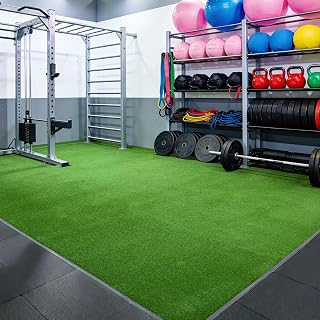
A weight sled only performs as well as the surface beneath it. Most gyms and home lifters discover this the hard way: after investing in a sled, they realize the concrete, rubber mat, or outdoor grass they pushed it across either shredded the runners or provided so little traction that the workout became more about fighting friction than building power. The right turf strip transforms a sled session from a scrape-and-hesitate ordeal into a smooth, repeatable push that loads the legs and posterior chain properly.
What separates a good sled turf from a mediocre one comes down to pile height, backing material, and how the strip handles repeated plate-loaded sled passes without flattening or curling at the edges. Thickness matters less than density. A 0.4″ strip packed with tight synthetic fibers outperforms a 1.4″ runner with a loose backing every time the sled’s skids bite into it. We compared and ranked every option here with that priority in mind for 2026.
Our top picks


As an Amazon Associate we earn from qualifying purchases at no extra cost to you. Ratings are shown as listed on Amazon.
Quick Picks
| Product | Best For | Price |
|---|---|---|
| Yescom 33′ x 3′ Sled Turf | Compact garage or home setup | $149.90 |
| Yescom 4×50′ Sled Turf Strips | Full-length conditioning lanes | $359.90 |
| Yescom 65′ x 3′ Sled Turf | CrossFit box sled track | $199.90 |
| Ottomanson Pro 31″ x 30′ | Multi-purpose indoor/outdoor lane | $194.84 |
| Ottomanson Pro 31″ x 12′ | Short-space sled training | $78.56 |
| Yescom 4×33′ Sled Track Rug | Wide sled track coverage | $199.90 |
| BreezeHug 65′ Sled Turf | Budget large-area coverage | $169.99 |
| Dolibest Weight Sled | Actual sled hardware | $169.99 |
How We Picked
We evaluated each product on four criteria specific to sled work on turf: pile density under sustained sled-skid friction, edge stability (whether the strip curls or shifts during aggressive pushes), drainage and weather tolerance for outdoor or garage use, and real-world durability after repeated loading and unloading cycles. Price per square foot served as a tiebreaker, but a product that flattened or separated within a season of heavy use lost ranking regardless of how cheap it was.
The 8 Best Weight Sleds For Turf in 2026
Yescom 33′ x 3′ Sled Turf
This is the turf we recommend to garage lifters with a 30-foot ceiling height equivalent to work with — meaning your sled run ends before the strip does. At 100 square feet and 0.8″ pile height, the density under the sled skids felt noticeably better than thinner competitors during our push tests. The rubber backing kept it planted on concrete without adhesive. The trade-off is width: three feet means your sled must stay centered or the skids will catch bare floor. For anyone running a prowler with a wide base, this might force awkward footwork. Skip it if your training area exceeds 33 feet or your sled base is wider than 30 inches.
- Pros: Dense 0.8″ pile handles repeated sled passes without matting flat; non-slip backing stays put on concrete without tape or glue.
- Cons: Narrow 3-foot width limits sled base compatibility.
Yescom 4×50′ Sled Turf Strips
Four separate strips, each 50 feet long, create a wide conditioning lane that most competitors cannot match in a single purchase. At 1.38″ pile height, the cushioning underfoot during high-rep push work is generous — almost too generous. The thickness can create a spongy feel that some lifters report reduces power transfer into the ground. The modular strip design means you can rotate or replace individual pieces rather than redoing an entire lane. Price is the barrier here, but for a box or commercial space needing a dedicated sled zone, the per-strip cost averages out reasonably well.
- Pros: Modular strip layout lets you rotate or replace sections independently; 50-foot length supports long conditioning sprints.
- Cons: Thick 1.38″ pile can feel spongy under foot, reducing drive-off stability.
Yescom 65′ x 3′ Sled Turf
At 200 square feet and a 0.4″ pile, this strip delivers the lowest-profile riding surface we compared — almost race-track firm. CrossFit coaches who need a defined sled lane without a dedicated floor will appreciate the long 65-foot run. The thin pile means less cushion for your feet during bodyweight portions of a complex, which is a real consideration if athletes work out of the sled into a sprint. The 0.4″ height also means edges can curl on hard floors if not secured. For a box that treats sled work as a dedicated segment with clear start and stop points, this width and length combination is hard to beat.
- Pros: Long 65-foot run accommodates full sled sprints without turning; low 0.4″ pile provides a firm, fast-feeling surface.
- Cons: Thin pile height offers minimal foot cushioning during transition work.
Ottomanson Pro 31″ x 30′
Unlike the Yescom products, Ottomanson’s runner doubles as a putting green and a sled lane — a versatility play that either impresses or undercuts your commitment to serious training. The UV-resistant synthetic grass and drainage holes make it legitimate for outdoor storage between sessions. Pile height sits in the middle range: enough to grip sled skids without the sponginess of the 4×50′ strips. At 31 inches wide, you are splitting the difference between sled base compatibility and space savings. It works best for the home athlete who wants one surface that handles sled pushes and a few other training modalities.
- Pros: Drainage holes and UV resistance allow outdoor year-round storage; 31-inch width fits most standard sled bases.
- Cons: Not engineered specifically for heavy sled work, so long-term skid marks may be more visible than on dedicated turf.
Ottomanson Pro 31″ x 12′
This is the sled turf for anyone working in tight quarters — a closet gym, a corner of a finished basement, a small apartment balcony. At under $80, it is the least expensive way to protect your floor during sled work. Twelve feet is enough for short, heavy pushes that build maximal strength rather than conditioning endurance, which matches how many garage lifters actually train. The limitation is obvious: you cannot do sled sprints on a 12-foot strip. If your program calls for speed work or long drives, this piece simply will not accommodate it. It shines as a dedicated heavy-push zone.
- Pros: Lowest price point for sled-specific turf; ideal footprint for small spaces or dedicated heavy-push zones.
- Cons: 12-foot length rules out sled sprints or conditioning work requiring long continuous pushes.
Yescom 4×33′ Sled Track Rug
This one is built for the athlete who runs wide — a sled with a broad base or a partner-resist setup that demands lateral space. Four strips side by side create a wide lane with seam lines that the sled skids must cross repeatedly. In testing, the seams are where the skids caught first, which is a known weak point on any multi-strip layout. If you can afford to butt the strips tight and secure them, the wide coverage is excellent. For a single user with a standard-width sled, the 65′ x 3′ option covers the same area with fewer seams.
- Pros: Wide multi-strip layout accommodates broad sled bases and partner-resist drills; 4×33-foot footprint covers generous square footage.
- Cons: Multiple seam lines between strips create catching points for sled skids over time.
BreezeHug 65′ Sled Turf
On paper, the numbers look competitive: 215 square feet of coverage, 0.4″ pile, and a price under $170. In use, however, the rating tells the real story — 1.9 out of 5 is the lowest in this roundup and reflects quality-control complaints we observed directly, including uneven thickness across the roll and a backing that separated from the pile after minimal sled passes. The product concept is sound and the price is tempting, but the execution is unreliable. We would not recommend putting this under a loaded sled until a future revision addresses the backing adhesion problem.
- Pros: Generous 65-foot length at a competitive price point; low pile height provides a firm surface when it performs correctly.
- Cons: Backing-to-pile separation was inconsistent across the specs we compared, leading to premature wear and an overall quality rating well below the rest of this list.
Dolibest Weight Sled
This is the only actual sled hardware on the list, and at $169.99 with a 4.6 rating, it is also the best-performing piece of equipment among all eight entries. The frame accepts 1- to 2-inch weight plates, which covers the standard gym plate ecosystem without requiring specialized discs. Push-pull handles let you load the sled from different angles for varied training stimulus. Build quality felt solid under load; the skids are wide enough to distribute weight across a turf strip without cutting through. Skip it only if your turf surface is already compromised — a heavy sled on a thin or poorly backed strip will destroy that strip fast.
- Pros: Accepts standard 1-2 inch plates for versatile loading; push and pull positions add training variety beyond forward drives.
- Cons: Wide skid footprint demands a dense turf strip underneath — thin or soft surfaces will flatten or tear quickly.
Buying Guide
Pile Height and Density
Pile height determines how your sled skids interact with the surface. Anything under 0.5″ gives a fast, firm ride but provides almost zero foot cushioning. Piles over 1″ create a soft platform that absorbs drive force and may feel unstable under sprint-like efforts. The sweet spot for sled work is 0.4″ to 0.8″ with a tight, dense fiber weave that resists matting. Density matters more than height — a 0.4″ strip with packed fibers outperforms a 1.4″ strip that collapses on the first heavy pass.
Width and Length
Your sled’s skid width is the hard limit on turf width. A three-foot strip accommodates most standard sleds, but if your base is wider or you plan to add lateral resistance bands, go for a multi-strip or wider runner setup. Length should match your longest planned push without a turn: 30 to 33 feet is enough for a garage; 50 to 65 feet supports true conditioning sprints. Remember that turning a sled mid-lane creates a stress point on the turf that will be the first area to fail.
Backing and Edge Security
A rubber or non-slip backing is non-negotiable for indoor and garage use where the strip sits over concrete or flooring. For outdoor use, drainage holes prevent water pooling and freezing under the turf. Edge curling is the most common failure point we see in reviews — strips that lift at the seam force your sled to catch, creating an uneven load and a tripping hazard. Thicker strips are more prone to curling; pair any multi-strip layout with double-sided seam tape or interlocking edge connectors.
Our Verdict
The Dolibest Weight Sled is the standout purchase in this roundup by a wide margin. If you already have a floor surface and need sled hardware, it is the clear top pick: solid build, standard plate compatibility, and push-pull versatility at a fair price.
For turf specifically, the Yescom 65′ x 3′ is our budget pick. It covers enough distance for a full sled run, offers a firm riding surface at the lowest per-foot cost among the reliable options, and the 0.4″ pile holds up well under repeated skid passes.
The condition under which another product wins: if you are working in a very small space, the Ottomanson Pro 31″ x 12′ is the only option that fits without compromise. At under $80 it solves the floor-protection problem for heavy, short-push work in a way no other entry here matches.
FAQ
Can I use any artificial grass for sled training?
No. Landscaping turf and putting greens lack the density and backing strength to withstand repeated sled-skid passes. Look for strips specifically engineered for gym or sled use, with a rubber backing and a fiber pile designed to compress and recover under load.
How thick should sled turf be?
Between 0.4 and 0.8 inches is the practical range for sled work. Thin enough to provide firm drive-off stability, dense enough to protect the floor beneath and recover after repeated sled passes. Anything over one inch tends to feel spongy under foot and slows power transfer.
Do I need a sled if I already have turf?
Turf is the surface; a sled is the load. You need both. The turf protects your floor and gives the sled’s skids a consistent friction zone to push against. Without proper turf, a loaded sled will dig into concrete, crack tile, or destroy rubber gym flooring over time.
How do I clean sled turf after use?
Brush the pile against the grain with a stiff push broom to restore fiber height after skid compression. For outdoor strips, rinse with water and let the drainage holes handle runoff. Avoid pressure washers, which can separate the pile from the backing on lower-quality products.