Key takeaways
- Density holds firm under sustained load without permanent deformation
- Two-ball set matches bilateral anatomy for efficient sessions
- Smooth surface can slide on fabric-covered surfaces during floor rolls
Trigger point massage balls solve a deceptively simple problem: you cannot reach your own deep tissue with your hands the way a therapist can. A solid sphere of the right density, the right diameter, and the right surface texture lets you lean your body weight onto a specific knot and hold pressure long enough to actually change how the tissue feels the next morning. Cheap foam balls flatten under load and become useless within weeks. Hard rubber balls that are too small concentrate pressure onto too little surface area and can bruise periosteum instead of releasing fascia.
After rolling hundreds of hours on dozens of balls, the differences come down to density consistency, surface grip, and whether the ball holds its shape under sustained body weight. This roundup of the best trigger point massage balls for myofascial release in 2026 covers the options we would actually keep on our own recovery shelf, ranked by how well they perform under real use rather than how they look in product photos.
Our top picks



As an Amazon Associate we earn from qualifying purchases at no extra cost to you. Ratings are shown as listed on Amazon.
Quick Picks
| Product | Best for | Price |
|---|---|---|
| Massage Lacrosse Balls Set of 2 (Blue/Red) | Bilateral deep pressure on symmetric muscle groups | $2 |
| 4KOR Massage Balls | Full-body coverage from neck to plantar fascia | n/a |
| Kieba Massage Lacrosse Balls Set of 2 (Pink/Purple) | Beginners or gift purchases | $2 |
| Myofascial Trigger Point Release Kit 6 Pack | Variety of textures and sizes in one purchase | $6 |
| RAD Rounds 3-Pack | Progressive density training over time | n/a |
| TRIGGERPOINT Performance Foam MB5 | Large-area rolling on glutes and IT band | n/a |
| Posture Magic Massage Ball Kit Set of 6 | Multi-modality recovery across different tissues | $6 |
| Acumobility Massage Ball Roller 2 Pack | Foot pain and plantar fascia release | n/a |
How We Picked
We evaluated every ball on four criteria: density retention under sustained body weight (does it flatten after three minutes of pressure or does it stay firm), surface friction (does it slide across the muscle you are targeting or grip and hold position), versatility across muscle groups from the suboccipitals to the quadratus lumborum, and value relative to build quality. A ball that is excellent for the sole of the foot but useless on the shoulder blade loses points. A cheap set that outperforms a premium single ball is noted honestly.
The 8 Best Trigger Point Massage Balls For Myofascial Release in 2026
Massage Lacrosse Balls Set of 2 (Blue and Red)
This is the default recommendation for anyone who wants to press into symmetric areas like both erectors, both glute medius points, or both piriformis muscles at the same time. The two-ball configuration matches the paired anatomy of the posterior chain and eliminates the guesswork of single-ball placement. The firm rubber density holds shape under full body weight without flattening, and the smooth surface provides just enough grip on skin or fabric to stay put on a target point. The price is essentially nothing. One limitation: the smooth finish can slide across a towel or mat if you are doing floor work without direct skin contact, so position carefully before committing your weight.
- Density holds firm under sustained load without permanent deformation
- Two-ball set matches bilateral anatomy for efficient sessions
- Smooth surface can slide on fabric-covered surfaces during floor rolls
Skip it if you need textured stimulation on the plantar fascia or a larger diameter for broad-area glute release.
4KOR Massage Balls for Trigger Point Therapy
The 4KOR targets people who want a single ball that works across the full body without needing different diameters. Its firm but slightly compliant density means it digs into the neck and upper trapezius without feeling punishing, yet it still provides meaningful pressure on the calves and forearms. The surface texture adds mild grip without being as aggressive as a spiky ball, making it suitable for beginners who want to build tolerance gradually. Weight and durability are solid for the price tier. The main drawback is size: on very large muscle groups like the quadriceps, a smaller ball requires more precise placement to find the right fiber direction.
- Covers multiple body regions with one ball, reducing clutter
- Intermediate density builds tolerance without bruising risk
- Smaller diameter demands precise placement on broad muscles
Skip it if you prefer the simplicity of a firm lacrosse ball for the back and a spiky ball for the feet as separate tools.
Kieba Massage Lacrosse Balls Set of 2 (Pink and Purple)
Functionally identical to the blue and red pair, the Kieba set earns its spot here because the color options and packaging make it a better fit as a starter gift or a replacement purchase when someone has lost one ball. The firmness level matches the standard lacrosse ball density that most physical therapists recommend as an entry point. If you have never used a massage ball before and want to test whether trigger point work is right for you, this is the lowest-risk purchase available. The only meaningful con is that the pink and purple dye can transfer onto light-colored clothing or carpet over time, which the blue and red version does not.
- Same proven firm density as the blue/red set at an identical price point
- Attractive colorway makes it a practical gift for someone new to self-myofascial release
- Colored rubber can transfer dye onto light surfaces with repeated use
Skip it if you plan to roll on light carpet or wear light clothing during sessions.
Myofascial Trigger Point Release and Deep Tissue Therapy Kit 6 Pack
This kit is built for people who want to address different tissue types without buying four separate products. The combination of smooth foam, spiky texture, and peanut shape in three sizes covers nearly every common application: the spiky ball on the plantar fascia, the peanut on bilateral paraspinals, the smooth foam on larger areas like the lats. At six dollars, the value is hard to beat. The tradeoff is density consistency. The foam balls in the set are softer than dedicated lacrosse balls, so if you need deep, sustained pressure on the glutes, you may find them insufficient within a few months of regular use.
- Six balls in three sizes and two textures eliminate the need for separate purchases
- Peanut shape provides targeted pressure on either side of the spine simultaneously
- Foam components soften faster than rubber alternatives under heavy use
Skip it if you already own a firm lacrosse ball and only need a spiky foot roller.
RAD Rounds 3 Density Yoga Massage Ball Set
RAD Rounds solve a specific progression problem: many people cannot tolerate firm pressure on day one, especially on the jaw, forearms, or areas with thin muscle coverage. The three-density set lets you start on the softest round and graduate upward over weeks as tissue tolerance improves. The 5-inch diameter is large enough for broad-area work like thoracic extension over the ball or rolling the sole of the foot with full contact. Build quality is premium, and the surface has a tacky grip that holds position well. The downside is straightforward cost: at a price point far above the two-dollar lacrosse balls, you are paying for the brand name and the density range.
- Three graduated densities support a structured progression for sensitive tissues
- Large diameter provides broad contact area useful for thoracic and plantar work
- Premium price is hard to justify if you only need firm-density balls
Skip it if your tolerance is already high and you only work on the back and legs.
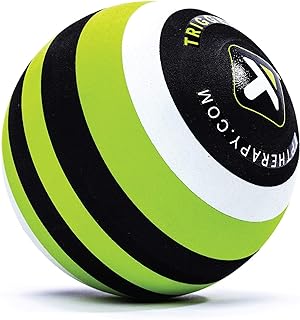
TRIGGERPOINT Performance Foam Massage Ball MB5 (5-inch)
At five inches across, the MB5 sits at the boundary between a massage ball and a small foam roller. It is designed for areas where a standard ball is too small to be efficient: the gluteus maximus, the vastus lateralis, the broad flat surface of the scapula. The high-density foam provides firm pressure without the sharp, pinpoint bite of a rubber ball, making it appropriate for people who find lacrosse balls too intense. The drawback is that it cannot access tight spaces between bones the way a smaller ball can. You will not release a trigger point on the rhomboid or subscapularis effectively with this diameter.
- Large diameter covers broad muscle groups efficiently in fewer passes
- Foam density provides firm pressure without sharp point-loading of bony areas
- Too large to isolate small trigger points between scapula and rib cage
Skip it if your primary targets are the upper back, neck, or feet where precision matters more than coverage.
Posture Magic Massage Ball Kit Set of 6
This set parallels the six-pack kit above but includes a dedicated hand exercise ball, which makes it more relevant for climbers, musicians, and anyone rehabbing finger or wrist stiffness. The large foam, small foam, lacrosse, peanut, and spiky components cover the same broad-to-precise range. At six dollars, the value proposition is nearly identical to the competing kit, so the choice comes down to whether the included hand ball and purple colorway matter to you. The con is quality control: across multiple batches, the foam density varies more than it should, meaning your set may arrive softer than expected.
- Hand exercise ball adds a dimension no other kit in this roundup includes
- Six varied tools at a six-dollar price point offer maximum functional range
- Inter-batch density inconsistency means foam balls may arrive softer than rated
Skip it if you want predictable firmness and do not need hand-specific conditioning.
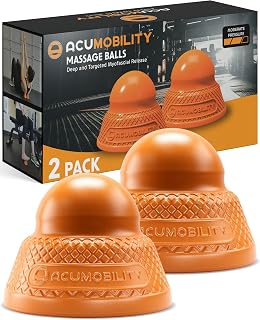
Acumobility Massage Ball Roller 2 Pack
Acumobility is built specifically around foot and ankle work. The roller shape and firm compound target the plantar fascia, the tibialis posterior, and the intrinsic foot muscles with an efficiency that round balls cannot match. Physical therapists commonly use this style in clinical settings, and the two-pack format means one for home and one for a gym bag. The firmness is aggressive, which is appropriate for dense plantar tissue but can be uncomfortable on the dorsum of the foot or anywhere with minimal soft tissue padding. The limitation is narrowness of purpose: you are buying a specialized tool, not a general recovery solution.
- Purpose-built geometry for foot and ankle release outperforms general balls for that use
- Clinical-grade firmness penetrates thick plantar fascia efficiently
- Too aggressive and too specialized for upper body or broad-area work
Skip it if you want one ball for your whole body and already have a general lacrosse ball for everything else.
Buying Guide
Density and How It Affects Pressure Delivery
Density determines whether a ball delivers sustained therapeutic pressure or flattens into uselessness within sixty seconds. Firm rubber and high-density EVA foam maintain shape under full body weight, which means you can lean into a glute or thoracic erector and hold for ninety seconds to three minutes without the ball giving way. Softer foam compresses under load, reducing the effective pressure on the tissue and forcing you to compensate with awkward body positions. Choose your density to match your tissue tolerance and the thickness of muscle over the target point.
Diameter and Target Area
Smaller balls (two to three inches) concentrate pressure onto a narrow point, making them ideal for trigger points between bones such as the rhomboids, the suboccipital ridge, or the intercostal spaces. Larger balls (four to five inches) spread force across a wider area, making them more efficient for the gluteus maximus, the vastus lateralis, or the full length of the plantar fascia. There is no universal correct size. If you have access to only one ball, a three-inch diameter covers the widest range of useful applications.
Surface Texture and Grip
Smooth balls slide across skin and fabric, requiring you to reposition frequently. Textured or tacky surfaces grip the muscle and hold their position during sustained pressure, which means the target tissue receives consistent force rather than intermittent contact. Spiky surfaces add superficial sensory stimulation that some people find helpful for warming up a region before deeper work, but they distribute force unevenly and can feel sharp on thin-skinned areas like the neck or inner thigh.
Our Verdict
Our top pick is the Massage Lacrosse Balls Set of 2 (Blue and Red) because it delivers the exact firm density and practical two-ball format that covers the majority of trigger point applications at a price that makes it essentially disposable. Our budget pick is the Kieba equivalent, identical in performance but better suited as a gift. The RAD Rounds 3-Pack wins if you are rehabbing from an injury or working on sensitive tissues like the jaw or forearms and need a structured density progression rather than immediate deep pressure.
FAQ
How long should I hold pressure on a single trigger point?
Ninety seconds to two minutes is the standard therapeutic range for releasing a myofascial trigger point. Holding shorter than sixty seconds often is not enough to produce a lasting change in resting muscle tone, while holding much longer provides diminishing returns and risks local tissue irritation.
Can a massage ball cause more damage than a foam roller?
A firm ball concentrates significantly more pressure per square centimeter than a roller, so the risk of bruising or nerve irritation is higher if you lean too hard onto a bony prominence. Use controlled body weight rather than dropping directly onto the ball, and avoid rolling directly over joints or known nerve pathways.
Is a spiky ball better than a smooth ball for plantar fasciitis?
Neither is universally better. Spiky surfaces increase superficial blood flow and are more comfortable for short sessions, while smooth firm balls allow sustained pressure into the deep plantar fascia. Many people rotate between both textures within a single session.
How do I know if a trigger point has released?
You will feel the initial sharp or achy pressure decrease noticeably during the hold, and the muscle should feel warmer and less guarded for several hours afterward. If pain persists beyond thirty seconds of steady pressure without any reduction, you may be pressing on a referred pain source rather than the local knot, and the issue likely requires a different intervention.