Key takeaways
- Choosing length based only on price. A longer roller is not always the best value. Buy the length that suits your exercises and storage area.
- Ignoring diameter. Two rollers can both be 12 inches long but feel very different if one is 5 inches wide and the other is 6 inches wide.
- Buying an extra-long roller for targeted massage. Long rollers are stable, but they can be cumbersome when working on one calf, arm, or foot.
- Confusing texture with size. Ridges and knobs affect pressure and sensation; they do not replace the stability provided by a longer roller.
- Forgetting usable storage space. A 24-inch roller may fit on paper but fail to fit across a shelf once nearby items are included.
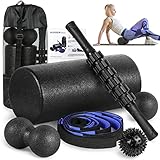
- Assuming every set has the same dimensions. Foam roller sets can combine a back roller, stick, and massage ball. Confirm each item’s measurements before purchasing.
What's inside
The Short Answer
For most people, a 12- or 13-inch foam roller is the best starting size. It is long enough to support your back, legs, and shoulders while remaining easy to store in a closet or carry to the gym. A standard roller in this size is usually about 5 to 6 inches in diameter (12.7 to 15.2 cm).
Choose a 24-inch roller if you want extra stability for balance exercises, Pilates, yoga, or full-body movement. Its longer surface makes it easier to keep both arms or both legs supported, but it also takes up more floor and storage space. For targeted muscle work, a compact 6-inch or 12-inch roller is generally more practical.
As an Amazon Associate we earn from qualifying purchases at no extra cost to you. Product prices and availability are accurate as of the date shown and are subject to change.


Size and firmness are separate decisions. A longer roller is not automatically better for deep-tissue massage. A high-density foam roller feels firmer than a soft recovery roller of the same length and diameter. If you are new to foam rolling, a medium-density, smooth roller is often easier to control than an aggressively textured model.
Standard Sizes
Foam rollers are commonly sold in a few repeatable lengths and diameters. The measurements below are useful benchmarks when comparing products. Actual dimensions can vary slightly by brand, especially on molded rollers with rounded edges.
| Roller size | Dimensions in inches | Dimensions in centimeters | Best for |
|---|---|---|---|
| Compact | 6 x 5 inches | 15.2 x 12.7 cm | Travel, feet, calves, arms, and small spaces |
| Standard | 12 x 6 inches | 30.5 x 15.2 cm | General recovery, back, legs, and home workouts |
| Standard narrow | 13 x 5.5 inches | 33 x 14 cm | Targeted massage and gym use |
| Long | 18 x 6 inches | 45.7 x 15.2 cm | Extra support for stretching and balance work |
| Extra-long | 24 x 6 inches | 61 x 15.2 cm | Yoga, Pilates, stability exercises, and two-leg support |
A 12-inch roller is often the most versatile choice because it provides enough surface area for the upper and lower back without being difficult to move. A 13-inch model is nearly identical in everyday use. For example, a 12-inch high-density roller may cost about $10 to $20, while a 13-inch textured or multi-density roller may cost roughly $25 to $35. A 24-inch model commonly falls in the $18 to $30 range.
Diameter affects how high your body sits off the floor and how much leverage you have. A 5-inch diameter roller is easier to control for precise work. A 6-inch roller provides more lift and can feel more comfortable under the spine during mobility exercises. If you have limited flexibility or want a gentler angle, consider a smaller diameter.
How to Measure Your Space
- Measure the storage length. Use a tape measure to check the width of the shelf, cabinet, or closet where the roller will live. Add at least 1 inch (2.5 cm) of clearance so you can remove it without forcing it into place.
- Measure the storage depth and height. A roller that is 6 inches in diameter needs more than 6 inches of usable clearance if it will sit beside other equipment. Allow about 7 to 8 inches of open space for easy handling.
- Mark the exercise area. Place your exercise mat on the floor and measure the open area around it. For comfortable rolling, leave at least 12 inches of clearance on each side of your body. A 24-inch roller needs more room to rotate and reposition than a compact model.
- Check doorways and stairs. If the roller will be stored in another room, measure the narrowest doorway or passage. Most rollers fit through standard doors, but a long roller can be awkward to carry around furniture.
- Account for accessories. A foam roller set may also include a massage stick, storage bag, or smaller ball. Measure the entire set rather than only the roller if you plan to keep everything together.
By Room or Use Case
Home gym
For a dedicated home gym, choose a 12- to 18-inch roller with a 5- to 6-inch diameter. This range works for warmups, post-workout recovery, and mobility drills without taking over the room. A textured surface can help you target tight areas, but a smooth surface is better if several people with different preferences will use it.
If your gym includes strength equipment, select a high-density roller that will hold its shape under body weight. Keep it away from sharp corners, hot radiators, and direct sunlight, which can damage foam over time.
Living room
A 12-inch roller is usually the best living-room choice. It can slide beneath a sofa or fit vertically in a narrow closet. Look for a neutral color and a durable exterior if it will remain visible. A 24-inch model can work in a large open room, but it may be inconvenient to store and easier to trip over when left on the floor.
For occasional use while watching television, a compact roller or massage ball may be enough for calves, feet, and shoulders. A short roller is less useful for supporting the full length of your spine.
Yoga or Pilates room
Choose an 18- or 24-inch roller for balance, alignment, and controlled movement. The extra length provides more consistent support beneath both legs or across the upper back. A 24-inch roller is especially helpful for exercises where you need to keep your hands or feet aligned on the same surface.
Make sure the diameter is appropriate for your practice. A 6-inch roller creates a higher lift, while a 5-inch roller offers a lower, more stable starting position.
Small apartment or bedroom
Space-conscious shoppers should start with a 6- or 12-inch roller. A 6-inch model can fit in a drawer or under a bed, although it will not provide the same back support as a longer roller. A 12-inch roller is the better all-purpose option if you have room for an item about 30.5 cm long.
A collapsible or inflatable roller may save storage space, but check its maximum user weight and firmness before buying. These designs can feel different from solid high-density foam and may be less suitable for heavy pressure.
Travel and office use
A compact roller measuring about 6 x 5 inches is easiest to pack in a suitcase or keep under a desk. It is useful for calves, feet, forearms, and localized muscle work. If you need a full-back roller, a 12-inch model is a better choice, but measure your bag first and remember that rigid foam takes up more space than its listed length alone suggests.
Common Sizing Mistakes
- Choosing length based only on price. A longer roller is not always the best value. Buy the length that suits your exercises and storage area.
- Ignoring diameter. Two rollers can both be 12 inches long but feel very different if one is 5 inches wide and the other is 6 inches wide.
- Buying an extra-long roller for targeted massage. Long rollers are stable, but they can be cumbersome when working on one calf, arm, or foot.
- Confusing texture with size. Ridges and knobs affect pressure and sensation; they do not replace the stability provided by a longer roller.
- Forgetting usable storage space. A 24-inch roller may fit on paper but fail to fit across a shelf once nearby items are included.
- Assuming every set has the same dimensions. Foam roller sets can combine a back roller, stick, and massage ball. Confirm each item’s measurements before purchasing.
FAQ
Is a 12-inch or 24-inch foam roller better?
A 12-inch roller is better for most people because it is versatile and easy to store. Choose 24 inches when you want more stability for yoga, Pilates, balance exercises, or supporting both legs at once.
What foam roller size is best for back pain?
A 12- to 18-inch roller with a 5- to 6-inch diameter is a practical starting point for gentle back mobility. Use controlled pressure and avoid rolling directly over the neck or lower-back bones. If you have an injury or diagnosed condition, ask a medical professional which movements are appropriate.
Can a small person use a 24-inch foam roller?
Yes. Height does not prevent you from using a 24-inch roller. The main tradeoffs are storage space, portability, and maneuverability. A smaller user may prefer a 12-inch roller for targeted work, while still benefiting from a longer roller for stability exercises.
How much should I spend on a foam roller?
For basic home use, expect approximately $10 to $20 for a simple high-density roller. Textured or multi-density rollers often cost about $25 to $35, while sets with multiple tools can cost roughly $25 to $40. Focus first on the correct dimensions, firmness, and return policy rather than choosing the most expensive model.