Key takeaways
- Buying by length alone. A 36-inch roller is not automatically better for back rolling. It is more stable, but a 12-inch roller often provides better control for targeted upper-back work.
- Ignoring diameter. A 4-inch roller and a 6-inch roller may look similar online, yet the 2-inch height difference significantly changes the stretch angle and pressure.
- Assuming a roller should span your whole back. For crosswise upper-back rolling, a 12-inch roller is normally wide enough. Your body moves over the roller; the roller does not need to reach from shoulder to shoulder.
- Forgetting storage clearance. A 6-inch-diameter roller needs more than a 6-inch opening for easy removal. Add at least 0.5 to 1 inch of clearance.
- Choosing texture instead of the right size. Knobs, ridges, and patterned surfaces change sensation, not the space required. Select length and diameter first, then decide whether you prefer smooth or textured foam.
- Using a roller that is too tall for comfort. An 8-inch diameter can be useful for some stretches, but it may feel unstable or overly intense for beginners rolling the upper back.
What's inside
The Short Answer
For most people, the best foam roller dimensions for back rolling are 12 to 13 inches long and 5.5 to 6 inches in diameter. This compact size is wide enough to support the upper back comfortably while staying easy to store, carry, and control on the floor.
Choose a 36-inch-long roller if you want one roller for broader back work, chest-opening stretches, Pilates, balance exercises, or gentle full-spine positioning. A longer roller provides more side-to-side stability, especially for beginners, but it takes up three times as much storage length as a 12-inch model.
As an Amazon Associate we earn from qualifying purchases at no extra cost to you. Product prices and availability are accurate as of the date shown and are subject to change.

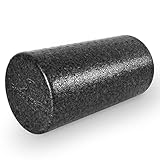

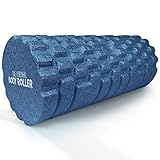
Diameter matters as much as length. A standard 6-inch diameter is the everyday choice for back rolling. A 4-inch diameter roller sits lower to the ground and can feel more manageable for mobility work, while an 8-inch diameter roller creates a stronger stretch and may feel too high or intense for some users.
In 2026, compact 12-inch rollers remain a practical choice for small homes because they fit in most closets, under many beds, and inside a gym bag without requiring a dedicated workout area.
Standard Sizes
Foam rollers are usually sold by length and outside diameter. The usable rolling surface can be slightly shorter than the listed length on textured models because of rounded or capped ends. Measure the roller from end to end and across its widest circular point if you are comparing a new purchase with an existing storage space.
| Common Roller Size | Dimensions in Inches | Dimensions in Centimeters | Best For | Storage Footprint |
|---|---|---|---|---|
| Travel / targeted roller | 12 in. L x 4 in. D | 30.5 cm L x 10.2 cm D | Upper back, neck-adjacent mobility, arms, calves, travel | About 12 x 4 in. |
| Compact standard roller | 12 in. L x 6 in. D | 30.5 cm L x 15.2 cm D | Back rolling, lats, glutes, legs, apartment workouts | About 12 x 6 in. |
| Textured compact roller | 13 in. L x 5.5 in. D | 33.0 cm L x 14.0 cm D | Focused pressure on upper-back and shoulder muscles | About 13 x 5.5 in. |
| Mid-length roller | 18 in. L x 6 in. D | 45.7 cm L x 15.2 cm D | Back plus lower-body recovery with extra stability | About 18 x 6 in. |
| Full-length roller | 36 in. L x 6 in. D | 91.4 cm L x 15.2 cm D | Full-spine positioning, balance, Pilates, stretching | About 36 x 6 in. |
| Large stretch roller | 36 in. L x 8 in. D | 91.4 cm L x 20.3 cm D | Gentle chest-opening positions and advanced mobility work | About 36 x 8 in. |
A 12-inch by 6-inch high-density roller is the familiar compact format. Examples in this size category include the Amazon Basics High-Density Foam Roller and ProsourceFit High Density Foam Roller, both commonly listed at 12 inches long. Textured recovery rollers are often close in overall size but may be slightly longer and narrower. For example, the TriggerPoint Grid 1.0 is approximately 13 inches long by 5.5 inches in diameter.
Typical prices for basic smooth high-density 12-inch rollers run about $10 to $15. More structured or textured compact rollers commonly fall around $20 to $30. Price should not determine size by itself: a $10.79 smooth roller and a $27.99 textured roller can occupy nearly the same amount of floor and shelf space while delivering a noticeably different feel.
How to Measure Your Space
You do not need a large home gym for back rolling, but you do need enough clear floor around your torso to move safely. Measure the workout zone before choosing between a compact and full-length roller.
- Measure your clear floor length. For a 12-inch roller, aim for a clear area at least 6 feet long. This gives an adult enough room to lie down and shift position without bumping into furniture. For a 36-inch roller, a 7-foot-long clear zone is more comfortable.
- Measure the clear width. Plan for at least 4 feet of width for compact back rolling. A 5-foot-wide area is better if you want to extend your arms, rotate onto one side, or use the roller for Pilates movements.
- Check the ceiling height only if you will store the roller upright. A 36-inch roller can stand in a closet with a shelf clearance of at least 38 inches. A 12-inch roller fits easily on most shelves that are 7 inches deep or more.
- Allow for the roller’s diameter. A 6-inch-diameter roller needs a shelf, cubby, or under-bed gap slightly larger than 6 inches. Leave at least 1 inch of clearance, so target a 7-inch-deep storage spot.
- Measure under-bed clearance accurately. A standard 6-inch roller will not slide under a bed with only 5.5 inches of open space. For under-bed storage, look for at least 6.5 to 7 inches of clearance.
- Account for a mat. A yoga mat is typically 24 to 26 inches wide and 68 to 72 inches long. If your roller routine happens on a mat, measure the mat area rather than assuming any open patch of floor will work.
By Room or Use Case
Small Apartment or Bedroom
Choose a 12-inch by 6-inch roller for the best balance of back support and compact storage. It fits in a closet bin, beside a dresser, or under a bed with adequate clearance. A 12-inch roller is also easy to move out of sight after a short recovery session. Avoid a 36-inch roller unless you know you will use it for stretching or Pilates several times a week; its 3-foot length can be awkward in a crowded bedroom.
Home Office Recovery Setup
For relieving upper-back tightness after desk work, a 12- to 13-inch roller with a 5.5- to 6-inch diameter is usually sufficient. It can be stored near a desk or in a cabinet and pulled out for five to 10 minutes of controlled upper-back rolling. Smooth rollers distribute pressure more evenly. Textured rollers can feel more targeted around the shoulder blade area, but aggressive patterns may be uncomfortable when used directly along the spine.
Dedicated Home Gym
A home gym can justify a 36-inch by 6-inch roller, particularly if multiple people use the space. The added length supports the head, upper back, and pelvis at the same time during alignment drills and chest-opening stretches. It is also useful for balance work because it is less likely to tip sideways than a 12-inch roller. Many households benefit from owning both a 36-inch roller for mobility and a 12-inch roller for more focused muscle work.
Travel, Dorm, or Shared Living
Pick a 12-inch roller; a 4-inch or 6-inch diameter depends on your tolerance and intended use. The 4-inch version saves space and can fit more easily in luggage, but the reduced height changes the leverage of the exercise. For conventional upper-back rolling, the 6-inch diameter is generally more versatile. A compact roller can fit inside a medium suitcase, although hard-sided luggage dimensions vary and should be checked before packing.
Gentle Stretching and Beginner Use
Start with a smooth 36-inch by 6-inch roller if you want stable, low-pressure positioning rather than intense muscle release. Lie lengthwise on the roller with your head and pelvis supported, then open the arms slowly to stretch the chest. For rolling across the upper back, a smooth 12-inch by 6-inch model is also beginner-friendly. Firmness affects comfort: high-density foam holds its shape well but often feels more intense than softer molded foam.
Focused Deep-Tissue Style Rolling
Use a 12- to 13-inch roller around 5.5 to 6 inches in diameter. A shorter length makes it easier to place the roller across the upper back, lats, glutes, or legs without excess bulk. Textured models in this category are commonly priced from about $20 to $30, while firm smooth models often cost $10 to $20. Keep pressure on the surrounding muscles rather than rolling directly over the neck, low-back vertebrae, or bony shoulder blade edges.
Common Sizing Mistakes
- Buying by length alone. A 36-inch roller is not automatically better for back rolling. It is more stable, but a 12-inch roller often provides better control for targeted upper-back work.
- Ignoring diameter. A 4-inch roller and a 6-inch roller may look similar online, yet the 2-inch height difference significantly changes the stretch angle and pressure.
- Assuming a roller should span your whole back. For crosswise upper-back rolling, a 12-inch roller is normally wide enough. Your body moves over the roller; the roller does not need to reach from shoulder to shoulder.
- Forgetting storage clearance. A 6-inch-diameter roller needs more than a 6-inch opening for easy removal. Add at least 0.5 to 1 inch of clearance.
- Choosing texture instead of the right size. Knobs, ridges, and patterned surfaces change sensation, not the space required. Select length and diameter first, then decide whether you prefer smooth or textured foam.
- Using a roller that is too tall for comfort. An 8-inch diameter can be useful for some stretches, but it may feel unstable or overly intense for beginners rolling the upper back.
FAQ
What foam roller size is best for rolling the back?
A 12- to 13-inch-long roller with a 5.5- to 6-inch diameter is the best all-around size for back rolling. It is compact, stable enough for most users, and easy to position across the upper back. Choose 36 inches long if you specifically want full-spine support for stretching, posture work, or Pilates.
Is a 12-inch foam roller long enough for the back?
Yes. A 12-inch foam roller is long enough for upper-back rolling because it sits crosswise beneath the body while you shift your torso over it. It is also a practical size for lats, glutes, calves, and thighs. It is less suitable than a 36-inch model for lying lengthwise with your entire spine supported.
Should I choose a 4-inch or 6-inch diameter foam roller?
Choose 6 inches for the most versatile back-rolling experience. It is the standard diameter and offers a useful mix of pressure and range of motion. Choose 4 inches if you need a lower-profile roller for travel, gentler mobility work, or limited storage. The smaller diameter may feel less intense but provides a reduced stretch.
How much space do I need to use a foam roller at home?
For a compact 12-inch roller, reserve a clear floor area about 6 feet long by 4 feet wide. For a 36-inch roller or a routine that includes wide arm movements and stretching, aim for roughly 7 feet long by 5 feet wide. Keep the area clear of low tables, sharp furniture corners, and loose rugs that could shift during use.