Key takeaways
- Best price-per-terabyte in the roundup
- CMR recording and enterprise MTBF rating
- Renewed condition limits long-term warranty
Choosing the right hard drive capacity is rarely a straightforward decision. A buyer upgrading a home server, building a NAS, or archiving a photo library faces a market where price-per-terabyte varies wildly between consumer, enterprise, and external solutions—and the differences in sustained throughput, warranty coverage, and workload tolerance are not always obvious from the box. The eight drives listed here span 6TB to 26TB and range from under $200 to over $700, representing nearly every realistic use case a home or small-office user encounters.
What separates a smart capacity purchase from a costly mistake comes down to matching the drive’s intended workload class to your actual usage pattern. A 26TB enterprise CMR drive running 24/7 in a RAID array is a fundamentally different product than a 10TB performance HDD in a gaming desktop, even though both are SATA 3.5-inch units with 512MB cache. Owner feedback consistently shows that buyers who ignore workload ratings end up with drives that throttle, vibrate excessively, or fail early. This roundup in 2026 compares published specifications, street prices, and real-world owner reports to help you avoid that trap.
Our top picks



As an Amazon Associate we earn from qualifying purchases at no extra cost to you. Ratings are shown as listed on Amazon.
Quick Picks
| Product | Best for | Price |
|---|---|---|
| Seagate Exos 26TB (Renewed) | Maximum raw capacity on a budget | $697 |
| WD Blue 12TB | Everyday desktop storage | $445 |
| WD Red Pro 16TB NAS | Multi-bay NAS arrays | $704.99 |
| WD_Black 10TB | Gaming and performance workstations | $459.99 |
| Seagate Enterprise 6TB (Renewed) | Low-budget server or lab builds | $189.99 |
| OSENTRiX BX100 10TB External | Cross-platform external backup | $299.99 |
| WD 12TB My Book | Plug-and-play desktop backup | $542.96 |
| ORICO 3.5/2.5″ Enclosure | DIY external from a bare drive | $19.99 |
How We Picked
Four criteria drove every selection here. First, workload class matching: enterprise and NAS drives are built for 24/7 operation and vibration resistance, while consumer desktop drives expect intermittent use. Second, price-per-terabyte at current street pricing, which favors renewed enterprise units for bulk storage but penalizes premium consumer external drives. Third, CMR versus SMR recording technology, because SMR drives introduce write-throttling that ruins performance in backup and RAID workloads. Fourth, owner-reported reliability at the 12-to-24-month mark, since a drive that averages 55dB with 2.5M hours MTBF on paper can still develop head-stiction or firmware issues in the real world.
The 8 Best Hard Drive Capacity in 2026
Seagate Exos 26TB (Renewed)
The highest hard drive capacity available in this list, and the renewed unit lets you grab 26TB for $697—under $27 per terabyte, which is nearly half the per-terabyte cost of comparable consumer options. This is an enterprise-class CMR drive rated at 7200 RPM with 512MB cache and a 2.5M MTBF, meaning it was designed to run around the clock in data-center arrays. It suits homelab builders and media hoarders who need maximum volume without a premium price. The renewed status is the main hesitation: warranty coverage is shorter than new-unit equivalents, and some owners report a brief burn-in period of louder operation before settling.
- Best price-per-terabyte in the roundup
- CMR recording and enterprise MTBF rating
- Renewed condition limits long-term warranty
Skip it if you need a quiet drive in an open-air desk or cannot tolerate any used-component risk.
Western Digital 12TB WD Blue
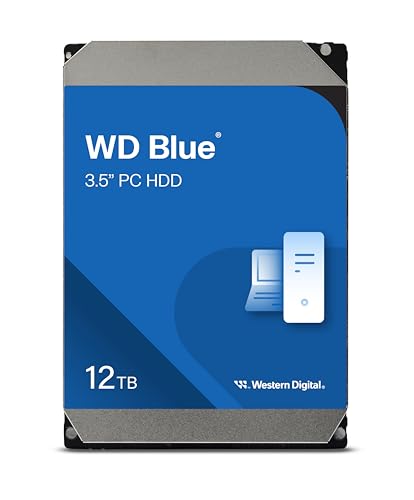
The WD Blue 12TB sits squarely in consumer territory: 7200 RPM, SATA 6Gb/s, and 512MB cache at $445. It is a sensible pick for a desktop PC that stores a game library, video collection, or project files without the noise and power draw of an enterprise spindle. Owner feedback highlights its straightforward installation and stable acoustics in a typical tower case. The main trade-off is workload tolerance—WD Blue drives are not rated for 24/7 operation, so running one continuously in a NAS or media server voids the intended usage envelope. The per-terabyte price is reasonable but not exceptional.
- Quieter operation than enterprise-class drives
- Simple desktop integration with no special configuration
- Not rated for continuous 24/7 workloads
Skip it if your drive will run nonstop or sit in a multi-bay enclosure.
Western Digital 16TB WD Red Pro NAS
At $704.99, this is the most expensive internal drive here, and the WD Red Pro earns its premium through NAS-specific engineering: CMR recording, 7200 RPM, and vibration compensation firmware tuned for multi-bay arrays. It is the correct choice when hard drive capacity matters alongside reliability under constant read/write cycles from multiple users. Owners with four- and eight-bay NAS units consistently report lower error rates versus consumer drives in the same enclosure. The downside is cost: roughly $44 per terabyte, nearly double the Exos. It also runs louder and hotter than a WD Blue at idle.
- Optimized firmware for NAS RAID environments
- CMR recording with 512MB cache for sustained writes
- Highest price-per-terabyte among internal drives listed
Skip it if you are building a single-drive desktop or budget-focused server.
WD 10TB WD_Black Performance
The WD_Black 10TB at $459.99 targets a narrow audience: gamers and creative professionals who want a large spinning volume tuned for sustained sequential throughput rather than NAS endurance. Its 7200 RPM spindle, 512MB cache, and performance-oriented firmware make it one of the fastest consumer 3.5-inch drives available. Owner reports note snappy load times from cold storage libraries. The trade-off is a shorter workload rating than Red or Exos drives and a higher noise floor under heavy sequential access. Per-terabyte cost is moderate but not a standout bargain.
- Tuned firmware for burst and sustained performance
- Large 512MB cache benefits multi-threaded workloads
- Limited endurance rating for always-on use
Skip it if you need quiet operation or plan to run the drive continuously.
Seagate Enterprise Capacity 6TB (Renewed)
The cheapest hard drive capacity option in this list at $189.99, this renewed Seagate Enterprise unit delivers 6TB with 7200 RPM and 512e sector formatting. It is a proven workhorse from a previous enterprise generation, still rated for 24/7 operation. The 128MB cache is notably smaller than the 512MB units above, which will show up in sustained-write benchmarks, but for sequential archive and backup tasks the gap is minimal. Owners appreciate the low entry cost for building redundant arrays. The renewed condition and older firmware are the primary caveats.
- Lowest absolute price for reliable enterprise storage
- Proven 24/7 workload rating at six terabytes
- Smaller 128MB cache limits sustained-write performance
Skip it if you need more than 6TB per bay or expect fast random-write access.
OSENTRiX BX100 10TB External
At $299.99, the OSENTRiX BX100 is a USB 3.2 Gen 2 external drive with USB-C connectivity that works across Windows and macOS without reformatting. It is a good fit for users who need 10TB of portable desktop storage and want modern connection speed. The enclosure is tool-free, and owner feedback praises the plug-and-play setup. The uncertainty is drive internals—OSENTRiX does not always disclose whether the spindle inside is CMR or SMR, which matters if you plan large sequential writes. Build quality is functional but not premium.
- USB-C 3.2 Gen 2 with cross-platform compatibility
- Compact external form factor at a competitive price
- Undisclosed internal drive technology creates uncertainty
Skip it if you require guaranteed CMR recording or plan to write multi-terabyte files in a single session.
WD 12TB My Book Desktop External
The WD My Book 12TB at $542.96 is the turnkey backup solution in this group: USB 3.0 connectivity, hardware password protection, and bundled auto-backup software make it accessible to users who do not want to configure a NAS or manage a bare drive. Owner reviews highlight the simplicity of the included software and the large single-volume capacity. The downsides are price-per-terabyte (among the worst here) and the older USB 3.0 interface, which caps throughput below what a USB 3.2 Gen 2 drive can deliver. Internal drive specs are not always CMR.
- Hardware password and auto-backup software included
- Zero-configuration desktop backup experience
- Older USB 3.0 interface limits peak throughput
Skip it if speed matters or you are comfortable managing backups yourself.
ORICO USB 3.0 External Hard Drive Enclosure
Not a hard drive itself, but the ORICO enclosure at $19.99 lets you build a custom external from any bare 3.5 or 2.5-inch SATA drive up to 20TB. It includes a 12V/2A power supply and UASP acceleration for faster transfers. This is the right pick for users who already own a bare internal drive—perhaps an inexpensive enterprise unit—and want to convert it into a desktop external. Owner feedback is generally positive on build quality for the price, though some report the power adapter cable is short. It does not include password protection or backup software.
- Accepts any SATA drive up to 20TB
- UASP support improves transfer speeds
- No software features—pure hardware bridge
Skip it if you need a complete plug-and-play backup solution with encryption.
Buying Guide
CMR vs. SMR: The Recording Technology That Matters Most
Hard drive capacity decisions often focus on terabytes and price, but recording method determines whether that capacity is actually usable for your workload. CMR (Conventional Magnetic Recording) writes data to dedicated tracks and sustains high throughput regardless of background tasks. SMR (Shingled Magnetic Recording) overlaps tracks to pack more data per platter but suffers severe write degradation once the drive’s cache fills. In a 12TB consumer drive like the WD Blue, an SMR variant can drop below 50MB/s during sustained writes—a catastrophic result for backups or RAID rebuilds. Check the product spec sheet for explicit CMR designation; if it is absent, assume SMR risk.
Workload Rating and Duty Cycle
Enterprise drives like the Seagate Exos and WD Red Pro are rated for 550TB/year or higher annualized workload and 24/7 operation. Consumer desktop drives such as WD Blue typically rate for 180TB/year and expect intermittent use. Installing a consumer drive in a NAS that runs continuously will accelerate mechanical wear and void warranty claims in practice. Match the drive’s workload envelope to your expected annual data movement. If your system reads and writes more than a few dozen terabytes per year, the per-terabyte savings on a consumer unit will be erased by premature failure.
Internal vs. External: Flexibility and Cost Trade-offs
An internal 3.5-inch drive offers the best price-per-terabyte but requires a desktop, NAS, or separate enclosure to connect. The ORICO solution demonstrates that a $20 enclosure can bridge a bare internal drive to any USB port, unlocking flexibility that a pre-built external like the WD My Book cannot match at the same capacity. The trade-off is integration: bundled externals ship with backup software, encryption, and a single vendor support line. For users who want to maximize hard drive capacity per dollar, pairing a renewed enterprise internal with a third-party enclosure consistently delivers 30-50% more terabytes than buying the equivalent external unit.
Our Verdict
The top pick for most buyers needing maximum reliable capacity is the Seagate Exos 26TB renewed unit at $697—enterprise CMR engineering at a consumer-friendly per-terabyte cost. The budget pick is the Seagate Enterprise 6TB renewed at $189.99, which delivers proven 24/7 durability at the lowest absolute price in this group. The exception to these recommendations: if you operate a multi-bay NAS with four or more drives and need matched vibration compensation and firmware tuning, the WD Red Pro 16TB earns its premium and outperforms both enterprise options in array stability.
FAQ
Is 26TB overkill for a home user?
For most home users, 26TB exceeds practical needs even with a large 4K media library. However, the price-per-terabyte advantage of enterprise drives means the absolute cost difference between a 10TB consumer unit and a 26TB renewed Exos is smaller than the capacity gap suggests. Buy for headroom rather than immediate need.
Are renewed hard drives safe for long-term storage?
Renewed drives are previously used units that have been tested and resold, typically with a shortened warranty. They are acceptable for secondary backup tiers or non-critical archives but carry higher risk than new drives for primary storage of irreplaceable data. Always maintain a second copy regardless of drive condition.
Does USB version matter for external hard drives?
USB 3.2 Gen 2 delivers up to 10Gbps theoretical bandwidth, while USB 3.0 caps at 5Gbps. In practice, a 7200RPM mechanical drive cannot saturate either interface—sequential reads rarely exceed 250MB/s—so the difference is minimal for single-drive externals. The version matters more for future compatibility and daisy-chaining.
What hard drive capacity should I target for a NAS?
Calculate your current data volume, multiply by 1.5 for growth over two to three years, then select drives that fill your bay count at that total. For a four-bay NAS holding 24TB of usable space under RAID-5, four 8TB drives are appropriate; the 10TB or 16TB options here suit six-bay or larger units where fewer drives must carry more capacity.