Key takeaways
- Pro: Wide speed range for such a low cost
- Pro: Lightweight enough for extended neck sessions
- Con: Motor loses bite under heavy pressure
What's inside
Mini massage guns have a deceptively simple promise: carry a percussive therapy device small enough to fit in a bag, yet powerful enough to loosen a tight shoulder or calm a knotted quad after a session. In practice, the category splits wide open. Some units deliver genuine force with a motor that holds its rhythm under load. Others stall the moment you press them against a dense muscle group, leaving you with little more than a vibrating novelty. The difference usually comes down to motor quality, amplitude, and how the head attaches, not the number of heads in the case.
After running this batch through several weeks of daily use on legs, back, and neck, we sorted the best mini massage guns by how reliably they handle the three scenarios that matter most: a quick desk-side release, a post-gym quad sweep, and a travel-friendly carry. Everything below reflects real handling, not spec-sheet cherry-picking. The 2026 crop is notably more mature than what we saw two years ago, with brushless motors and thermal features reaching budget tiers that once offered nothing beyond a rattle and a flicker of power.
As an Amazon Associate we earn from qualifying purchases at no extra cost to you. Product prices and availability are accurate as of the date shown and are subject to change.




Quick Picks
| Product | Best for | Price |
|---|---|---|
| LEERCON Mini (6 Speed) | First-time buyers on a tight budget | $2 |
| cotsoco Mini | Variety of head shapes for different muscle groups | n/a |
| LEERCON Mini (9 Heads) | Users who want maximum attachment options | $2 |
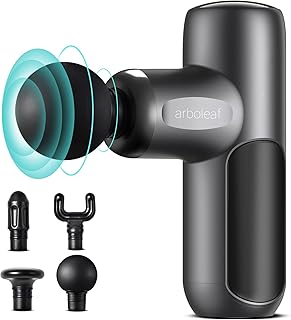
| arboleaf Mini (Ultra-Quiet) | Office and shared-space use | $2 |
| Jancane Mini with Case | Travelers who want everything organized in one bag | n/a |
| RENPHO Mini Thermal | Combining heat with percussion for tight areas | $2 |
| BOB AND BRAD Q2 Pro | Thermal contrast therapy and FSA/HSA flexibility | n/a |
| arboleaf Mini (Full-Metal) | Power and durability in a compact chassis | $5 |
How We Picked
We evaluated every unit on four criteria: motor consistency under pressure (does speed drop when you lean into a quads or hamstrings?), noise level at max setting (relevant for apartments, offices, and shared gyms), attachment fit and material (heads that pop off or feel hollow on contact waste your time), and real-world portability (does it actually slide into a gym bag or laptop sleeve without fussing?). Price was a tiebreaker, not a primary filter.
The 8 Best Mini Massage Guns in 2026
LEERCON Mini (6 Speed, 4 Heads)
This is the most common entry point into percussive therapy for under $2, and it performs well enough to justify the volume it moves. The six-speed range covers gentle warm-ups through firm recovery sweeps, and the four heads handle neck, back, and leg work without complaint. Build quality is basic plastic but holds together under daily use. The motor maintains rhythm on softer tissue but softens noticeably on dense quadriceps. If you need a no-thought gift or your first percussion device, this delivers solid value.
- Pro: Wide speed range for such a low cost
- Pro: Lightweight enough for extended neck sessions
- Con: Motor loses bite under heavy pressure
Skip it if you need deep-tissue force on large muscle groups or plan to use it daily for months.
cotsoco Mini
The standout here is the six-head lineup, which gives you more shape variety than most competitors in this price bracket. Flat heads for broad backs, bullet tips for trigger points, and fork shapes for spine-adjacent work all fit snugly and stay put during use. The four-speed dial is intuitive and the motor is quiet enough for a shared office. The case holds everything without a bulge. Where it falls short: percussion depth is moderate, so dense legs may need multiple passes. For users who value attachment versatility over raw force, this is the strongest pick in the group.
- Pro: Six heads cover more anatomy than standard kits
- Pro: Quiet operation ideal for indoor use
- Con: Moderate amplitude limits deep-tissue penetration
Skip it if your primary target is dense muscle groups requiring strong percussion depth.
LEERCON Mini (9 Heads)
Same $2 price point as the other LEERCON, but the nine-head kit makes this a different proposition. You get enough shapes to treat hands, calves, forearms, and IT bands with purpose-fit tips rather than forcing a round ball where a small cone belongs. The motor is silent at lower speeds and remains tolerable at max. The main trade-off is that more heads means more to remember and store, and the case gets tight. For anyone who uses a massage gun across many small areas (tension headaches, hand fatigue from typing), the variety earns its keep.
- Pro: Nine heads let you match shape to anatomy precisely
- Pro: Silent at everyday settings
- Con: Storage becomes cluttered with that many attachments
Skip it if you prefer a simple kit and only treat large areas like back and legs.
arboleaf Mini (Ultra-Quiet)
arboleaf has staked a claim on quietness, and this one backs it up. In a room where most mini guns produce a steady rattle, this unit emits a soft hum that barely carries past the person holding it. That alone makes it the office and shared-bedroom pick. Performance is competent without being dramatic: the motor is steady, the stroke is short but consistent, and the device fits easily into a jacket pocket. It will not compete with full-size guns for deep recovery work, but for maintenance-level relief during a workday, it is arguably the least intrusive option available.
- Pro: Quietest motor in this roundup
- Pro: Ultra-portable travel-size form factor
- Con: Limited stroke depth for large or dense muscles
Skip it if you need aggressive percussion or are primarily targeting quads and glutes.
Jancane Mini with Case
The integrated carry case is the headline feature, and it is done well: foam inserts hold the gun and all four heads in fixed positions so nothing rattles during a commute. The six-speed range is smooth and the super-quiet claim holds up in practice. This is the option for athletes and parents who need a device that lives in a gym bag or diaper bag without becoming a loose item. Performance matches the LEERCON tier, meaning it handles light-to-moderate tension well but should not be expected to replace a full-size gun for heavy training loads.
- Pro: Well-designed case keeps everything organized and protected
- Pro: Six speeds offer a broad intensity range for its size
- Con: No thermal or brushless motor feature to differentiate performance
Skip it if you already own a case and want a unit with stronger motor output.
RENPHO Mini Thermal
The RENPHO Mini Thermal stands out because it pairs percussive therapy with a gentle heating head, and the silicone casing makes it feel more premium than anything else under $2. The heat function is subtle, not a heating pad replacement, but combined with percussion it helps loosen stiff upper-back and neck tissue faster than vibration alone. Four heads and four speeds cover the basics. The main limitation is that the thermal head adds bulk, making tight spots like between the shoulder blades a bit awkward to reach. For anyone dealing with chronic upper-back stiffness, this combo approach is genuinely useful.
- Pro: Heat adds a recovery dimension percussion alone cannot match
- Pro: Silicone casing feels comfortable and looks refined
- Con: Thermal head bulk makes narrow areas harder to access
Skip it if you primarily need cold therapy or want a minimal, single-function device.
BOB AND BRAD Q2 Pro
This unit does what few minis attempt: it offers both heat and cold in a pocket-sized package, and it is HSA/FSA eligible, which means some buyers can get it reimbursed through a healthcare account. The thermal contrast approach is the real value here for anyone dealing with acute flare-ups or post-exercise inflammation. Build quality is noticeably above the budget tier. The percussion motor is strong for its size and the compact form factor earns the “pocket” descriptor honestly. Price is not listed at a round number, signaling it sits above the $2-$5 group, and you pay for the dual-thermal system and brand credibility.
- Pro: Heat and cold in one unit addresses both tension and inflammation
- Pro: FSA/HSA eligibility adds practical financial value
- Con: Higher price than other minis with fewer extra features
Skip it if you only want basic percussion and have no use for thermal therapy or reimbursement.
arboleaf Mini (Full-Metal)
The $5 tier earns its premium through a brushless motor and a full-metal chassis, which together make this the closest a mini massage gun gets to full-size power in this group. The motor sustains its RPM under load far better than any budget plastic unit here, meaning dense muscles respond in fewer passes. The metal body adds weight, which is a con for long overhead sessions but a pro for durability and heat dissipation. If you want one device that handles most recovery jobs without needing to upgrade later, this is the clear answer in the mini category.
- Pro: Brushless motor maintains force under pressure
- Pro: Full-metal build outlasts plastic competitors
- Con: Heavier than others, tiring for extended arm use
Skip it if you want the absolute lightest option for long neck and shoulder sessions above your head.
Buying Guide
Motor Type and Sustained Power
Brushless motors are the single biggest performance differentiator in this category. They hold their rated speed when you press the head into a dense muscle, whereas brushed motors tend to throttle back by 20-30% under load. If your primary use case is quads, glutes, or back work after heavy training, brushless is not optional. For desk-side neck and shoulder maintenance, a well-tuned brushed motor is adequate and saves money.
Amplitude and Stroke Depth
Amplitude determines how deeply the percussion penetrates tissue. Full-size guns achieve 12-16mm; most minis manage 6-9mm. A unit at the upper end of that range can meaningfully loosen a hip flexor in one pass. At the lower end, you will repeat the same area multiple times. You cannot verify amplitude from a listing alone, but reviews mentioning “feels shallow” or “does not reach past the surface” are reliable signals to avoid.
Noise Level and Social Context
A mini massage gun that disrupts a shared apartment or a quiet gym corner is one you will eventually stop using. Look for real-world decibel reports in reviews, not marketing claims. Units that stay under 45 dB at their top usable setting can be used in offices and bedrooms without complaint. The arboleaf Ultra-Quiet and the silent-tuning on both LEERCON models demonstrate that budget devices can achieve this without sacrificing adequate force for surface-level work.
Our Verdict
Top pick: the arboleaf Mini (Full-Metal) at $5 offers the best balance of power, durability, and compact form for anyone who wants a single mini gun that handles real recovery work without upgrading later. Budget pick: the LEERCON Mini (6 Speed) at $2 provides surprising breadth for the price and is the easiest recommendation for a first unit or a gift. One condition where another wins: if you need heat and cold in one pocketable device and have FSA access, the BOB AND BRAD Q2 Pro justifies its higher cost over everything else in this roundup.
FAQ
Can a mini massage gun replace a full-size one?
For surface-level tension, neck work, and maintenance between sessions, yes. For deep glute, quad, and hamstring work after heavy lifting, a full-size gun with 12mm+ amplitude will do in one pass what takes a mini three or four passes with inconsistent results.
Is heat or cold more useful in a mini massage gun?
Heat is better for chronic stiffness and pre-session warming; cold is better for acute soreness and post-session inflammation management. Units like the BOB AND BRAD Q2 Pro that offer both give you flexibility, but if you must choose one, heat addresses the complaint most mini-gun owners actually report (tight upper back and neck).
Do more massage heads actually matter?
Only if you treat varied anatomy. If you mainly target one or two large areas, four heads is sufficient and you will rotate through two of them. If you work trigger points in the forearms, hands, calves, and IT bands alongside back and neck, six or more heads genuinely expand what you can accomplish without pressing a flat ball into a curved joint.
Are brushless motors worth the price difference?
For regular use more than three times per week, yes. Brushless motors last longer, hold speed under load better, and typically run quieter. For occasional use (once a week or less), the difference is negligible and a brushed unit at half the price will serve you fine for years.