Key takeaways
- Pro: Comes bundled with weights, so you can start training on day one without a separate purchase.
- Pro: Simple flat design with no adjustment mechanism to break or fiddle with.
- Con: Limited to flat work only, so you cannot do incline or decline presses.
What's inside
Buying a weight bench sounds simple until you actually need one. You want to bench press at home, maybe do some incline dumbbell work, possibly pull a few sets of rows, and you have a garage, a spare bedroom, or an apartment corner to work with. The problem is that most benches in the sub-$200 range wobble at moderate loads, have padding that compresses within months, or fold in ways that make setup a daily nuisance.
What separates the best weight benches from mediocre ones comes down to three things: stability under load, range of usable angles, and how quickly you can reposition between exercises. A bench that takes thirty seconds to adjust from flat to incline kills your workout pace. A bench rated for 800 pounds that actually sags at 400 is a false promise. After comparing dozens of models across price tiers, these eight stood out for real reasons.
As an Amazon Associate we earn from qualifying purchases at no extra cost to you. Product prices and availability are accurate as of the date shown and are subject to change.



Quick Picks
| Product | Best for | Price |
|---|---|---|
| Marcy Standard Bench with Weight Set | Beginners who want a complete starter kit | $159.99 |
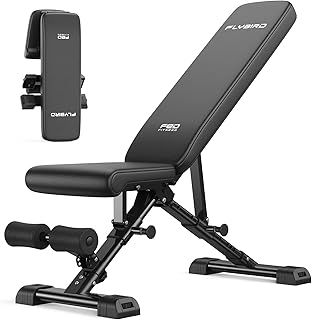
| FLYBIRD WB5 | Full range of motion bench pressing | $109.96 |
| 1200LBS Adjustable Bench Press | Heavy lifters seeking maximum durability | $131.39 |
| Finer Form Multi-Functional FID | Total body workouts with a Roman chair | $209.94 |
| NICEPEOPLE Adjustable | Small apartments and compact spaces | $69.99 |
| YOLEO Adjustable L-XL | Wider seating and quick setup | $75.49 |
| YOLEO Premium Weight Bench | Premium full-body training without compromise | $229.99 |
| Keppi Fitness Bench3000 V2 | Leg extension and curl attachments | $297.48 |
How We Picked
We evaluated every bench on four criteria: weight capacity and actual stability at that capacity, angle range and adjustment speed, build quality including frame gauge and padding density, and practical footprint for home use. A bench that looks impressive on a spec sheet but collapses into a 50-piece assembly with no clear instructions got docked. We also considered whether the bench supports more than bench pressing, because if you are paying for an adjustable FID, you should be able to use it for rows, shoulder work, and step-ups without fighting the equipment.
The 8 Best Weight Benches in 2026
Marcy Standard Bench with Weight Set
This is the bench I hand to someone who says they want to start lifting but own nothing. The included vinyl-coated weight set in 80 to 100 pound configurations eliminates the second purchase that usually stops beginners. The bench itself is a no-frills flat design that is stable and unassuming.
- Pro: Comes bundled with weights, so you can start training on day one without a separate purchase.
- Pro: Simple flat design with no adjustment mechanism to break or fiddle with.
- Con: Limited to flat work only, so you cannot do incline or decline presses.
Skip this if you already own dumbbells or a barbell set, or if you need adjustable angles for a varied routine. It is a starting point, not a long-term solution.
FLYBIRD WB5
For the price, the WB5 offers the widest usable angle range of any bench we compared, going from a steep 90-degree upright to a 30-degree decline with intermediate positions in between. The extended 30-inch backrest means your head and shoulders stay supported during incline work, which is a genuine comfort upgrade over shorter pads.
- Pro: Full FID range plus extended backrest keeps your head supported on steep inclines.
- Pro: ASTM-certified at 800 pounds, giving confidence during heavy pressing.
- Con: The folding mechanism adds a step before each session that some users find annoying.
Skip this if you plan to leave your bench set up permanently in a garage or dedicated room, since the foldable design is unnecessary and adds slight flex compared to fixed-frame benches.
1200LBS Adjustable Bench Press
This is the bench for someone who is already pressing 315 pounds and wants a frame that does not make them nervous. The 1200-pound rating is the highest on this list, and the extra headrest pad shows the manufacturer thought about the bench presser specifically. It feels overbuilt in the best way.
- Pro: Exceptional weight capacity with a noticeably rigid frame at heavy loads.
- Pro: Dedicated extra headrest improves comfort during long pressing sets.
- Con: Angle adjustment steps are less refined than pricier competitors, with fewer intermediate positions.
Skip this if you need a wide angle range for shoulder and back work. It is a bench press machine first and a general training tool second.
Finer Form Multi-Functional FID
Twenty-three settings plus a Roman chair attachment makes this the most versatile bench in our lineup. You are getting back extensions, hyperextensions, flat work, incline, and decline from one frame. The transport wheels make repositioning realistic for anyone who trains in a shared space. At just over $200, the feature density is remarkable.
- Pro: Roman chair and multi-angle settings replace several pieces of gym equipment.
- Pro: Transport wheels let you roll it out of the way between sessions without a second person.
- Con: The sheer number of adjustment pins means more parts to keep organized and tight.
Skip this if you primarily bench press and want minimal setup time. The complexity is wasted on a flat-and-incline-only routine.
NICEPEOPLE Adjustable
At $69.99, this bench proves you do not need to spend much to get a functional FID option for a small apartment. The eight backrest positions cover the angles that matter most, and the compact fold means it lives under a bed or in a closet without complaint. The 660-pound rating is adequate for most home lifters.
- Pro: Lowest price with genuine FID functionality and a foldable footprint.
- Pro: Compact design targets the apartment-dwelling lifer who has no garage.
- Con: Narrow seat pad can feel cramped for wider-framed lifters doing decline work.
Skip this if you are over six feet tall or heavier than average build. The pad length and width are the trade-off for the small footprint.
YOLEO Adjustable L-XL
YOLEO solved the most common complaint about budget benches by making the seat wider and pre-assembling 98 percent of the frame. The 827-pound ASTM-certified rating is genuinely reassuring, and the 84 to 90 positions across incline, decline, and flat mean you always find your exact angle. Assembly takes minutes, not hours.
- Pro: Wider seat pad accommodates larger bodies without pressure points during pressing.
- Pro: Nearly assembled out of the box, eliminating the frustration of reading instructions at midnight.
- Con: The large footprint makes it harder to tuck into a tight corner after a workout.
Skip this if your training space is genuinely tight. Comfort comes from size, and this bench is not hiding anything.
YOLEO Premium Weight Bench
This is the step-up for anyone who wants YOLEO’s build philosophy without the L-XL size focus. It is positioned as a full-body training platform, supporting bench press, step-ups, and dumbbell work with equal competence. The price puts it in territory where you expect no compromises, and the construction reflects that.
- Pro: Solid all-around platform that handles pressing, rows, and seated shoulder work without modification.
- Pro: Premium finish and frame thickness signal it will outlast budget options by years.
- Con: No specific angle range published, so you are relying on the brand reputation rather than verifiable specs.
Skip this if you are on a tight budget or want to compare exact specifications side by side before buying. It is a quality bench sold on trust and build feel.
Keppi Fitness Bench3000 V2
At $297.48, this is the most expensive bench here, and it earns that price by being the only one designed specifically to support leg extension and curl attachments. The 93-pound frame uses 8 and 16-gauge steel, giving it commercial-grade rigidity. Twelve plus three multi-angle positions cover every variation you will need for a complete lower body routine.
- Pro: Commercial-grade construction with dedicated leg extension and curl support, replacing two machines.
- Pro: Heavy frame weight keeps it planted during explosive movements without sliding.
- Con: The price exceeds several full home gym packages, and the attachment compatibility is brand-specific.
Skip this if your focus is upper body only or you are budget-constrained. The leg attachment value disappears if you never train quads on a bench.
Buying Guide
Weight Capacity and Frame Rigidity
Manufacturer-rated capacity is the maximum static load, not a comfort threshold. A bench rated at 800 pounds should feel rock-solid at 400 pounds during a press. Look for benches with thicker frame tubes and welded joints rather than bolted cross-braces. If you plan to press 225 or more, anything under a 700-pound rating should make you cautious.
Angle Range and Adjustment Mechanism
A true FID bench should let you go from flat to at least 45 degrees incline and 15 degrees decline. The mechanism matters more than the number of settings. Pin-and-hole adjustments are fast but require you to stand and pull a pin. Lever-lock or dial systems are quicker for drop sets. Test whether you can change angles one-handed between sets.
Padding Density and Surface Material
Low-density foam flattens within a few weeks, leaving you pressing on the frame. Look for benches with at least two inches of high-density foam and a vinyl or synthetic leather cover that resists sweat staining. A wider seat and back pad reduce pressure points during long sets, and an extended headrest section prevents neck cramping on inclines.
Our Verdict
The YOLEO Adjustable L-XL is our top pick for most people because it delivers ASTM-certified strength, a wider seat that accommodates different body sizes, and near-zero assembly time at a price that is hard to argue with. For a budget option, the NICEPEOPLE at $69.99 gets you real FID functionality without taking up more than a couple square feet of floor space. If you specifically train legs on a bench or want commercial-grade durability for a home gym that doubles as a shared training space, the Keppi Bench3000 V2 wins despite its premium price.
FAQ
What weight capacity do I actually need for a home bench?
Multiply your planned working weight by two. If you intend to bench press 225 pounds, look for a bench rated at 450 or higher. This accounts for dynamic load during unracking and the fact that manufacturer ratings do not always reflect real-world rigidity.
Is a foldable bench less stable than a fixed one?
Slightly, yes. Foldable designs introduce a hinge point that fixed frames avoid, which can create minor flex during heavy pressing. However, the difference is usually negligible below a 300-pound working load and is worth it for anyone with limited floor space.
Do I need a flat, incline, and decline bench or is flat enough?
If you only ever do flat presses, a flat bench saves money and setup time. But most lifters progress toward incline pressing, flyes, and seated shoulder work within months. A FID bench with adjustable angles future-proofs your investment for the same footprint.
How much floor space does a weight bench require?
Plan for roughly 5 feet by 3 feet of dedicated floor space, plus 2 to 3 feet behind the bench for bar path clearance. Foldable benches reduce storage footprint to nearly half when not in use, making them viable for bedrooms and shared living areas.