
Our Top Picks
 TURBRO Suburbs 25" WiFi Electric Fireplace Infrared Heater25"14 x 24 x 25 inches30.5 PoundsCheck on Amazon
 TURBRO Eternal Flame 26 in. WiFi Infrared Quartz26" Pinewood,Black,WiFi8.2 x 26 x 14 inchesCheck on Amazon
 TURBRO Suburbs TS17Q Infrared Electric Fireplace Stove19"6.1 x 12 x 19.1 Inches10.1 PoundsCheck on Amazon

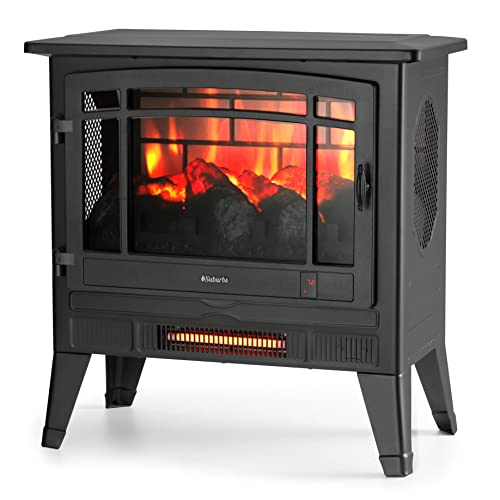

The best Turbro electric fireplace for most rooms is the TURBRO Suburbs 25″ WiFi Infrared Fireplace Stove. It pairs a 1,500-watt infrared heater with WiFi app control, an adjustable thermostat, adjustable flame brightness, and a crackling sound effect inside a freestanding stove cabinet that needs nothing but a standard wall outlet — no venting, no gas line, no contractor. That combination makes it the right pick for living rooms, dens, and open-plan corners in the 200–400 square foot range where you want visible fire and meaningful supplemental heat.
If the budget is the deciding factor, the TURBRO Suburbs TS17 Compact delivers the same heating class in a smaller cabinet for less. If you already have a fireplace box and want a log set inside it rather than a stove in front of it, the TURBRO Eternal Flame 26″ is the entry point. And if you are building a feature wall in a large room, the TURBRO 72″ Smart WiFi linear unit is the premium answer. Everything below is compared on heating coverage, cabinet and insert dimensions, flame settings, thermostat control, noise, and installation demands — the six things that actually decide whether a plug-in fireplace feels like a good purchase two winters later.
Top 3 Picks
Best overall: TURBRO Suburbs 25″ WiFi Infrared Fireplace Stove. It sits at the sweet spot of the Turbro range: a full-size freestanding cabinet, 1,500 watts of infrared heat, and the connected control stack — WiFi app, remote, adjustable thermostat, timers — that the plain TS25 lacks. It suits anyone who wants one appliance to do both ambiance and real supplemental heat in a main living space.
Best budget: TURBRO Suburbs TS17 Compact Electric Fireplace Stove. It is the smallest and simplest freestanding option here, CSA-certified, with the same 1,500-watt heating class and adjustable thermostat as its bigger siblings. Buy it for bedrooms, home offices, apartments, and anywhere the cabinet needs to disappear into the corner rather than anchor the room.
Best premium: TURBRO 72″ Smart WiFi Infrared Electric Fireplace. A 72-inch-wide linear unit is a different product category from a stove — it is wall-mounted or recessed, it is a design element, and it needs planning before drywall goes up. For a media wall or a large open-plan space where the fireplace is part of the architecture, it is the most impressive thing Turbro makes.
Quick Comparison
Every product below is a plug-in, 120-volt electric fireplace. That matters because it means they all share the same ceiling on heat output: roughly 1,500 watts, or about 5,100 BTU per hour, is the maximum a standard North American household circuit will allow a portable heater to draw. None of these units will heat a whole house, and none of them need venting. The differences between them are format, footprint, control stack, flame presentation, and how much planning the installation requires. Price tiers below are budget, mid-range, and premium; specific prices move constantly, so treat the tier as the signal.
| Product | Best for | Format & footprint class | Heat output | Controls | Flame & sound | Price tier |
|---|---|---|---|---|---|---|
| TURBRO Suburbs 25″ WiFi Infrared Fireplace Stove | Main living room, connected control | Freestanding stove, ~25 in class cabinet | 1,500 W / ~5,100 BTU infrared | WiFi app + remote + adjustable thermostat + timer | Adjustable flame brightness, crackling sound | Mid-range |
| TURBRO Eternal Flame 26″ WiFi Infrared Quartz Log Heater | Existing firebox or fireplace opening | Log set insert, ~26 in class width | 1,500 W / ~5,100 BTU quartz infrared | WiFi app + remote + thermostat | Realistic log flame, crackling sound | Budget |
| TURBRO Suburbs TS17 Compact Electric Fireplace Stove | Small rooms, bedrooms, apartments | Freestanding compact stove, ~17 in class | 1,500 W / ~5,100 BTU infrared quartz | Manual controls + remote + adjustable thermostat | Realistic flame, adjustable brightness | Budget |
| TURBRO Suburbs TS25 Electric Fireplace Infrared Heater | Simple operation, no app required | Freestanding stove, ~25 in class cabinet | 1,500 W / ~5,100 BTU infrared | Remote + adjustable thermostat, no WiFi | Adjustable flame, no sound effect | Mid-range |
| TURBRO Suburbs TS17Q Infrared Electric Fireplace Stove | Corner placement, multi-angle viewing | Freestanding stove, ~19 in class, 3-sided view | 1,500 W / ~5,100 BTU infrared | Remote + adjustable thermostat | 3-sided flame view, adjustable brightness | Budget |
| TURBRO Eternal Flame 30″ WiFi Infrared Quartz Log Heater | Larger fireboxes, dens, master suites | Log set insert, ~30 in class width | 1,500 W / ~5,100 BTU quartz infrared | WiFi app + remote + thermostat | Larger log display, crackling sound | Premium |
| TURBRO 72″ Smart WiFi Infrared Electric Fireplace | Feature walls and large open-plan rooms | Wall-mount or recessed linear, ~72 in class width | 1,500 W / ~5,100 BTU infrared | WiFi app + remote + thermostat | Wide linear flame, crackling sound | Premium |
How We Chose
This roundup is built from published manufacturer specifications, format categories, and the practical requirements of plug-in electric heating — not from hands-on use of the individual units. The criteria were chosen because they are the things that determine whether a fireplace still feels like a good decision after the novelty wears off.
First, heating class and honesty about coverage. Every 120-volt plug-in electric fireplace in this list is capped at roughly 1,500 watts and 5,100 BTU per hour. Marketing coverage claims in the 1,000 square foot range describe ideal, well-insulated, low-ceiling conditions; realistic supplemental coverage for a unit in this class is closer to 300–400 square feet in an average insulated room. We weighted units on how clearly they fit that reality rather than on the largest number in a bullet list.
Second, category fit. Freestanding stoves, log set inserts, and wall-mounted linear units solve three different problems: a piece of furniture that heats, a firebox you already own, and an architectural feature. Comparing a 72-inch recessed unit against a 17-inch stove on heat output would be meaningless, so each product is judged inside its own format.
Third, control stack and upgrade path. WiFi app control, remote control, adjustable thermostats, and timers are the difference between a heater you use daily and one you stop bothering with. We also looked at how the range steps up — compact stove to full-size stove to connected stove to built-in linear — so a reader can see where their next purchase would land.
1. TURBRO Suburbs 25″ WiFi Infrared Fireplace Stove – Best for Connected Living Rooms
As an Amazon Associate we earn from qualifying purchases at no extra cost to you.

The Suburbs 25″ WiFi is the model most people should start with if they have one main room to heat and they want the fireplace to be controllable without getting up. It is a freestanding stove-format unit with a cabinet in the 25-inch class, an infrared heating element rated at 1,500 watts, and the fullest control stack Turbro puts on a stove: WiFi app control, a physical remote, an adjustable thermostat, and timer functions. It also carries the crackling sound effect that Turbro uses across its “realistic” line, which plays alongside the flame and can be switched off if you find it distracting.
Who it suits
This is the pick for a living room, family room, den, or finished basement in the roughly 200–400 square foot range where the fireplace will be on most evenings from October through March. It suits households that want to schedule or remote-start the heat — warming a room before you come downstairs, or turning it off from the couch — and households where two people disagree about temperature, because app and remote control means nobody has to walk over and bend down to change a setting.
It also suits renters and anyone who does not want to modify the building. A freestanding stove needs an outlet and clearance; it does not need a framed opening, a gas line, a flue, or a permit.
Key specs
- Format: freestanding stove with cabinet base and front-view glass
- Cabinet size class: approximately 25 inches wide — the largest freestanding format Turbro sells, so budget floor or corner space accordingly
- Heat output: 1,500 W / roughly 5,100 BTU per hour infrared, the standard maximum for a 120 V plug-in heater
- Power draw: approximately 12.5 amps at full heat on a 120 V circuit
- Controls: WiFi app control, remote control, adjustable thermostat, built-in timer
- Flame: adjustable brightness levels; flame can run with the heater off
- Sound: crackling fire effect with independent on/off
- Safety class: CSA-certified construction with overheat protection and a tip-over cutoff switch, which is standard across the Turbro Suburbs range
Strengths
The biggest strength is the combination of heat and control in a format that installs in five minutes. Because the unit is freestanding, the “installation” is choosing a spot with clearance, plugging it in, and connecting it to your WiFi network. The infrared element heats objects and surfaces in the room rather than only the air, which is why a 1,500-watt infrared unit tends to feel warmer at a given distance than a comparable fan-forced ceramic heater — and why it keeps feeling warm for a few minutes after the thermostat cycles off.
The second strength is that flame-only mode is genuinely useful. Through most of the shoulder seasons, you will run this with the heat off, and the crackling sound plus adjustable flame gives you the atmosphere without the electricity bill. That is a large part of why a unit like this gets used year-round instead of being packed away in April.
The third is the connected control stack. A thermostat you can adjust from your phone, plus timers, turns a space heater into something closer to a zone-heating appliance. In a room you occupy on a schedule, that is worth more than an extra hundred watts of output.
Pros
- Full-size 25-inch cabinet gives the presence of a real stove rather than a tabletop appliance
- WiFi app control, remote, adjustable thermostat, and timer all included
- Crackling sound and flame can run independently of the heater
- No venting, no gas, no installation beyond clearance and an outlet
- CSA-certified with overheat and tip-over protection
Cons
- Still limited to 1,500 W — it will not carry a large open-plan space on its own in a cold climate
- WiFi setup adds a step that a purely manual stove does not have, and app features are only useful if your network reaches the room
- The cabinet takes up real floor space, and you must respect the manufacturer’s clearance to combustibles
- Fan noise is present whenever the heat is on; the crackling effect does not mask it entirely
How it compares with the nearest alternative
The obvious comparison is the TURBRO Suburbs TS25, which is the same 25-inch freestanding stove format at the same price tier but without WiFi and without the crackling sound effect. If you know you will only ever use the physical remote or the front panel, the TS25 is the more straightforward machine and there is nothing to configure. The moment you want scheduling, phone control, or the sound effect, the WiFi version justifies itself. Against the 72″ Smart WiFi, the Suburbs 25″ is the pragmatic choice: same heating class, dramatically simpler installation, but far less visual impact. Choose the stove if the fireplace is furniture; choose the linear unit if it is architecture.
2. TURBRO Eternal Flame 26″ WiFi Infrared Quartz Log Heater – Best for Existing Fireboxes

The Eternal Flame 26″ is a log set, not a stove. It is designed to sit inside a fireplace opening or firebox you already have — a masonry fireplace you never use, a prefab firebox with a dead gas log, or a built-in niche — and turn it into an electric heater with a realistic log flame. It is a 26-inch class unit with quartz infrared heating rated at 1,500 watts, WiFi app control, a remote, an adjustable thermostat, and the crackling sound effect.
Who it suits
This is the right product for anyone whose problem is an ugly, unusable fireplace rather than a cold room with no fireplace at all. If you have a firebox that drafts, smells, or simply sits there being a black rectangle, a log insert gives you the visual of a fire without the chimney work, the ash, or the annual sweeping. It is also the sensible option if you want the fireplace to look built-in without paying for a built-in — the logs sit at floor level inside an opening and read as a real fire from across the room.
It suits apartments with decorative (non-functional) fireplaces, older homes with sealed flues, and dens where a freestanding stove would block traffic flow. It is less suited to a room with no fireplace opening at all, because a log set on the floor in front of a blank wall does not look intentional.
Key specs
- Format: log set insert with realistic molded logs and ember bed, designed for an existing firebox or opening
- Width class: approximately 26 inches, so measure the inside of your opening before ordering — the log set needs to fit within the firebox with clearance
- Heat output: 1,500 W / roughly 5,100 BTU per hour quartz infrared
- Power draw: approximately 12.5 amps at full heat; you will likely need an outlet inside or immediately beside the firebox, or a cord routed discreetly
- Controls: WiFi app control, remote control, adjustable thermostat
- Flame: realistic log flame effect, runs with the heater off
- Sound: crackling fire effect
- Venting: none required — this is why it works in a sealed or blocked-off chimney
Strengths
The value proposition is unusual: for a budget-tier price you get the look of a fire inside a firebox you already own, plus the same 1,500-watt heating class as the freestanding stoves, plus WiFi control. Nothing about the installation requires a mason, a chimney liner, or a gas fitter. In a house where the fireplace has been decorative for years, that is a lot of return.
Quartz infrared is also a good match for this format. Because the elements are inside the firebox and the logs sit low, the heat radiates outward and upward into the room in a way that feels like a real fire’s warmth rather than a wall of hot air. The flame effect running independently means you can use the log set purely as decor in warmer months.
The crackling sound effect matters more here than on a stove, because the visual is a log fire — the audio and the image reinforce each other. As with all Turbro sound features, it can be turned off.
Pros
- Converts an unused firebox into a working, realistic-looking heat source
- Budget-tier pricing for a WiFi-connected, quartz infrared unit
- No venting, no gas, no chimney work
- Log flame and crackling sound run without the heater
- Low visual footprint — the unit disappears into the opening instead of occupying floor space
Cons
- Requires an existing opening of roughly the right size; measure carefully, because a log set that is too wide or too shallow simply will not fit
- Cord management inside an existing firebox can be awkward, and some fireboxes have no nearby outlet
- Provides less radiant reach into a room than a freestanding stove whose glass faces outward at chest height
- Log sets can look less convincing up close than a wide linear flame
How it compares with the nearest alternative
Against the TURBRO Eternal Flame 30″, the 26-inch version is the budget entry to the same concept. The 30-inch model gives you a wider log display and more presence in a large firebox, which matters if your opening is generous — a small log set floating in a big masonry firebox looks undersized. If your opening is a standard prefab size, the 26-inch is the more proportionate and more affordable choice, and the heating performance is the same class. Against the Suburbs TS17, the tradeoff is format, not power: the TS17 is a freestanding object you can put anywhere, while the Eternal Flame 26″ only makes sense if you have somewhere to put it.
3. TURBRO Suburbs TS17 Compact Electric Fireplace Stove – Best Budget Freestanding Pick

The Suburbs TS17 is the compact member of the Suburbs stove family and the most straightforward way to get a freestanding electric fireplace into a small room. It is a 17-inch class cabinet with a front-view flame, an infrared quartz heating element rated at 1,500 watts, an adjustable thermostat, remote control, and CSA-certified safety construction including overheat protection and a tip-over cutoff.
Who it suits
This is the pick for bedrooms, home offices, dorm rooms, small apartments, reading nooks, and any space where a 25-inch cabinet would dominate the room. It is also the best choice for someone buying their first electric fireplace and unsure how much they will actually use it — it costs the least, takes the least space, and does the same heating job as the bigger stoves in the line.
It suits people who want heat and flame without any configuration. There is no network to join, no app to install. You plug it in, set the thermostat, and use the remote or the panel.
Key specs
- Format: freestanding compact stove, front-view glass, classic stove silhouette
- Cabinet size class: approximately 17 inches — roughly two-thirds the width of the 25-inch Suburbs models
- Heat output: 1,500 W / roughly 5,100 BTU per hour infrared quartz
- Power draw: approximately 12.5 amps at full heat on 120 V
- Controls: front panel plus remote, adjustable thermostat
- Flame: realistic flame effect with adjustable brightness; flame-only operation supported
- Safety: CSA certified, overheat protection, tip-over switch
- Connectivity: none — no WiFi, no app
Strengths
The headline strength is that the TS17 gives you the same 1,500-watt heating class as every other unit in this roundup for the lowest price tier in the range. Because all of these heaters are capped by the same 120-volt circuit limit, the smaller, cheaper stove is not meaningfully weaker at heating a small room than the expensive ones. That is the single most useful fact in this article: in electric fireplaces, cabinet size buys you looks and presence, not extra heat.
Its compact footprint is the second strength. A 17-inch class stove tucks into a corner, sits beside a desk, or fits at the end of a bed without becoming the dominant object in the room. For renters moving frequently, it is also the easiest unit here to move.
The third strength is simplicity. No app, no network troubleshooting, no firmware. The controls are physical and immediate, which for a bedroom appliance that you operate half-asleep is arguably a feature rather than a limitation.
Pros
- Lowest price tier in the Turbro freestanding range
- Same 1,500 W / ~5,100 BTU heating class as the larger stoves
- Compact enough for bedrooms, offices, and small apartments
- CSA certified with overheat and tip-over protection
- No app, no account, no setup — plug in and use
Cons
- No WiFi control and no crackling sound effect
- Small flame display, so it reads as a small appliance rather than a focal point
- Smaller cabinet means less radiant surface area, so the perceived warmth at a distance is slightly less than a 25-inch unit
- Not appropriate as the only heat source for a large open-plan room
How it compares with the nearest alternative
The nearest alternative is the TURBRO Suburbs TS17Q, which is the same compact concept but with a 19-inch class cabinet and a three-sided view. The Q gives you a flame you can see from more than one seat, which is a real advantage if the stove sits in the middle of a room or at the end of a sofa arrangement; the standard TS17 is cheaper and more discreet, with a traditional front-facing stove look. If the fireplace will be against a wall and viewed head-on, the TS17 is the better value. If it will be viewed from the side, pay the small step up for the Q.
Against the Suburbs 25″ WiFi, the tradeoff is control and presence rather than heat. Step up only if you want app control, the crackling effect, or a cabinet big enough to anchor a living room.
4. TURBRO Suburbs TS25 Electric Fireplace Infrared Heater – Best for Simple, No-App Operation

The Suburbs TS25 is the full-size freestanding stove without the connected extras. It is a 25-inch class cabinet with a front-view flame, 1,500 watts of infrared heating, an adjustable thermostat, and a remote control, but no WiFi and no crackling sound effect. Think of it as the Suburbs 25″ WiFi with the network card removed and the price tier held at mid-range by the larger cabinet and build.
Who it suits
This is the right stove for people who actively do not want another app. If your household has already reached app fatigue, or if the room is in a detached garage, a basement with weak WiFi, or a cabin where the network is unreliable, the TS25 removes an entire category of failure. It also suits anyone who wants a large, traditional-looking stove as a piece of furniture — the kind of unit that looks right in a farmhouse living room or a den with wood paneling — and who will operate it with the remote or the panel.
It is a good fit for guest rooms and rental properties, where a simple remote is more useful than a smartphone app that a guest has to download and configure.
Key specs
- Format: freestanding stove, ~25-inch class cabinet, front-view glass
- Heat output: 1,500 W / roughly 5,100 BTU per hour infrared
- Power draw: approximately 12.5 amps at full heat
- Controls: remote control and on-unit panel, adjustable thermostat, flame brightness adjustment
- Connectivity: none
- Sound: no crackling effect
- Safety: overheat protection and tip-over cutoff, standard Suburbs safety package
Strengths
The TS25’s strength is that it is the biggest cabinet in the freestanding line at a mid-range tier, and it does the essential job — heat a room, look like a stove — with no moving parts in the control chain that you have to maintain. A physical remote with a battery is about as reliable as consumer electronics get.
Because there is no app, there is also no dependency on your router, no firmware updates, and no privacy consideration. For a secondary property or a room where you want zero setup friction, that is a genuine advantage rather than a missing feature.
The larger cabinet also means a larger glass front and a more substantial flame picture than the compact models, and more surface area radiating warmth into the room. At the same 1,500-watt draw, a bigger, taller unit with more exposed glass and metal tends to feel warmer at a given distance than a small one, because more of the heat is delivered to the room rather than to the cabinet’s own mass.
Pros
- Full-size 25-inch cabinet with the traditional stove silhouette
- Remote control and adjustable thermostat without any network dependency
- Works identically well in basements, garages, cabins, and rentals with poor WiFi
- Fewer electronics to fail or update than the WiFi version
- Same 1,500 W heating class as the rest of the range
Cons
- No app control, so no scheduling or remote-start from your phone
- No crackling sound effect for atmosphere
- Takes up the same substantial floor footprint as the WiFi model without the extra features
- If you later decide you want connected control, there is no upgrade path short of buying a different unit
How it compares with the nearest alternative
The direct comparison is with the Suburbs 25″ WiFi at the same tier. Same cabinet class, same heating, same flame format. The WiFi model adds app control, timers, and the crackling sound; the TS25 removes them. The decision comes down to one question: will you actually use phone control? If you want to warm a room before you walk into it, or you want the fireplace on a schedule, the WiFi version is worth it. If you will use the remote on the arm of the sofa and nothing else, the TS25 is the cleaner machine and one less thing to configure.
Against the Suburbs TS17, the TS25 buys you presence and a bigger flame picture for a higher tier — not more heat. If the room is under 150 square feet, the compact unit will do the job for less.
5. TURBRO Suburbs TS17Q Infrared Electric Fireplace Stove – Best for Corner Placement and Multi-Angle Viewing
The Suburbs TS17Q takes the compact stove formula and changes the viewing geometry. It is a 19-inch class freestanding unit with a three-sided view — glass on the front and both angled sides — so the flame is visible from a wider arc than a conventional front-view stove. It uses the same 1,500-watt infrared heating class, with remote control and an adjustable thermostat, at the budget tier.
Who it suits
The three-sided view is not a gimmick; it solves a specific placement problem. A standard front-view stove has to face the seating area, which limits where you can put it. The TS17Q works when the fireplace sits at the end of a sofa arrangement, between two chairs, at an angle in a corner, or anywhere two or more people will see it from different directions. It is a strong choice for a small living room where the stove has to be part of the furniture layout rather than a wall-mounted object.
It is also a good pick for a bedroom with two occupants who face different directions, or for a home office where the desk is at an angle to the wall.
Key specs
- Format: freestanding compact stove with three-sided glass viewing
- Cabinet size class: approximately 19 inches — slightly larger than the standard TS17, smaller than the 25-inch models
- Heat output: 1,500 W / roughly 5,100 BTU per hour infrared
- Power draw: approximately 12.5 amps at full heat
- Controls: remote control and on-unit panel, adjustable thermostat
- Flame: three-sided flame effect with adjustable brightness, usable with heat off
- Safety: overheat protection and tip-over cutoff, standard Suburbs package
- Connectivity: none
Strengths
The multi-angle flame is the reason to buy it. In a small room, a fireplace that can only be seen from one chair is a piece of furniture; one that can be seen from three seats is an amenity. Because the flame runs independently of the heater, the TS17Q earns its floor space year-round, which is a meaningful improvement in value for a unit in the budget tier.
It also sidesteps the biggest aesthetic problem with compact stoves: a small front-facing flame can look like a glowing panel. Spreading the effect across three faces makes the fire read as a source of light in the room rather than a screen on a box.
Practically, the 19-inch class cabinet remains small enough for apartments, bedrooms, and offices, and it uses the same 1,500-watt heating class as everything else here. There is no app to configure.
Pros
- Three-sided flame view works in corners and mid-room placements
- Budget tier pricing
- Compact 19-inch class cabinet suits small rooms
- Flame and light usable with the heater off
- Simple remote and panel controls, no network setup
Cons
- No WiFi app control or scheduling
- No crackling sound effect
- Three-sided glass means you must keep clearance on more than one side, which restricts tight corner placement more than it first appears
- Smaller radiant surface than the 25-inch stoves, so it is best in rooms under about 200 square feet
How it compares with the nearest alternative
Against the standard Suburbs TS17, the Q version costs a little more and gives you a slightly larger cabinet plus the third viewing side. If your stove faces a single sofa directly, the standard TS17 saves you money and takes less clearance. If the room layout means the fireplace will be seen from two or three seats — or if the stove will sit between two chairs — the TS17Q is the one to buy, and the difference in daily satisfaction is larger than the price gap suggests.
Against the Suburbs 25″ WiFi, the comparison is scale versus capability. The 25-inch model has a bigger flame picture, app control, and the sound effect, but it is a substantial piece of furniture. In a small apartment, the TS17Q is usually the more sensible footprint.
6. TURBRO Eternal Flame 30″ WiFi Infrared Quartz Log Heater – Best for Larger Fireboxes and Master Suites

The Eternal Flame 30″ is the larger sibling of the 26-inch log heater: a 30-inch class log set insert with quartz infrared heating rated at 1,500 watts, WiFi app control, a remote, an adjustable thermostat, and the crackling sound effect. It is the premium-tier option among the log-style units, and the extra four inches of width is the entire point — a wider log display fills a larger opening properly instead of looking like a small fire in a big cave.
Who it suits
This is the right unit if you have a generous fireplace opening — a wide masonry firebox in an older home, a large prefab unit, or a built-in niche in a master suite or den — and you want the fire to look like it belongs there. It is also the pick for anyone who wants the log-set aesthetic but wants the connected control stack: app control, timers, and remote operation, which is a genuinely useful feature in a bedroom fireplace you want to start without leaving the bed.
It suits primary bedrooms, master suites, dens, and formal living rooms where a freestanding stove would look out of place but a built-in fire is expected.
Key specs
- Format: log set insert for an existing firebox or opening, realistic logs and ember bed
- Width class: approximately 30 inches — measure the inside dimensions of your opening before ordering, and allow clearance on all sides
- Heat output: 1,500 W / roughly 5,100 BTU per hour quartz infrared
- Power draw: approximately 12.5 amps at full heat; plan an outlet inside or beside the firebox
- Controls: WiFi app control, remote control, adjustable thermostat, timer functions
- Flame: realistic log flame with adjustable brightness, runs with heat off
- Sound: crackling fire effect with independent on/off
- Venting: none required
Strengths
Proportion is the main advantage. In a large firebox, a log set that is too small is immediately obvious — the fire looks like it is sitting in the middle of a void. The 30-inch version fills the opening, and because the logs are wider, the flame has more surface to play across, which makes the effect more convincing than on the smaller model.
The second advantage is the control stack. Log heaters are often used in bedrooms and formal rooms where you want the fire on before you enter or before guests arrive; WiFi control and timers make that possible. The crackling sound reinforces the illusion in a way that matters more for a log display than for a stove, since the visual promise is a real wood fire.
The third advantage is that it delivers all of this without any chimney work. A sealed or unused flue is fine — the unit vents nothing, produces no smoke, and needs no liner. In an older home where restoring a wood-burning fireplace would run into thousands, a log insert at the premium tier of the electric category is still the inexpensive route to a working fire.
Pros
- Wide 30-inch class display properly fills a large firebox
- WiFi app control, remote, thermostat, and timers
- Quartz infrared heat with no venting or gas connection
- Crackling sound and flame operate independently of the heater
- Reads as a built-in fire without construction work
Cons
- Premium tier pricing for the same 1,500 W heating class as the budget units
- Only makes sense with an existing opening of roughly the right size
- Cord routing and outlet access inside a firebox often require a plan
- WiFi dependency for the app features, which is the one thing a purely remote-controlled unit avoids
How it compares with the nearest alternative
Against the Eternal Flame 26″, the 30-inch model is the same concept scaled up, with the same heating class and the same control stack. The decision is purely about the size of your opening: if your firebox is wide, the 30-inch is worth the premium because the alternative looks undersized. If your opening is a standard size, the 26-inch is proportionate, cheaper, and just as warm.
Against the 72″ Smart WiFi, the choice is between a log fire and a linear fire. The Eternal Flame 30″ reads as traditional and belongs in an existing fireplace; the 72-inch linear unit reads as contemporary and requires you to build the opening. If your room already has a firebox and a traditional feel, the log set is the natural answer.
7. TURBRO 72″ Smart WiFi Infrared Electric Fireplace – Best for Feature Walls and Large Open-Plan Rooms

The 72″ Smart WiFi is the outlier in this roundup: a wide linear electric fireplace designed to be wall-mounted or recessed into a framed wall, with a 72-inch class viewing width, an infrared heating element rated at 1,500 watts, WiFi app control, a remote, an adjustable thermostat, and the crackling sound effect. It is a premium-tier product, and unlike every other unit here, it is not something you unbox and place — it is something you plan.
Who it suits
This is for a living room, great room, or open-plan space where the fireplace is part of the architecture rather than a piece of furniture. It suits anyone building or renovating: a media wall with a linear fire beneath or beside the television, a feature wall in a large living area, a finished basement bar, or a modern home where a stove would read as a period piece in the wrong decade.
It also suits anyone who wants a lot of visual fire for the money. A 72-inch-wide flame is a completely different experience from a 17-inch stove flame, and the linear format spreads light across the room in a way a compact cabinet cannot.
Key specs
- Format: wall-mounted or recessed linear fireplace; recessed installation requires framing the wall to the published rough-opening dimensions before finishing
- Viewing width class: approximately 72 inches wide — by far the largest unit in this roundup
- Depth class: slim-wall linear units in this size class are typically only a few inches deep, which is why they recess into a standard stud wall
- Heat output: 1,500 W / roughly 5,100 BTU per hour infrared
- Power draw: approximately 12.5 amps at full heat; plan a dedicated outlet or circuit during the build
- Controls: WiFi app control, remote control, adjustable thermostat
- Flame: wide linear flame with adjustable brightness and color options, usable with heat off
- Sound: crackling fire effect
- Venting: none required
Strengths
The visual impact is the whole point. A 72-inch flame line turns a blank wall into the focal point of a room, and because the unit is shallow, it can be recessed flush so that only the glass and a slim trim are visible. That is a finish you cannot achieve with any freestanding stove.
Despite the size, the heating class is identical to the rest of the range: 1,500 watts, roughly 5,100 BTU. That is not a weakness — it is a useful reality check. The 72-inch unit is a design-forward space heater, not a central heating system, and it should be chosen for the way it looks and the way it anchors a room, with the heat treated as a bonus that takes the chill off the space.
The WiFi control stack is genuinely more useful here than on a stove, because a wall-mounted fireplace is often harder to reach and its controls may be at the side or the top edge. App and remote control keep the glass clean — you touch the remote, not the panel.
Pros
- Dramatic 72-inch viewing width that defines a room
- Wall-mounted or recessed installation gives a built-in look
- WiFi app control, remote, and adjustable thermostat
- Flame and crackling sound run without heat for year-round use
- No venting, no gas, no chimney
Cons
- Premium tier pricing, and the real cost includes framing, finishing, and electrical work
- Requires planning and a rough opening sized to the published dimensions — this is not a plug-and-place product
- Same 1,500 W heat ceiling as a budget compact stove, so the extra money buys appearance rather than output
- Difficult to move or reposition once installed
- In a very large open-plan room, one 1,500 W unit will not carry the whole space
How it compares with the nearest alternative
Against the Suburbs 25″ WiFi — the other WiFi-enabled freestanding option — the comparison is architectural versus portable. Both draw the same power and produce the same heat class. The Suburbs stove can be moved, plugged in anywhere, and installed in five minutes; the 72-inch linear unit has to be built in and looks ten times more impressive once it is. If you are renting, moving soon, or unwilling to open a wall, the stove is the answer regardless of budget.
Against the Eternal Flame 30″, the choice is contemporary versus traditional. The 30-inch log set assumes you already have a firebox and want it to look like a wood fire; the 72-inch linear unit assumes you are creating the opening and want a modern flame line. Both are premium-tier; they simply belong in different rooms.
How to Choose
Choosing between these units is easier once you accept a single constraint: every plug-in electric fireplace in this roundup draws the same maximum — about 1,500 watts, or roughly 5,100 BTU per hour — because that is the limit of a standard 120-volt household circuit. That means the decision is almost never “which one heats the most.” It is “which one fits my room, my wall, my outlet, and the way I want to control it.”
Start with the heat math, not the flame
A rough rule of thumb for supplemental heating is that you need about 20 BTU per hour for every square foot of an average insulated room with standard eight-foot ceilings, plus more in a cold climate or a poorly insulated space. At 5,100 BTU, a 1,500-watt electric fireplace is therefore in the right class for roughly 250 square feet of average room — and manufacturers’ claims of up to 1,000 square feet assume ideal insulation, mild outdoor temperatures, and a low ceiling, which almost nobody has.
| Room size (average insulation, 8 ft ceiling) | What a 1,500 W unit will do | Sensible pick from this list |
|---|---|---|
| Up to 150 sq ft (bedroom, office, small den) | Heats comfortably on low or medium; often cycles off | Suburbs TS17 or TS17Q |
| 150–300 sq ft (living room, primary bedroom) | The sweet spot — maintains a comfortable temperature as supplemental heat | Suburbs 25″ WiFi, Suburbs TS25, or a log insert sized to the opening |
| 300–450 sq ft (large living room, finished basement) | Takes the chill off and warms the zone you sit in; expect it to run continuously in cold
Affiliate disclosure. As an Amazon Associate we earn from qualifying purchases at no extra cost to you. Prices accurate as of the date shown. Best Turbro Electric Fireplaces for Cozy RoomsCheck price on Amazon More ways to save on Amazon 
Black Friday and Cyber Monday Gym Equipment Deals: A Buyer’s PlaybookBlack Friday and Cyber Monday gym equipment deals: how to judge a real discount, what to check by machine type, a budget example and mistakes to avoid. 
Best vibration plate for small apartment workoutsFor a small apartment, a compact or slim vibration plate with a... 
Best Under Desk Treadmill for Small Apartments: Noise and StorageThe best under desk treadmill for most small apartments is the WalkingPad... 
Best Big Spring Sale 3-in-1 Charging Station DealsTop 3 Picks The best overall pick for most people is the... 
How to Catch Captain’s Goldfish in FischHow to Catch Captain’s Goldfish in Fisch To catch Captain’s Goldfish in... 
How to Lob Pass in College Football 26How to Lob Pass in College Football 26 The lob pass in... 
Honkai Star Rail Hysilens Guide: Build and TeamsWhat Makes Hysilens Work Hysilens is a Physical-element character on the Nihility... 
GTA 6 Female Police Officers Spotted: What We KnowGTA 6 Female Police Officers Spotted: What We Know The GTA 6... 
Grand Summoners Tier List: Best Units RankedGrand Summoners Tier List: Best Units Ranked for 2026 The best units... 
Fruit Legends Beginner Tips for Faster ProgressFruit Legends Beginner Tips: What Actually Moves Your Progress Fastest The single... |