Our Top Picks
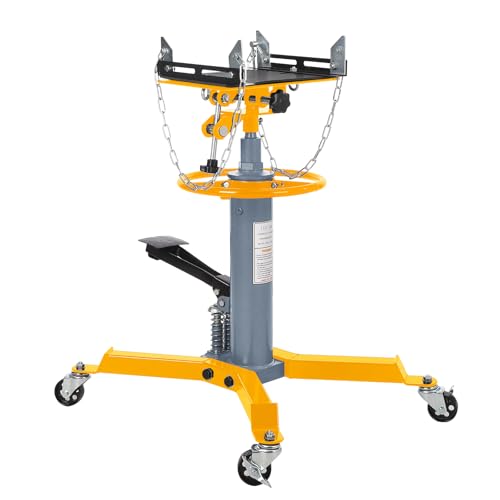
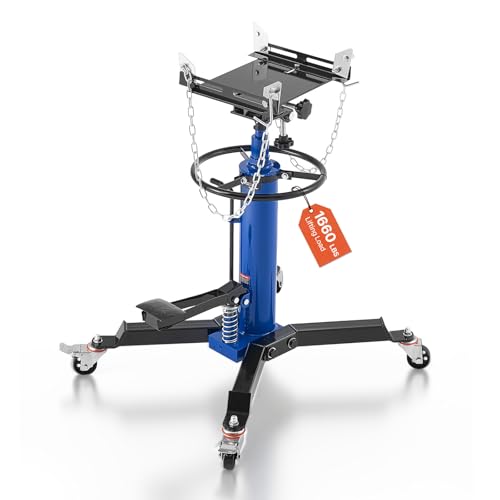 VEVOR Hydraulic Transmission Jack2-Stage 1660 lbs28.94 x 24.61 x 38.19 inches98.55 poundsCheck on Amazon
 JustSmart Dual Plunger Hydraulic Transmission Jack 1322lbs Capacity25.6 x 31.9 x 33.5 inches97 PoundsCheck on Amazon
 VEVOR Adjustable Floor Transmission Jack 1000 LBS LowCompact31.89 x 16.14 x 10.83 inches82.01 poundsCheck on Amazon


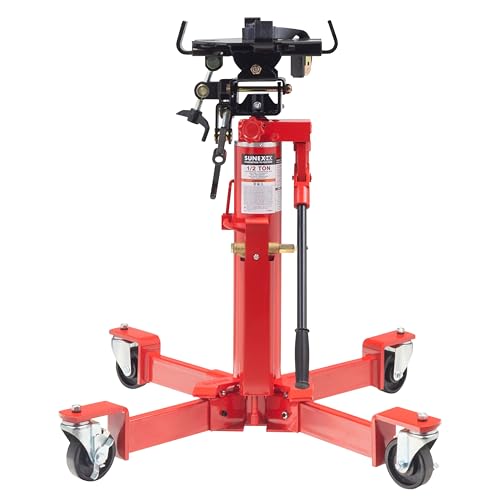
The best transmission jack for most garage repairs is the Sunex Tools 7793B 1,000 lb Telescopic Transmission Jack: a foot-pump hydraulic ram paired with a tilt saddle and safety chain keeps both hands free to guide a 150–300 lb gearbox onto the bell housing instead of one hand pumping. It suits anyone with a two-post lift or tall jack stands who pulls transmissions more than once a year. If you work on the ground with limited clearance, the VEVOR Adjustable Floor Transmission Jack 1000 LBS Low Profile is the budget pick that slides under a low car; if you run a busy shop and want the tallest, most serviceable unit here, the OTC TJH10 1,000 lb High-Lift is the premium answer. Everything below is organized around the six numbers that actually decide whether a jack is safe for your job: lifting capacity, saddle adjustment, minimum height, maximum height, wheel design, and stability.
Top 3 Picks
Best overall: Sunex Tools 7793B Telescopic Transmission Jack
A 1,000 lb capacity, telescopic hydraulic ram, foot-pump operation, and a tilt saddle with a chain give you the combination that matters most during a R&R: two free hands and a load that cannot slide off while you line up the input shaft. It is the pick for a home shop with a lift or tall stands that works on rear-wheel-drive cars and light trucks. The price tier is premium, but the serviceable hydraulic design is what you are paying for.
Best budget: VEVOR Adjustable Floor Transmission Jack 1000 LBS Low Profile
A 1,000 lb capacity in a low-profile, adjustable, telescoping package at a budget price tier makes this the sensible first transmission jack for someone doing one or two gearbox jobs a year. The low-profile base is the key feature, because it gets under a car sitting on jack stands without you having to raise the vehicle higher than your stands allow. Accept a slower pump and lighter-feeling casters as the trade-off.
Best premium: OTC TJH10 1,000 lb High-Lift Transmission Jack
OTC builds for professional service bays, and the TJH10’s headline number is its 71-5/8 in. maximum height, which lets you meet a transmission that is still high in the air on a two-post lift rather than lowering the lift arms to the jack. It suits shops where the jack is in daily use and downtime costs money. The price tier is premium and the unit is heavy, so it is a poor fit for a crowded one-car garage.
Quick Comparison
| Product | Best for | Key specs | Price tier |
|---|---|---|---|
| VEVOR Transmission Jack, 1322 LBS Hydraulic Telescoping | High-lift truck and SUV work on a lift | 1,322 lb capacity; 32–67 in. lift range; hydraulic telescoping ram | Mid-range |
| Sunex Tools 7793B Telescopic Transmission Jack | Overall lift-based shop and home use | 1,000 lb capacity; foot-pump hydraulic; telescopic; tilt saddle with chain | Premium |
| SUNEX Tools Air and Hydraulic Telescopic Jack | High-volume shops, tall reach, fast cycles | 1,000 lb capacity; air + hydraulic; adjustable saddle arms; from 35.5 in. | Premium |
| VEVOR Hydraulic Transmission Jack, 1660 lbs | The heaviest loads in this roundup | 1,660 lb capacity; 34.6–69.3 in. lift range | Mid-range |
| JustSmart Dual Plunger Hydraulic Transmission Jack | Fast two-stage rise on mid-weight loads | 1,322 lb capacity; 33.5–69 in.; dual-plunger, 2-stage hydraulic | Mid-range |
| VEVOR Adjustable Floor Transmission Jack 1000 LBS Low Profile | Low cars with tight underbody clearance | 1,000 lb capacity; low-profile telescoping; adjustable saddle | Budget |
| MOTOOS 1100 lb Hydraulic Transmission Jack | Ground-level car and transaxle work | 1,100 lb capacity; 7.68–24.8 in. lift range; low profile | Budget |
| KAFLLA High Lift Hydraulic Transmission Jack | Tall reach on a tight budget | 1,660 lb capacity; 35–72 in. lift range | Budget |
| Garvee Transmission Jack 450 LBS | Light transaxles and small gearboxes | 450 lb capacity; 7–23 in. lift range; 2 m safety straps; 4 brake wheels | Budget |
| VEVOR Transmission Jack, 33″–67″ High Lift, 1100 lbs | All-round mid-weight high-lift work | 1,100 lb capacity; 33–67 in. lift range; 2-stage telescoping | Mid-range |
| OTC TJH10 High-Lift Transmission Jack | Professional shop duty and maximum height | 1,000 lb capacity; 71-5/8 in. maximum height; high-lift design | Premium |
| OEMTOOLS 26842 1-Ton Transmission Jack | One-ton truck transmissions and heavy gearboxes | 1-ton (2,000 lb) capacity; 37.5–76 in. high-lift range | Premium |
How We Chose
This roundup is assembled from published spec sheets, brand service reputations, and the physical realities of dropping a transmission, not from bench testing. Four filters decided which units made the cut. First, spec integrity: a jack had to publish a real capacity, a real lift range, and a real saddle design, because vague listings hide the numbers that determine whether a jack is safe under your vehicle. Second, category fit: low-profile units under 25 in. of reach and high-lift units above 30 in. solve completely different problems, so both classes are represented rather than forcing one design to cover everything. Third, use case: capacity tiers were matched to real gearbox weights, from a 450 lb light transaxle class up to a 1-ton truck class. Fourth, upgrade path: we favored jacks with retention hardware and serviceable hydraulics, since those are what you replace a budget jack for. Price tiers are relative bands only, because listing prices move constantly.
1. VEVOR 1322 LBS Telescoping Transmission Jack – Best for High-Lift Truck and SUV Work
As an Amazon Associate we earn from qualifying purchases at no extra cost to you.

This is the jack to look at if your vehicles sit high. The 32 in. minimum and 67 in. maximum lift range is a high-lift class envelope, which means it can meet a transmission that is still elevated on a two-post lift or on tall stands under a lifted truck. It suits DIY owners of full-size pickups and SUVs, and small shops that work on a mix of raised vehicles, more than it suits someone dropping a transaxle out of a lowered car on the garage floor.
Key specs
- Capacity: 1,322 lb (roughly 600 kg) — comfortably above the 300–400 lb range of most pickup and SUV transmission-plus-transfer-case assemblies
- Lift range: 32 in. to 67 in.
- Lift mechanism: hydraulic telescoping ram, high-lift class
- Base: wheeled caster base with a pump pedal, typical of this class of high-lift telescoping jack
- Saddle: tilting plate with a retention point; confirm whether the specific listing ships with a chain or strap before you buy
- Best paired with: a two-post lift, or jack stands tall enough to put the bell housing above 32 in.
- Price tier: mid-range
The core strength here is headroom. A transmission jack’s most common failure in practice is not overload, it is reach: you buy a 24 in. jack, discover the gearbox is sitting at 40 in. on the lift, and end up lowering the vehicle to the jack instead of the other way around. A 67 in. maximum removes that problem. The 1,322 lb rating also gives useful margin on a rear-drive truck assembly, where the transmission, transfer case, and an adapter plate stack up faster than people expect.
The trade-off is the low end. A 32 in. collapsed height is not going to slide under a sedan sitting on 18 in. stands, and the unit is heavy and tall enough that it wants floor space when parked. If your work is mostly low cars, this is the wrong class of tool. If your work is mostly trucks on a lift, it is close to ideal, and the mid-range price tier means you are not paying professional-shop money for the reach.
Pros
- 67 in. maximum height meets transmissions on a raised lift instead of forcing you to lower the vehicle
- 1,322 lb capacity covers full-size truck transmissions with transfer cases attached
- Wide 32–67 in. working band suits both mid-height stands and full lift height
- Mid-range price tier for a high-lift class envelope
- Telescoping ram design keeps the footprint manageable through the lift range
Cons
- 32 in. minimum height makes it unusable for low-clearance cars on the ground
- Heavy and bulky to store compared with a low-profile unit
- Retention hardware should be verified on the listing rather than assumed
- Overkill on capacity and height for anyone doing light front-wheel-drive transaxle work
Compared with the nearest alternative: the VEVOR 1660 lbs model later in this list covers the same high-lift territory with more capacity and a slightly different height band (34.6–69.3 in.), so the choice between them comes down to whether you need the extra 338 lb of rating or the slightly lower 32 in. starting height. If your heaviest load is a light-truck automatic, the 1,322 lb unit is enough and you gain a little low-end reach.
2. Sunex Tools 7793B Telescopic Transmission Jack – Best Overall for Lift-Based Repairs

If you want one transmission jack that does the job properly rather than adequately, this is it. The 7793B pairs a 1,000 lb capacity with foot-pump hydraulic operation and a tilt saddle with a chain, which is the exact combination that makes a two-person job into a one-person job. It suits the serious home mechanic with a lift or tall stands and the small independent shop that wants a jack it can service rather than replace.
Key specs
- Capacity: 1,000 lb
- Lift mechanism: hydraulic telescopic ram
- Pump: foot-pump operated, leaving both hands free to steady the load
- Saddle: tilt saddle with chain retention
- Construction class: professional-grade steel chassis and casters, in the weight class typical of shop-duty 1,000 lb jacks
- Best suited to: rear-wheel-drive cars and light trucks worked on a lift or tall stands
- Price tier: premium
The foot pump is the feature people underestimate before they own one. With a hand-pump or a lever you are committed to one hand on the pump handle at the moment the input shaft is a quarter inch from the pilot bearing. A foot pedal lets you make micro-adjustments with both hands on the gearbox, which is where damage happens: a bent input shaft, a cracked bell housing, a torn converter seal. Add the chain and the load cannot roll off the tilting plate while you work the angle.
The tilt saddle is the second half of that equation. Transmissions do not come out level. The tailshaft drops, the bell housing tips, and you need the saddle to follow the angle without you shimming the load with blocks. A proper tilt mechanism keeps the load’s center of gravity over the ram instead of hanging off the edge of a fixed plate.
The premium price tier buys serviceability as much as specification. Shop-grade hydraulic jacks in this class are built around seals, rams, and casters that can be replaced, and a foot-pump assembly that does not develop a slow leak in the first year of hard use. That is the difference between a tool you own for a decade and a tool you replace.
Pros
- Foot-pump operation frees both hands during the critical alignment phase
- Tilt saddle with chain retention keeps an angled load secured
- 1,000 lb capacity handles the large majority of car and light-truck gearboxes
- Professional-grade build with serviceable hydraulics and casters
- Telescopic ram keeps the working envelope practical for lift-based work
Cons
- Premium price tier is a real step up from budget and mid-range units
- Heavier than most budget jacks, which matters if you move it between bays
- 1,000 lb is ample for cars and light trucks but leaves less headroom than a 1,660 lb unit for one-ton work
- Foot-pump design takes up pedal space under the vehicle, so clearance still matters
Compared with the nearest alternative: the Sunex air and hydraulic unit in the next section is the same brand’s answer for shops that want to stop pumping entirely and drive the ram with shop air. If you have a compressor and do several gearboxes a month, the air/hydraulic model wins on cycle time. If you do not have air, the 7793B is the better buy because it needs nothing but your foot.
3. SUNEX Tools 1,000 lb Air and Hydraulic Telescopic Transmission Jack – Best for High-Volume Shops

This is the productivity pick. By combining air assist with a hydraulic telescopic ram, it removes the pumping motion almost entirely, which matters when the jack goes up and down dozens of times a week. The adjustable saddle arms are the second reason to choose it: they let the plate match different bell housing and pan footprints instead of you hunting for a spot where the load balances. It suits professional bays and busy home shops with a compressor.
Key specs
- Capacity: 1,000 lb
- Lift mechanism: air and hydraulic, telescopic
- Minimum height: 35.5 in. as listed, putting it firmly in the high-lift class
- Saddle: adjustable saddle arms for varying load footprints
- Power source: shop air plus hydraulic ram, so a compressor is required
- Best suited to: high-volume shops, or home shops with air and a lift
- Price tier: premium
Air assist changes the ergonomics of a transmission job more than any other feature. Instead of 40 or 50 pump strokes to bring a gearbox up to the bell housing, you feather a valve. On a job where you raise and lower the load repeatedly to check alignment, reseat the converter, or swap a clutch, that adds up to real time and less fatigue at the end of the day when mistakes get made.
Adjustable saddle arms address the other recurring problem: not every gearbox has a flat, centered pan. A front-wheel-drive transaxle, an odd-shaped transfer case, or a transmission with a protruding pan bolt pattern can all sit awkwardly on a fixed plate. Adjustable arms let you build a cradle that matches the load, which lowers the risk of the gearbox shifting mid-descent.
The obvious requirement is air. A 35.5 in. minimum height also means this jack assumes a lifted vehicle, so it is not the tool for ground-level work. If neither of those is a problem, this is the fastest way to drop and refit a gearbox repeatedly without wearing yourself out.
Pros
- Air and hydraulic operation drastically cuts pumping effort and cycle time
- Adjustable saddle arms fit a wider range of bell housing and pan shapes
- 1,000 lb capacity covers most car and light-truck transmissions
- High-lift starting height of 35.5 in. suits vehicles already in the air
- Professional-grade construction aimed at daily shop use
Cons
- Requires a compressor with adequate flow, which not every home garage has
- Air lines add clutter under the vehicle and a trip hazard if not managed
- Premium price tier puts it out of reach for one-job-a-year users
- High minimum height rules out low-clearance vehicles on the ground
Compared with the nearest alternative: the Sunex 7793B is the same capacity and the same brand, but foot-pump operated with a tilt saddle and chain instead of air drive and adjustable arms. Choose the 7793B if you have no compressor and value the chain retention; choose this air/hydraulic model if you have air and want adjustable arms and speed. They solve the same problem with different inputs.
4. VEVOR 1660 lbs Hydraulic Telescopic Transmission Jack – Best for the Heaviest Loads in This Roundup
At 1,660 lb, this is the highest-capacity jack in this list. That rating matters for one-ton trucks, diesel applications, and any job where the transmission comes down with a transfer case, a bell housing adapter, or a heavy flywheel housing attached. It suits owners of heavy-duty pickups, shops that service commercial vehicles, and anyone who would rather have too much jack than not quite enough.
Key specs
- Capacity: 1,660 lb (roughly 750 kg)
- Lift range: 34.6 in. to 69.3 in.
- Lift mechanism: hydraulic telescopic ram, high-lift class
- Base: wheeled caster base with pump operation
- Saddle: tilting plate with retention provision typical of this class; verify chain or strap inclusion on the listing
- Best suited to: heavy-duty trucks and SUVs on a lift or tall stands
- Price tier: mid-range
The case for 1,660 lb is not that you will ever lift 1,660 lb. It is that capacity rating is a limit, not a target, and the load on a transmission jack is never purely vertical. A gearbox hanging off a tilted saddle puts a bending load on the ram and a tipping load on the base. Working at a third of rated capacity instead of two-thirds gives you a machine that is still comfortable when the load is off-center.
The 34.6 in. minimum height is the number to check against your setup. If you work on a two-post lift with the arms at 60–70 in., the transmission tunnel may sit well above 34.6 in. and this jack meets it easily. If you work on the ground with stands, it will not reach under the car at all. The 69.3 in. top end is generous enough to keep the load in a comfortable working position rather than at full extension.
Being a mid-range price tier at this capacity is the headline value. Comparable capacity from professional brands tends to sit higher, so if raw lifting capability per dollar is your metric, this is the strongest entry in the roundup.
Pros
- Highest capacity here at 1,660 lb, with real margin for heavy assemblies
- 34.6–69.3 in. range covers lift-based work on full-size trucks
- Mid-range price tier for a heavy-capacity high-lift jack
- Generous maximum height keeps the load at a workable level rather than full extension
- Sensible choice for one-ton and diesel transmission jobs
Cons
- High 34.6 in. minimum height makes it useless on the ground
- Large and heavy, so storage and maneuverability in a small garage suffer
- More capacity than most car owners will ever use, which is wasted money
- Retention hardware should be confirmed rather than assumed
Compared with the nearest alternative: the VEVOR 1322 LBS model is the same brand, the same high-lift concept, and a slightly lower starting height at 32 in. Its 1,322 lb rating is enough for most light-truck work. Step up to this 1,660 lb version only if your loads genuinely run heavy, because you give up a little low-end reach in exchange for capacity you may not need.
5. JustSmart Dual Plunger Hydraulic Transmission Jack – Best for Fast Two-Stage Rise
The dual-plunger, two-stage design is the reason to look at this one. Two hydraulic stages mean the ram rises faster through the low part of its travel and still reaches high, which shortens the tedious part of the job where the gearbox is neither on the bench nor at the bell housing. It suits anyone doing mid-weight transmission work on a lift who wants the jack up to height quickly.
Key specs
- Capacity: 1,322 lb
- Lift range: 33.5 in. to 69 in.
- Lift mechanism: dual-plunger, two-stage hydraulic telescoping ram
- Base: wheeled caster base with pump operation
- Saddle: tilting plate typical of this class; check listing for chain or strap
- Best suited to: mid-weight car and light-truck gearboxes worked at height
- Price tier: mid-range
Two-stage rams are not marketing. A single-stage ram has to travel its full stroke to reach maximum height, and hydraulic jacks slow down as the load comes on. A two-stage design lets the first plunger do the fast, low-effort portion of the lift and the second plunger take over as the load rises. In practice you get to working height in noticeably fewer pump strokes, which is the difference between a job that feels routine and one that feels like a workout.
The 33.5–69 in. envelope is a broad one and covers most lift-based work. The 33.5 in. minimum is a hair lower than several high-lift competitors, which slightly widens the range of stands and lift heights it can serve, though it is still nowhere near low-profile territory.
Capacity at 1,322 lb is the same as the VEVOR 1322 LBS unit, so if you are comparing those two directly, the deciding factor is the pump architecture and the height band rather than load rating.
Pros
- Dual-plunger two-stage ram reaches working height in fewer strokes
- 1,322 lb capacity handles mid-weight car and light-truck transmissions
- 33.5 in. minimum is slightly lower than several rivals in the high-lift class
- 69 in. maximum height suits lift-based work on trucks and SUVs
- Mid-range price tier for a two-stage hydraulic design
Cons
- Still a high-lift jack, so ground-level work is out of the question
- Two-stage rams add seals and complexity, which is one more thing to maintain
- 1,322 lb leaves less margin than a 1,660 lb unit for heavy truck assemblies
- Retention hardware is not guaranteed by the listing name alone
Compared with the nearest alternative: the VEVOR 1322 LBS jack matches this one on capacity almost exactly, and its 32 in. minimum height is 1.5 in. lower, which can matter if your lift or stands put the bell housing in that narrow band. The JustSmart unit counters with the dual-plunger, two-stage ram. Pick on pump speed versus a slightly lower starting height.
6. VEVOR Adjustable Floor Transmission Jack 1000 LBS Low Profile – Best Budget Low-Profile Pick

This is the jack most home mechanics should buy first. A 1,000 lb capacity in a low-profile, adjustable, telescoping package at a budget price tier covers the majority of real jobs: front-wheel-drive transaxles, small automatics, and light-truck gearboxes worked on the ground or on modest stands. It suits the owner with one vehicle project and limited space who needs the jack to fit under a car rather than reach the ceiling.
Key specs
- Capacity: 1,000 lb
- Design: low-profile floor jack format with a telescoping hydraulic ram
- Saddle: adjustable, letting you match the load footprint
- Base: four-caster wheeled base for rolling under a raised vehicle
- Best suited to: ground-level and low-stand work on cars and light trucks
- Price tier: budget
The low-profile format is the entire point. If your car sits on 16–20 in. stands, a 33 in. minimum-height high-lift jack physically will not go under it, and you end up raising the vehicle higher than your stands safely allow. A low-profile jack slides in underneath at floor level, then telescopes upward to meet the transmission. That is the correct sequence, and it is why low-profile and high-lift jacks are not interchangeable.
The adjustable saddle adds flexibility at the price of a little fiddling. It lets you set the plate to the pan or bell housing footprint rather than accepting whatever angle a fixed plate gives you. Combined with a 1,000 lb rating, that covers everything from a small four-cylinder transaxle to a light-truck automatic with margin to spare.
At the budget price tier, expect trade-offs in pump feel, caster quality, and finish rather than in basic function. For a job or two a year, those trade-offs rarely show up. For weekly use, they will, and the premium jacks in this list exist for exactly that reason.
Pros
- Low-profile design fits under cars on ordinary jack stands
- 1,000 lb capacity covers most car and light-truck transmissions
- Adjustable saddle matches different pan and bell housing footprints
- Telescoping ram gives useful height on top of the low starting profile
- Budget price tier makes it a low-risk first transmission jack
Cons
- Maximum height will not meet a transmission high on a two-post lift
- Budget-tier hydraulics and casters will not last like shop-grade units
- Adjustable saddle adds setup steps compared with a fixed plate
- Retention hardware should be checked before relying on it
Compared with the nearest alternative: the MOTOOS 1100 lb low-profile jack is the closest competitor on concept and price tier, with a published 7.68–24.8 in. lift range and a slightly higher 1,100 lb rating. The VEVOR’s adjustable saddle is the differentiator if you work on more than one type of vehicle; the MOTOOS wins on capacity and on having a clearly published height envelope.
7. MOTOOS 1100 lb Hydraulic Transmission Jack – Best for Ground-Level Car Work

With a published 7.68 in. to 24.8 in. lift range, this is a true low-profile jack built for vehicles sitting on the ground or on short stands. That makes it the right tool for clutch jobs, front-wheel-drive transaxle removal, and any work where the car cannot be raised high for structural or space reasons. It suits the home mechanic in a garage with a normal ceiling and a normal floor jack.
Key specs
- Capacity: 1,100 lb
- Lift range: 7.68 in. to 24.8 in.
- Lift mechanism: hydraulic, low-profile class
- Base: wheeled caster base for positioning under a raised vehicle
- Saddle: plate designed for under-vehicle access at low height
- Best suited to: ground-level and low-stand work on cars and small SUVs
- Price tier: budget
The 7.68 in. starting height is the number that unlocks jobs. Many low-profile transmission jacks start around 7–9 in., and that is the difference between sliding under a sedan and not. On a car with the frame on 17 in. stands, the bottom of the bell housing often sits around 14–18 in. off the floor. A jack that starts at 7.68 in. gets in; one that starts at 24 in. does not.
The 1,100 lb capacity is a useful step above the 1,000 lb tier and comfortably covers a rear-drive car automatic with a bell housing adapter. For a front-wheel-drive transaxle, which typically lands in the 150–250 lb range, you are working at roughly a fifth of rated capacity, which is exactly the kind of margin that makes a jack feel stable rather than nervous.
The 24.8 in. maximum is the limit to understand. This jack will not meet a transmission on a two-post lift, and it will not serve a lifted truck with a high bell housing. It is a specialist tool for a specific height band, and within that band it does the job well at a budget price tier.
Pros
- 7.68 in. minimum height slides under cars on ordinary stands
- 1,100 lb capacity gives real margin on car and light-truck loads
- Clearly published lift range makes it easy to check against your setup
- Budget price tier suits occasional use
- Compact enough to store in a small garage
Cons
- 24.8 in. maximum height rules out lift-based work entirely
- Not suitable for heavy truck transmissions
- Budget-tier hydraulic components and casters
- Low working height means more time on your back under the car
Compared with the nearest alternative: the Garvee 450 LBS jack occupies the same low-profile, ground-level niche but with less than half the capacity, at 7–23 in. The MOTOOS is the better choice if you might ever pull a rear-drive car automatic or a heavier transaxle; the Garvee makes sense only if you are certain your loads stay in the light transaxle class.
8. KAFLLA High Lift Hydraulic Transmission Jack – Best Budget Tall-Reach Pick

A 1,660 lb capacity and a 35–72 in. lift range at a budget price tier is an unusual combination, and that is what makes this jack interesting. It covers the same high-lift territory as mid-range and premium units, including the tallest reach in this list, for significantly less money. It suits the owner of a lifted truck or SUV who works on a two-post lift or very tall stands and wants maximum height without a premium price.
Key specs
- Capacity: 1,660 lb
- Lift range: 35 in. to 72 in.
- Lift mechanism: hydraulic, high-lift class
- Base: wheeled caster base for positioning under a raised vehicle
- Saddle: tilting plate typical of high-lift jacks; confirm retention hardware on the listing
- Best suited to: lifted trucks and SUVs serviced on a lift or tall stands
- Price tier: budget
The 72 in. top of the range is the headline. That is high enough to meet a transmission with the vehicle up on a two-post lift at a comfortable working height, which is where the job is easiest on your back and your shoulders. Combined with a 1,660 lb capacity that matches the heaviest mid-range jack here, the specification sheet reads like a premium unit.
The 35 in. minimum is the constraint. This is a dedicated high-lift jack; it will not go under a car on the ground, and it will not help with a front-wheel-drive transaxle on modest stands. If you own a lifted truck and a lift, that is irrelevant. If you work on a mix of vehicles, it is disqualifying on its own.
Budget price tier at this capacity and height means the savings come from somewhere: finish, caster quality, seal quality, and the consistency of the pump. Those are exactly the parts that determine how the jack feels after two years. Treat it as a capable tool for occasional heavy work rather than a daily driver.
Pros
- 72 in. maximum height is the tallest reach in this roundup
- 1,660 lb capacity matches the heaviest mid-range units here
- 35–72 in. range gives a wide working band for lifted vehicles
- Budget price tier for a heavy-capacity, high-lift specification
- Suits truck and SUV owners who already work with a lift
Cons
- 35 in. minimum height makes ground-level work impossible
- Budget-tier components will show wear faster under frequent use
- Very tall jack with a correspondingly large storage footprint
- Retention hardware needs verifying rather than assuming
Compared with the nearest alternative: the VEVOR 1660 lbs jack matches this one on capacity exactly and offers a lower 34.6 in. starting height, which slightly widens the vehicles it can serve. The KAFLLA counters with 72 in. of reach versus 69.3 in. and a budget price tier. If you need every inch of height, KAFLLA; if you want a slightly wider band and a mid-range build, VEVOR.
9. Garvee Transmission Jack 450 LBS – Best for Light Transaxles and Small Gearboxes

At 450 lb, this is a deliberately light-duty jack, and that is not a weakness if your work matches it. Front-wheel-drive transaxles, small manual gearboxes, and compact automatics typically land between 100 and 250 lb, so a 450 lb jack still gives a healthy margin. It also brings two features the heavier budget jacks often skip: a 2 m safety strap set and four brake-equipped casters. It suits the home mechanic working on compact cars and hatchbacks at ground level.
Key specs
- Capacity: 450 lb
- Lift range: 7 in. to 23 in.
- Design: low-profile, for under-vehicle access
- Retention: 2 m safety straps included
- Wheels: four braked casters, so the jack locks in place under load
- Best suited to: light transaxles, compact gearboxes, and small cars on the ground
- Price tier: budget
The included straps are the standout detail. Most budget transmission jacks leave you to improvise retention, which usually means a ratchet strap hooked to something convenient. Purpose-made 2 m straps with the jack are safer because they are sized for the application and you know they are there. A gearbox that shifts on the plate mid-lift is the single most common way these jobs go wrong.
The four braked casters matter more than they sound. A transmission jack is a rolling platform with a heavy load balanced high up. If the casters roll while you are working the input shaft into the pilot bearing, you lose the alignment you just built. Brakes let you lock the base once the jack is positioned, then work the ram and saddle without the whole assembly creeping.
The 7–23 in. range confirms this is a ground-level tool. It will not serve a lift, and 450 lb is not enough for a rear-drive truck automatic with a transfer case. Within its class, though, it is a thoughtful design.
Pros
- 2 m safety straps included, so retention is solved out of the box
- Four braked casters lock the base while you work
- 7 in. minimum height gets under low cars on stands
- Light and compact, easy to store and maneuver in a small garage
- Budget price tier with retention hardware included
Cons
- 450 lb capacity rules out rear-drive truck and heavy automatic work
- 23 in. maximum height limits it to ground-level jobs
- Light construction is not intended for frequent professional use
- Small capacity margin means you must actually weigh your load first
Compared with the nearest alternative: the MOTOOS 1100 lb jack covers the same low-profile, ground-level role with more than double the capacity and a similar height band at 7.68–24.8 in. Choose the Garvee if included straps and braked casters matter more to you than capacity; choose the MOTOOS if you want one low-profile jack that can handle a heavier gearbox later.
10. VEVOR Transmission Jack, 33″–67″ High Lift, 1100 lbs – Best Mid-Range All-Rounder

This is the middle of the road in the best sense: 1,100 lb of capacity, a 33–67 in. two-stage lift range, and a mid-range price tier. It covers the widest range of ordinary jobs without the bulk of a 1,660 lb unit or the cost of a premium one. It suits the home mechanic with a lift who works on cars and light trucks, and the small shop that wants a dependable second jack.
Key specs
- Capacity: 1,100 lb
- Lift range: 33 in. to 67 in.
- Lift mechanism: two-stage hydraulic telescoping ram
- Base: wheeled caster base for positioning under a raised vehicle
- Saddle: tilting plate typical of high-lift jacks; check the listing for chain or strap inclusion
- Best suited to: car and light-truck transmissions worked on a lift or tall stands
- Price tier: mid-range
The two-stage ram is the practical advantage. It rises quickly through the early part of the stroke and then takes over with more mechanical advantage as the load comes on, which means fewer strokes to get from the bench to the bell housing. For a job you do a few times a year, that is convenience. For a job you do weekly, it is time you get back.
Capacity at 1,100 lb is the sensible middle. It comfortably handles a rear-drive car automatic, a light-truck gearbox, and most transfer cases, with enough margin that an off-center load on a tilted saddle does not push the jack near its limit. It stops short of the 1,660 lb tier that one-ton truck work calls for, and that is a deliberate boundary rather than a shortcoming.
The 33 in. minimum confirms the high-lift classification. This is a lift-based tool. If your vehicle is on the ground, look at the low-profile jacks instead; if it is in the air, the 33–67 in. band is a comfortable working envelope that keeps the load off the extremes of the ram’s travel.
Pros
- Two-stage ram reaches working height in fewer pump strokes
- 1,100 lb capacity covers most car and light-truck gearboxes with margin
- 33–67 in. band is a comfortable working envelope for lift-based jobs
- Mid-range price tier balances cost against capability
- Less bulky than 1,660 lb units, which helps in a small bay
Cons
- 33 in. minimum height rules out ground-level work
- 1,100 lb is not enough for one-ton truck transmissions with transfer cases
- Retention hardware not guaranteed by the listing name
- 67 in. maximum is below the 71–72 in. reach of the tallest jacks here
Compared with the nearest alternative: the JustSmart dual-plunger jack matches this one on concept almost exactly, with 1,322 lb of capacity and a 33.5–69 in. range. The JustSmart gives you more capacity and 2 in. more reach for a similar price tier; the VEVOR keeps a slightly lower 33 in. minimum. It is a close call decided by which end of the range matters more to you.
11. OTC TJH10 High-Lift Transmission Jack – Best Premium Shop-Grade Pick

OTC is a long-established professional tool brand, and the TJH10 is built for the environment that implies: a service bay where the jack is used repeatedly and downtime is expensive. Its defining specification is a 71-5/8 in. maximum height, one of the tallest in this roundup. It suits professional technicians and very serious home mechanics who want a jack that will still be working in ten years.
Key specs
- Capacity: 1,000 lb
- Maximum height: 71-5/8 in.
- Class: high-lift transmission jack
- Construction: professional-grade steel chassis, casters, and hydraulic assembly
- Saddle: high-lift plate designed for under-vehicle load support; check listing for chain or strap provision
- Best suited to: professional shops and high-use home garages with a lift
- Price tier: premium
The 71-5/8 in. maximum height solves a specific problem: on a two-post lift with the arms raised, the transmission can sit higher than most jacks can reach. You then face a choice between lowering the lift, which changes your working position, or extending a smaller jack past its comfortable range. A jack that reaches 71-5/8 in. lets you leave the vehicle where you want it and bring the jack to the load.
Capacity stays at 1,000 lb, which is the professional convention for this class. That rating covers the large majority of passenger car and light-truck transmissions, and the professional approach is to match the jack to the job rather than buy excess capacity. If you need more, you move to a heavier class of equipment entirely.
The premium price tier buys consistency: hydraulics that hold position under load, casters that roll straight on a smooth shop floor, and a chassis that does not flex when the load is off-center. Those are the qualities that determine whether a jack is a tool or a consumable.
Pros
- 71-5/8 in. maximum height meets transmissions high on a two-post lift
- Professional-grade construction from an established service-equipment brand
- 1,000 lb capacity covers most car and light-truck transmissions
- Built for repeated daily use rather than occasional jobs
- Consistent hydraulics that hold position under load
Cons
- Premium price tier is the highest in this roundup
Affiliate disclosure. As an Amazon Associate we earn from qualifying purchases at no extra cost to you. Prices accurate as of the date shown.Best Transmission Jacks for Safe Vehicle RepairsCheck price on Amazon