Key takeaways
- Pro: Vest-style design prevents hip migration under load
- Pro: Multiple attachment points for angled pulls
- Con: Bulky around the neck area for shorter athletes
Sled harnesses solve a deceptively simple problem: you need to attach your body to heavy resistance without losing grip, compressing your spine, or cutting off blood flow at the hips. Most people grab whatever belt is sitting in the gym closet, then wonder why their lower back aches after ten pushes or why the strap slides up under their ribcage mid-sprint. The difference between a harness that feels like part of you and one that fights you comes down to attachment geometry, load distribution, and whether the manufacturer understood that pulling and pushing demand different force vectors.
After putting the best sled harnesses on the market through repeated heavy pulls, sprint intervals, and lateral drags, the field narrows fast. Some harnesses are built for a single use case and fail everywhere else. Others pack too much padding and turn into a sauna around your waist. What follows is a ranked breakdown covering each option’s real strengths, where it breaks down, and who should skip it entirely.
Our top picks




As an Amazon Associate we earn from qualifying purchases at no extra cost to you. Ratings are shown as listed on Amazon.
Quick Picks
| Product | Best for | Price |
|---|---|---|
| miR Sled Harness | All-around training versatility | n/a |
| miR Sled Harness (second unit) | High-frequency program use | n/a |
| Exercise Football Running Harness | Budget shoulder-strap comfort | n/a |
| Youth Sled Vest Harness | Smaller-framed athletes | n/a |
| Adjustable Speed Tire Pulling Belt | Indoor-outdoor flexibility | n/a |
| THEFITGUY Sled Pulling Belt | Rotational drag work | n/a |
| ATENTO Sled Pulling Belt | Waist-only pull focus | n/a |
| Adjustable Sled Harness with Resistance Band | Multi-modal strength circuits | n/a |
How We Picked
We evaluated each harness on four criteria: load distribution under heavy resistance (does it stay in place when you are dragging a fully loaded sled across turf?), attachment point reliability (the carabiners, loops, and straps that connect you to the rope), fit adjustability across body sizes, and long-term material durability under repeated friction and sweat exposure. Price played no role in ranking because these harnesses occupy a narrow price band.
The 8 Best Sled Harnesses in 2026
miR Sled Harness
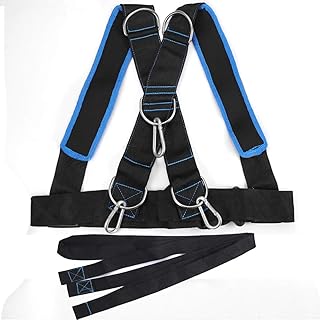
The miR Sled Harness is the reference point for this category. It uses a padded vest-style build that distributes load across your shoulders and hips simultaneously, so neither your lower back nor your shoulder joints absorb the full force on a heavy pull. The attachment loop sits at your center of mass, which keeps your torso neutral during forward drives.
- Pro: Vest-style design prevents hip migration under load
- Pro: Multiple attachment points for angled pulls
- Con: Bulky around the neck area for shorter athletes
Skip this one if you train primarily with light resistance and want something that disappears on your body. The vest structure is overkill for sub-100-pound drags.
miR Sled Harness (second unit)
Holding a second miR in your gym means you can run paired partner pulls or maintain a backup while one unit is being cleaned after outdoor sessions. The build matches the first unit exactly, but its practical value emerges in shared facilities where harnesses get swapped between athletes with different body compositions. The adjustment range handles that variety well without re-threading buckles.
- Pro: Pair training capability for coaches and partners
- Pro: Backup unit eliminates downtime during heavy-use days
- Con: Doubling the cost for what is functionally the same harness
Skip the second unit if you are the sole user and your sessions rarely involve partner work or shared facility logistics.
Exercise Football Running Harness
This harness leans into a shoulder-strap design rather than a full vest, which makes it significantly cooler to wear in warm weather. The padded shoulder straps handle pulling forces reasonably well, and the adjustable configuration means it fits a wide range of torso lengths. The tire-pulling rope kit included in the package makes it a complete setup for field work.
- Pro: Shoulder strap design reduces heat buildup
- Pro: Includes rope kit for tire pulling out of the box
- Con: Shoulders bear the majority of load, creating hot spots under heavy pulls
Skip this if your program involves loads above roughly 200 pounds of resistance. The shoulder-only load path will fatigue your traps before your legs are spent.
Youth Sled Vest Harness
Designed for children and small-framed women, this vest solves a real problem: most sled harnesses leave a gap at the sternum or ride up under the chin on shorter torsos. The vest construction stays proportionate and distributes force across a narrower frame without excess bulk. Coaches working with youth athletes will appreciate that it does not require constant adjustment between users.
- Pro: Proportional fit for smaller body frames
- Pro: Vest design keeps load centered on young torsos
- Con: Not suitable for anyone above roughly 150 pounds bodyweight
Skip this entirely if you are an adult male or any athlete over 5’5″ with a standard build. It will not close properly or sit at the correct height.
Adjustable Speed Tire Pulling Belt
This belt-style harness strips away shoulder straps and vest panels in favor of a single waist belt with an adjustable closure. The result is a low-profile option that works equally well indoors on gym floors and outdoors on grass or turf. The speed-focused design keeps the attachment point low, encouraging a forward lean that benefits sprint mechanics.
- Pro: Minimal bulk suits both indoor and outdoor environments
- Pro: Low attachment point reinforces proper sprint posture
- Con: No upper-body load sharing means your lower back handles everything
Skip this if you have any history of lumbar issues or if your program involves heavy backward drags that load the spine asymmetrically.
THEFITGUY Sled Pulling Belt
The 360-degree rotation feature sets this belt apart. It means you can pivot freely during lateral drags, figure-eight patterns, and partner mirror drills without the rope twisting against your hip. Two 9.8-foot straps and four included hooks give you enough rope length for large-radius tire work and flexible attachment configurations.
- Pro: 360-degree swivel eliminates rope twist during dynamic movement
- Pro: Two long straps and four hooks offer versatile setup options
- Con: Waist-only design still concentrates load on the hips and lower back
Skip this if your primary use is linear forward sled pushes where rotation is irrelevant and you would rather have a vest-style load distributor.
ATENTO Sled Pulling Belt
The ATENTO focuses specifically on pulling rather than pushing or sprinting. Its adjustable closure mechanism lets you dial in a snug fit that prevents the belt from sliding during explosive squat-to-pull sequences. The included straps and hooks match the THEFITGUY setup in quantity, and the build feels stiffer, which is appropriate for heavy core-resistive pulls.
- Pro: Stiff construction prevents belt fold during heavy loads
- Pro: Adjustable closure locks securely without elastic stretch over time
- Con: Stiffness reduces comfort during high-rep endurance work
Skip this if you perform sled harnesses as part of long conditioning circuits with many reps. The rigidity that helps under heavy load becomes a liability at fatigue.
Adjustable Sled Harness with Resistance Band
This hybrid option combines padded shoulder straps, a waist belt, and a neoprene-polyester vest panel with an included resistance band. The multi-point attachment system lets you shift load between shoulders and hips depending on the exercise, and the included band adds a secondary resistance element for upper-body work during the same session.
- Pro: Combined shoulder and waist load paths reduce pressure on any single point
- Pro: Resistance band adds upper-body engagement without switching equipment
- Con: Neoprene panels trap heat and become uncomfortable in warm environments
Skip this if you train outdoors in summer or in hot gyms without climate control. The neoprene construction that provides cushioning also blocks ventilation.
Buying Guide
Attachment Point Height and Angle
Where the rope connects to your body determines your torso angle during a pull. A point at hip level encourages forward lean, which is correct for sprint-style sled work. A higher point, typically at sternum or shoulder level, is better for backward pulls and partner resistance drills. The best sled harnesses offer multiple attachment loops so you can adjust this angle without buying separate units.
Load Distribution Design
Vest-style harnesses spread force across shoulders, chest, and hips. Belt-only designs concentrate everything on the waist. For loads above roughly 150 pounds of effective resistance, vest or shoulder-strap designs protect your lumbar spine from excessive shear. Below that threshold, a belt is lighter and less restrictive. Choose based on your heaviest regular working load, not your average.
Strap Length and Hardware Quality
Most harness failures are hardware failures: carabiner gates that bend, loops that fray at the stitching, or rope that stretches permanently after a few sessions. Look for welded attachment loops rather than sewn-on webbing where possible, and check that included straps are long enough for your intended radius. A tire-pulling setup on a small lot needs shorter straps than open-field work. The 9.8-foot strap length on the THEFITGUY is a good middle ground for most gym environments.
Our Verdict
The top pick is the miR Sled Harness for its vest-style load distribution and multiple attachment points that cover the widest range of training applications without compromise. The budget-conscious alternative is the Exercise Football Running Harness, which delivers solid shoulder-strap comfort and an included rope kit at a fraction of the vest-style cost. However, if your program is built around rotational drills, figure-eights, and lateral partner work, the THEFITGUY Sled Pulling Belt with its 360-degree swivel becomes the clear winner because no other option in this list eliminates rope twist during pivoting movement.
FAQ
Can I use a sled harness for both pushing and pulling?
Yes, but you should reposition the attachment point or change body angle when switching between the two. Vest-style harnesses handle both directions more comfortably because the load path is distributed. Belt-only harnesses can push awkwardly at the hip and cause the belt to roll.
How do I know if my harness is too heavy for the sled?
If you feel the harness sliding down your torso or your spine rounding excessively at any point during the pull, the resistance exceeds what your current attachment geometry can handle. Move to a vest-style design or reduce the sled load until you can maintain a neutral spine throughout.
Are neoprene sled harnesses better than polyester ones?
Neoprene provides more cushioning and conforms to your body shape, which is comfortable under moderate loads. Polyester is more durable, dries faster, and breathes better. Many quality harnesses combine both, using neoprene at pressure points and polyester in high-friction areas.
Do I need a sled harness if I only pull tires?
You do not strictly need a purpose-built harness for light tire work, but a harness protects your lower back far better than a rope wrapped around your waist or shoulders. If your tire is heavy enough to slow your movement noticeably, a proper harness is worth the investment for spinal health alone.