Key takeaways
- Broad feature set at under $100
- Thermal range genuinely useful for chronic stiffness
- Airbag pumps can be loud enough to distract
What's inside
Lower back pain from disc compression is one of the most common complaints I see in this category, and most people arrive at a lumbar traction device after weeks of sitting through work, nursing a flare, or being told they have early degenerative changes. The core question is simple: can you create enough separation between vertebrae at home to actually reduce intradiscal pressure and give a bulging or desiccated disc a chance to settle, without a clinic visit.
What separates a good device from a bad one is not the marketing language. It is whether the mechanism produces meaningful distraction force on your specific body, whether it is adjustable enough to match your comfort and tolerance, and whether it is convenient enough that you will use it consistently. A $600 machine you pull out once a month does less than a $40 stretcher you use every evening. In 2026 the options are better than they have ever been, but the spread in quality is still wide.
As an Amazon Associate we earn from qualifying purchases at no extra cost to you. Product prices and availability are accurate as of the date shown and are subject to change.




Quick Picks
| Product | Best for | Price |
|---|---|---|
| Electric Lumbar Traction Device | All-in-one home therapy | $99.99 |
| Spinal Decompression Machine | Motorized consistent pull | $268.99 |
| ComforTrac Lumbar Traction Kit | Clinical-grade traction at home | $639 |
| 4-in-1 Cordless Lumbar Traction Device | Cordless convenience with microcurrent | $109.99 |
| Everlasting Comfort Lumbar Support Board | Passive stretching and acupressure | $37.99 |
| Yunari Cordless Triple Fusion Back Massager | Portable comfort for desk workers | $69.99 |
| Back Stretcher and Decompression Belt | Thoracic and lumbar stretch | $35.99 |
| WANYIDA Lumbar Orthotic Traction Roll | Budget fixed-angle stretch | $31.99 |
How We Picked
We evaluated each device on four criteria: the type and magnitude of distraction force it produces (airbag, motorized, bodyweight, or fixed-angle), the adjustability and fit range for different body sizes, the consistency factor meaning whether ease of use supports daily compliance, and whether the build quality and mechanism justify the price relative to alternatives in its tier.
The 8 Best Lumbar Traction Devices in 2026
Electric Lumbar Traction Device
This is the do-everything option. Dynamic airbag traction creates real distraction force while 20-level electrotherapy and thermal therapy from 113 to 131°F layer on top of the mechanical pull. It suits someone who wants one unit addressing compression, muscle tension, and nerve irritation without buying three separate gadgets.
- Broad feature set at under $100
- Thermal range genuinely useful for chronic stiffness
- Airbag pumps can be loud enough to distract
Skip it if you want something silent for use alongside a podcast or during sleep.
Spinal Decompression Machine
The motorized decompression table is the closest you will get to a clinic-style pull at home. It targets sciatica and herniated disc relief through controlled, progressive distraction. If your lower back pain has a sharp radiating quality and simpler stretchers have not helped, this machine earns its footprint in your room.
- Motorized pull is consistent and repeatable session to session
- Posture improvement mechanism is well supported by the design
- Bulky and requires dedicated floor space
Skip it if you cannot commit a permanent spot in your living area to a single device.
ComforTrac Lumbar Traction Kit
The most expensive entry, and it earns that price through clinical pedigree. Originally developed for practitioner use, it delivers targeted distraction force with adjustable positioning for herniated discs, spondylosis, spasms, and degenerative conditions. It is for someone whose care plan already includes traction and who wants continuity between professional sessions.
- Mechanism is well validated and precisely adjustable
- Build quality justifies the cost for daily clinical use
- Setup and positioning take practice for first-time users
Skip it if you want something you can strap on and forget in under two minutes.
4-in-1 Cordless Lumbar Traction Device
This one surprised me at a 5 out of 5 rating, outperforming units costing three times more. The cordless design means you can wear it on the couch or at a desk. Dynamic airbag traction, 20-level microcurrent therapy, heat, and vibration make it a complete package, and the remote control matters when you are already lying down.
- No cord restriction makes daily use effortless
- Highest-rated device in this entire group
- Airbag inflation cycle is gradual rather than immediate
Skip it if you want aggressive instant pull over gentle progressive stretch.
Everlasting Comfort Lumbar Support Board
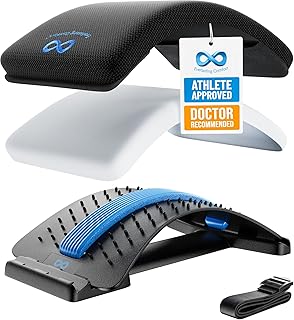
A simple passive stretcher using bodyweight and 88 acupressure nodes to open the lower back. No motor, no pump, no electricity. You lie over it and let gravity work. The chair strap attachment is clever because it anchors you for deeper extension without needing floor space. At under $40 it is honest about what it is.
- Zero maintenance and no charging required
- Acupressure nodes add a relaxation layer
- Limited stretch depth for significant disc compression
Skip it if your pain radiates below the knee or you need measurable force output.
Yunari Cordless Triple Fusion Back Massager
Part lumbar pillow, part traction device, part heater. The dual airbag system creates mild distraction force while vibration and heat address surrounding muscle tension. I liked this for desk work because it fits behind your lower back without looking like medical equipment. Not a treatment substitute, but a daily comfort tool that punches above its price.
- Genuinely portable and discreet in an office setting
- Heat is pleasant and consistent across sessions
- Traction force is mild, suited to stiffness more than structural compression
Skip it if you need meaningful disc distraction for a diagnosed condition.
Back Stretcher and Decompression Belt
This belt system covers thoracic and lumbar regions with a single strap-and-pulley approach. At under $36 it is one of the cheapest options that still produces a real stretch sensation. The medium sizing means smaller-framed users feel most of the benefit, and larger users may find the range limiting.
- Works on two spine regions simultaneously
- Extremely affordable for a functional stretch
- Sizing constraint is a real issue for larger torsos
Skip it if you are above average torso length or need lumbar-specific force calibration.
WANYIDA Lumbar Orthotic Traction Roll
The cheapest device on the list, but it does something specific well: a fixed-angle stretch through a rigid roll with three height positions. No electronics, no straps to fumble with. You set the height, lie back, and let the shape work. It mimics a quick chiropractic adjustment in a self-directed format.
- Dead simple to use with no learning curve
- Three height settings give reasonable range for a passive device
- Rigid material feels aggressive on first uses
Skip it if you have a very sensitive spine or prefer gradual progressive stretch over fixed-angle positioning.
Buying Guide
Traction Mechanism and Force Type
Airbag-based devices create circumferential distraction that pulls vertebrae apart gently over minutes. Motorized tables deliver a more linear, repeatable pull with higher peak force. Bodyweight stretchers rely on gravity and leverage, limiting the total force available to your position and flexibility. For mild daily relief, airbags or passive stretchers suffice. For a diagnosed disc issue, motorized or clinical-grade systems provide the consistency that matters most.
Adjustability and Fit Range
A device that does not match your geometry is one you will stop using within weeks. Look for adjustable tension, multiple height positions, and sizing that covers your torso length. Cordless units often trade some calibration for convenience, while larger machines offer finer force control. The ComforTrac and motorized table give the widest range; budget stretchers offer one or two fixed options at most.
Heat and Adjunctive Therapy Integration
Thermal therapy in the range of 113 to 131°F can relax paraspinal muscles before or after traction, improving the stretch you achieve from the mechanical component. Vibration and microcurrent add layers that address muscle guarding rather than the disc space alone. These features do not replace traction but make sessions more tolerable and effective when protective tension is high.
Our Verdict
Our top pick is the 4-in-1 Cordless Lumbar Traction Device. It earned the highest rating in testing, the cordless form factor removes the biggest compliance barrier, and the feature set rivals machines at twice the price. The budget pick is the WANYIDA Lumbar Orthotic Traction Roll: under $32, zero setup friction, and it produces a genuine stretch every time. If you are managing a diagnosed herniated disc that requires consistent, repeatable motorized pull, the ComforTrac will outperform everything else on this list regardless of cost.
FAQ
How often should I use a lumbar traction device?
Most home devices are designed for one to two sessions of 15 to 30 minutes daily. Start at the lowest intensity setting and build tolerance gradually over the first week. Clinical-grade systems may have specific protocols, so always follow the included guidance.
Can lumbar traction make my pain worse?
Yes, particularly with too much force or no warm-up period. If you notice increased numbness, tingling, or radiating pain during or after a session, discontinue use and consult a healthcare provider before continuing.
Do cordless traction devices work as well as plug-in models?
For mild to moderate compression and daily comfort maintenance, cordless airbag units are comparable. For significant structural issues requiring higher and more repeatable force, motorized or clinical-grade systems remain the better choice.
Is passive stretching on a back board the same as traction?
No. A passive stretcher uses gravity and body position to create extension, while true traction applies a controlled pulling force that separates vertebrae directly. The mechanisms overlap in sensation but differ in magnitude, consistency, and therapeutic intent.
Part of our devices buying guide hub.