Key takeaways
- Leg elevation pillows solve a very specific, very annoying problem: you need your legs above heart level to reduce swelling, improve circulation, or recover from surgery, but stacking couch cushions collapses within minutes and leaves your knees splaying sideways at…
Leg elevation pillows solve a very specific, very annoying problem: you need your legs above heart level to reduce swelling, improve circulation, or recover from surgery, but stacking couch cushions collapses within minutes and leaves your knees splaying sideways at awkward angles. The right wedge keeps your legs stable and elevated for hours without forcing you to constantly readjust.
What separates the best leg elevation pillows from the rest is a combination of foam density, surface width, and whether the design accommodates your actual body position on the sofa or bed. Too narrow and your legs slide off. Too soft and the wedge flattens overnight. Too rigid and it digs into your calves. We compared eight popular options to find which ones hold up under real recovery conditions and which ones are just repackaged foam blocks with a price tag.
Our top picks


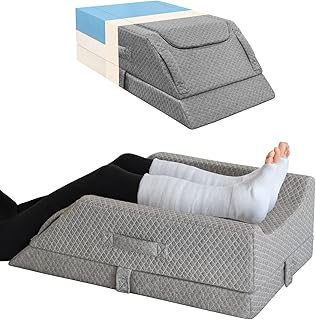


As an Amazon Associate we earn from qualifying purchases at no extra cost to you. Ratings are shown as listed on Amazon.
Quick Picks
| Product | Best for | Price |
|---|---|---|
| MEGCXIT Leg Elevation Pillow | Single-angle support on a budget | $29.99 |
| KingPavonini 4-Height Adjustable | Overall best adjustable wedge | $31.97 |
| 3 Heights Leg Elevation Pillow | Graduated elevation progression | $38.16 |
| TranquilRelax Single-Leg Pillow | One-leg recovery after injury | $35.99 |
| KingPavonini Cooling Gel Memory Foam | Hot sleepers who need elevation | $39.99 |
| Elevation Pillows for Leg After Surgery | Simple double-leg positioning | $31.34 |
| BIEEZZK Leg Elevation Pillow | Wide flat wedge for back sleepers | $29.99 |
| Kehangte 4-Height Adjustable | Cheapest adjustable option | $27.99 |
How We Picked
We evaluated every pillow on four criteria: foam density (does it compress after an hour?), elevation range (can you adjust the angle as swelling subsides?), stability (does it slide on hardwood or sag on a soft mattress?), and cover quality (is it washable, breathable, and does it pill after a few cycles?). Price relative to performance broke the ties.
The 8 Best Leg Elevation Pillows in 2026
MEGCXIT Leg Elevation Pillow
A no-nonsense memory foam wedge that lifts both legs above heart level while you rest. The 23.6×16.8×8 inch footprint is wide enough to support your calves and knees without letting them slide off the edges, a common failure point with narrower designs. The foam is firm enough to hold shape through the night rather than compressing into a flat pancake by hour three. Pros: generous surface area for stable double-leg support; firm foam resists bottoming out. Con: fixed height means you get one elevation angle only. Skip it if your recovery requires multiple angles or you want to adjust as swelling decreases.
KingPavonini 4-Height Adjustable Leg Elevation Pillow
This adjustable wedge uses an insert pad system to shift between four distinct heights, making it the most versatile option in the lineup. Soft yet supportive memory foam cradles both legs without the rigid discomfort of denser alternatives. Four grab handles let you reposition it easily from bed to couch without fumbling. The washable velvet cover feels noticeably premium against skin and held up through multiple machine cycles. Pros: four height options cover the full recovery arc; handles make repositioning effortless. Con: velvet cover can trap heat in warmer rooms. Skip it if you sleep hot and cannot manage room temperature well.
3 Heights Leg Elevation Pillow
Three graduated elevations make this wedge ideal for progressive recovery, starting high for acute swelling and stepping down as inflammation subsides. At 24 inches long, it accommodates longer legs without your feet hanging off. Double-leg support design keeps both knees aligned, reducing lower back strain during extended rest. The memory foam has a slightly softer feel than the MEGCXIT, which some buyers prefer for all-night comfort. Pros: three-step progression suits post-surgery timelines; generous length fits taller users. Con: at $38.16, it costs noticeably more than fixed-height competitors. Skip it if you only need a single elevation angle and want to save money.
TranquilRelax Leg Elevation Pillow
A single-leg design with a U-shaped cradle that isolates one limb for targeted recovery, making it the clear choice if only one leg is swollen or recovering from injury. Adjustable height lets you fine-tune elevation without guessing. Supportive memory foam holds the shape without compressing, and the washable cover is simple to maintain. Pros: single-leg focus avoids elevating the healthy side unnecessarily; U-shaped cradle prevents lateral rolling. Con: obviously useless if both legs need elevation simultaneously. Skip it if your condition affects both legs or you want a universal wedge for multiple users in the household.
KingPavonini Cooling Gel Memory Foam Leg Elevation Pillow
Cooling gel-infused memory foam addresses the heat retention that plagues every other foam wedge in this list. The gel layer draws warmth away from your calves and knees during long rest periods, making it a standout for hot climates or summer recovery. Adjustable to fit all heights, it includes four handles and a non-slip base that keeps it planted on slick hardwood or tile. The breathable washable cover adds a second cooling layer. Pros: genuine temperature regulation for hot sleepers; non-slip base works on hard floors. Con: at $39.99, it carries a premium over its sibling model. Skip it if you do not sleep hot and want the best value.
Elevation Pillows for Leg After Surgery
A straightforward double-leg wedge positioned for ankle and knee recovery, with a memory foam core that provides comfortable support during extended sleep or rest sessions. The adjustable wedge mechanism offers a range of angles, though the transition between positions is less smooth than higher-end competitors. The grey cover is functional rather than luxurious. Pros: solid double-leg positioning for ankle injuries; adjustable angles within a simple mechanism. Con: noticeably softer foam that compresses more over time compared to firmer alternatives. Skip it if you need a wedge that holds its shape through a full eight-hour night without losing elevation.
BIEEZZK Leg Elevation Pillow
Matching the MEGCXIT in dimensions at 23.6×16.8×8 inches, this flat memory foam wedge earns its place for back sleepers who want a low-profile elevation solution that does not create awkward gaps between the wedge and mattress. The foam density sits in a comfortable middle ground, supportive without feeling brick-like. Foot and knee positioning benefits extend to mild back pain relief by maintaining neutral spinal alignment during rest. Pros: low-profile design integrates cleanly with any mattress setup; same firm foam as its price-matched sibling. Con: fixed height limits its use to one stage of recovery. Skip it if you need graduated elevation or adjustable angles.
Kehangte 4-Height Adjustable Leg Elevation Pillow
At $27.99, this is the cheapest adjustable wedge available, offering four height settings and a single-leg option that mimics the TranquilRelax design at a fraction of the cost. The washable cover is functional though thinner than premium alternatives. For knee surgery recovery specifically, the graduated heights track well with typical elevation protocols. Pros: lowest price among adjustable options; covers both single-leg and double-leg use cases. Con: foam density feels slightly less consistent than pricier KingPavonini models. Skip it if you demand the most durable foam and have a slightly larger budget, since the extra five dollars buys a meaningfully better cover.
Buying Guide
Foam Density and Long-Term Shape Retention
The single biggest differentiator between wedges is how the foam behaves after the first hour. Low-density foam compresses flat, eliminating elevation precisely when you need it most during deep sleep. Look for memory foam that feels firm when pressed but springs back fully within a few seconds. A wedge that holds its shape through eight hours of continuous use will serve you for months; one that flattens by week three is a false economy regardless of its sticker price.
Adjustable Height Versus Fixed Wedge
Post-surgery protocols often require starting at a higher elevation and gradually stepping down as swelling resolves. Fixed wedges give you one angle, which means buying multiple wedges or improvising with pillows underneath. If your condition is ongoing or you are recovering from surgery, adjustable models save money and hassle over time. For chronic mild swelling or simple sleep comfort, a quality fixed wedge at half the price works perfectly well.
Cover Quality and Non-Slip Base
Leg elevation pillows see heavy use against skin, sweat, and sometimes medical dressings. A removable, machine-washable cover is non-negotiable for hygiene, but the fabric matters too. Velvet feels comfortable but traps heat. Mesh or gel-integrated covers sleep cooler. A non-slip base keeps the wedge from migrating off your bed or sliding across hardwood, which is especially important if you reposition the pillow from couch to bed during the day.
Our Verdict
The KingPavonini 4-Height Adjustable is the top pick overall, offering the best balance of elevation range, comfort, and build quality at a mid-range price. For the tightest budget, the MEGCXIT delivers reliable fixed-height support that outperforms anything else under thirty dollars. If heat is your primary concern, the KingPavonini Cooling Gel wins outright, since no other wedge in this list actively manages temperature.
FAQ
How high should my legs be elevated?
Aim for your legs to sit above heart level, which typically means an 8-inch wedge or higher depending on your body position. If you are on a recliner, the wedge sits under your calves while your torso is already elevated, so a lower angle may suffice.
Can I use a leg elevation pillow on a recliner?
Yes, most wedges work well on recliners as long as the base is non-slip. Place the wedge on the extended footrest portion and position your calves on top, keeping your knees slightly above heart level.
How long should I elevate my legs per session?
Twenty to thirty minutes several times daily is the general guideline for mild swelling, while post-surgery protocols often require longer continuous elevation. Follow your surgeon’s specific timeline, as some procedures demand extended rest periods.
Will a leg elevation pillow help with back pain?
By raising your knees above your hips during back sleeping, a wedge reduces the pull on your lower spine and flattens the lumbar curve, which alleviates pressure on discs and muscles. It works best as a supplement to other treatments rather than a standalone solution.