Key takeaways
- Check head alignment: ask someone to photograph you from behind while you lie in your normal position. Your nose should remain broadly in line with the center of your chest rather than pointing toward the mattress or ceiling.
- Account for the mattress: a soft mattress lets your shoulder sink, reducing the required pillow height. A firm mattress leaves the shoulder higher, increasing it.
- Match firmness to movement: firm foam holds a precise contour; medium foam is easier for combination sleepers; soft fill is forgiving but may collapse under a heavier head.
- Consider shoulder width: side sleepers with wider shoulders generally need more loft than back sleepers of the same body weight.
The best cervical pillows for neck pain are the ones that keep your head level with your spine in your usual sleeping position—not necessarily the tallest, firmest, or most expensive model.
A cervical pillow uses a contoured shape to support the natural curve of the neck. The right choice depends on your shoulder width, mattress firmness, sleeping position, preferred feel, and whether you can tolerate a fixed shape. Use the guide below to match those variables instead of choosing by appearance alone.
Our top picks
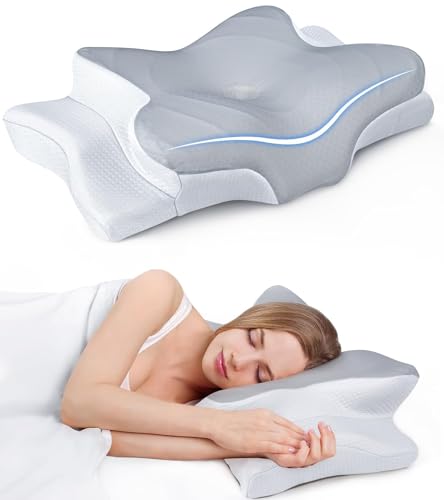

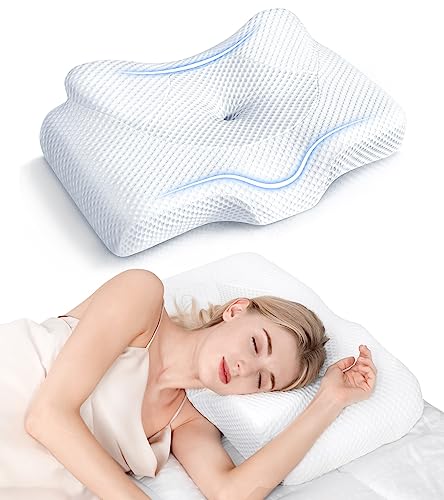

As an Amazon Associate we earn from qualifying purchases at no extra cost to you. Ratings are shown as listed on Amazon.
Quick picks by sleeping situation
| Sleeping situation | Shape to look for | Starting loft | Useful firmness | Best material type |
|---|---|---|---|---|
| Back sleeper with average shoulders | Neck-roll contour with a lower head cradle | 9–12 cm neck side | Medium-firm | Responsive memory foam or latex |
| Side sleeper with broad shoulders | High, rectangular contour or adjustable-fill design | 12–16 cm | Medium-firm to firm | Shredded foam or supportive latex |
| Combination sleeper | Dual-height contour or adjustable insert system | 8–14 cm | Medium | Adjustable shredded foam |
| Stomach sleeper | Low-profile, gently curved shape | 6–9 cm | Soft to medium | Low-density foam or down-alternative fill |
| Very firm mattress | Deeper side-support contour | Add approximately 1–2 cm | Medium-firm | Latex or resilient foam |
| Soft mattress | Moderate contour with some compression | Subtract approximately 1–2 cm | Medium | Memory foam or adjustable fill |
These are starting points rather than medical prescriptions. A pillow that feels correct in a showroom or product photograph can compress differently on your mattress, so an adjustable design is useful when your sleeping position changes or your measurements fall between sizes.
Best cervical pillow types for different needs
Best for back sleepers: a shaped memory-foam cervical pillow
Back sleepers usually need a pillow that fills the space beneath the neck while allowing the back of the head to rest slightly lower. Look for a curved neck bolster, a central head recess, and two height options if possible. A neck-side height of about 9–12 cm suits many average-sized adults, but smaller-framed sleepers may need less.
Memory foam provides stable support and does not require frequent reshaping. Its drawback is that it can feel restrictive when you roll onto your side and may retain warmth. A removable, machine-washable cover and ventilated foam are more valuable than decorative contouring.
Best for side sleepers: a high-contour or adjustable cervical pillow
Side sleeping creates a larger gap between the mattress and the side of the head, especially for people with broad shoulders. A pillow that is too low allows the head to tilt downward; one that is too high pushes it upward. Measure the distance from the mattress to your neck while lying on your side, then allow for roughly 1–2 cm of compression.
Side sleepers often do better with a rectangular contour that supports the neck without forcing the shoulder forward. Adjustable shredded-foam models can be preferable to one-piece foam because you can remove fill in small amounts. They need occasional redistribution, however, and their shape is less predictable than molded foam.
Best for combination sleepers: dual-height or adjustable-fill designs
If you alternate between your back and side, a single fixed contour may be comfortable in one position and awkward in another. Choose a pillow with different-height edges, removable inserts, or a fill compartment that can be opened. Start with the middle setting rather than overfilling it.
A practical adjustment method is to change only one variable at a time. Sleep two or three nights with the original fill, remove approximately 10% of the fill, and reassess. Removing half the fill immediately makes it difficult to identify what caused a change in comfort.
Best for stomach sleepers: a low, flexible pillow
Traditional cervical contours are often too tall for stomach sleepers because this position already rotates the neck. If you sleep mainly on your stomach, choose a low profile—usually 6–9 cm before compression—with soft edges and no aggressive neck ridge. A thin, flexible pillow may be more suitable than a firm orthopedic contour.
If you are trying to change positions because stomach sleeping causes discomfort, use a lower pillow during the transition. A tall cervical pillow can make the new position feel unstable and encourage you to return to your old posture.
How to choose loft and firmness without guessing
Loft is the pillow’s height before your weight compresses it. What matters in use is the supported height, not the advertised height. A 12-cm memory-foam pillow may compress to roughly 9–10 cm, while a firm latex pillow may compress much less.
- Check head alignment: ask someone to photograph you from behind while you lie in your normal position. Your nose should remain broadly in line with the center of your chest rather than pointing toward the mattress or ceiling.
- Account for the mattress: a soft mattress lets your shoulder sink, reducing the required pillow height. A firm mattress leaves the shoulder higher, increasing it.
- Match firmness to movement: firm foam holds a precise contour; medium foam is easier for combination sleepers; soft fill is forgiving but may collapse under a heavier head.
- Consider shoulder width: side sleepers with wider shoulders generally need more loft than back sleepers of the same body weight.
Do not use neck pain alone as a sizing signal. A new pillow can expose an unsuitable sleeping position, an overly firm mattress, or an existing condition. Persistent, worsening, radiating, or numbness-related symptoms warrant advice from a qualified healthcare professional.
Materials: what you gain and what you give up
| Material | Feel and support | Typical lifespan | Ownership considerations |
|---|---|---|---|
| Molded memory foam | Stable, pressure-relieving, slow response | 2–4 years | Cannot usually be machine-washed; may retain heat |
| Latex | Springy, supportive, easier to move on | 3–5 years | Usually cooler; latex sensitivity is possible |
| Shredded foam | Adjustable and adaptable | 1.5–3 years | Needs refluffing; fill can develop uneven areas |
| Fiber or down-alternative fill | Soft and compressible | 1–2 years | Easy to wash in some designs; loses loft sooner |
“Cooling” covers generally improve surface feel but do not eliminate heat from dense foam. Breathable fabric, ventilation channels, and a cool bedroom usually matter more than a thin metallic or gel layer. If you sweat at night, prioritize a fully removable cover and confirm the care label before buying.
Decision matrix: which features matter most?
| Your priority | Prioritize | Be cautious about |
|---|---|---|
| Lowest reasonable cost | Simple molded foam, washable cover, one useful height | Unnecessary cooling layers and complex inserts |
| Uncertain size or changing position | Adjustable fill or dual-height sides | Fixed, very firm contours |
| Nightly long-term use | Dense core, reinforced seams, replacement-cover availability | Thin covers, loose foam crumbs, permanent odor |
| Heat sensitivity | Latex, ventilated foam, breathable washable cover | Dense unventilated memory foam |
| Travel or occasional use | Compressible fill, manageable weight, protective case | Large molded contours that cannot be packed |
Realistic price expectations
Basic cervical pillows commonly cost about $25–$50. Better-made molded foam and adjustable-fill models often fall in the $50–$100 range, while premium latex or specialized orthopedic designs may cost $100–$180 or more. Price does not guarantee correct loft. A less expensive pillow with the right height and a washable cover can outperform a premium model that forces your neck into an awkward angle.
For nightly use, compare ownership cost rather than purchase price alone. For example, a $75 pillow used for two years costs approximately 10 cents per night: $75 divided by 730 nights. If replacing a washable cover extends the usable core by another year, that can be cheaper than replacing the whole pillow because the cover is usually the first component to show wear.
Cleaning and durability: the details that affect comfort
- Use a washable protector beneath the decorative cover to limit sweat, skin oils, and dust reaching the foam.
- Wash covers according to their label, and dry them completely before reinstalling them.
- Never machine-wash or soak molded foam unless the manufacturer specifically permits it; trapped moisture can damage the core and create odors.
- Air out a new foam pillow in a ventilated room for the recommended period rather than covering it immediately.
- Rotate the pillow occasionally if its design allows, but do not reverse a contoured pillow if doing so removes the intended neck support.
The cover zipper, seam corners, and the area beneath the neck ridge usually wear first. A pillow that has developed a permanent depression, cracking foam, persistent odor, or a flattened support edge is no longer maintaining its original geometry and should be replaced.
Bottom line
For back sleepers, start with a medium-firm contoured memory-foam pillow around 9–12 cm. For side sleepers, look for 12–16 cm of usable support or an adjustable design. Combination sleepers benefit most from dual-height or removable-fill construction, while stomach sleepers should choose a low, flexible profile. In every case, give the pillow several nights of gradual adjustment, keep the cover washable, and stop using it if it increases symptoms. A healthcare professional can help evaluate persistent neck pain or symptoms that extend into the shoulder, arm, or hand.