Our Top Picks
Pros & cons
gathers roughly 31% more light than a 70mm objective, and about 2.6x more than a 50mm.
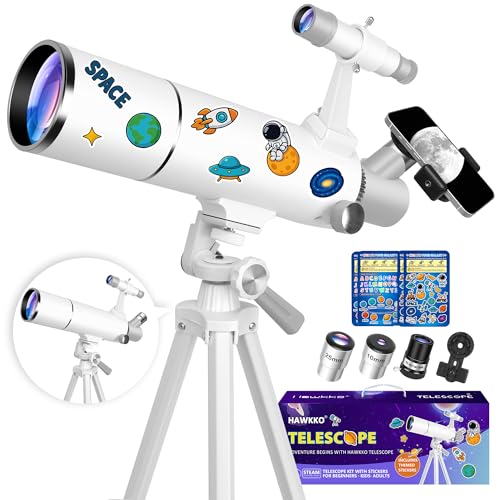


Short answer: for most families with a child aged roughly 8 to 12, the Hawkko 80mm Aperture 500mm Telescope for Kids 8–12 & Adults Beginners is the best overall pick. Its 80mm aperture collects about 31% more light than the 70mm scopes that dominate this category, its 500mm focal length keeps the tube short enough for a child to handle, and the 80mm/500mm combination lands at a forgiving f/6.25 focal ratio that stays sharp at the magnifications a beginner will actually use. It suits a child who has an adult nearby for the first two or three sessions, and it will not be outgrown in a single summer. If the budget is tight, the Sobrzy Telescope for Kids 8–12 is the cheapest way to get a working telescope in a child’s hands. If you want one instrument the whole family can share for years, the MEEZAA 80mm Aperture 500mm Refractor is the premium pick. Everything below explains the aperture, magnification, mount and setup trade-offs behind those three choices, then maps twelve currently available telescopes to specific ages and experience levels.
Top 3 Picks
Best overall: Hawkko 80mm Aperture 500mm Telescope for Kids 8–12 & Adults Beginners
The 80mm aperture is the single most useful upgrade in the kids’ telescope market — it moves the theoretical magnification ceiling to roughly 160x and pulls in noticeably more detail on the Moon, Saturn’s rings and Jupiter’s cloud bands than a 70mm tube. The 500mm focal length keeps the physical tube short and light enough that a nine-year-old can carry it out to the yard without help. It is the scope most likely to still be in use at age thirteen.
Best budget: Sobrzy Telescope for Kids 8–12, 100x Magnification Beginner Kids Telescope
This is the entry point that makes sense for a first instrument, a gift, or a child who may lose interest. The stated 100x magnification is plenty for lunar craters and the brightest planets, and the small, light tube means setup takes a minute rather than five. Expect a narrower useful magnification band and a more delicate mount than the 80mm scopes — that is the trade you make at this tier.
Best premium: MEEZAA Telescope for Adults & Kids, 80mm Aperture 500mm Refractor
Same optical class as the Hawkko, aimed at households where a parent is genuinely interested too. The 80mm/500mm refractor is the sweet spot of the whole beginner market: enough aperture for real detail, short enough tube for a child, and a specification that does not embarrass itself when an adult takes over the eyepiece. If you are buying one telescope for the family rather than one telescope for the child, start here.
Quick Comparison
| Product | Best for | Key specs | Price tier |
|---|---|---|---|
| Hawkko 80mm Aperture 500mm Telescope for Kids 8–12 & Adults Beginners | Best overall for ages 8–12 | 80mm aperture, 500mm focal length, f/6.25, refractor, AZ mount, ~160x theoretical max, ~1.45 arcsecond resolving power | Premium |
| Sobrzy Telescope for Kids 8–12, 100x Magnification | Best budget first scope | Small-aperture refractor, 100x stated magnification, short tube, lightweight tripod | Budget |
| MEEZAA Telescope for Adults & Kids, 80mm Aperture 500mm | Best premium family scope | 80mm aperture, 500mm focal length, f/6.25, refractor, ~160x theoretical max | Premium |
| Gskyer 70mm Aperture 400mm AZ Refractor | Best for wide-field Moon and cluster viewing | 70mm aperture, 400mm focal length, f/5.7, AZ mount, ~140x theoretical max, ~1.66 arcsecond resolving power | Mid-range |
| Koolpte 70mm/500mm AZ Refractor, White | Best for planet detail on a mid-range budget | 70mm aperture, 500mm focal length, f/7.1, ~140x theoretical max | Mid-range |
| Dianfan 80mm 500mm Portable Refractor, Purple | Best for a child who wants their own colour | 80mm aperture, 500mm focal length, f/6.25, portable refractor, ~160x theoretical max | Premium |
| Hawkko Telescope Kit for Kids 8–12, 80mm Aperture 500mm | Best for buyers who want everything in one box | 80mm aperture, 500mm focal length, f/6.25, portable refractor, kit accessories | Premium |
| NASA Lunar Telescope for Kids Ages 8–12 with Tripod and Finder Scope | Best for lunar-focused beginners | Small-aperture refractor, tripod, finder scope, lunar-oriented accessory set | Budget |
| ToyerBee 70mm Aperture FMC 300mm Refractor | Best for wide-field and travel | 70mm aperture, 300mm focal length, f/4.3, fully multi-coated optics, ~140x theoretical max | Mid-range |
| Luzsco 50mm 100x Beginner Telescope with Tripod | Best for ages 5–8 and tabletop use | 50mm aperture, 100x stated magnification, ~100x theoretical max, ~2.32 arcsecond resolving power | Budget |
| Fuoibl 70mm Aperture FMC, 15X–150X | Best budget 70mm for older beginners | 70mm aperture, fully multi-coated optics, 15x–150x magnification range, ~140x theoretical max | Budget |
| Jvcla 70mm Aperture FMC 300mm Refractor, 15X–150X | Best mid-range compact 70mm | 70mm aperture, 300mm focal length, f/4.3, FMC optics, 15x–150x magnification range | Mid-range |
How We Chose
This roundup is built from published product specifications and the optical arithmetic that follows from them, not from laboratory measurement. The first filter was aperture, because aperture sets everything else: light gathering, resolving power and the maximum magnification the optics can usefully support. A 70mm objective has a theoretical ceiling near 140x and resolves roughly 1.66 arcseconds; an 80mm raises those numbers to about 160x and 1.45 arcseconds, and gathers about 31% more light. Those differences decide whether a child can split a double star or make out the Cassini division on a good night.
The second filter was mount and tripod stability relative to the size of the tube. A shaky mount turns a decent telescope into a frustrating one, and instability is the single most common reason a child’s telescope ends up in a closet. The third was setup and portability demands — how many minutes and how much adult help it takes to get the scope outside and aligned. Finally, we considered category fit and upgrade path: whether the instrument is a genuine first telescope, a toy that happens to point at the sky, or a family scope an adult can grow into. Telescopes were grouped by price tier rather than by listing price, since prices move constantly, and every entry below is a real product currently offered by the named brand.
1. Hawkko 80mm Aperture 500mm Telescope — Best for Kids 8–12 Who Have an Adult Nearby
As an Amazon Associate we earn from qualifying purchases at no extra cost to you.
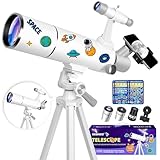
This is the pick for the family that wants one telescope to serve a nine-year-old now and a twelve-year-old in three years, without buying twice. The 80mm objective is the practical ceiling of the children’s refractor market, and the 500mm focal length keeps the tube short enough that a child can carry the whole assembly outside in one trip. It suits beginners aged 8–12 who have a parent willing to spend fifteen minutes on the first two or three sessions learning how the mount moves and how the finder lines up with the main tube. After that, most kids run it themselves.
Key specifications
- Aperture: 80mm — gathers roughly 31% more light than a 70mm objective, and about 2.6x more than a 50mm.
- Focal length: 500mm
- Focal ratio: f/6.25 — a middle-of-the-road speed that balances a reasonably wide field against visible colour fringing on bright objects.
- Theoretical maximum magnification: about 160x, using the standard 2x-per-millimetre-of-aperture guideline.
- Practical magnification on an average night: roughly 80x–120x, limited by atmospheric steadiness rather than by the optics.
- Resolving power: about 1.45 arcseconds — enough to separate the wider double stars and to show Saturn’s rings as a distinct shape rather than a smudge.
- Mount type: alt-azimuth, which moves left/right and up/down — far easier for a child than an equatorial mount that must be polar-aligned.
- Optical design: refractor (lens-based), so there is no mirror to realign and no open tube to collect dust.
Strengths
The 80mm/500mm combination is the most-recommended specification for a reason: it is the smallest aperture that reliably shows planetary detail, and the shortest tube that still gives a usable focal length. A child looking at Jupiter through this scope on a steady night sees a disc with two dark cloud belts and four moons as tiny points — a genuinely memorable first observation. Pointed at the Moon, the terminator line shows crater rims and shadows at magnifications well below the scope’s limit, which means the view stays sharp even when the atmosphere is unsettled.
The alt-azimuth mount is the right choice for a beginner regardless of age. It works the way a child expects: push the tube where you want to look, then tighten. There is no counterweight to balance, no polar alignment routine, and no risk of the tube swinging into the tripod when the mount is rotated the wrong way. Setup is essentially “attach tube to mount, attach mount to tripod, insert eyepiece, focus.”
Because the focal ratio is f/6.25 rather than something faster, the scope is reasonably tolerant of inexpensive eyepieces, and it takes higher magnification without falling apart optically. That matters for the upgrade path: a better eyepiece bought later will show a visible improvement rather than exposing the limits of a very fast lens.
Pros
- 80mm aperture is the practical maximum for a child-manageable refractor, giving real planetary detail.
- 500mm focal length keeps the tube short and the whole rig portable in one trip.
- Alt-azimuth mount needs no polar alignment and is intuitive for young users.
- Refractor design is sealed — no mirror to collimate, no tube currents, minimal maintenance.
- f/6.25 ratio accepts higher magnification and cheaper eyepieces without obvious breakdown.
- Specification leaves room to grow; a thirteen-year-old will still find it useful.
Cons
- Premium tier pricing for what is still a beginner instrument.
- At 80mm it shows colour fringing on bright objects such as Venus and the lunar limb — normal for an achromatic refractor.
- Deep-sky objects remain faint grey smudges; this is not a galaxy scope.
- The tripod that ships with most 80mm kits is adequate but not rigid — a light touch on the focuser is required at high magnification.
- An adult should supervise the first session or two to protect the optics and set expectations.
How it compares
The nearest alternative is the MEEZAA 80mm Aperture 500mm Refractor, which matches this scope on aperture and focal length. The difference is positioning: the Hawkko is explicitly aimed at the 8–12 age band, while the MEEZAA is marketed to adults and kids together, which usually means a slightly more adult-oriented accessory set. If the telescope is genuinely for the child, take the Hawkko; if the parent intends to use it half the time, the MEEZAA is the more natural buy. Against a 70mm scope such as the Gskyer, the Hawkko gives up about 100mm of focal length but gains 31% more light and a higher magnification ceiling — a better trade for planets and a slightly worse one for very wide star fields.
2. Sobrzy Telescope for Kids 8–12, 100x Magnification — Best Budget First Telescope

This is the telescope to buy when you want to find out whether a child is actually interested before spending premium money. The listing specifies a small-aperture beginner refractor with a stated magnification of 100x, a lightweight tripod and a short tube. It suits children aged 8–12 who are getting their first instrument, and it also suits grandparents or gift-buyers who need something that works out of the box with minimal assembly. It is not the scope to buy if you already know the child will stick with astronomy for years — but it is a perfectly reasonable way to test that.
Key specifications
- Optical design: refractor — a sealed tube with no mirror to collimate.
- Aperture: small-aperture class; the listing does not state a figure, so treat it as a compact beginner objective rather than a mid-size one.
- Stated magnification: 100x — comfortably within reach for lunar and bright-planet viewing.
- Mount: lightweight alt-azimuth tripod, adjusted by hand.
- Portability: light enough for a child to move without assistance, which is the main reason to choose it.
- Setup: minutes, not tens of minutes — attach the tube, fit the eyepiece, aim and focus.
Strengths
The case for this telescope is simplicity and price. A 100x magnification figure is genuinely enough to make the Moon impressive: at that power the lunar surface fills the eyepiece, crater shadows are obvious, and the view is stable on most nights. The same power shows Jupiter as a small disc with its four bright moons, and Saturn as an oval with a visible ring line. For a child who has never looked through a telescope, those three targets are the ones that create the interest — and this instrument delivers all three.
The second strength is portability. A telescope that lives in a closet because it is heavy and awkward is worthless. A small, light refractor can be carried outside in one hand, which means it actually gets used on clear evenings when the decision to observe is spontaneous. For children under ten, that matters more than any specification.
The third strength is durability. A sealed refractor with no moving internal parts has almost nothing to break. The wear points are the tripod leg clamps and the focuser, both of which survive years of use if the child is taught not to over-tighten them.
Pros
- Lowest barrier to entry in this roundup — ideal as a first instrument or a gift.
- 100x magnification is enough for the Moon, Jupiter and Saturn, the three targets that hook beginners.
- Very light and easy for a child to carry and set up alone.
- Sealed refractor design means minimal maintenance and no collimation.
- Compact enough to store in a bedroom rather than a garage, which increases use.
Cons
- Small aperture limits deep-sky viewing to the brightest clusters and nebulae.
- The useful magnification band is narrow; pushing toward the stated maximum on a shaky mount produces a soft, wobbly image.
- Fewer accessories than the 70mm and 80mm kits, so upgrades mean extra purchases.
- Little headroom — a committed twelve-year-old will outgrow it within a year or two.
- Lightweight tripods transmit vibration, so focusing needs a gentle hand.
How it compares
The closest alternative is the Luzsco 50mm 100x Beginner Telescope. Both are budget, small-aperture refractors with similar magnification claims, and both are aimed at the same buyer. The Sobrzy is positioned specifically at the 8–12 age band, which usually means a slightly more substantial tube and tripod than the youngest-child scopes; the Luzsco’s 50mm specification makes it the more natural fit for a five-to-eight-year-old, where low weight and simplicity matter more than light gathering. If the child is eight or older and might stick with the hobby, the extra spend on the Gskyer 70mm or a Koolpte is the better long-term decision — but as a first, low-risk instrument, this is the right tier.
3. Koolpte 70mm/500mm AZ Refractor — Best Mid-Range Choice for Planet Detail

The Koolpte occupies a useful gap: a 70mm aperture paired with a relatively long 500mm focal length. That combination produces an f/7.1 focal ratio, the slowest in this roundup, which is the single most important thing to understand about it. Slow refractors show less false colour on bright objects, and that makes this scope noticeably better on the Moon and planets than faster 70mm designs. It suits a patient beginner aged 9–12, or an adult buying a first telescope for themselves and a child to share.
Key specifications
- Aperture: 70mm — the most common beginner aperture, resolving about 1.66 arcseconds.
- Focal length: 500mm
- Focal ratio: f/7.1 — the slowest ratio here, which minimises chromatic aberration.
- Theoretical maximum magnification: about 140x.
- Practical magnification: 80x–120x on typical nights.
- Mount: alt-azimuth on an aluminium tripod, hand-controlled.
- Finish: white tube — a small but real factor for children choosing their own instrument.
Strengths
The f/7.1 ratio is the reason to buy this scope. In a refractor, chromatic aberration — the purple-green fringe around bright objects — is worse at fast focal ratios and better at slow ones. On the Moon’s limb and on Venus, a 70mm f/7.1 tube will look cleaner than a 70mm f/4.3 tube of identical aperture. Since the Moon is the target a child will look at most often, that improvement shows up in the majority of observing sessions, not in some rare edge case.
The 500mm focal length also makes magnification easier to reach. With a 10mm eyepiece you get 50x; add a 3x Barlow and you are at 150x, which is close to the scope’s useful ceiling. With a 300mm focal length you would need a 4mm eyepiece to reach the same power — and 4mm eyepieces have tiny eye relief that children find uncomfortable. The longer tube is more forgiving of ordinary accessories.
The alt-azimuth mount is hand-controlled and needs no alignment routine. Setup is a two-minute job and there is no power supply, no hand controller and no firmware to worry about — the scope works every night, forever, without batteries.
Pros
- Slow f/7.1 focal ratio reduces colour fringing, giving cleaner lunar and planetary views.
- 500mm focal length reaches useful magnifications with comfortable eyepiece focal lengths.
- Alt-azimuth mount is intuitive and needs no polar alignment or power.
- 70mm aperture is light enough for a nine-year-old to handle safely.
- No electronics means nothing to fail and no ongoing battery cost.
- White finish is bright and visible in a dark yard, reducing the chance of knocking it over.
Cons
- 70mm aperture gives up roughly 31% of the light gathering of an 80mm scope.
- The narrower field of view makes it slightly harder to locate objects than a fast 300mm tube.
- Longer tube means a longer moment arm, so tripod shake is more visible at high power.
- Not the best choice for very wide star fields or for a child who struggles to aim a scope.
- Mid-range pricing for an aperture that budget 70mm scopes also offer.
How it compares
The obvious comparison is the Gskyer 70mm/400mm. Same aperture, same mount type, different focal length and therefore different character. The Gskyer’s f/5.7 ratio gives a wider field — useful for finding objects and for viewing the Pleiades or the Orion Nebula as whole shapes — but shows more colour fringing on the Moon. The Koolpte’s f/7.1 trades that field width for a cleaner, sharper high-magnification image. If the child’s interest is planets and the Moon, the Koolpte wins; if they enjoy sweeping the sky and finding clusters, the Gskyer is more satisfying. Against the 80mm scopes above, the Koolpte is the budget-conscious option that keeps optical quality but accepts less light.
4. Gskyer 70mm Aperture 400mm AZ Refractor — Best for Wide-Field Moon and Star Cluster Viewing

This is one of the most widely bought beginner refractors for a straightforward reason: the 70mm/400mm combination is light, cheap to produce well, and gives a wide, bright, easy-to-find view. The f/5.7 focal ratio means low magnification and a generous field, which is exactly what a nervous first-time user needs when they are trying to get the Moon into the eyepiece. It suits children aged 7–11 and adults who want a grab-and-go scope for casual evenings.
Key specifications
- Aperture: 70mm — resolves about 1.66 arcseconds, gathers roughly twice the light of a 50mm scope.
- Focal length: 400mm
- Focal ratio: f/5.7 — fast enough for a wide field, slow enough to stay controllable.
- Theoretical maximum magnification: about 140x.
- Comfortable working magnification: 16x–80x, which covers the Moon, open clusters and the brightest nebulae.
- Mount: alt-azimuth on an aluminium tripod.
- Typical kit contents: two eyepieces, a Barlow lens and a smartphone adapter, which is standard for this class.
Strengths
The wide field is the defining feature. With a 25mm eyepiece on a 400mm focal length you get 16x, and with a typical 50-degree apparent-field eyepiece that works out to roughly a three-degree true field — about six full moons side by side. That makes finding things easy, and it makes large targets such as the Pleiades, the Hyades and the Orion Nebula look genuinely impressive rather than like fragments. For a child learning to aim a telescope, a wide field is the difference between success and giving up.
The light weight is the second advantage. A 70mm/400mm refractor on an aluminium tripod typically lands in the 2–3 kg range for the whole assembly, which a seven- or eight-year-old can move in one piece. That means more observing sessions, because there is no logistics barrier between a clear sky and a look through the eyepiece.
Third, the smartphone adapter included with kits of this class turns the telescope into a photography tool. A child can hold a phone to the eyepiece and capture a lunar crater, which is far more motivating than a verbal description. The results are modest — afocal phone photography through a beginner refractor is limited — but the engagement value is high, and it costs nothing extra.
Pros
- Wide field of view makes objects easy to find for beginners.
- Light and compact; a child can carry the whole setup outside alone.
- 70mm aperture is a real step up from toy scopes and small 50mm instruments.
- Usually bundled with eyepieces, a Barlow and a phone adapter.
- Alt-azimuth mount is intuitive and needs no alignment.
- Good value at the mid-range tier.
Cons
- Fast f/5.7 ratio produces visible colour fringing on the Moon’s limb and on bright planets.
- High magnification is limited by both the aperture and the tripod’s rigidity.
- 400mm focal length means you need short eyepieces or a Barlow for planetary detail.
- Deep-sky objects are faint; this is a bright-object telescope.
- The supplied tripod is the weak link — vibration at high power is the most common complaint in this class.
How it compares
Against the Koolpte 70mm/500mm, the Gskyer is the wide-field instrument and the Koolpte is the planet instrument. Both have the same aperture and the same resolving power, so the difference is entirely about field of view versus colour correction. Against the ToyerBee 70mm/300mm — an even faster f/4.3 design — the Gskyer is the more balanced scope: still wide, but less prone to the heavy chromatic aberration that very fast beginner refractors show on the Moon. If the child will mostly look at the Moon and Jupiter, choose the Koolpte; if they want to sweep the sky and find things easily, choose this one.
5. Dianfan 80mm 500mm Portable Refractor — Best for a Child Who Wants Their Own Colour
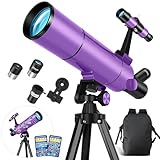
Strip away the purple finish and this is the same optical specification as the other 80mm/500mm refractors in this roundup: 80mm aperture, 500mm focal length, f/6.25, roughly 160x theoretical maximum magnification. What the Dianfan adds is a colour a child actually chose, plus a portable form factor. It suits families where the telescope is unambiguously the child’s, and where a bit of personal ownership is worth paying for — because a telescope a child feels is theirs gets used more.
Key specifications
- Aperture: 80mm — about 31% more light than 70mm, roughly 2.6x more than 50mm.
- Focal length: 500mm
- Focal ratio: f/6.25
- Theoretical maximum magnification: about 160x.
- Resolving power: about 1.45 arcseconds — enough to resolve the larger lunar craters and split wide double stars.
- Mount: alt-azimuth, hand-controlled.
- Form factor: portable refractor with a coloured tube — easy to identify in a dark yard.
Strengths
The colour is not a trivial detail in this market. A telescope that looks like the child’s own instrument, rather than a piece of shared grey equipment, is more likely to be taken outside unprompted. That single behavioural difference can matter more than 10mm of aperture, because the best telescope is the one that actually gets used.
On the optics, 80mm at f/6.25 is a strong beginner specification. It is fast enough to give a reasonably wide field for locating objects, and slow enough that chromatic aberration stays tolerable on the Moon. The 500mm focal length reaches 50x with a 10mm eyepiece and 150x with a 10mm eyepiece plus a 3x Barlow — both comfortable, both achievable with ordinary accessories. With a 25mm eyepiece you get 20x, which is a good starting magnification for a child learning to aim.
The 80mm aperture also raises the ceiling on what is visible. Globular clusters such as M13 begin to resolve into individual stars rather than remaining a fuzzy ball, and the brighter galaxies such as M31 become extended shapes rather than smudges. That progression — from “bright dot” to “resolved object” — is what keeps a child interested past the first month.
Pros
- 80mm aperture gives real planetary and lunar detail.
- f/6.25 ratio balances field width against colour correction.
- Distinctive coloured tube encourages ownership and use.
- Portable enough for one-person setup by a child aged nine or older.
- Specification leaves room for eyepiece upgrades without hitting optical limits.
- Bright finish reduces the risk of collisions in a dark yard.
Cons
- Premium tier pricing for an optical specification shared with several other 80mm scopes.
- Still an achromatic refractor — colour fringing on bright objects is unavoidable.
- No advantage in aperture or focal length over the Hawkko or MEEZAA 80mm options.
- Colour availability can affect stock; the purple version is not always the easiest to find.
- Supplied tripods in this class are the limiting factor for high-magnification stability.
How it compares
The nearest alternative is the MEEZAA 80mm/500mm. Optically they are the same class — same aperture, same focal length, same focal ratio, same theoretical magnification ceiling. The difference is intent: the MEEZAA is pitched at adults and children sharing, the Dianfan at a child owning. Against the Hawkko 80mm/500mm for kids 8–12, the Dianfan is the more personal choice and the Hawkko the more broadly specified one. If two children will share the telescope, a neutral-coloured 80mm is the fairer buy; if one child is the owner, the Dianfan’s colour is a genuine feature.
6. Hawkko Telescope Kit for Kids 8–12, 80mm Aperture 500mm — Best for Buyers Who Want Everything in One Box

This is the kit version of the 80mm/500mm specification: same optics, packaged with the accessories a beginner needs so nothing has to be bought separately. It suits parents and gift-buyers who do not want to research eyepieces, Barlows and phone adapters, and who would rather open one box on a birthday and have a complete working setup. It is aimed at children aged 8–12, with the usual caveat that an adult should be involved for the first session or two.
Key specifications
- Aperture: 80mm — the practical maximum for a child-manageable refractor.
- Focal length: 500mm
- Focal ratio: f/6.25
- Theoretical maximum magnification: about 160x; comfortable working range 40x–120x.
- Magnification examples: 20x with a 25mm eyepiece, 50x with a 10mm eyepiece, 150x with a 10mm eyepiece plus a 3x Barlow.
- Mount: alt-azimuth, hand-controlled, on an aluminium tripod.
- Packaging: complete kit — tube, mount, tripod, eyepieces, Barlow and accessories in one purchase.
Strengths
The value of a kit is that everything is known to work together. Buying an 80mm optical tube, a tripod, a diagonal, two eyepieces and a Barlow separately is a research project, and mismatched parts — particularly a diagonal that will not reach focus with a given eyepiece — are a common source of frustration for first-time buyers. A kit eliminates that risk entirely.
Beyond packaging, the specification is the strong one. 80mm at f/6.25 is the sweet spot of the beginner market: enough aperture for Saturn’s rings and Jupiter’s cloud belts, short enough focal length that the tube stays portable, and a focal ratio that is neither so fast that colour fringing ruins the Moon nor so slow that the field becomes too narrow for a child to find anything. The 160x theoretical ceiling is more than the atmosphere will usually allow, which means the optics are never the limiting factor on an average night.
The kit format also handles the upgrade question gracefully. Because the accessories are included, the first upgrade a family makes is an eyepiece — a genuinely transformative change on an f/6.25 refractor — rather than a missing part they did not know they needed.
Pros
- Complete setup in one purchase — no compatibility guesswork.
- 80mm aperture gives genuine detail on the Moon and planets.
- f/6.25 focal ratio is a good all-round compromise.
- Alt-azimuth mount requires no alignment and no power.
- Eyepieces and Barlow included, so magnification options exist on day one.
- Upgrade path is straightforward — better eyepieces make a visible difference.
Cons
- Premium tier price, and part of that cost is the bundled accessories rather than the optics.
- Included eyepieces are functional rather than good; a quality eyepiece upgrade is the obvious next step.
- Bundled tripods in this class are adequate, not rigid — high magnification will show vibration.
- Achromatic refractor, so colour fringing on bright objects remains.
- Overlaps heavily with the other 80mm/500mm scopes here, so the choice is about accessories and price, not optics.
How it compares
Against the standalone Hawkko 80mm/500mm, this kit version is the same telescope with more in the box. If you are starting from nothing, the kit is the simpler purchase; if you already own eyepieces from another telescope, the standalone tube is the better value. Against the MEEZAA 80mm/500mm, the optics are equivalent and the difference is again packaging and intended audience — the MEEZAA leans toward family sharing, this kit toward a child’s complete first setup. Against the Dianfan 80mm/500mm, the optics match and the choice comes down to whether you value the coloured tube or the fuller accessory set.
7. MEEZAA 80mm Aperture 500mm Refractor — Best Premium Family Telescope
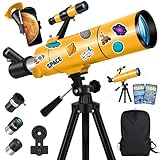
This is the telescope to buy when the child is not the only observer. The 80mm/500mm refractor specification is the same class-leading one used by the other premium picks here, but the MEEZAA is explicitly positioned for adults and kids together. It suits a household where a parent is curious about astronomy themselves, where siblings of different ages will take turns, and where the telescope needs to be comfortable for an adult eye as well as a child’s.
Key specifications
- Aperture: 80mm — about 1.45 arcseconds of resolving power, 31% more light than 70mm.
- Focal length: 500mm
- Focal ratio: f/6.25
- Theoretical maximum magnification: about 160x.
- Practical magnification: 60x–120x on an average night.
- Mount: alt-azimuth, hand-controlled.
- Intended users: adults and children sharing the instrument.
Strengths
The strongest argument for the MEEZAA is longevity. A telescope that works for an adult is a telescope that does not become a child’s cast-off at fourteen. The 80mm aperture and 500mm focal length are a specification an adult can use seriously for lunar and planetary observing, for double stars, and for the brighter Messier objects. That means the instrument has a lifespan measured in a decade rather than a summer.
Sharing matters more than it sounds. When a parent and child observe together, the adult can handle the aiming and focusing while the child looks — which removes the two hardest parts of using a telescope and leaves only the rewarding part. It also means the telescope gets set up on nights the child would not have bothered alone. An 80mm scope used forty nights a year delivers far more value than a 70mm scope used eight.
Optically, f/6.25 is a genuine all-rounder. With a 25mm eyepiece you get 20x and a wide field for locating targets; with a 10mm eyepiece you get 50x for the Moon; with a Barlow you reach 150x for Jupiter and Saturn when the atmosphere allows. Nothing in that progression pushes the optics beyond their limits, which is why this specification is so widely recommended.
Pros
- Specification works for adults as well as children, extending the telescope’s useful life.
- 80mm aperture delivers real detail on planets and the Moon.
- f/6.25 focal ratio balances field width, colour correction and magnification range.
- Encourages shared observing, which increases how often the scope is used.
- Alt-azimuth mount is simple enough for a child and quick enough for an adult.
- No electronics — nothing to charge, update or replace.
Cons
- Premium tier pricing.
- Not marketed specifically to children, so the accessory set may suit adults more than young users.
- Chromatic aberration on bright objects is inherent to the achromatic design.
- At 80mm it is still a modest deep-sky instrument; expectations should be set accordingly.
- The tripod supplied in this class is the limiting factor for stability at high magnification.
How it compares
The closest comparison is the Hawkko 80mm/500mm for kids 8–12. The optics are equivalent; the difference is who the scope is for. Choose the Hawkko if the child is the primary user and you want a design and accessory set tuned to that. Choose the MEEZAA if you expect to be standing at the eyepiece yourself. Against the Dianfan 80mm/500mm, the MEEZAA is the more neutral, family-oriented option, while the Dianfan is the more personal, child-owned one. All three share the same optical ceiling, so this is a decision about positioning, not performance.
8. NASA Lunar Telescope for Kids Ages 8–12 — Best for Lunar-Focused Beginners
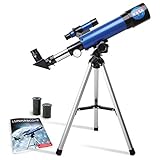
This is a budget-tier beginner refractor from Blue Marble, branded and themed around NASA’s lunar imagery, supplied with a tripod and a finder scope. It suits children aged 8–12 who are specifically excited about the Moon, and it suits buyers who want an instrument with a clear, single purpose rather than a general-purpose telescope. It is the right answer for a child who has been looking at lunar photographs and wants to see the craters themselves.
Key specifications
- Optical design: small-aperture refractor — a sealed tube, no collimation required.
- Included accessories: tripod and finder scope, which is the minimum a beginner needs.
- Finder scope: a separate low-power sighting tube that makes aiming the main telescope far easier than sighting along the barrel.
- Mount: alt-azimuth tripod, hand-adjusted.
- Portability: light enough for a child to move alone.
- Best targets: the Moon, Jupiter’s moons, Saturn’s ring shape, and the brightest star clusters.
Strengths
The finder scope is the detail that lifts this above the most basic instruments. Aiming a telescope without a finder is genuinely difficult: the field of view at high magnification is tiny, and a child trying to point a long tube at a specific crater will usually fail. A finder scope gives a wide, low-power view with a crosshair, so the target can be centred there and then magnified. For beginners of any age, this is the single most useful accessory after the eyepiece.
The NASA branding and lunar focus also do real work. A child who has seen the Apollo landing sites in photographs and then looks at the same region through an eyepiece is making a connection that a generic telescope does not offer. The lunar surface is also the ideal first target: it is bright enough to see from a light-polluted back garden, large enough that finding it is easy, and detailed enough at 60x–100x that the view is genuinely rewarding.
As a budget instrument, the priorities are right. Light weight, simple mount, no electronics, nothing to break. The wear points are the tripod leg clamps and the focuser, and both last years with reasonable care.
Pros
- Finder scope included — a major usability advantage for beginners.
- Budget tier pricing with a themed, motivating presentation for children.
- Light and portable; a child can set it up alone.
- Sealed refractor design needs no collimation and little maintenance.
- Lunar viewing is where small apertures perform best, so the scope plays to its strengths.
- No power supply, no batteries, no software.
Cons
- Small aperture limits planetary detail and rules out most deep-sky objects.
- Budget tripod will vibrate at higher magnifications.
- Narrow useful magnification band compared with a 70mm or 80mm scope.
- Lunar and planetary focus means it is less versatile than a mid-range 70mm.
- Limited upgrade path — the next meaningful step is a larger aperture, not an accessory.
How it compares
Against the Sobrzy 100x beginner telescope, this scope’s advantage is the included finder scope, which makes aiming dramatically easier for a young user. Against the Luzsco 50mm, the NASA-branded scope is the more capable lunar instrument because of its accessory set rather than its aperture. Where it sits relative to the Gskyer 70mm is straightforward: the Gskyer has more aperture, more focal length and a better upgrade path, but it costs more and is a general-purpose scope rather than a focused one. If the child’s interest is specifically the Moon and the budget is fixed, this is the better fit; if the interest is broader, spend up to the 70mm tier.
9. ToyerBee 70mm FMC 300mm Refractor — Best for Wide-Field and Travel Use

At 70mm aperture and 300mm focal length, this refractor runs at f/4.3 — the fastest focal ratio in this roundup. That single number defines everything about it. Fast optics give a wide field of view and bright, low-magnification images, which makes the scope exceptionally easy to aim and well suited to large targets. It suits beginners who want to find things quickly, families who want a telescope that packs small for trips, and children aged 9–12 who get frustrated when they cannot locate a target.
Key specifications
- Aperture: 70mm — resolves about 1.66 arcseconds.
- Focal length: 300mm
- Focal ratio: f/4.3 — the fastest ratio here, giving the widest field of view.
- Optics: fully multi-coated (FMC) lens surfaces, which reduce internal reflections and improve contrast compared with single-coated or uncoated optics.
- Theoretical maximum magnification: about 140x, though the fast ratio makes high magnification less rewarding.
- Comfortable working magnification: 12x–60x.
- Field of view: with a 25mm eyepiece you get 12x, and with a typical 50-degree apparent-field eyepiece that is roughly a four-degree true field — eight full moons across.
Strengths
Fully multi-coated optics are a meaningful specification, not marketing filler. Every air-to-glass surface in the optical path reflects a small percentage of light; multi-coating reduces that loss to a fraction of a percent per surface. In a telescope with a lens, a diagonal and two eyepiece elements, the cumulative difference between coated and uncoated optics is visible as improved contrast on faint objects. For a beginner, better contrast means the Orion Nebula looks like a nebula rather than a grey smudge.
The fast f/4.3 ratio makes this the easiest scope in the roundup to aim. A four-degree field means the Moon, the Pleiades and large asterisms all fit comfortably, and a child can sweep the sky and find things without precise pointing. Combined with the short 300mm tube, this is also the most packable option — it fits in a rucksack and survives a car journey to a darker site.
The low magnifications this scope favours are also the ones that look best through a beginner refractor. At 12x–40x the image is bright, wide and stable, and the tripod’s limitations matter far less than they do at 140x. In practice, this is a scope that performs near its best in the conditions a child will actually use it in.
Pros
- Fully multi-coated optics improve contrast and light transmission.
- Fastest focal ratio here — widest field, easiest aiming for beginners.
- Short tube packs small and travels well.
- Performs at its best at the low magnifications a beginner uses most.
- 70mm aperture gives a real step up over 50mm instruments.
- Bright, stable images reduce tripod-shake frustration.
Cons
- Fast f/4.3 ratio produces noticeable chromatic aberration on the Moon and bright planets.
- 300mm focal length makes high magnification awkward — reaching 150x needs a 2mm eyepiece or a strong Barlow, and both degrade the image.
- Less satisfying on planets than a slower 70mm or 80mm scope.
- Very short tube can be awkward to balance on some tripods.
- Mid-range pricing for an aperture that budget 70mm scopes also offer.
How it compares
Its closest twin in this list is the Jvcla 70mm/300mm FMC — same aperture, same focal length, same focal ratio, same coating specification and the same 15x–150x magnification range. The two are functionally equivalent, and the choice between them comes down to bundled accessories and availability. Against the Gskyer 70mm/400mm, the ToyerBee is faster, wider and more portable, but worse on planets; the Gskyer’s slower ratio gives cleaner high-magnification views. If the child wants to find things easily and take the scope places, this is the better instrument. If they want to study the Moon at 100x, it is not.
10. Luzsco 50mm 100x Beginner Telescope — Best for Ages 5–8 and Tabletop Use

At 50mm aperture, this is the smallest instrument in the roundup, and that is precisely the point. It suits children aged roughly five to eight, where weight and simplicity matter more than light gathering, and it suits households with very limited storage space. The 50mm objective resolves about 2.32 arcseconds and supports a theoretical maximum magnification of about 100x, matching the stated figure on the box.
Key specifications
- Aperture: 50mm — the smallest usable beginner aperture.
- Stated magnification: 100x.
- Theoretical maximum magnification: about 100x, following the 2x-per-millimetre guideline.
- Resolving power: about 2.32 arcseconds — enough for the Moon’s larger features and the shape of Saturn’s rings, not enough for fine planetary detail.
- Mount: lightweight alt-azimuth tripod, hand-adjusted.
- Weight class: the lightest here; manageable by a six-year-old.
- Best targets: the Moon, Jupiter as a disc with moons, Saturn as an oval, the brightest star clusters.
Strengths
The strongest argument for a 50mm telescope is that it gets used. A five-year-old cannot carry a 4 kg instrument, cannot tighten a tripod clamp properly, and cannot reliably aim a long tube. A 50mm refractor on a light tripod can be carried, aimed and focused by a young child with a little help, which means the telescope becomes part of their routine rather than a special-occasion object. That is worth more than aperture in the early years.
The 100x magnification figure is genuinely useful at this aperture. The Moon at 100x is a compelling sight — the terminator line shows crater rims casting long shadows, and the maria are clearly darker than the highlands. Jupiter shows as a small disc with its four Galilean moons strung out in a line, which is one of the most reliable “wow” moments in amateur astronomy and requires very little aperture.
Durability is also a genuine strength. There is no mirror to fall out of alignment, no electronics, and very little that can be broken by a careless child. The scope either works or it does not, and with reasonable care it works for years.
Pros
- Lightest and simplest instrument here — usable by a five- to eight-year-old.
- 100x magnification is enough for rewarding lunar and Jupiter viewing.
- Budget tier pricing makes it a low-risk gift or trial purchase.
- Sealed refractor design needs no maintenance or collimation.
- Small footprint stores easily in a bedroom.
- No batteries, no alignment, no setup routine.
Cons
- 50mm aperture gathers about half the light of a 70mm scope and roughly 38% of an 80mm.
- Fine planetary detail is beyond it — Jupiter’s cloud belts will not be obvious.
- Deep-sky objects are largely out of reach beyond the brightest clusters.
- Limited upgrade path; the next step is a larger aperture, not an accessory.
- Light tripod is sensitive to vibration even at moderate magnification.
How it compares
Against the Sobrzy 100x, the Luzsco is the better fit for younger children because of its smaller aperture and lighter build, while the Sobrzy suits the eight-to-twelve band better. Against the NASA Lunar Telescope, the Luzsco trades the finder scope for lower weight — a fair trade for a six-year-old, a poor one for a ten-year-old. And against the Gskyer 70mm, the difference is stark: the Gskyer has roughly twice the light gathering and a much higher useful magnification ceiling. If the child is eight or older, spend up; if they are five, this is the right size.
11. Fuoibl 70mm FMC 15X–150X Refractor — Best Budget 70mm for Older Beginners
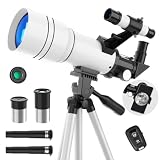
This is a budget-tier 70mm refractor with fully multi-coated optics and a stated magnification range of 15x to 150x. It suits older beginners aged 10–14 and adults on a tight budget who want a genuine 70mm aperture without paying mid-range prices. The FMC coating specification is the notable feature: it is the kind of optical detail usually reserved for more expensive instruments.
Key specifications
- Aperture: 70mm — resolves about 1.
Affiliate disclosure. As an Amazon Associate we earn from qualifying purchases at no extra cost to you. Prices accurate as of the date shown.Best Telescopes for Kids by Age and Skill…Check price on Amazon