Key takeaways
- Using a visually similar charger: A connector that fits may have a different pin layout, polarity, or shape. Match the exact watch model.
- Charging while wet: Dry the watch and contacts completely after exercise, rain, or swimming.
- Forcing a clip or puck: Pressure can bend pins, scratch the case, or damage the charging assembly.
- Using damaged accessories: Replace cables with exposed wires, cracked plugs, loose USB ends, or burn marks.
- Charging on soft surfaces: Bedding and upholstery trap heat and can pull the watch out of alignment.
- Cleaning with metal: Pins and contacts can be scratched or shorted by needles, paper clips, or screwdrivers.
- Relying on a weak port: A television or older computer port may provide limited power and charge very slowly.
- Ignoring battery behavior: A watch that drains rapidly, becomes hot, or shuts down during charging may have a battery or circuit problem.
Charging a GPS smartwatch sounds simple, but using the wrong cable, lining up contacts poorly, or exposing the watch to moisture can lead to slow charging, missed workouts, or damage to the charging port. A watch that appears connected may not actually be receiving power if its magnetic pins or charging clip are slightly misaligned. Dirt, sweat, and sunscreen can also interrupt the connection.
This guide explains how to charge a GPS smartwatch safely in 2026, whether it uses a magnetic puck, a two- or four-pin clip, or a proprietary cradle. The process usually takes only a few minutes to set up, but a full charge may take roughly 60 to 150 minutes depending on the battery size, charger, temperature, and watch model.
As an Amazon Associate we earn from qualifying purchases at no extra cost to you. Product prices and availability are accurate as of the date shown and are subject to change.

What You Need
| Item | Why | Optional? |
|---|---|---|
| Compatible charging cable, puck, clip, or cradle | Transfers power to the watch through its specific contacts or port. Check the model number before buying a replacement. | No |
| USB wall adapter or powered USB port | Provides electricity to the charging cable. A standard 5-volt adapter rated around 1 to 2 amps is suitable for many watches, unless the manufacturer specifies otherwise. | No |
| Clean, dry microfiber cloth | Removes sweat, dust, sunscreen, and moisture from the watch and charging contacts. | No |
| Toothpick or soft, dry brush | Helps remove loose debris from around contacts. Never scrape the contacts with metal. | Yes |
| Replacement charging cable | Useful if the original cable is frayed, intermittently disconnects, or no longer fits securely. | Yes |
| Stable, ventilated surface | Allows heat to escape while the battery charges and prevents the watch from being pulled off a table. | Yes |
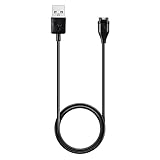
Replacement cables vary widely in price. A basic model-specific USB charging cable or clip commonly costs about $7 to $20. For example, the E ECSEM compatible replacement clip for several Garmin Vivoactive models is listed at $6.98. Compatibility matters more than appearance: a cable designed for one Vivoactive generation may not fit another watch correctly.
Step-by-Step
-
Confirm the charger matches your watch (2 minutes)
Look at the watch’s model name on the case, packaging, companion app, or settings menu. Compare it with the name printed on the charging cable or its product description. GPS smartwatch chargers are often proprietary, even when the USB end looks standard.
Do not force a magnetic puck, clip, or plug into place. If the charger does not sit flush, the contacts do not line up, or the cable needs to be held at an angle, stop and verify compatibility.
-
Let the watch cool and dry (5 to 10 minutes)
Remove the watch after a run, swim, or hot-weather workout and allow it to reach room temperature. Wipe away sweat and water with a soft microfiber cloth. Even watches labeled water-resistant should be completely dry around their charging contacts before you connect power.
Never charge a watch while it is wet, submerged, or covered with saltwater or pool chemicals. Water resistance protects against certain exposure conditions; it does not make wet charging safe.
-
Clean the charging contacts (1 to 2 minutes)
Inspect the back of the watch and the charger. Look for lint, skin oils, corrosion, or a film of dried sweat. Wipe both surfaces gently. If debris is lodged beside a contact, use a soft, dry brush or wooden toothpick with a light touch.
Avoid alcohol, household cleaners, abrasive pads, and metal tools unless the manufacturer specifically recommends a cleaning method. Do not bend spring-loaded pins or press hard on small contact points.
-
Connect the USB cable to power (1 minute)
Plug the charging cable into a reliable USB wall adapter, computer port, or power bank. For many GPS watches, a basic 5-volt USB adapter delivering about 1 to 2 amps is sufficient. The watch draws only the current it is designed to accept, but you should still follow the manufacturer’s instructions.
Use a reputable adapter with an intact housing and cable. Avoid loose travel adapters, damaged power banks, and unknown accessories that become unusually hot. A high-wattage phone or laptop charger may work with some watches, but do not assume fast-charging compatibility simply because the connector fits.
-
Attach the watch in the correct position (1 to 2 minutes)
For a magnetic charger, place the puck against the back of the watch and let the magnets align it. For a clip-style charger, position the clip so every pin touches the matching metal contact. For a charging cradle, seat the watch evenly without pressing the display or buttons against the stand.
The screen should show a charging icon, battery animation, vibration, or another charging indicator within a few seconds. If nothing appears, remove the charger, rotate or reseat it, and check the contacts again. Do not leave a doubtful connection unattended for hours.
-
Check the first few minutes (5 minutes)
Keep the watch and charger on a hard, open surface such as a desk or nightstand. Confirm that the battery percentage increases after several minutes. A slight warmth can be normal, but unplug the charger if the watch becomes hot, smells unusual, swells, or repeatedly connects and disconnects.
Do not charge under bedding, inside a closed drawer, in direct sun, or next to a heater. Remove a protective case if it prevents the charging connector from sitting flat.
-
Charge to the level you need (30 to 150 minutes)
Many GPS smartwatches reach a useful level of charge in 20 to 40 minutes and a full charge in roughly 1 to 2.5 hours. Larger batteries, older cables, low-power USB ports, active GPS, and software updates can extend that time. The watch may charge more slowly while it is being used.
When the display indicates 100 percent, or the manufacturer’s full-charge signal appears, unplug the cable. Leaving a watch connected occasionally is not usually an immediate problem, but disconnecting it after charging reduces unnecessary heat and cable wear.
-
Inspect the result and store the cable (2 minutes)
Confirm that the battery percentage rose and that the watch starts normally. Disconnect by holding the connector or plug, not by yanking the wire. Coil the cable loosely and store it somewhere dry. Keep magnetic chargers away from small metal objects that can cling to the contacts.
Mistakes to Avoid
- Using a visually similar charger: A connector that fits may have a different pin layout, polarity, or shape. Match the exact watch model.
- Charging while wet: Dry the watch and contacts completely after exercise, rain, or swimming.
- Forcing a clip or puck: Pressure can bend pins, scratch the case, or damage the charging assembly.
- Using damaged accessories: Replace cables with exposed wires, cracked plugs, loose USB ends, or burn marks.
- Charging on soft surfaces: Bedding and upholstery trap heat and can pull the watch out of alignment.
- Cleaning with metal: Pins and contacts can be scratched or shorted by needles, paper clips, or screwdrivers.
- Relying on a weak port: A television or older computer port may provide limited power and charge very slowly.
- Ignoring battery behavior: A watch that drains rapidly, becomes hot, or shuts down during charging may have a battery or circuit problem.
How Often
Charge the watch whenever the battery reaches about 20 to 30 percent, or according to your planned activity. Most GPS models need charging every few days with ordinary notifications and occasional workouts, while continuous GPS tracking, music, calls, bright displays, and frequent notifications can reduce runtime substantially.
For a long hike, race, or travel day, charge to at least 80 to 100 percent beforehand. If you use GPS for several hours, a short top-up during a shower or meal may be more convenient than waiting for the battery to become nearly empty. Avoid routinely storing the watch at 0 percent. If it will sit unused for weeks, leave it around 40 to 60 percent and check it periodically.
When to Call a Pro or Replace
Stop charging and contact the manufacturer or an authorized repair service if the watch swells, cracks, emits an odor, becomes too hot to touch, or shows signs of liquid intrusion. A battery that will not hold a charge, drops from full to empty unusually quickly, or repeatedly shuts down may need professional replacement.
Replace the cable when the watch charges only if the wire is bent, the connector must be held in one position, or the cable shows physical damage. If a new, verified-compatible cable and clean contacts do not solve the problem, the fault may be in the watch’s charging contacts, battery, or internal charging circuit. Do not open a sealed smartwatch yourself; piercing its battery can cause fire or injury.
FAQ
Can I charge a GPS smartwatch with a phone charger?
Often, yes, if the watch cable terminates in USB and the adapter meets the watch manufacturer’s requirements. A standard 5-volt adapter in the approximately 1 to 2 amp range is commonly suitable. The USB plug alone does not guarantee compatibility, so use the correct watch-specific cable and avoid assuming that a fast-charging mode is supported.
Why is my smartwatch not charging when the cable is connected?
Remove and reseat the charger, clean and dry the contacts, and check that the cable matches the exact model. Test another known-good USB adapter or outlet. If the charging icon flickers, the cable may be worn or the pins may not be making consistent contact.
How long should a GPS smartwatch take to charge?
Many models take about 60 to 150 minutes from low battery to full. A small top-up may take 20 to 40 minutes. Charging time varies with battery capacity, temperature, charger output, cable condition, and whether GPS or other features remain active.
Is it safe to leave a GPS smartwatch charging overnight?
Modern watches generally manage charging automatically, but overnight charging is best done on a hard, ventilated surface with an undamaged, compatible cable. Unplug the setup if the watch becomes hot, smells unusual, swells, or repeatedly disconnects. For maximum battery care, disconnect it after it reaches full charge.