Key takeaways
- Convenient self-care: You can use one at home in a few minutes without scheduling an appointment.
- Useful for temporary tightness: It may help muscles feel more relaxed after exercise, travel, gardening, or long periods of sitting.
- Easy to share: A household can use the same device on appropriate muscle areas, provided each person follows the safety instructions.
- Many contact options: Multiple heads let you choose broader or more focused pressure, though more attachments do not necessarily mean better results.
- Potentially good value: A $39.99 model costs less than several professional massage visits and may be worthwhile if you use it weekly.
- Portable enough for routines: A cordless design can fit into a gym bag or bedroom drawer, depending on the model’s size and battery setup.
- Simple to control: You can start gently and adjust the speed based on comfort instead of relying on someone else to set the pressure.
What's inside
The Short Answer
Yes—if you want a convenient way to relieve temporary muscle tightness and you can use it safely. A massage gun is worth considering when you regularly exercise, sit for long periods, or prefer self-massage at home. It is not a cure for an injury, chronic pain, or an unexplained medical problem, and it cannot replace physical therapy or professional care.
For most shoppers, the decision comes down to expectations. A massage gun can make sore muscles feel looser for a while, but the results are usually temporary. At a roughly $40 entry price, models such as the TOLOCO massage guns can be a reasonable convenience purchase. The question is whether you will use that convenience often enough to justify buying another device.
As an Amazon Associate we earn from qualifying purchases at no extra cost to you. Product prices and availability are accurate as of the date shown and are subject to change.

What You Actually Get
A massage gun is a handheld percussive massager. Its motor moves an attachment rapidly back and forth against the body, creating repeated pressure over a muscle. Different heads are intended for broad areas, smaller muscle groups, or more targeted contact. Most consumer models include several attachments and multiple speed settings, although the exact controls and power vary by model.
In practical terms, you get a tool for short sessions before or after activity. You might use it on your thighs after a run, your calves after standing all day, or your upper back after desk work. The sensation ranges from a gentle vibration to a firm tapping or pounding, depending on the setting and the amount of pressure you apply.
It is important to separate “feels better” from “heals faster.” Percussion may temporarily reduce the feeling of stiffness and make movement feel easier. It does not automatically repair a strained muscle, correct posture, remove scar tissue, or treat the cause of persistent pain. A massage gun also cannot reach every area safely, especially the spine and some joints.
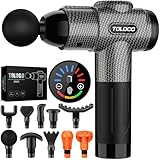
The two related TOLOCO listings are essentially the same type of budget product: a deep-tissue percussion massager with 10 massage heads and a brushless motor, priced at $39.99 each. The Black and Carbon versions may appeal to different tastes or gift buyers, but color and marketing language should not be treated as proof of superior performance. Before buying, confirm the current specifications, included charger, warranty, noise information, and return policy.
Pros
- Convenient self-care: You can use one at home in a few minutes without scheduling an appointment.
- Useful for temporary tightness: It may help muscles feel more relaxed after exercise, travel, gardening, or long periods of sitting.
- Easy to share: A household can use the same device on appropriate muscle areas, provided each person follows the safety instructions.
- Many contact options: Multiple heads let you choose broader or more focused pressure, though more attachments do not necessarily mean better results.
- Potentially good value: A $39.99 model costs less than several professional massage visits and may be worthwhile if you use it weekly.
- Portable enough for routines: A cordless design can fit into a gym bag or bedroom drawer, depending on the model’s size and battery setup.
- Simple to control: You can start gently and adjust the speed based on comfort instead of relying on someone else to set the pressure.
Cons
- Relief may be short-lived: The device addresses sensations of tightness, not necessarily the underlying cause.
- It can hurt when misused: Too much pressure, too high a speed, or too long a session can leave you bruised, sore, numb, or irritated.
- Some areas are off-limits: Avoid the front of the neck, head, spine, kidneys, bones, open wounds, bruises, and directly over joints.
- Hard-to-reach muscles are difficult: You may need another person to position the device safely on parts of your back, and that person may apply too much pressure.
- Budget models involve compromises: A low price can mean less refined controls, a less comfortable grip, shorter battery life, or inconsistent durability.
- Noise and vibration can be annoying: Even a motor advertised as quiet still produces sound and noticeable vibration in your hand.
- It is easy to overuse: Feeling good in the moment can encourage repeated treatment of the same tender area.
Who Should Buy It
A massage gun makes the most sense for someone who already has a repeatable use case. Regular exercisers may appreciate a short warm-up or recovery routine for large muscle groups such as the glutes, quadriceps, hamstrings, and calves. People who spend much of the day at a desk may like it for general upper-back or shoulder-muscle tension, as long as they avoid the neck and spine.
It can also suit shoppers who value convenience more than a luxury experience. If you would use a $39.99 TOLOCO model several times per week, the purchase may be easier to justify than a more expensive device. A beginner should prioritize a comfortable grip, clear speed controls, an automatic shutoff if available, a return window, and instructions that explain safe use. Ten attachments sound impressive, but practical controls and good handling matter more.
Buyers should also be realistic about treatment time. Start with about 30 seconds on one muscle area, then move slowly for up to a few minutes rather than holding the device in one painful spot. Use the lowest comfortable setting first. The goal is mild, manageable pressure—not a test of how much discomfort you can tolerate.
Who Should Skip It
Skip a massage gun if you are hoping it will diagnose or fix severe, recurring, or unexplained pain. Seek medical advice for pain after a serious injury, major swelling, weakness, loss of sensation, fever, significant bruising, or symptoms that do not improve. A massage gun is particularly inappropriate over a suspected fracture, fresh sprain, acute tear, infected area, or open wound.
Ask a clinician before using one if you take blood thinners, have a bleeding or clotting disorder, reduced sensation, significant circulation problems, osteoporosis, or a condition that affects muscle or nerve function. People with implanted medical devices, recent surgery, or pregnancy-related concerns should also get individualized guidance rather than relying on general online advice.
It is also a poor choice if you dislike gadgets, have limited hand strength, or are unlikely to establish a routine. A device that sits unused in a drawer is not a bargain, regardless of its price.
Cheaper Alternatives
| Option | Cost | Trade-off |
|---|---|---|
| Foam roller | $10–$35 | Very affordable and useful for larger muscle groups, but it takes more effort and can be awkward for the upper body. |
| Massage ball | $5–$20 | Excellent for targeted pressure and travel, but it offers no vibration and can feel intense on tender areas. |
| Manual roller stick | $8–$25 | Lightweight and easy to control, though it requires both hand strength and active effort. |
| Stretching routine | $0 | Costs nothing and may improve mobility when practiced consistently, but it does not provide the immediate massage sensation some people want. |
| Professional massage | $60–$150 per session | More personalized and relaxing, but substantially more expensive over time and dependent on appointments. |
FAQ
Does a massage gun actually work?
It can temporarily reduce the feeling of tightness and make a muscle feel easier to move. Results differ by person, body area, pressure, and timing. Think of it as a comfort and mobility tool, not a guaranteed treatment for pain or injury.
How long should I use a massage gun?
Start with about 30 seconds on a muscle area and keep a session brief—often one to two minutes per area is enough. Keep the device moving, use a comfortable setting, and stop if you notice sharp pain, tingling, numbness, bruising, or worsening soreness. More time and more pressure are not automatically better.
Can I use a massage gun every day?
Many healthy adults can use gentle percussion regularly on appropriate muscle groups, but daily use is not required. Let soreness settle and avoid repeatedly treating the same painful spot. If you need the device every day just to function, investigate the underlying problem with a qualified professional.
Is a $39.99 massage gun worth buying?
It can be, especially for occasional muscle tightness and basic recovery at home. At this price, judge the purchase by usability rather than attachment count. Check the controls, grip, charging setup, warranty, return policy, and safety guidance. The TOLOCO Black and Carbon listings are reasonable budget options to compare, but neither should be expected to deliver the refinement or durability of every premium model.