Key takeaways
- Pro: 360 sheets per roll at 3-ply gives strong per-roll longevity.
- Pro: Organic, FSC certified, PFAS-free, and septic safe — the broadest certification stack in this group.
- Con: Only 12 rolls per pack, so high-use households may reorder frequently.
Most “eco-friendly” toilet paper on the market is still chemically bleached, just packaged in brown paper. The difference matters: unbleached toilet paper skips the chlorine, oxygen bleach, and optical brighteners that give conventional rolls their stark white color, leaving the natural tone of bamboo or recycled fiber intact. Buyers searching for genuine unbleached toilet paper are usually trying to eliminate PFAS, reduce chemical load on sensitive skin, or ensure their bathroom habits align with a low-impact household.
What separates a worthwhile roll from a mediocre one comes down to verifiable sourcing (FSC or organic certification), actual ply and sheet count rather than marketing fluff, septic compatibility, and packaging that practices what the fiber preaches. We compared the published specs and owner feedback across the eight models below to sort the genuinely unbleached from the merely unbranded.
Our top picks




As an Amazon Associate we earn from qualifying purchases at no extra cost to you. Ratings are shown as listed on Amazon.
Quick Picks
| Product | Best for | Price |
|---|---|---|
| Betterway 12-Roll | Overall balance | $29.99 |
| Amazon Aware 24-Roll | Household volume | $31.94 |
| Amazon Aware 12-Roll | Value entry point | $18.25 |
| Betterway 36-Roll | Bulk stocking | $67.99 |
| Caboo Tree Free | Minimalist ingredients | $29.99 |
| ECOLipak 2-Ply | Septic-sensitive plumbing | $27.99 |
| Seventh Generation | Lowest price per pack | $5.29 |
| Reel Premium | Softness priority | $27.99 |
How We Picked
We evaluated every product on four axes: material composition (bamboo, recycled, or mixed tree-free fiber), third-party certification (FSC, organic, PFAS-free claims backed by labeling), sheet architecture (ply count and sheets per roll, which determine real-world performance), and packaging footprint. A roll that lists 3-ply but uses fewer sheets per roll than a competitor delivers less usable tissue per dollar, so we normalized value to cost-per-sheet where specs allowed. Septic safety claims from the manufacturer were noted when stated, since that remains a frequent buyer concern.
The 8 Best Unbleached Toilet Paper in 2026
Betterway 12-Roll
Betterway’s 12-pack serves households that want premium bamboo fiber without committing to a bulk order. At 360 sheets per roll and 3-ply construction, each roll delivers more usable tissue than several competitors at similar price points. Owner feedback consistently highlights softness and lack of lint residue, which matters for anyone switching from conventional bleached paper. The FSC certification and organic labeling provide traceable sourcing, and the PFAS-free claim is printed directly on the packaging.
- Pro: 360 sheets per roll at 3-ply gives strong per-roll longevity.
- Pro: Organic, FSC certified, PFAS-free, and septic safe — the broadest certification stack in this group.
- Con: Only 12 rolls per pack, so high-use households may reorder frequently.
Skip this if you need more than 12 rolls per delivery window or want a lower entry price.
Amazon Aware 24-Roll
Amazon’s house brand targets households that go through paper quickly. Twenty-four rolls at 350 sheets each means 8,400 total sheets in a single shipment, which translates to fewer reorder cycles. The 3-ply build and FSC certification keep it competitive with pricier bamboo brands on material credentials, and plastic-free packaging aligns with the broader eco-positioning. Owner reviews note the roll diameter is slightly smaller than conventional supermarket rolls, so expect a perceptibly thinner profile in the holder.
- Pro: Highest total sheet count in this roundup at 8,400.
- Pro: FSC certified and plastic-free with no added fragrance.
- Con: No PFAS-free or organic certification listed, which may concern the strictest buyers.
Skip this if your priority is the widest possible certification stack rather than volume.
Amazon Aware 12-Roll
The smaller pack of the same formula works as an introduction to unbleached bamboo paper at the lowest price for a 12-roll bundle in this comparison. Specs mirror the 24-roll version — 3-ply, 350 sheets per roll, FSC certified, plastic-free — so you get the same tissue experience without overcommitting to a large order. It suits single-person homes, small bathrooms, or anyone testing whether bamboo fiber feels acceptable before scaling up.
- Pro: Lowest cost per 12-roll bamboo pack here at $18.25.
- Pro: Identical material and certification to the 24-roll version.
- Con: No septic-safe or PFAS-free claims on the listing.
Skip this if your household burns through paper fast enough that the 24-roll pack is cheaper per sheet.
Betterway 36-Roll
For a full-year supply in one order, Betterway’s 36-roll pack delivers 12,960 sheets of 3-ply organic bamboo at a competitive per-roll rate. The certifications are identical to the 12-roll version: FSC, organic, septic safe, lint-free, PFAS-free. Owner feedback praises the long shelf life since bamboo fiber resists degradation better than recycled pulp. The tradeoff is a $67.99 upfront cost that exceeds most single-pack budgets.
- Pro: Highest total sheet count of any Betterway option, minimizing reorder frequency.
- Pro: Full certification stack with septic-safe confirmation.
- Con: Largest single-purchase price; requires storage space for 36 rolls.
Skip this if you rent with limited storage or prefer smaller, more frequent deliveries.
Caboo Tree Free
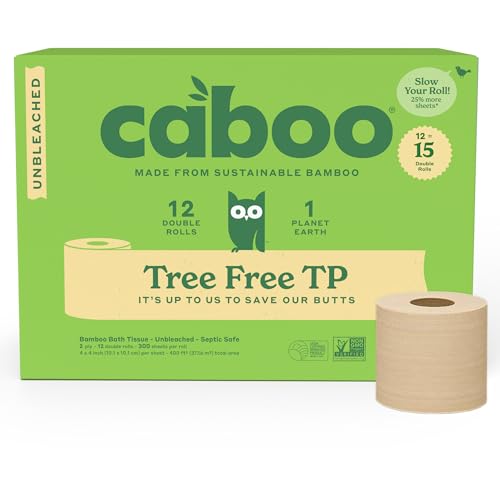
Caboo occupies a different niche: it does not emphasize ply count or sheet-per-roll data the way bamboo competitors do. The “Tree Free” branding signals bamboo and sugarcane blend fiber, unbleached, with plastic-free packaging. Owner reviews frequently mention a slightly coarser hand-feel than premium 3-ply bamboo options, but note the product breaks down quickly in plumbing, which appeals to older septic systems. At $29.99 for 12 rolls, it sits at the same price point as Betterway’s 12-pack.
- Pro: Plastic-free packaging and clear unbleached positioning without greenwashing ambiguity.
- Pro: Owners report fast breakdown in septic systems.
- Con: Published specs do not list ply count or sheets per roll, making direct comparison harder.
Skip this if you need confirmed 3-ply softness for sensitive skin.
ECOLipak 2-Ply
ECOLipak uses 2-ply construction with 320 sheets per roll across 24 double rolls, offering a middle ground between softness-focused 3-ply options and value-driven thin rolls. The listing calls out septic safety, tree-free sourcing, non-toxic production, and dye-free paper. Owners describe the tissue as noticeably thinner than 3-ply competitors but adequate for single-sheet use. The $27.99 price for 24 rolls works out to a low per-roll cost.
- Pro: Septic-safe, dye-free, and non-toxic labeling without a premium markup.
- Pro: 24 double rolls provide strong value per dollar.
- Con: 2-ply at 320 sheets means each roll has less usable surface area than 3-ply options here.
Skip this if you prefer plush, multi-ply softness over functional simplicity.
Seventh Generation Recycled 4-Roll
Seventh Generation takes a different material path entirely: 100% recycled paper, chlorine-free processing, 2-ply, sold in a 4-count pack. It is the cheapest option in this roundup at $5.29, which makes it the natural budget pick. Owner feedback notes the recycled pulp feel is distinctly less cushiony than bamboo, and some users report more lint. For anyone whose priority is removing chlorine bleach from their routine at the lowest possible cost, it delivers.
- Pro: Lowest absolute price and chlorine-free 100% recycled composition.
- Pro: Established brand with transparent sourcing history.
- Con: Only 4 rolls per pack and no FSC, organic, or PFAS-free certification listed.
Skip this if you want bamboo fiber, higher ply count, or certification-backed sourcing.
Reel Premium 3-Ply
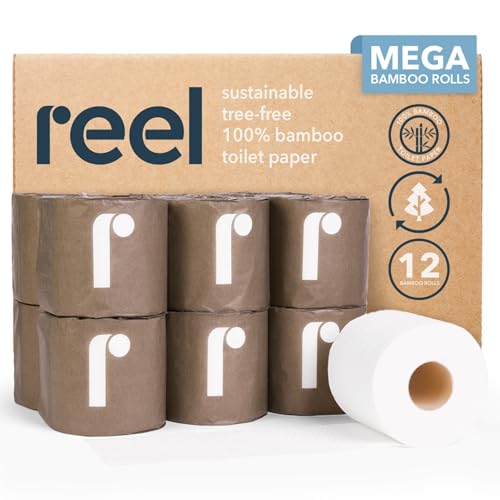
Reel positions itself on comfort, using 3-ply bamboo with 300 sheets per roll across 12 rolls. Owner reviews consistently rank it among the softest unbleached options available, with minimal lint transfer. At $27.99 it undercuts Betterway’s 12-pack by a couple dollars while matching the same ply count. The tradeoff is 300 sheets per roll versus Betterway’s 360, so each roll empties faster in real use. Reel’s listing does not mention FSC certification or septic safety, leaving the certification stack thinner than its competitors.
- Pro: Frequently praised as the softest 3-ply bamboo option in this group.
- Pro: Competitive pricing at $27.99 for 12 rolls.
- Con: Fewest sheets per roll (300) and no published FSC or septic-safe claims.
Skip this if certification depth and sheet-per-roll longevity matter more than hand-feel.
Buying Guide
Certification tells the real story
“Unbleached” without a certification trail is a marketing label, not a guarantee. FSC certification confirms responsibly sourced fiber; USDA Organic or equivalent confirms no synthetic pesticides entered the growing process. The strongest listings in this group — Betterway’s two packs — stack organic, FSC, PFAS-free, septic-safe, and lint-free claims. When a product omits these, it does not prove the fiber was chemically treated, but it leaves you unable to verify. Prioritize whichever certification maps to your specific concern: skin sensitivity, chemical avoidance, or forestry impact.
Ply and sheets per roll determine actual value
Two rolls can both say “3-ply” while delivering very different amounts of usable tissue. Betterway puts 360 sheets per roll; Reel puts 300; ECOLipak puts 320. A household using one roll per person per week will notice that gap compound quickly. Divide price by total sheets rather than price by roll count when comparing value. A $5 pack of 4 rolls is not a bargain if each roll is half the length of a standard roll.
Packaging and septic compatibility
Bamboo fiber is naturally longer and stronger than recycled pulp, which means it resists breaking apart in plumbing. Manufacturers like Betterway and ECOLipak explicitly state septic safety; others do not. If you are on a septic system, look for that confirmation rather than assuming all tree-free paper is safe. On the packaging side, plastic-free wrapping eliminates the film layer most conventional brands use, reducing your household waste footprint beyond just the paper itself.
Our Verdict
Our top pick is the Betterway 12-Roll at $29.99. It balances the deepest certification stack (organic, FSC, PFAS-free, septic-safe, lint-free), the highest sheet count per roll in this group (360 at 3-ply), and a price that remains reasonable for most households. Our budget pick is Seventh Generation’s 4-count at $5.29, the cheapest route to chlorine-free recycled paper with an established brand behind it. The Amazon Aware 24-roll pack wins outright if your household’s consumption rate makes reorder frequency the primary cost driver — 8,400 sheets at $31.94 is the best total-sheet price available here.
FAQ
Is unbleached toilet paper safe for septic systems?
Generally yes, because the fibers in bamboo and recycled paper break down at similar rates to conventional wood-pulp paper. Products like Betterway and ECOLipak explicitly confirm septic safety on their packaging, which removes the guesswork. Avoid rolls with added lotions, thickeners, or synthetic binders regardless of whether they are bleached or unbleached.
Why is unbleached toilet paper brown or tan?
It shows the natural color of the fiber after processing. Bamboo pulp is light tan; recycled paper tends darker because ink removal during recycling cannot achieve a fully neutral tone. The color itself is not an indicator of quality — certification and fiber composition are.
Does unbleached mean chemical-free?
No. Unbleached only means the fiber skips the whitening step (chlorine, hydrogen peroxide, or optical brighteners). Other chemicals may still appear in adhesives, inks, or processing aids. PFAS-free labeling, which Betterway includes, addresses one specific class of concern, but no product can claim to be entirely chemical-free.
How many rolls does an average household need?
Published consumer data suggests one person uses roughly one standard roll per week. A 24-roll pack covers two people for three months, which is why the Amazon Aware 24-roll option appeals to households wanting fewer deliveries. Smaller packs suit testing or single-occupancy use.