Key takeaways
- Pro: Large bag size keeps cost per pound low for frequent grillers.
- Pro: Hickory-charcoal combination produces a traditional BBQ profile without the bitter edge some mesquite blends show.
- Con: Some owners note slightly more fines than competition-grade pellets, requiring occasional hopper cleaning.
Every pellet grill owner eventually hits the same wall: the manufacturer-recommended hardwood pellets deliver clean smoke but lack that deep, pit-like charcoal backbone. Blending in charcoal pellets or switching to a charcoal-forward fuel solves the flavor gap, but not all charcoal pellets burn the same. Dense, low-ash pellets feed steadily and keep temperatures stable through a long cook. Thin, under-pressed pellets break down in the hopper, spike temp swings, and leave you scraping clinkers out of the firepot mid-brisket.
What separates a good charcoal pellet from a mediocre one comes down to three things: the actual charcoal-to-wood ratio in the recipe, how the pellet is bound and compressed, and whether the blend is engineered for the airflow dynamics of a pellet grill specifically. A pellet designed for a stick burner or a pizza oven may not feed cleanly through a standard auger. This roundup compares eight options that pellet grill owners actively discuss, pulling together published ingredient claims, price-per-pound math, and recurring owner feedback to sort the worthwhile from the underwhelming.
Our top picks


As an Amazon Associate we earn from qualifying purchases at no extra cost to you. Ratings are shown as listed on Amazon.
Quick Picks
| Product | Best for | Price |
|---|---|---|
| Royal Oak Charcoal & Hickory | Classic smoky BBQ flavor | $34.99 |
| Royal Oak Charcoal & Competition Blend | Competition-style multi-meat cooks | $34.99 |
| Royal Oak Charcoal & Apple | Sweet, pork-forward cooking | $34.99 |
| Royal Oak Charcoal & Mesquite | Bold, beef-heavy cooks | $34.99 |
| Kona Coal-Fired Pizza Blend | High-heat pizza and small-format cooks | $15.95 |
| Traeger Signature Blend | Everyday versatility at a low price | $19.99 |
| Camp Chef Competition Blend | 20-lb value with multi-meat performance | $18.99 |
| Kona Wood Pellet Variety Pack | Flavor experimentation without commitment | $39.95 |
How We Picked
We narrowed these eight by weighing ingredient transparency (does the label state a real charcoal percentage or blend composition?), ash behavior as reported by owners running similar grills, price per pound relative to bag size, and format compatibility with pellet grill augers and firepots. Products that require a specific grill brand to feed correctly were noted but not disqualified, since a meaningful segment of buyers already owns that equipment.
The 8 Best Charcoal Pellets For Pellet Grill in 2026
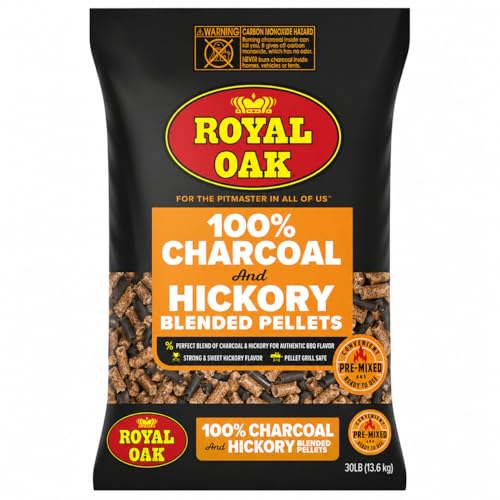
Royal Oak Charcoal & Hickory
This is the default choice for owners who want that unmistakable smokehouse note on brisket and ribs without buying competition-grade fuel at a premium. The 30-pound bag keeps price-per-pound competitive against smaller hardwood bags, and owners consistently report a steady feed with minimal dust in the hopper. Hickory pairs naturally with charcoal, so the smoke reads warm and rounded rather than acrid.
- Pro: Large bag size keeps cost per pound low for frequent grillers.
- Pro: Hickory-charcoal combination produces a traditional BBQ profile without the bitter edge some mesquite blends show.
- Con: Some owners note slightly more fines than competition-grade pellets, requiring occasional hopper cleaning.
Skip if you cook only poultry or fish, where hickory can overwhelm delicate proteins.
Royal Oak Charcoal & Competition Blend
Marketed for multi-meat competition cooks, this blend layers several woods over a charcoal base to hit pork, beef, and poultry without swapping pellets mid-session. Owners running Traeger or Pit Boss grills report it feeds cleanly and holds setpoints well through six-hour cooks. The trade-off is a milder individual flavor—each wood is present but none shouts.
- Pro: Versatile enough to smoke a whole board of different meats in one session.
- Pro: Consistent burn geometry reported across multiple grill brands.
- Con: Lacks the punch a single-wood blend delivers if you only cook one protein at a time.
Skip if you prefer a pronounced, single-wood flavor on every cook.
Royal Oak Charcoal & Apple
Apple wood brings a gentle sweetness that complements pork shoulder, chicken, and even smoked turkey without the tannic bite of heavier woods. At 30 pounds, the price-per-pound math works in its favor for anyone grinding through bags during grilling season. Owners praise the clean burn and the way apple smoke pairs with charcoal’s depth for a well-rounded profile.
- Pro: Sweet, approachable smoke that suits family cooks and poultry-focused menus.
- Pro: Bulk bag pricing makes it one of the most economical options here.
- Con: The mild apple character can disappear behind strong rubs or bold sauces.
Skip if you cook exclusively heavy beef where you want assertive smoke up front.
Royal Oak Charcoal & Mesquite
Mesquite is the loud, earthy wood that beef lovers chase. Combined with charcoal, it delivers the deep, almost leathery smoke that pairs with thick-cut steaks and fatty brisket. The 30-pound format again keeps per-pound cost grounded. Owners report robust flavor but caution that mesquite can turn soapy in small, underfired pellets.
- Pro: Bold, assertive smoke that stands up to heavy seasoning and large cuts.
- Pro: Consistent size and density across bags reported by repeat buyers.
- Con: Mesquite is polarizing; some tasters perceive a chemical or soapy note at lower temps.
Skip if your household includes anyone sensitive to mesquite flavor.
Kona Coal-Fired Pizza Blend
This two-pound bag is explicitly built for the Ninja Woodfire Outdoor Grill, a compact electric unit with tighter airflow tolerances than full-size pellet grills. The charcoal-and-wood blend targets the high-heat, short-duration profile needed for pizza crust and small proteins. Owners using a Ninja report a rich, coal-fired taste that standard hardwood pellets cannot replicate.
- Pro: Engineered for a specific grill, so feed behavior is predictable in that unit.
- Pro: Delivers a genuinely coal-fired flavor profile in a compact format.
- Con: Only two pounds per bag, so cost per pound is high for frequent use.
Skip if you do not own a Ninja Woodfire; the small pellet size and blend may not feed correctly in standard grills.
Traeger Signature Blend
The familiar yellow bag remains the safe default for Traeger owners who want a mild, all-purpose smoke without experimenting. At eighteen pounds, it is not the cheapest per pound here, but its availability and consistency reduce the risk of a bad cook. The blend is hardwood-forward with no listed charcoal content, which positions it as a baseline rather than a charcoal upgrade.
- Pro: Widely available and reliably consistent across production runs.
- Pro: Mild flavor works on virtually any protein or vegetable without overstepping.
- Con: Contains no declared charcoal, so it will not deliver the deeper smoke character buyers seeking charcoal pellets expect.
Skip if your specific goal is to add charcoal depth to your fuel.
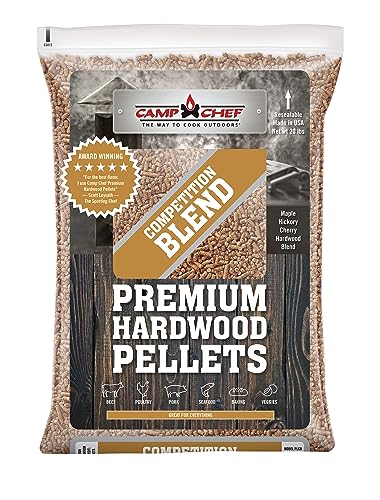
Camp Chef Competition Blend
A twenty-pound bag priced under twenty dollars makes this one of the strongest value plays in the roundup. The blend combines oak, cherry, and maple for a balanced sweet-and-smoky profile suited to multi-protein cooks. Owners report low ash and steady temps, though some note the flavor is gentler than dedicated competition brands at the same price tier.
- Pro: Aggressive price per pound for a multi-wood competition blend.
- Pro: Low reported ash output reduces firepot maintenance between cooks.
- Con: The cherry-maple sweetness may read too mild for heavy beef applications.
Skip if you want a single dominant wood character rather than a blended profile.
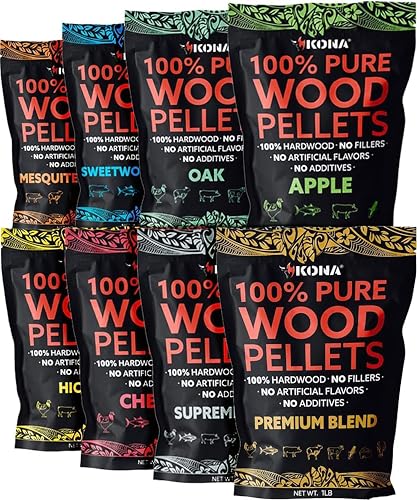
Kona Wood Pellet Variety Pack
Eight one-pound bags of distinct flavors let owners test multiple profiles without committing a thirty-pound bag to a blend that might disappoint. The pack is designed for the Ninja Woodfire, so it pairs naturally with the Kona pizza blend above. It is the logical companion purchase for anyone exploring the system’s flavor range.
- Pro: Zero-risk sampling across eight flavor profiles.
- Pro: Compact one-pound bags stay fresh and resist moisture better than open thirty-pound sacks.
- Con: Highest cost per pound in this roundup; not practical for volume cooking.
Skip if you already know your preferred flavor and need bulk supply.
Buying Guide
Charcoal Ratio and Ingredient Transparency
Labels that state “100% natural hardwood” often contain zero charcoal despite being marketed alongside charcoal blends. Look for packaging that names charcoal as an actual ingredient and, ideally, specifies a ratio. Without that detail, you cannot predict whether the pellet will deliver the deeper, richer smoke you are paying for.
Pellet Size and Feed Compatibility
Standard pellet grills expect roughly six-to-nine-millimeter pellets with sufficient compressive strength to survive auger travel. Specialty blends for compact units like the Ninja Woodfire sometimes use smaller or differently shaped pellets. Mismatching pellet geometry to your grill can cause feed jams or uneven burn, so verify the manufacturer’s compatibility note before buying.
Ash Content and Long-Cook Stability
Charcoal pellets typically produce more ash than pure hardwood because the binding process and charcoal carbon structure leave mineral residue. Owners of six-hour-plus cooks should check feedback for ash volume and firepot cleanout frequency. A slightly higher price-per-pound is worth paying if the alternative is a clogged firepot at hour four.
Our Verdict
The top pick is Royal Oak Charcoal & Hickory: it balances price, flavor, and feed reliability in a bulk format that suits the widest range of proteins and cook styles. For the budget pick, Camp Chef Competition Blend offers a genuine multi-wood competition profile at the lowest per-pound cost in this group. However, if you cook exclusively on a Ninja Woodfire, the Kona Coal-Fired Pizza Blend outperforms every standard grill pellet in that specific system because it is engineered to match its airflow and heat profile.
FAQ
Can I mix charcoal pellets with regular hardwood pellets?
Yes, and many owners do exactly that to fine-tune smoke intensity. Start with a fifty-fifty mix, note the result, and adjust. Avoid mixing brands with radically different pellet sizes, as the smaller diameter can roll past the auger while the larger one starves the firepot.
Do charcoal pellets burn hotter than hardwood pellets?
Generally, yes. Charcoal has a higher carbon density, so it radiates more heat per unit consumed. This can slightly reduce the total pellets you burn over a long cook, partially offsetting a higher bag price.
How should I store charcoal pellets to prevent dust?
Keep bags sealed in a dry, cool area—ideally off the garage floor. Charcoal pellets absorb moisture faster than hardwood, and damp pellets crumble into fines that clog the auger. An airtight bin with a desiccant pack extends shelf life meaningfully.
Are charcoal pellets safe for all pellet grills?
They are safe for any grill rated for wood or charcoal pellets, but check your warranty. Some manufacturers specify proprietary or “approved” pellets. Higher ash from charcoal blends may require more frequent firepot cleaning regardless of warranty language.