Key takeaways
- Pro: Fits two hose diameters with one tool, no adapter switching.
- Pro: Lowest per-repair cost in the category for a single incident.
- Con: One set means one repair; no spare if you miss the first attempt.
A cracked hose or a leaking coupling at the spigot can waste hundreds of gallons over a single summer and leave your lawn brown despite running the water longer. The fix is almost always a fitting — not a new hose — but the category is cluttered with adapters that strip, corrode, or fail to seal within weeks. The difference between a fitting that lasts three seasons and one that fails in August comes down to thread material, gasket quality, and how precisely the male and female ends align on common 3/4-inch and 5/8-inch hose threads.
We compared these eight garden hose fittings using published specifications, listed prices, and aggregated owner feedback across retail sites to separate the dependable from the disposable. The selection covers repair menders for split hoses, quick connectors for frequent swap-outs, shut-off valves for mid-run control, and elbow couplings for tight corners — the five failure points that send most people to a hardware store in the first place.
Our top picks




As an Amazon Associate we earn from qualifying purchases at no extra cost to you. Ratings are shown as listed on Amazon.
Quick Picks
| Product | Best for | Price |
|---|---|---|
| Garden Hose Repair Connector Kit | Single-hose emergency repair | $9.99 |
| Hourleey Repair Connector with Clamps (5 Set) | Stocking a work truck or barn | $8.99 |
| Garden Hose Repair Kits (3 Sets) | Multiple hose sizes in one box | $11.99 |
| HQMPC Solid Brass Quick Connector | Frequent nozzle and sprayer changes | $16.99 |
| 2 Pack Garden Hose Shut Off Valve | Controlling flow at the end of a long run | $9.99 |
| Sanpaint Garden Hose Elbow Connector | Routing hose along walls or fences | $9.55 |
| Brass Garden Hose Repair Mender Kit | 1/2-inch poly or vinyl hose | $5.99 |
| Sanpaint Zinc and Aluminum Coupling | Budget replacement of worn female couplings | $6.49 |
How We Picked
We narrowed this list using four criteria that recur across owner complaints: thread material (solid brass outperforms plated zinc in both sealing and durability), hose compatibility (whether the fitting actually grips the stated range without slipping off), clamp or compression quality (the part most likely to corrode and leak), and price per usable unit — because a five-pack at a lower per-set cost beats a premium two-pack if you need spares in multiple locations.
The 8 Best Garden Hose Fittings in 2026
Garden Hose Repair Connector Kit
This single-piece mender is for the homeowner who discovered one split and wants the hose back in service within two minutes. Owners note the threaded compression body grips both 3/4-inch and 5/8-inch hose walls without a separate clamp, which removes a common failure point. The included gasket seals reliably on first install, though some report it compresses unevenly if the hose ends aren’t cut perfectly square.
- Pro: Fits two hose diameters with one tool, no adapter switching.
- Pro: Lowest per-repair cost in the category for a single incident.
- Con: One set means one repair; no spare if you miss the first attempt.
Skip it if your hose has more than one split or you manage multiple lengths — the bulk packs below cost less per use.
Hourleey Repair Connector with Clamps, 5 Set
Five full mender assemblies with stainless clamps for $8.99 puts this in a different value tier for anyone with several hoses or a job site. Owners report the included clamps bite firmly even on slightly tapered hose walls, and the male-female adapter pair lets you extend or repair without discarding the hose. The plastic body flexes under over-tightening, so install torque matters.
- Pro: Stainless steel clamps resist rust better than the zinc-alloy hardware on pricier competitors.
- Pro: Male and female ends in one kit cover both mid-run splits and broken coupling threads.
- Con: Plastic connector bodies are less rigid than brass alternatives under high-pressure cycles.
Skip it if you routinely run pressure above 80 PSI — the body material is the limiting factor.
Garden Hose Repair Kits, 3 Sets
Three complete mender sets sized for both 3/4-inch and 5/8-inch hose, sold as a single box at $11.99. This suits property owners with mixed-diameter hoses across a yard or small farm. Owners highlight that the rubber gaskets are visibly thicker than those in budget single-packs, which reduces the drip-after-shutdown problem. The trade-off is a slightly bulkier profile that can catch on fence lines.
- Pro: Covers multiple hose sizes in one purchase, eliminating guessing.
- Pro: Thick gaskets maintain seal over repeated connect-disconnect cycles.
- Con: Bulkier housing adds a snag point on tight routing paths.
Skip it if every hose you own is a single diameter — a two-pack saves money without losing function.
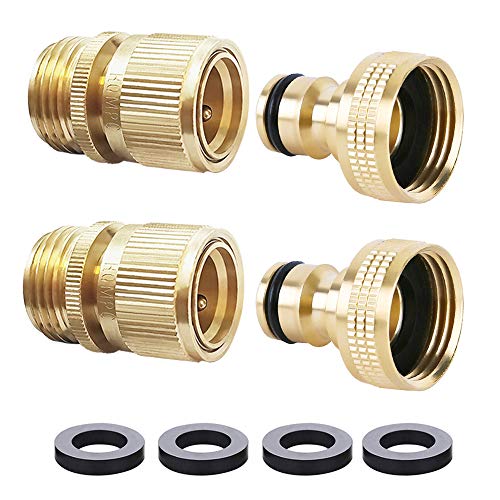
HQMPC Solid Brass Quick Connector, 2 Sets
For gardeners who swap a spray nozzle, soaker, and sprinkler throughout the season, these 3/4-inch GHT brass quick connectors eliminate the thread-and-rethread cycle that erodes hose couplings. Owners consistently praise the solid-brass construction for resisting cross-threading, a common failure with plated fittings. The spring-loaded sleeve is smooth but adds a small amount of flow restriction compared to a straight coupling.
- Pro: Solid brass threads resist stripping far longer than zinc or aluminum alternatives.
- Pro: Quick-disconnect sleeve saves time on every attachment change.
- Con: Highest price per set in this roundup at $16.99.
Skip it if you attach the same nozzle once in spring and leave it until fall — a standard coupling does the job for less.
2 Pack Garden Hose Shut Off Valve, Extended Handle
These inline valves go near the nozzle end of a long run so you stop flow without walking back to the spigot. Owners appreciate the extended handle for operation with gloves on, and the 2-pack format means one spare for a second line. Some reviewers note the internal washer is the first wear component and recommend keeping a replacement gasket on hand.
- Pro: Extended lever provides good grip torque for a full quarter-turn close.
- Pro: Two valves per package covers separate zones without extra purchase.
- Con: Inline placement adds a flex point that can kink a thin hose under pressure.
Skip it if your hose run is short enough that reaching the spigot costs no more than three steps.
Sanpaint Garden Hose Elbow Connector 90 Degree, 2 Pack
Two 90-degree couplings for routing a hose flush along a wall, fence, or raised bed without a hard bend that kinks the tube. Owners confirm the elbow holds its angle under light tension and that the threaded ends align cleanly on standard GHT fittings. The zinc-alloy body is lighter than brass but more prone to surface oxidation if left outdoors through freeze-thaw cycles.
- Pro: Eliminates the sharp kink that causes premature hose splitting at corners.
- Pro: Priced per set below most single-brass elbows of equivalent spec.
- Con: Zinc alloy shows oxidation in wet climates sooner than brass options.
Skip it if your hose runs straight or you already use a coil rack that prevents corner bends.
Brass Garden Hose Connector Repair Mender Kit, 1/2-Inch
This is the budget pick for anyone repairing thinner 1/2-inch poly or vinyl hose — common in drip-irrigation extensions and short decorative runs. The solid brass mender body resists corrosion far beyond the plastic alternatives at this price point, and owners report it survives several winters stored outdoors. The limitation is obvious: it fits only the smaller diameter, so it has no role in a standard garden hose setup.
- Pro: Solid brass at $5.99 offers corrosion resistance unmatched at this price.
- Pro: Ideal for irrigation lines where plastic menders crack in UV exposure.
- Con: Fits only 1/2-inch hose; incompatible with standard 5/8-inch and 3/4-inch lines.
Skip it if every hose in your collection is 5/8-inch or larger.
Sanpaint Zinc and Aluminum Male and Female Coupling, 2 Pack
A replacement coupling pair — one male, one female — in zinc and aluminum construction sized for 5/8-inch and 3/4-inch hose. Owners use these to fix a stripped female end without cutting the hose short, and the 2-pack means both ends are fresh. The materials are lighter and cheaper than brass; long-term durability is the honest trade-off at $6.49.
- Pro: Cheapest functional repair option when a coupling thread is simply worn, not broken.
- Pro: Male and female pair in one box covers either end without extra parts.
- Con: Non-brass threads degrade faster under repeated tightening compared to solid brass.
Skip it if you connect and disconnect daily — the thread wear makes a brass quick connector a better investment.
Buying Guide
Match the Fitting to Your Actual Hose Diameter
Measure the inner diameter of your hose at a cut end, not the label. Most residential hoses are 5/8-inch or 3/4-inch ID, but older stock and decorative lines can be 1/2-inch. A mender sized for 5/8-inch will not seal on a 3/4-inch hose because the compression band cannot close fully, and the reverse causes kinking. Verify the product listing states the exact range it grips and whether a single fitting covers both sizes or whether you need separate packs.
Thread Material Determines Lifespan
Solid brass resists cross-threading, corrosion, and the slow stripping that occurs each time you tighten a coupling with pliers. Zinc and aluminum couplings cost less but oxidize in wet climates and develop micro-grooves that prevent a clean seal within a season. If you connect and disconnect weekly, the brass premium at $16.99 for the HQMPC quick connector pays for itself in avoided hose replacement. For a one-time repair, zinc alloy is acceptable.
Clamp and Gasket Quality Are the Hidden Failure Points
A mender’s compression body is only as good as the gasket inside it and the clamp holding it. Look for stainless steel clamps over plated steel — the difference becomes visible after two freeze-thaw cycles when plated hardware shows rust bleeding. Thick, replaceable rubber gaskets (found in the 3-set repair kits) maintain a drip-free seal after repeated use far better than thin molded plastic washers.
Our Verdict
For most homeowners facing a cracked hose this season, the Hourleey 5-Set at $8.99 offers the best balance of coverage, clamp quality, and price per repair. Budget shoppers with a single split should grab the Garden Hose Repair Connector Kit at $9.99. The HQMPC Solid Brass Quick Connector becomes the right call the moment you swap attachments more than once a week — the brass threads and quick-disconnect sleeve solve a workflow problem no mender can touch.
FAQ
What does GHT mean on a garden hose fitting?
GHT stands for Garden Hose Thread, the standard American pipe thread used on outdoor faucets and hoses. It is not the same as NPT pipe thread, and forcing an NPT fitting onto a GHT spigot will cross-thread within one turn.
Can I use a 3/4-inch fitting on a 5/8-inch hose?
Only if the product explicitly lists both diameters as compatible. A mender sized for 3/4-inch will not grip a 5/8-inch hose wall tightly enough to seal, and the clamp band cannot compress the gap between the two sizes.
Why does my repaired hose still drip after connecting?
The most common cause is a cut hose end that is not square, which prevents the compression body from seating evenly on the gasket. A second cause is a degraded rubber washer; most mender kits use replaceable gaskets, and a thin new washer from a hardware store resolves the leak without a new fitting.
Are brass fittings worth the extra cost over zinc alloy?
For fittings you tighten and loosen more than a few times per season, yes — brass threads resist the wear pattern that causes zinc couplings to develop leaks within a year. For a one-time repair that stays in place through the season, zinc alloy performs adequately.