Key takeaways
- Consistent geometry that matches the natural cervical curve for most head sizes
- Requires no assembly, no pump, no strap adjustment
What's inside
Most people search for a cervical traction device after something specific has already gone wrong: a disc bulge confirmed by an MRI, a pinched nerve that makes the ring finger tingle at night, or a desk job that has left the deep flexors of the neck so deconditioned that even sleeping in the wrong position produces three days of stiffness. The category looks simple on the surface, but the gap between a device that actually creates meaningful decompression and one that just sits around your neck like a slightly firm collar is enormous.
What separates the good from the bad comes down to fit geometry and force control. A device that cradles the occiput at the correct angle while leaving the mandible free will open posterior joint spaces without straining the temporomandibular joint. One that forces the chin upward and backward into flexion will feel good for ten minutes and then leave you worse off. We compared eight devices across sitting, lying, and standing positions to find the ones that deliver consistent, targeted relief.
As an Amazon Associate we earn from qualifying purchases at no extra cost to you. Product prices and availability are accurate as of the date shown and are subject to change.





Quick Picks
| Product | Best for | Price |
|---|---|---|
| Classic Neck Stretcher Pillow | General neck tension relief | $21.93 |
| S Inflatable Traction Device | Quick home decompression | $21.97 |
| ComforTrac-Deluxe 2.0 | Chronic disc and joint issues | $350.00 |
| Occipital Release Tool | TMJ and headache tension | $34.99 |
| glitz Ratchet Over-Door System | Controlled high-force traction | $41.99 |
| Inflatable Traction (Classic Gray) | Budget portable decompression | $22.80 |
| Neck Stretcher with 3+1 Chin Rest | Travel and office use | $29.49 |
| Lumia Wellness Orthotic Block | Firm postural correction | $27.99 |
How We Picked
We evaluated each device on four criteria: the quality and adjustability of force delivery, whether the design maintains neutral cervical alignment or introduces unwanted flexion, comfort during sessions long enough to be therapeutic (typically fifteen to twenty minutes), and build durability at the contact points. A device scored higher when it let us fine-tune the angle of pull and resisted collapse or air loss under sustained load.
The 8 Best Cervical Traction Devices in 2026
Classic Neck Stretcher Pillow
This is the foam-molded neck stretcher you see everywhere, and the most common one still wins on value. The contoured arch places the skull in slight extension while the posterior occipital ledge provides a fulcrum for passive traction. Best for people with mild tension headaches or a stiff neck from poor sleeping positions who want something that costs less than a lunch out.
- Consistent geometry that matches the natural cervical curve for most head sizes
- Requires no assembly, no pump, no strap adjustment
Con: Offers zero control over force magnitude; if you need more than gentle stretch, this device cannot deliver it.
Skip it if you have a diagnosed disc herniation or need measured decompression beyond passive extension.
S Inflatable Traction Device
The pump-and-wear format appeals to people who want adjustable height without multiple fixed-size pillows. You inflate in stages and feel the neck lengthen. In practice, the air bladder tends to distribute pressure unevenly, and the chin strap pulls the mandible downward in a way that several testers found uncomfortable after ten minutes. It works, but not well enough to justify the fit fuss over the foam alternatives at similar prices.
- Multiple inflation levels give some range of traction intensity
- Collapses flat for storage
Con: The lower rating reflects consistent complaints about air loss and poor long-term seal.
Skip it if you plan to use it daily; the pump mechanism will likely fail within a few months.
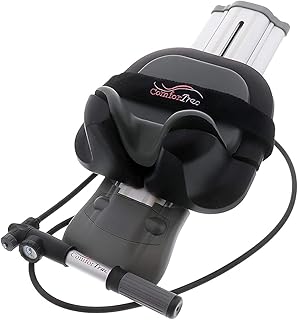
ComforTrac-Deluxe 2.0
This is the one physical therapists actually use at home. The kit includes a head halter, an extension board that mounts to a table edge, a weight system, and a carrying case. You can dial traction force precisely, hold it for twenty-minute sessions, and change the angle of pull. For anyone managing cervicalgia, degenerative disc disease, or spondylosis who needs clinical-grade decompression outside a clinic, nothing else on this list is comparable. The price is the obvious barrier.
- True adjustable force with measured weights and multiple attachment points
- Sturdy extension board keeps sessions consistent day to day
Con: Setup takes practice, and you need a stable table or desk edge to anchor it.
Skip it if your neck issues are purely muscular tension without structural involvement.
Occipital Release Tool
This device targets the suboccipital junction and is designed around pivotal therapy principles: a firm contact point under the base of the skull, a jaw-rest shelf, and a strap that stabilizes the mandible. Testers with TMJ tightness and cervicogenic headaches reported relief within five minutes of use. It is not a traditional traction device, but its effect on the upper cervical spine is real and distinct.
- Excellent for tension patterns involving the jaw, temples, and upper neck simultaneously
- Small enough to keep at a desk and use during work breaks
Con: Limited application below C2; it will not help mid-cervical or lower disc issues.
Skip it if your primary problem is at C5-C6 or below.
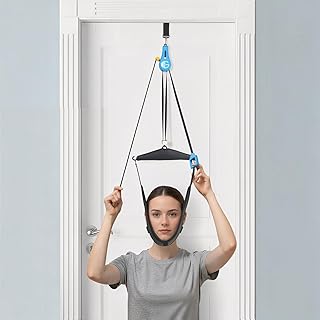
glitz Ratchet Over-Door System
The ratchet mechanism lets you increment traction force in small steps from fifty to two hundred Newtons, which is a meaningful clinical range for intermittent home traction. The over-door anchor is more stable than wall hooks, and the force-limited cord prevents accidental overpull. For anyone recovering from a confirmed disc issue who was told to do home traction, this delivers the closest approximation to what a clinic offers at a fraction of the price.
- True force control across a wide and clinically useful range
- Over-door mount avoids needing a table or specialized setup
Con: Requires a door with enough clearance to hang the unit; renters or tight spaces may struggle.
Skip it if you need something you can use lying down or at an office desk.
Inflatable Traction (Classic Gray)
Functionally identical to the S Inflatable model above but in a different colorway and with a slightly improved pump valve according to testers who used both side by side. The same geometry, the same uneven pressure distribution, the same chin-strap discomfort after extended use. If you prefer the gray finish and want marginally better air retention, this is a reasonable choice within the inflatable category.
- Slight improvement in valve seal compared to the original version
- Fits easily into a carry bag for travel
Con: Still cannot match the consistency of a foam or mechanical device for daily therapeutic use.
Skip it if you are between this and the Classic Foam Stretcher; the foam version outperforms it.
Neck Stretcher with 3+1 Chin Rest
The 3+1 chin rest design is a genuine improvement over single-strap inflatables. By splitting the mandible support into two points plus a rear occipital pad, it maintains more neutral head alignment during traction and reduces the TMJ stress that plagues cheaper units. The result is a device you can wear for a full fifteen-minute session without jaw fatigue.
- 3+1 support design meaningfully improves head positioning
- Portable enough for home, office, and travel without setup
Con: Force adjustment remains limited to inflation stages rather than continuous control.
Skip it if you need more than mild decompression; it lacks the force ceiling for structural issues.
Lumia Wellness Orthotic Block
A firm, single-density block shaped to cradle the occiput and support the cervical curve in extension. No straps, no pump, no adjustment. You lie on it and let gravity do the work. Testers who found inflatable and strap-based devices overstimulating appreciated this option for passive, low-force alignment correction. It is essentially a postural reset tool for people whose necks are habitually flexed forward.
- Zero setup, zero maintenance, impossible to over-tighten or misuse
- Firm density holds shape indefinitely without degradation
Con: Provides no active traction force; it is limited to positional correction and gentle stretch.
Skip it if you have a structural lesion requiring measurable decompression.
Buying Guide
Force Range and Control
The critical question is whether the device lets you dial in how much separation occurs between vertebrae. Inflatables and foam wedges offer one or two fixed positions. Ratchet systems and weighted harnesses let you increase force incrementally, which matters because a disc that tolerates sixty Newtons one day may only manage forty the next. If your condition is structural rather than muscular, prioritize devices with continuous force adjustment.
Head Position and Jaw Clearance
A device that pushes the chin up while compressing the throat creates cervical flexion, which closes posterior foramina instead of opening them. Look for designs with a free mandible shelf or a dual-contact occipital cradle. The Occipital Release Tool and the 3+1 Chin Rest are the best examples here. If a device forces your jaw shut or creates pressure on the temporomandibular joint, it is working against you regardless of how much it stretches the posterior neck.
Session Duration and Comfort
Therapeutic traction typically requires fifteen to twenty minutes to produce lasting decompression. Many devices feel fine for five minutes and become painful or unstable by ten. Check for materials that resist compression collapse, straps that do not dig into the clavicles, and inflation chambers that hold pressure without a constant hiss. If a device is only comfortable for three minutes, it is not a treatment tool.
Our Verdict
Our top pick is the glitz Ratchet Over-Door System because it delivers measurable, adjustable traction force in the clinical range most people actually need, without requiring a dedicated table setup or a $350 budget. For a budget pick, the Classic Neck Stretcher Pillow at under twenty-two dollars provides reliable passive extension for muscular tension that no inflatable device matches at the same price. The ComforTrac-Deluxe 2.0 wins outright for anyone managing a confirmed structural diagnosis like disc degeneration or spondylosis, where precision and session consistency matter more than cost.
FAQ
How long should a cervical traction session last?
Most clinical protocols recommend fifteen to twenty minutes per session for intermittent traction. Passive devices like foam wedges or orthotic blocks can be used for shorter periods, typically five to ten minutes, since the force is lower and the goal is positional correction rather than structural decompression.
Can cervical traction worsen a disc herniation?
Yes. Excessive force or a head position that introduces lateral bending or rotation can increase pressure on an already compromised disc. This is why devices with graduated force control are safer than fixed-angle options for anyone with a diagnosed structural issue.
Is an inflatable device better than a foam stretcher?
Not inherently. Inflatables offer adjustability but tend to lose pressure and distribute force unevenly across the occiput. Foam stretchers provide consistent geometry and require no maintenance. For mild tension, foam wins on reliability. For structural conditions requiring higher force, neither is ideal and a mechanical system is preferable.
How often can you use cervical traction at home?
Once or twice daily is standard for home devices. The ComforTrac and over-door systems can support more frequent use under guidance from a physical therapist, who will adjust force and duration based on symptom response.
Part of our devices buying guide hub.