Key takeaways
- Choosing by screen size alone. A larger screen can be helpful, but lug-to-lug length and thickness determine whether the watch physically overhangs your wrist.
- Assuming all 40mm watches wear the same. A 40mm round case, a 40mm square case, and a 40mm case with long lugs can look dramatically different.
- Ignoring the included strap size. Check the minimum wrist circumference, especially if your wrist is below 5.5 inches (14 cm).
- Buying a replacement band by width only. An 18mm, 20mm, or 22mm band must also use the correct attachment system. Quick-release pins are not automatically compatible with proprietary connectors.
- Wearing the watch too loose. A loose watch can rotate, feel heavier, and reduce sensor contact during exercise. It should be secure enough to stay in place without leaving deep marks.
- Forgetting about sleeve clearance. Thick cases and raised bezels can catch on fitted cuffs, even when the diameter seems appropriate.
What's inside
The Short Answer
For most adults with small wrists, a smartwatch case between 34mm and 41mm is the most comfortable starting point. If your wrist measures under 5.5 inches (14 cm) around, look first at watches with a case diameter or height of about 34mm to 38mm, plus a short-to-medium strap that can tighten securely without leaving a long tail.
Case size matters, but it is not the only measurement. A 40mm square watch can wear larger than a 40mm round watch, while a slim 42mm model with short lugs may still fit a smaller wrist well. The most important fit points are the watch’s lug-to-lug length, case thickness, strap adjustment range, and overall weight.
As an Amazon Associate we earn from qualifying purchases at no extra cost to you. Product prices and availability are accurate as of the date shown and are subject to change.


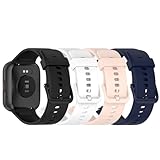
As a practical guideline, small wrists usually do best with a watch that has a lug-to-lug length of 45mm or less, a thickness under 12mm, and a strap that fits wrists beginning around 5.1 to 5.5 inches (13 to 14 cm). In 2026, there are more compact smartwatch options than ever, including square fitness watches, small round GPS watches, and narrow fitness trackers.
Standard Sizes
Smartwatch brands use several measurements: round watches are typically labeled by case diameter, while square and rectangular models are often labeled by case height. Use the table as a broad guide, then compare the manufacturer’s stated wrist-fit range before buying.
| Size Category | Typical Watch Case Size | Recommended Wrist Circumference | Best For |
|---|---|---|---|
| Extra-small fitness tracker | 0.7 to 1.0 in wide 1.8 to 2.5 cm wide |
4.7 to 6.7 in 12 to 17 cm |
Very slim wrists, sleep tracking, discreet everyday wear |
| Small square smartwatch | 34 to 38mm case height 1.34 to 1.50 in |
5.1 to 6.7 in 13 to 17 cm |
Small wrists, notifications, activity tracking |
| Medium square smartwatch | 40 to 42mm case height 1.57 to 1.65 in |
5.5 to 7.5 in 14 to 19 cm |
Buyers who want a larger screen without an oversized look |
| Small round smartwatch | 35 to 40mm diameter 1.38 to 1.57 in |
5.1 to 6.9 in 13 to 17.5 cm |
Traditional-watch styling and lighter daily wear |
| Large round smartwatch | 42 to 47mm diameter 1.65 to 1.85 in |
6.3 to 8.3 in 16 to 21 cm |
Maps, outdoor sport features, and maximum screen visibility |
For a small wrist, the sweet spot is usually a 35mm to 40mm round case or a 34mm to 40mm square case. If you prefer an especially subtle look, choose a narrow tracker-style device rather than simply selecting the smallest full smartwatch available.
Weight is another comfort factor. Lightweight tracker bands can weigh roughly 15 to 25 grams without a charger, while compact smartwatches commonly land around 25 to 40 grams for the case. Heavier metal models may exceed 45 grams before the strap is included. That extra weight can cause a watch to rotate around a narrow wrist during workouts.
How to Measure Your Space
Here, “space” means the usable area on the top of your wrist—not just the circumference around it. A tape measure gives the best starting point, but a paper strip and ruler work just as well.
- Measure wrist circumference. Wrap a flexible tape measure around your wrist, just above the wrist bone where you normally wear a watch. Keep it snug but not tight. Record the number in inches and centimeters.
- Measure the flat top of your wrist. Look at the upper surface where the watch case will sit. For a quick estimate, measure straight across that area from one edge of the wrist to the other. Many small wrists have a usable top width of about 1.7 to 2.1 inches (4.3 to 5.3 cm).
- Check lug-to-lug length. On a traditional watch-shaped model, lugs are the small projections where the strap attaches. The watch should not extend past the flat top of your wrist. For many small wrists, aim for 1.77 inches (45mm) or less from lug tip to lug tip.
- Account for thickness. A case around 0.35 to 0.47 inches (9 to 12mm) thick generally slips under sleeves more easily and feels less top-heavy. A thicker watch can still fit, but it should have a smaller, lighter case.
- Confirm the strap’s minimum fit. Find the manufacturer’s stated wrist range. Do not assume a universal-looking band will fit. A watch may have a small case but come with a strap that starts at 5.9 inches (15 cm), which can be too loose for a 5-inch wrist.
- Try the paper-template check. Cut a rectangle or circle matching the case dimensions listed online, place it on your wrist, and view it in a mirror. This simple check helps reveal whether the screen will look balanced from a normal viewing distance.
By Room or Use Case
All-Day Wear at Home or the Office
For typing, cooking, errands, and routine wear, prioritize a compact case and low profile. A 35mm to 40mm round watch or 34mm to 40mm square watch is usually easiest to live with. Choose a smooth silicone, nylon, or soft woven strap rather than a stiff metal bracelet. A lightweight watch under about 35 grams is less likely to feel distracting through a full day.
Sleep Tracking
Sleep tracking calls for the smallest and lightest option you can comfortably use. A narrow fitness tracker or a watch under 40mm is often preferable to a large GPS-focused model. Avoid bulky cases over roughly 0.5 inches (12.7mm) thick if you are sensitive to pressure on your wrist while sleeping. Soft nylon bands are especially useful because they can be adjusted in tiny increments as your wrist changes size overnight.
Running, Gym Sessions, and Everyday Fitness
A snug fit is more important than a large display for heart-rate tracking. The sensor should sit flat against the skin, about one finger above the wrist bone, without sliding. Small-wrist shoppers should look for a 34mm to 40mm case and a strap with closely spaced holes or hook-and-loop adjustment. Silicone replacement straps commonly cost about $7 to $15; multipacks can fall around $12 to $20, though quality and compatibility vary.
Outdoor Navigation and Long Workouts
Outdoor watches often have larger batteries, brighter screens, and more substantial cases. If you need navigation or detailed workout data but have a small wrist, look for a compact version in the 40mm to 42mm range rather than jumping to a 45mm or 47mm model. Pay close attention to lug-to-lug dimensions: a short 42mm case may fit better than a long 40mm case. A secure 20mm strap is common on smaller watches; 22mm straps are more often found on larger models.
Dressier or Jewelry-Inspired Styling
For a watch that resembles a traditional small timepiece, choose a 35mm to 38mm round case with a slim bezel and a 16mm to 20mm band. Keep in mind that band width affects visual scale. A 22mm strap can make a compact case look broader and sportier, while an 18mm or 20mm strap usually appears more proportional on a narrow wrist.
Common Sizing Mistakes
- Choosing by screen size alone. A larger screen can be helpful, but lug-to-lug length and thickness determine whether the watch physically overhangs your wrist.
- Assuming all 40mm watches wear the same. A 40mm round case, a 40mm square case, and a 40mm case with long lugs can look dramatically different.
- Ignoring the included strap size. Check the minimum wrist circumference, especially if your wrist is below 5.5 inches (14 cm).
- Buying a replacement band by width only. An 18mm, 20mm, or 22mm band must also use the correct attachment system. Quick-release pins are not automatically compatible with proprietary connectors.
- Wearing the watch too loose. A loose watch can rotate, feel heavier, and reduce sensor contact during exercise. It should be secure enough to stay in place without leaving deep marks.
- Forgetting about sleeve clearance. Thick cases and raised bezels can catch on fitted cuffs, even when the diameter seems appropriate.
FAQ
What smartwatch size is best for a 5-inch wrist?
For a 5-inch (12.7 cm) wrist, start with a fitness tracker or a compact smartwatch around 34mm to 38mm. Confirm that the included band fits at least a 5-inch wrist; many standard straps begin closer to 5.5 inches (14 cm).
Is a 40mm smartwatch too big for a small wrist?
Not necessarily. A 40mm watch can fit a small wrist well when it has a slim case, short lug-to-lug length, and a properly adjustable band. It is more likely to work on a wrist measuring 5.5 inches (14 cm) or larger than on one under 5 inches.
What band width looks best on small wrists?
For most small wrists, 18mm or 20mm bands look balanced. A 22mm band can work with a larger sport watch, but it may look wide and feel stiff on a narrow wrist. Always buy the width required by your specific watch case.
How tight should a smartwatch be?
For daily wear, the band should be comfortably snug: the watch should not spin freely, but you should still be able to slide one finger beneath the band. For workouts, tighten it one notch if needed so the sensor stays in contact with your skin without pinching.