Key takeaways
- How to Choose Mini Massage Guns: What Actually Matters
- How to Choose Massage Guns for Deep Tissue: What Actually Matters
- How to Choose Massage Chairs under 1000: What Actually Matters
- How to Choose Portable Saunas: What Actually Matters
- How to Choose Zero Gravity Massage Chairs for Home: What Actually Matters
What's inside
Navigating the percussion therapy market in 2026 can feel overwhelming, especially with brands like Renpho offering a dizzying array of options designed for muscle recovery. Whether you are an endurance runner trying to stave off delayed onset muscle soreness or someone sitting at a desk all day dealing with chronic upper back tightness, finding the right percussion device requires looking past the marketing noise. Choosing the correct model ensures you actually get the relief you need without paying for features that gather dust in your gym bag.
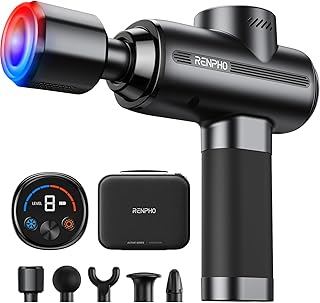
Too many buyers default to purchasing the cheapest device available or grabbing the heaviest unit on the shelf, assuming that more weight equals better deep-tissue penetration. In reality, a massage gun’s effectiveness is dictated by a specific interplay of mechanical specs, ergonomic design, and user intent. This guide breaks down the core metrics that actually matter when selecting a Renpho percussion massager, helping you make an informed investment in your physical well-being.
As an Amazon Associate we earn from qualifying purchases at no extra cost to you. Product prices and availability are accurate as of the date shown and are subject to change.
Understanding Amplitude and Stroke Depth
Amplitude refers to how far the massage gun head travels back and forth during operation, often described as stroke depth. This is arguably the most critical specification because it dictates whether the device can provide superficial relaxation or true deep-tissue relief. Devices with a shallow stroke tend to vibrate rather than hammer, which feels nice on the surface but rarely releases deep-seated knots in large muscle groups like the quadriceps or glutes. When evaluating options, look for a stroke depth that matches your physical density; larger, muscular builds generally require a deeper amplitude to reach the target tissue effectively.
However, a massive stroke depth is not always ideal for everyone. If you have a slender build, lower muscle mass, or sensitive bony areas around the shoulders and spine, a high-amplitude device can feel bruising and uncomfortable. Renpho offers various models calibrated for different tissue tolerances, so matching your personal pain threshold and muscle volume to the stroke depth will prevent you from buying a tool that sits unused due to discomfort.
Evaluating Stall Force and Motor Power
Stall force measures how much downward pressure you can apply to the massage gun before the motor completely stops or stalls out. Beginners often assume that maximum stall force is automatically better, but high-stall motors require more deliberate control to avoid bruising. If you intend to use the device casually for post-walk relaxation or light flushing of the legs, a moderate stall force is more than sufficient and allows for a smoother gliding motion across the skin.
Conversely, athletes and heavy lifters who need to lean their full body weight into tight hamstrings or calves will need a robust motor that resists stalling under heavy pressure. Keep in mind that high stall force paired with a weak battery will lead to rapid power degradation during a session. Always balance your need for pressure against your actual physical requirements to avoid overworking sensitive muscle tissue.
Weight, Form Factor, and Ergonomics
A massage gun is only as good as your ability to comfortably hold and maneuver it across your body. Ergonomics play a massive role during self-treatment, particularly when trying to reach awkward areas like the mid-back, lower lats, and back of the shoulders. Bulky, top-heavy designs can cause wrist fatigue within minutes, forcing you to cut your recovery session short before your muscles have fully relaxed.
Look for balanced weight distribution and consider whether an angled handle or a rotating arm would benefit your flexibility limitations. Mini massage guns are exceptionally lightweight and travel-friendly, but they often require more wrist strain to apply deep pressure because you lack the leverage of a full-sized handle. Weigh your desire for portability against how easy the device is to grip during longer, full-body recovery routines.
Battery Life and Charging Standards
Nothing is more frustrating than reaching for your recovery tool after a grueling workout only to find a dead battery. Battery capacity directly dictates how frequently you will need to plug the device in, especially if you run it at high speeds. Beyond total runtime, pay close attention to the charging infrastructure. Modern devices utilizing USB-C charging offer superior convenience compared to proprietary wall adapters, allowing you to top up your battery using standard power banks or laptop chargers while on the road.
Consider your typical usage patterns when judging battery specs. If you only use the device for five minutes post-workout, even a modest battery will last a week or more. However, if multiple household members share the device or if you use it for extended warm-up routines, a higher capacity battery with fast-charging capabilities is well worth prioritizing.
Attachment Variety and Material Quality
Most percussion massagers come bundled with an assortment of plastic or foam heads, each designed for specific muscle groups or types of pressure. While it is easy to get distracted by sheer numbers, quality vastly outweighs quantity. Rigid plastic bullet attachments are fantastic for pinpointing trigger points in the feet or deep knots in the shoulders, while softer, air-filled ball attachments are better suited for broad muscle sweeps over bony prominences.
Inspect the material quality of the attachments as well. Cheap, hard plastics can feel harsh against bare skin and may degrade or crack over time under high-frequency vibrations. Rubberized or dense silicone attachments offer a more comfortable tactile experience, resist sweat and massage oils better, and provide a secure fit onto the percussion shaft without slipping off mid-session.
Common Buying Mistakes to Avoid
One of the most frequent mistakes buyers make is chasing high speed settings while ignoring amplitude and stall force. Manufacturers often market high RPM numbers to impress novices, but spinning faster does not equal better tissue penetration; in many cases, ultra-high speeds just create a buzzing sensation that irritates surface nerves rather than relaxing the muscle fiber.
Another pitfall is buying based purely on aesthetics or celebrity endorsements rather than functional specs. A sleek matte finish looks great in photos, but if the handle lacks grip or the motor lacks thermal management, the device will overheat or slip out of your sweaty hands during intensive post-workout care. Focus on the core mechanics first, and treat cosmetic styling as a secondary bonus.
When to Spend More on Premium Tier Models
Entry-level percussion guns are fantastic for casual fitness enthusiasts who need light relief after weekend jogs or light gym sessions. However, there are distinct scenarios where investing in a higher-end model makes practical sense. If you suffer from chronic muscle stiffness, train twice a day, or require extremely quiet operation so you do not disturb others in your household or gym, paying extra for advanced brushless motors and superior build quality pays off immediately.
Higher-tier models also tend to offer finer speed graduations, better thermal management to prevent sudden motor cutouts, and superior battery longevity over years of repeated charging cycles. If you view your percussion massager as an essential, daily tool for mobility maintenance and injury prevention, stretching your budget for a premium unit is a smart long-term investment.
Related Guides
To expand your research on muscle recovery tools, check out our expert evaluations including Best Renpho Massage Guns in 2026: Tested and Ranked, compare alternative designs in Best Hypervolt Massage Guns in 2026: Tested and Ranked, or view additional testing updates via Best Hypervolt Massage Guns in 2026: Tested and Ranked to ensure you find the ultimate device for your daily routine.
FAQ
How often should I use a massage gun on the same muscle group?
For most muscle groups, spending one to two minutes per session is more than enough to stimulate blood flow and release tension. Avoid lingering on a single spot for too long, as excessive friction or pressure can bruise the tissue or irritate nerves.
Can massage guns help prevent delayed onset muscle soreness?
Yes, using a percussion massager post-workout helps clear metabolic waste by increasing local blood circulation and reducing acute muscle tightness. While it may not completely eliminate soreness, it significantly blunts the severity of stiffness the following day.
Is it safe to use a massage gun directly over bones and joints?
You should strictly avoid applying high-intensity percussion directly to bony prominences like the spine, kneecaps, collarbones, and joints. These areas lack protective muscle tissue and can easily suffer bone bruising, joint irritation, or nerve damage from heavy vibrations.
Should I use a massage gun before or after my workout?
Both approaches are beneficial when used correctly; brief 30-second passes on dynamic muscle groups help prime tissue for movement during a warm-up. Longer, methodical sessions are best saved for post-workout recovery when your goal is relaxation and down-regulation.