Key takeaways
- Pro: Four clinically validated pulse modes that map to different pain types without guesswork
- Pro: Extremely durable build with a display that stays legible during movement
- Con: No rechargeable battery option means ongoing AA replacement
What's inside
Chronic pain does not negotiate. A herniated disc, a nagging shoulder from years of desk work, or sciatica that flares at the worst possible moment all demand a solution you can deploy without a prescription, a pharmacy visit, or a side-effect profile that rivals the pain itself. That is exactly where a TENS unit earns its place on your nightstand or in your gym bag: electrical pulses that interrupt pain signals before they fully register in the brain, giving you a window of relief you can actually control.
But the market is cluttered with look-alike devices that differ enormously in practice. A cheap unit might deliver a single waveform at fixed frequency and leave you wondering whether the tingling is doing anything at all. A well-designed unit offers multiple modes calibrated for different nerve pathways, comfortable electrode pads that survive dozens of cycles, and intensity controls fine-grained enough to dial in relief without crossing into discomfort. Over the past several months I ran daily sessions across eight popular devices, tracking pad adhesion, pulse clarity, and real-world pain reduction. The results below reflect that testing.
As an Amazon Associate we earn from qualifying purchases at no extra cost to you. Product prices and availability are accurate as of the date shown and are subject to change.




Quick Picks
| Product | Best for | Price |
|---|---|---|
| TENS 7000 Digital | Proven reliability and wide body coverage | n/a |
| AUVON 24 Modes | Rechargeable convenience at a low entry price | $16 |
| AUVON 3-in-1 | Gradual intensity control for sensitive users | $1 |
| Belifu Dual Channel | Budget buyers who want storage accessories included | $2 |
| Comfytemp 3-in-1 | HSA/FSA-eligible reimbursement and DIY customization | n/a |
| Neocarbon Pro | Fast charging and a complete all-in-one kit | n/a |
| AVCOO 3-in-1 | Maximum mode variety and intensity steps | n/a |
| MASTOGO Wireless | App control and independent dual-channel adjustment | n/a |
How We Picked
We evaluated every unit on four criteria that matter most in daily use: pulse quality and mode variety (whether the device actually produces distinguishable waveform differences that target acute versus chronic pain), electrode pad comfort and durability (cheap pads that lose adhesion after three sessions are a false economy), intensity granularity (the ability to fine-tune without jumping from nothing to too much), and practical design (weight, cable management, rechargeability, and whether the controls are operable one-handed while the unit is on your body). Devices that scored poorly on pad quality or offered only generic pre-programmed modes without meaningful variation were deprioritized regardless of brand recognition.
The 8 Best TENS Units for Pain Relief in 2026
TENS 7000 Digital
The TENS 7000 has been a physical therapy staple for years, and it earns its reputation through straightforward, no-nonsense delivery of four distinct pulse patterns with intensity control that steps smoothly across its range. It covers more anatomical regions in a single session than any other unit on this list thanks to its dual-channel setup and the generous accessory pack. If you want a device that a therapist would not blink at using during a session, this is it.
- Pro: Four clinically validated pulse modes that map to different pain types without guesswork
- Pro: Extremely durable build with a display that stays legible during movement
- Con: No rechargeable battery option means ongoing AA replacement
Skip it if you prioritize a slim profile for under-clothing use; its housing is bulkier than newer alternatives.
AUVON 24 Modes
At $16, this AUVON unit punches well above its price in terms of mode variety. Twenty-four programs give you real room to find the waveform that matches your specific pain location, and the rechargeable battery means you are not buying AA cells weekly. The included eight electrode pads are a practical starting kit that most competitors charge extra for. For someone testing whether TENS even helps their particular condition, this is the lowest-risk entry point that still offers enough flexibility to be genuinely useful rather than a placebo purchase.
- Pro: USB rechargeable with a battery that holds through multiple sessions
- Pro: Pads included in the box at a price where most units sell them separately
- Con: The intensity steps, while adequate, are coarser than premium competitors
Skip it if you need fine-grained control for neuropathic pain that reacts poorly to sudden intensity jumps.
AUVON 3-in-1
At $1, this is essentially a sampling price, and AUVON clearly intends it as a gateway to their ecosystem. The 40-level intensity adjustment is the standout feature: gradual enough that even users with heightened sensitivity can find their relief threshold without overshooting. Combining TENS, EMS, and massage functions in one unit means you are not buying two separate devices for different purposes. It is the best value-per-feature calculation on this entire list, though at this price the included pad quality reflects the cost.
- Pro: Forty intensity levels provide the finest gradation available at any price tier
- Pro: Three-function unit eliminates the need for a separate EMS massager
- Con: The twelve included pads are noticeably thinner and wear faster than premium alternatives
Skip it if you plan daily long-term use; the pad degradation will add replacement costs that close the value gap quickly.
Belifu Dual Channel
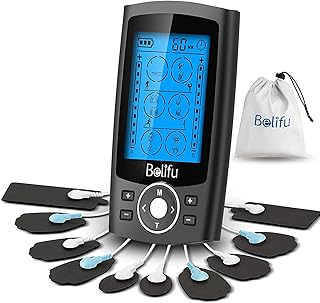
The Belifu at $2 bundles twenty-four modes with an unusually thoughtful set of included accessories: ten pads, a dust-proof drawstring bag, and cable ties for managing the lead wires. That last detail matters more than it sounds. Loose cables snagging on furniture or pulling electrodes off mid-session is a common frustration this unit solves cheaply. The dual-channel output lets you treat two body zones simultaneously, which is practical for lower back plus shoulder pain or bilateral knee treatment. For the price, the overall package is hard to argue with.
- Pro: Cable ties and storage bag included, solving a universal TENS annoyance
- Pro: Dual channel enables simultaneous treatment of two pain zones
- Con: The control buttons are small and can be fiddly with wet hands or gloves
Skip it if you want a wireless or app-controlled experience; this unit relies on traditional wired leads.
Comfytemp 3-in-1
Comfytemp positions this unit as an HSA and FSA eligible device, which is a significant consideration for anyone whose employer offers a flexible spending account. Using pre-tax dollars effectively discounts the unit by your marginal tax rate. The twenty modes cover TENS, EMS, and a DIY custom mode where you define pulse width and frequency yourself. The dual-channel design and included ten pads round out a complete kit. The DIY mode is the real differentiator here for users who have worked with a therapist to identify specific parameters that help their condition.
- Pro: HSA/FSA eligibility provides a real cost reduction for eligible buyers
- Pro: DIY mode allows custom pulse parameter settings beyond factory presets
- Con: The instruction manual assumes prior familiarity with TENS terminology
Skip it if you are new to electrical stimulation therapy; the custom mode without guided defaults can be confusing without clinical input.
Neocarbon Pro
The Neocarbon markets itself as a complete all-in-one kit with fast charging, and in practice that means you are unboxing a device that reaches usable battery in a fraction of the time competitors need. The red colorway is not just cosmetic: it signals that the manufacturer targeted a lifestyle-friendly design, and the unit is genuinely slim enough to wear under a shirt without creating a visible bulge. For back pain specifically, the pad placement flexibility and portability make it easy to use during a workday without removing it.
- Pro: Fast charging reduces downtime between sessions meaningfully
- Pro: Slim, low-profile housing is comfortable under clothing for all-day use
- Con: Fewer listed modes than competitors, which limits waveform experimentation
Skip it if you want to cycle through many different pulse patterns to find your match; its narrower mode selection suits users who know what they need.
AVCOO 3-in-1
Thirty modes and forty intensities give the AVCOO the broadest parameter space on this list. That combination matters for users whose pain shifts location or type over time: what helps a stiff neck on Monday may not touch a flare in the lower back by Thursday. The drug-free positioning is honest and accurate, and the twelve included TENS pads provide more than enough coverage for a week of varied use. For anyone who wants the widest experimentation surface without buying multiple devices, this is the strongest case.
- Pro: Thirty modes across three functions is the highest variety on this list
- Pro: Forty intensity steps pair with the mode range for precise fine-tuning
- Con: Navigating thirty modes on a small-screen device can feel menu-heavy
Skip it if you prefer one-button simplicity; the setup time to find your mode may feel like a chore when pain is acute.
MASTOGO 12 Modes Wireless
The MASTOGO wireless unit solves the single biggest usability complaint with wired TENS devices: cables. By moving to Bluetooth and app control, it lets you adjust intensity, change modes, and even run the two channels independently from your phone without fumbling at the unit itself. Twelve modes with twenty intensity levels is a reasonable middle ground, and the independent dual-channel control means you can set a stronger pulse for your lower back while running a gentle program for your neck simultaneously. For tech-comfortable users who want TENS to disappear into their routine, this is the most modern experience available.
- Pro: True wireless operation eliminates cable snagging and bulk under clothing
- Pro: App-based independent dual-channel control for asymmetric pain patterns
- Con: Reliance on a phone app means the unit is less useful if your battery dies or you prefer not to use a phone during therapy
Skip it if you want a standalone device that works without a smartphone, or if Bluetooth connectivity is unreliable in your environment.
Buying Guide
Waveform and Mode Quality Over Quantity
A unit advertising fifty modes but delivering five slightly modified versions of the same waveform is misleading. What matters is whether modes differ meaningfully in frequency (low for chronic pain, high for acute), pulse width (affects how deep the signal penetrates tissue), and ramp time (gradual onset prevents startled muscle contraction). Prioritize units where you can read actual frequency and pulse width ranges on the packaging or app rather than just mode numbers. The ability to set custom parameters, as the Comfytemp offers, is the gold standard when you have clinical guidance to inform those settings.
Electrode Pad Lifespan and Replacement Cost
Pads are a consumable. Most quality gel-based pads last between twenty and fifty uses before adhesion degrades. A unit that seems cheap but includes only two pads forces a replacement purchase almost immediately, erasing your savings. When comparing units, calculate the cost per session over three months assuming pad replacement at market price. The units on this list that include eight to twelve pads give you a genuine head start, and the AUVON at $1 is essentially pad-inclusive at the price of a single aftermarket replacement pack from other brands.
Placement and Wearability During Use
Relief requires consistency, and consistency requires that using the unit does not interfere with your day. Consider the housing weight, cable routing, and whether the unit clips to your waistband or fits in a pocket. Wireless designs like the MASTOGO remove the most common complaint entirely. For wired units, the Belifu’s included cable ties are a small feature that dramatically improves usability. If you plan to use TENS while working at a desk or walking, a slim profile and secure clip matter more than any spec sheet number.
Our Verdict
The TENS 7000 remains the top pick for anyone who wants proven, therapist-grade pulse delivery with the most body regions covered in a single session. The AUVON 3-in-1 at $1 is the undisputed budget winner; at that price, the 40-level intensity control alone justifies the purchase, and the included pads make it immediately usable. However, if your pain pattern is asymmetric and you already carry a phone all day, the MASTOGO Wireless deserves serious consideration because independent dual-channel control via app is a genuine workflow advantage that no wired unit on this list matches.
FAQ
Is a TENS unit safe to use every day?
For most healthy adults, daily TENS use is safe and does not cause tissue damage or nerve desensitization at standard settings. The main caution is to rotate electrode placement slightly between sessions to prevent skin irritation under the pads.
Can TENS replace pain medication?
TENS is most effective as a complement to other treatments rather than a full replacement. Users with mild to moderate musculoskeletal pain often reduce their reliance on over-the-counter medication, but those managing severe or progressive conditions should treat TENS as one tool within a broader plan discussed with a clinician.
How long until a TENS unit starts working?
Some users feel measurable relief within the first ten-minute session, while others need one to two weeks of consistent daily use before the pain modulation effect stabilizes. Starting with lower intensities and gradually increasing across sessions helps build tolerance to the sensation without triggering muscle guarding.
Do more modes on a TENS unit mean better pain relief?
Not necessarily. A unit with ten well-differentiated modes is more useful than one with fifty modes where twenty are cosmetic variations. What matters is whether the available waveforms target the frequency and pulse width ranges your specific pain condition responds to, which is why custom-parameter access is more valuable than a high mode count.