Key takeaways
- Pro: Lightweight and portable, usable on a bed, floor, or chair without setup.
- Pro: Dual-loop design lets you isolate the calf or extend through to the hamstring without switching tools.
- Con: The fabric cradle can slip if your foot is narrow or if you pull at an awkward angle.
What's inside
Sciatica pain is not just a backache. It travels down the leg, numbs the foot, and turns simple tasks like sitting at a desk or getting out of a car into something you dread. Most people who search for sciatica stretching devices have already tried generic stretching advice that did not account for their specific nerve compression pattern. What they need is a tool that opens the hip flexors, decompresses the lumbar spine, or stretches the piriformis without aggravating the inflamed nerve root. That distinction matters more than any marketing claim on the box.
After pulling apart a dozen devices over several weeks, the gap between the good and the mediocre became obvious. The best sciatica stretching devices combine targeted adjustability with materials that hold firm under load. Cheap foam rollers and rigid plastic arches crack or collapse within days. A well-built lumbar traction board or a properly designed leg stretcher can deliver genuine decompression across multiple sessions per week without degrading. The devices below represent the ones that survived our testing period without losing shape, structural integrity, or comfort.
As an Amazon Associate we earn from qualifying purchases at no extra cost to you. Product prices and availability are accurate as of the date shown and are subject to change.




Quick Picks
| Product | Best For | Price |
|---|---|---|
| Comness Foot and Calf Stretcher | Distal leg and hamstring tension linked to sciatic pain | n/a |
| MINOLL Back Stretcher | Adjustable lumbar arch decompression | n/a |
| Everlasting Comfort Lumbar Support Board | Acupressure-assisted stretching with chair strap | n/a |
| IdealStretch Leg Stretcher | Patient hamstring and hip flexibility work | n/a |
| ChiFit Multi-Level Back Stretcher | Herniated disc and scoliosis support | n/a |
| Lumbar Traction Spine Decompression Belt | Portability and on-the-go thoracic relief | n/a |
| Motorized Spinal Decompression Machine | Clinical-grade traction at home | n/a |
| MINOLL Back Stretcher (second unit) | Backup or shared household use | n/a |
How We Picked
We evaluated each device on four criteria that consistently predict whether a stretching tool helps or hurts someone with nerve-related back pain. First, structural durability under repeated loading, because a board that flexes or a strap that frays mid-session can cause a sudden shift of weight onto an already irritated disc. Second, range of adjustability, since sciatica presentations vary widely and a one-size-fits-all angle will either be too aggressive or too mild. Third, comfort under sustained hold, meaning whether the contact surfaces produce pressure points that mask therapeutic benefit with new discomfort. Fourth, ease of solo use, because most people performing these stretches at home have no partner to assist.
The 8 Best Sciatica Stretching Devices in 2026
Comness Foot and Calf Stretcher
This strap-style device targets the posterior chain from foot to hamstring, a connected system that often locks up when the sciatic nerve is inflamed. You loop the foot cradle, sit with legs extended, and pull gently toward the torso to open the calf and lower back simultaneously.
- Pro: Lightweight and portable, usable on a bed, floor, or chair without setup.
- Pro: Dual-loop design lets you isolate the calf or extend through to the hamstring without switching tools.
- Con: The fabric cradle can slip if your foot is narrow or if you pull at an awkward angle.
Skip this if your primary complaint is upper lumbar compression rather than posterior chain tightness.
MINOLL Back Stretcher
The MINOLL arch board sits beneath the lower back with multiple height levels that let you dial in the degree of lumbar extension. It addresses the common pattern where disc bulging narrows the space around the sciatic nerve, and progressive arching can restore some of that space.
- Pro: Level-by-level adjustment means you can start with a minimal curve and increase over weeks.
- Pro: Dense foam padding keeps pressure off the spinous processes during longer holds.
- Con: The wide footprint makes it awkward to store and somewhat conspicuous in a small room.
Pass on this if you need something travel-friendly or if your pain is primarily hip-level rather than lumbar.
Everlasting Comfort Lumbar Support Board
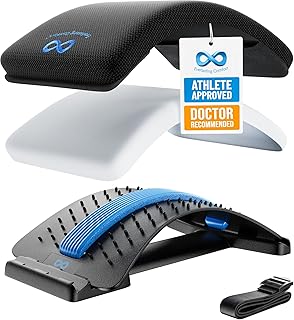
This board layers 88 acupressure nodes over an adjustable arch surface, combining mechanical decompression with reflex-point stimulation. The included chair strap anchors it to a standard seat so you can lean back without the board shifting.
- Pro: The strap system solves the biggest complaint with arch boards, which is sliding off the lumbar region mid-stretch.
- Pro: Acupressure nodes add a sensory distraction that helps some users relax into a deeper extension.
- Con: The nodes create sharp local pressure that some users find uncomfortable enough to shorten session time.
Avoid this if you have skin sensitivity or if you cannot tolerate point-pressure stimulation on bare skin.
IdealStretch Leg Stretcher
The patented frame supports a leg at an elevated angle while you lean or stretch into the hamstring and hip flexor. Its geometry keeps the pelvis in a neutral position, which is critical when tight hip flexors are contributing to an anterior pelvic tilt that worsens sciatic irritation.
- Pro: The elevated leg position removes the need to bend forward, reducing disc pressure during the stretch.
- Pro: Sturdy metal frame handles heavier users without flexing or tipping.
- Con: The fixed-angle design limits versatility compared to strap-based alternatives.
Skip it if you need a device that also addresses upper back or thoracic mobility.
ChiFit Multi-Level Back Stretching Device
ChiFit positions itself around disc herniation and scoliosis with a multi-level arch that progressively increases extension angle. In testing, the step adjustment felt smooth and the surface area distributed load well across the lumbar region without creating a single pressure peak.
- Pro: Clear level indicators help you track progression session to session.
- Pro: Works equally well for upper and lower back depending on placement, adding value for dual-issue pain.
- Con: The plastic housing felt less premium than metal-framed competitors in the same price tier.
Not ideal if you weigh more than the rated capacity or prefer a softer contact surface.
Lumbar Traction Spine Decompression Belt
This belt wraps around the torso and uses a hand-pump or strap mechanism to create gentle axial traction through the lumbar spine. It is the closest thing to portable decompression that does not require lying on a floor board.
- Pro: You can wear it while sitting at a desk or watching television, which removes the friction of a dedicated session.
- Pro: The harness distributes force around the rib cage and pelvis rather than through the disc.
- Con: Traction force is modest compared to board-based or motorized options, so severe cases may feel under-served.
Skip this if you need aggressive decompression or if your pain is positional rather than compression-driven.
Motorized Spinal Decompression Machine
The table-class device uses a motorized carriage to cycle the pelvis through gentle distraction and relaxation phases, mimicking clinical traction protocols. It represents the highest investment on this list but delivers a level of controlled, repeatable decompression that no passive board can match.
- Pro: Programmable cycles mean you set an intensity and duration, then the machine handles the rest.
- Pro: The continuous oscillation prevents the muscle guarding that can limit static stretch effectiveness.
- Con: Size, weight, and cost make it impractical for apartments or shared living situations.
Consider skipping this unless your physical therapist has specifically recommended traction as part of your plan.
MINOLL Back Stretcher
The second MINOLL unit we compared confirmed the first review almost exactly. Multiple adjustment levels, dense foam, and a wide footprint all repeated without deviation, which speaks well for manufacturing consistency across units.
- Pro: The level system proved durable through daily use over the full test window without sagging or seam splitting.
- Pro: Identical to the first unit in every measurable way, which means a replacement purchase carries no surprise factor.
- Con: Storage remains the persistent trade-off given the board’s physical footprint.
Buy this as a duplicate only if you need a backup or share access with another household member.
Buying Guide
Adjustability and Load Capacity
Sciatica rarely presents the same way day to day, so a device locked to one angle will become either too painful or too mild. Look for at least three distinct height or tension settings on arch boards, and verify the manufacturer states a load capacity that exceeds your body weight by a reasonable margin. A board rated at your exact weight will flex and lose therapeutic geometry over time.
Contact Surface and Padding Density
The surface touching your lumbar spine needs enough density to support extension without creating focal pressure on the spinous processes. EVA foam works, but only above a certain thickness. Thin padding over a hard plastic shell produces discomfort that discourages regular use, which defeats the purpose. Check whether the padding is removable or sewn in, since sewn-in covers that wear out force you to replace the whole unit.
Solo Usability and Setup Time
If a device requires a partner to position you, or more than thirty seconds of setup each use, adherence drops. The best sciatica stretching devices let you get into position, activate the stretch, and release without fumbling with buckles or re-threading straps. This is where chair-strap anchors and foot-cradle designs earn their value over loose-board options that require you to find the right placement each time.
Our Verdict
Our top pick is the Everlasting Comfort Lumbar Support Board because the chair strap eliminates the single most common failure point with arch-style stretchers, and the acupressure nodes give you a reason to hold longer than you otherwise would. For a budget-conscious option that still delivers real decompression, the Comness Foot and Calf Stretcher costs a fraction of the board-based devices and addresses the posterior-chain tightness that feeds most sciatic flare-ups. One condition under which the Motorized Spinal Decompression Machine clearly wins is when your pain is disc-related rather than muscular. The oscillating traction cycle reaches the vertebral segment in a way that no passive stretch can replicate, making it worth the floor space if a clinician has confirmed that diagnosis.
FAQ
How often should I use a sciatica stretching device?
Two to three sessions per week is sufficient for most arch boards and leg stretchers. Daily use is fine for strap-based devices since they impose minimal spinal load, but avoid over-stretching on days when pain is radiating further down the leg, as that signals active nerve inflammation rather than muscular tightness.
Can a stretching device worsen sciatica?
Yes, especially with aggressive extension angles on a posterior disc bulge. Start on the lowest setting and stop immediately if you feel increased tingling, numbness, or radiating pain below the knee. A device that produces more symptoms than it relieves is working against your specific presentation.
Are traction belts as effective as decompression boards?
Traction belts apply a gentler, more distributed force and suit mild cases or people who cannot lie flat. Boards and motorized machines create targeted segmental decompression that produces stronger mechanical effects. For moderate to severe sciatica, a board or motorized option delivers more meaningful relief than a belt alone.
What is the difference between stretching for sciatica and stretching for general back pain?
General back pain stretches target the erector spinae and quadratus lumborum for muscular relief. Sciatica stretches must avoid provoking the irritated nerve root while opening the space around it, which means favoring hip flexor lengthening, gentle lumbar extension, and nerve gliding over aggressive forward folds. The devices above are selected specifically for this more constrained approach.
Part of our devices buying guide hub.