Key takeaways
- 10 ATM or 100 m water resistance: useful for swimming and surface activities under controlled conditions. It does not mean the watch is safe for every high-speed, high-pressure, or hot-water situation.
- IP ratings: describe resistance to dust and water ingress under defined laboratory tests. They do not measure impact resistance or long-term seal aging.
- MIL-STD-810: indicates testing against selected environmental conditions, such as shock, vibration, temperature, or humidity. It is not a guarantee against every real-world accident.
- Sapphire crystal: highly scratch-resistant but not indestructible; a hard impact can still chip or crack it.
- Gorilla Glass or chemically strengthened glass: often lighter and less expensive to replace, but generally more vulnerable to scratches than sapphire.
The best rugged smartwatches for outdoor adventure are the Garmin Enduro 3 for maximum battery life, Garmin fēnix 8 for the broadest all-round feature set, COROS Vertix 2S for long expeditions, Suunto Vertical for offline maps and route planning, and Apple Watch Ultra 2 for iPhone users who prioritize a bright display and everyday smart features.
The right choice depends less on headline “military-grade” language than on four practical questions: how long you will be away from a charger, whether you need maps without a phone, how much impact and water exposure the watch will face, and whether health data or training analysis matters more than simplicity.
Our top picks



As an Amazon Associate we earn from qualifying purchases at no extra cost to you. Ratings are shown as listed on Amazon.
Best rugged smartwatches compared
| Watch | Best for | Approx. weight | Battery range | Water resistance | Durability and display highlights |
|---|---|---|---|---|---|
| Garmin Enduro 3 | Ultra-distance trips and multi-day trekking | Approximately 63 g with nylon strap | Up to about 36 days; solar conditions can extend this | 10 ATM | Fiber-reinforced polymer case, titanium bezel, sapphire lens, MIP display |
| Garmin fēnix 8 AMOLED | Feature-rich adventure and daily wear | Approximately 80–95 g, depending on size and strap | Up to about 15 days in smartwatch mode, depending on size | 10 ATM | Metal bezel options, sapphire option, bright AMOLED display, built-in speaker and microphone |
| Suunto Vertical | Offline mapping and route-focused hiking | Approximately 74–86 g, depending on version | Up to about 60 days in time mode; substantially less with frequent GPS | 100 m | Stainless-steel or titanium versions, sapphire option, solar version available |
| COROS Vertix 2S | Expeditions and endurance training | Approximately 70 g without strap | Up to about 40 days of daily use; roughly 118 hours of standard GPS | 10 ATM | Grade 5 titanium bezel, sapphire glass, reinforced case, large 1.4-inch display |
| Apple Watch Ultra 2 | iPhone users wanting the strongest smart features | Approximately 61 g without strap | Up to 36 hours, or up to 72 hours in Low Power Mode | 100 m; recreational diving support to 40 m | Titanium case, sapphire front crystal, bright OLED display, MIL-STD-810H testing |
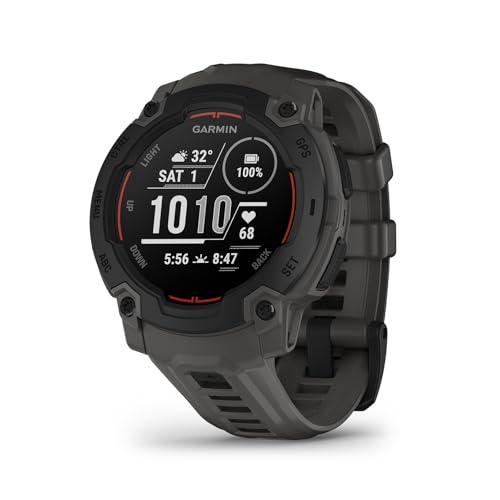
| Garmin Instinct 3 Solar | Lower-cost, lightweight outdoor use | Approximately 53–59 g, depending on case size | Up to about 28 days; solar can extend this substantially | 10 ATM | Fiber-reinforced polymer, chemically strengthened lens, high-contrast MIP display |
Battery figures are manufacturer estimates under specific settings. Continuous GPS, music, navigation, pulse-ox readings, cold temperatures, bright displays, and weak cellular signals can reduce them considerably.
Best overall: Garmin fēnix 8
The fēnix 8 is the strongest compromise between rugged construction, training depth, navigation, and smartwatch convenience. It is available in multiple case sizes and with AMOLED or solar-charging display options. The AMOLED version is easier to read indoors and at night, while the solar or memory-in-pixel approach generally favors outdoor endurance and lower power consumption.
It includes multiband GNSS on supported versions, downloadable maps, turn guidance, elevation data, weather tools, training readiness metrics, sleep tracking, heart-rate monitoring, incident detection, and a broad selection of activity profiles. Its 10 ATM water rating suits swimming and surface water exposure, but water resistance is not permanent: seals age, buttons can be damaged, and hot tubs or high-pressure water are poor conditions for any electronic watch.
Choose the fēnix 8 if you want one watch for hiking, running, strength training, travel, and normal daily notifications. The main disadvantages are weight, cost, and a learning curve caused by its many menus.
Best for maximum battery life: Garmin Enduro 3
The Enduro 3 is the better pick when charging access is uncertain. Its transflective MIP display is less vivid than an AMOLED screen but remains readable in direct sunlight and uses far less power. Solar charging can extend runtime when the watch receives strong outdoor exposure, although it is best treated as a battery extender rather than a replacement for charging.
Its ultramarathon tools include long-duration GPS modes, recovery and training information, navigation, elevation data, storm alerts, and an integrated flashlight. The nylon strap helps reduce weight over long days, while the sapphire lens and titanium bezel improve resistance to ordinary trail abrasion.
For a five-day trek, calculate conservatively rather than relying on the headline number. If a watch averages 20% battery use per day under your chosen GPS and display settings, five days consumes about 100%. Adding a 25% reserve means you should begin with at least 125% of your expected capacity, or plan one charging opportunity. Cold weather and frequent map use make that reserve more important.
Best for offline maps: Suunto Vertical
Suunto Vertical is particularly appealing to hikers who plan routes before leaving cellular coverage. Its offline maps, route planning, altitude tools, weather information, and breadcrumb navigation are designed around outdoor travel rather than phone-style app use. The solar version is attractive for extended trips, while titanium and sapphire variants reduce weight or improve scratch resistance.
GPS accuracy depends on satellite visibility, tree cover, steep walls, weather, and the selected recording mode. Multiband positioning can improve tracks in difficult environments, but it cannot eliminate every error in narrow canyons or dense forest. For serious navigation, keep a paper map or another independent backup; a watch should not be your only means of finding a route.
Best for long expeditions: COROS Vertix 2S
The Vertix 2S is built around endurance. Its large case, sapphire glass, titanium bezel, long GPS runtime, offline maps, route navigation, and expedition-oriented battery modes make it well suited to multi-day hiking, mountaineering, and ultra-distance events.
The trade-off is size. A large watch can catch on clothing, feel cumbersome during sleep, and sit poorly on a small wrist. Its health and training features cover heart rate, sleep, recovery, altitude, workouts, and route activity, but people who want the widest ecosystem of apps, payments, emergency functions, and lifestyle features may prefer Garmin or Apple.
Best for iPhone users: Apple Watch Ultra 2
Apple Watch Ultra 2 offers the clearest display in this group for many users, along with responsive maps, a strong phone-and-notification experience, cellular options, crash and fall features, depth tools, and extensive third-party software. Its large OLED screen is excellent for quick map checks and data fields in mixed lighting.
Its weakness is endurance. Even with Low Power Mode, it is designed around more frequent charging than Garmin, Suunto, or COROS expedition watches. It is therefore best for day hikes, regular training, diving-related recreation within its published limits, and users who return to a charger each night or every couple of days. It requires an iPhone, so it is not a universal Android choice.
Best value for simpler outdoor use: Garmin Instinct 3 Solar
The Instinct 3 Solar offers a lighter, less expensive route into rugged GPS wearables. Its high-contrast display is easy to read in sunlight, its 10 ATM rating is suitable for swimming, and its physical buttons work well with gloves or wet hands. It provides navigation, activity recording, sleep and heart-rate features, training information, and smartphone notifications without the complexity or price of a flagship mapping watch.
It is less suitable if you need detailed topographic maps on the wrist, a vivid full-color screen, or extensive smartwatch apps. Pick it when reliability, battery life, and low weight matter more than visual polish.
Durability standards: what the labels really mean
- 10 ATM or 100 m water resistance: useful for swimming and surface activities under controlled conditions. It does not mean the watch is safe for every high-speed, high-pressure, or hot-water situation.
- IP ratings: describe resistance to dust and water ingress under defined laboratory tests. They do not measure impact resistance or long-term seal aging.
- MIL-STD-810: indicates testing against selected environmental conditions, such as shock, vibration, temperature, or humidity. It is not a guarantee against every real-world accident.
- Sapphire crystal: highly scratch-resistant but not indestructible; a hard impact can still chip or crack it.
- Gorilla Glass or chemically strengthened glass: often lighter and less expensive to replace, but generally more vulnerable to scratches than sapphire.
The strap and charging contacts usually show wear before the case. Sweat, sunscreen, grit, salt, and repeated bending can weaken silicone or nylon. After saltwater or muddy use, rinse the watch with fresh water, dry it fully, and clean around buttons and charging contacts with a soft cloth. Do not charge it while wet. Avoid abrasive cleaners, compressed air, and sharp tools around seals.
Choose by situation
| Your situation | Best direction | Why |
|---|---|---|
| Weekend hikes and everyday fitness on a moderate budget | Garmin Instinct 3 Solar | Long battery life, physical buttons, strong water resistance, and a simpler interface |
| Frequent hiking with detailed route planning | Suunto Vertical or Garmin fēnix 8 | Offline maps, route guidance, elevation tools, and advanced GNSS options |
| Ultra-distance events or remote multi-day travel | Garmin Enduro 3 or COROS Vertix 2S | Much longer GPS endurance and expedition-oriented battery modes |
| iPhone user who wants calls, apps, and a bright display | Apple Watch Ultra 2 | Best integration with the iPhone and a highly readable OLED screen |
| Small wrist or dislike of bulky watches | Smaller fēnix 8 or Instinct 3 case | Better comfort and less movement during sleep and activity |
Health tracking: useful context, not a diagnosis
These watches can estimate heart rate, sleep duration, blood oxygen trends, stress, recovery, training load, and sometimes skin temperature or ECG-related data, depending on the model and region. Estimates can be affected by fit, skin contact, movement, tattoos, cold temperatures, and exercise intensity. Wear the watch securely but not tightly, and treat unusual readings as a reason to repeat the measurement or seek professional advice—not as a diagnosis. Contact a qualified clinician for persistent symptoms or concerning health data.
Bottom line
Buy the Garmin Enduro 3 when charging is the main concern, the fēnix 8 when you want the most complete all-round package, Suunto Vertical when maps drive the decision, COROS Vertix 2S for expedition endurance, Apple Watch Ultra 2 for iPhone-centered daily use, and Instinct 3 Solar for durable basics at a lower general market price. Whichever you choose, select the smallest case that gives you a readable screen, keep an independent navigation backup, and budget for eventual strap replacement rather than treating ruggedness as permanent.