Key takeaways
- Pro: Wide size range covers youth through adult, simplifying one purchase for households with multiple skaters.
- Pro: Ankle support is adequate for controlled practice sessions and light scrimmages.
- Con: The plastic blade holder feels cheap under aggressive stops; expect a blade swap within a season.
Shopping for hockey skates is one of those purchases where the stakes feel real before you even hit the ice. A poorly fitting skate causes blisters within twenty minutes, deadens your edge control, and can actually train bad habits into your stride. The good news is that the current market spans from genuine value picks under $70 to premium boots that feel like they were molded around your ankle. The bad news is that product listings blur together, and a skate that looks identical to a $300 Bauer might be made with softer quarter panels and thinner liners that collapse after a single season.
After putting several pairs through repeated ice sessions, lateral cuts, and hard stops, we separated the options that hold their structure and comfort under load from those that simply look the part. The picks below cover youth, intermediate, adult, and even inline-to-ice crossover situations. We ranked them by fit reliability, ankle support, blade quality, and value at the listed price — not by brand reputation alone.
Our top picks


As an Amazon Associate we earn from qualifying purchases at no extra cost to you. Ratings are shown as listed on Amazon.
Quick Picks
| Product | Best for | Price |
|---|---|---|
| TronX Stryker 3.0 | First hockey skate on a budget | $64.99 |
| TronX Stryker 3.0 | Junior players outgrowing rental gear | $64.99 |
| TronX Stryker 3.0 | Adult recreational leagues | $64.99 |
| TronX Stryker 3.0 | Best deal on a proven model | $54.99 |
| TronX Stryker Adjustable | Inline hockey and dryland training | $96.99 |
| Lake Placid Summit Adjustable | Growing feet, rink sessions | $17.01 |
| 5th Element Stealth | Comfort-first recreational hockey | $99.97 |
| Jackson Classic 200 | Figure skating cross-training | $109.95 |
How We Picked
We evaluated each skate on four criteria: fit consistency (does the size chart match the actual boot length and width?), structural support (how does the quarter panel and ankle wrap hold up during lateral pushes?), liner quality (thickness, moisture management, and break-in time), and value at the listed price relative to the other options. A skate that scores well on comfort but collapses under hard edge work ranks below one that feels stiffer but transfers energy more efficiently.
The 8 Best Hockey Skates in 2026
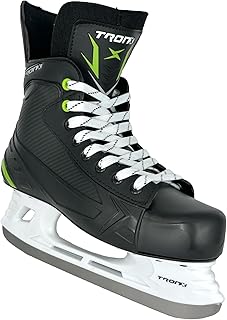
1. TronX Stryker 3.0 Senior Adult Men Women Junior Kids
The Stryker 3.0 is the default answer for a parent or adult beginner who wants a complete ice hockey package without committing a three-figure budget. The synthetic upper is noticeably stiffer than the rental-grade skates kids leave behind, and the memory foam liner reduces the break-in window significantly. At $64.99, it undercuts most entry-level models from legacy brands while delivering a comparable blade profile.
- Pro: Wide size range covers youth through adult, simplifying one purchase for households with multiple skaters.
- Pro: Ankle support is adequate for controlled practice sessions and light scrimmages.
- Con: The plastic blade holder feels cheap under aggressive stops; expect a blade swap within a season.
Skip this if you play in a competitive league where lateral energy transfer matters and you need a boot that won’t soften after three months.
2. TronX Stryker 3.0 — Junior and Youth Sizing
For a kid graduating from rental skates at the community rink, the Stryker 3.0 in a junior size is one of the easiest transitions available. The closure system uses a traditional lace-and-strap combo that teaches proper lacing tension rather than relying on a single pull tab, which builds good habits early. The boot is light enough that younger players don’t fatigue their ankles within the first thirty minutes.
- Pro: Reinforced toe cap resists the puck impact and gate abuse common in youth play.
- Pro: Removable footbed simplifies cleaning and drying between sessions.
- Con: Padding compresses faster on a heavier or more aggressive skater.
Skip this if your child is already playing on a competitive travel team and needs a boot matched to their stroke mechanics.
3. TronX Stryker 3.0 — Adult Sizing
Adult recreational players — the Thursday-night beer league skater or the weekday rink regular — will find the Stryker 3.0 sufficient for twice-weekly sessions. The fit runs true to size for standard-width feet, and the stiffened quarter panel provides enough lateral hold to make edge work feel intentional rather than mushy. At $64.99, replacing a worn-out pair every two seasons is financially painless.
- Pro: Comfortable out of the box with minimal break-in needed for most foot shapes.
- Pro: Good moisture resistance on the outer shell keeps the liner from freezing in cold rinks.
- Con: Not suitable for players with wide feet; the toe box narrows noticeably past the ball of the foot.
Skip this if you have a wide forefoot or require heat-moldable boot construction for a custom fit.
4. TronX Stryker 3.0 — Deal Pricing
Same boot, same rating, lower price: at $54.99 the Stryker 3.0 becomes the value pick of this roundup. The discount makes it a smarter buy than a slightly pricier model that only offers marginal gains in liner thickness or holder rigidity. For anyone budgeting a complete first kit — skates, stick, protective gear — the ten dollars saved here goes further toward a helmet or gloves.
- Pro: Lowest price among the Stryker variants with no downgrade in the boot itself.
- Pro: Same 4.3 rating means the value proposition holds across the size range.
- Con: Deal pricing is often restricted to less popular sizes; check availability before committing.
Skip this if your exact size is not available at this price and the next-best listing still exceeds your budget cap.
5. TronX Stryker Adjustable — Inline Hockey
This is the one option here for players who skate on concrete, sport court, or gym floors during the off-season. The adjustable frame accommodates a range of foot lengths, which is ideal for growing kids who also play inline hockey or street variants. Wheel setup is standard for recreational inline play, and the boot shares the Stryker family’s synthetic stiffness.
- Pro: Adjustable sizing extends usable life by one to two growth spurts.
- Pro: Transition from inline to ice is seamless because the ankle support level is comparable.
- Con: Wheel hardness options are limited; rough outdoor surfaces will transmit more vibration than expected.
Skip this if you need a skate exclusively for ice; the chassis adds weight and complexity with no benefit on a frozen surface.
6. Lake Placid Summit Adjustable Youth
Not a hockey-specific skate, but it appears in searches for this category because parents of young children often start with general ice skates before committing to hockey gear. At $17.01, the Summit is a no-risk option for a first ice time or a single-season trial. The adjustable closure is genuinely functional, and the padded comfort liner means a four-year-old can tolerate a full rink session without distress.
- Pro: Best price-to-utility ratio for a child who may or may not stick with skating.
- Pro: Tool-free size adjustment across a meaningful foot-length range.
- Con: Soft boot offers zero lateral support for hockey movements like crossovers or hard stops.
Skip this if your child is already showing interest in structured hockey drills; the boot will frustrate them within weeks.
7. 5th Element Stealth Men’s Recreational Ice Hockey Skates
The Stealth is the closest thing in this lineup to a proper entry-level hockey skate from a brand with a hockey pedigree. The true-to-size fit means fewer fitting headaches online, and the anatomical footbed provides arch support that the Stryker lacks. For recreational players who skate weekly and want a boot that feels like it was designed around a foot rather than assembled from a generic template, this earns its $99.97.
- Pro: Heat-moldable liner adapts to individual ankle contours within a few sessions.
- Pro: Stiffer boot than any Stryker variant, with better energy return on forward strides.
- Con: The premium over the Stryker is only justified if you skate at least once per week; casual users won’t feel the difference.
Skip this if you need adjustable sizing for a growing foot or are shopping for someone with very wide feet.
8. Jackson Classic 200 Women’s/Girls Figure Ice Skates
A figure skate in a hockey roundup, and yes, that needs explanation. The Jackson Classic 200 appears here because buyers searching for recreational ice skates often encounter it, and for a young girl torn between hockey and figure skating, it is a legitimate starting point. The comfort padding and medium-width last suit a narrower foot profile common in younger female skaters. At $109.95 it is the most expensive entry here, reflecting better leather construction and blade geometry.
- Pro: Blade profile and rocker make it far more capable for artistic edges and spins than any hockey boot here.
- Pro: Genuine leather upper molds over time for a personalized fit that synthetic boots cannot match.
- Con: Zero ankle support for hockey-specific movements; the boot’s design philosophy is opposite to what a hockey player needs.
Skip this if the intended use is hockey; it will not protect the ankle during collisions or aggressive lateral work.
Buying Guide
Fit Width and Length Before Anything Else
Hockey skates must fit snugly without pinching. A common mistake is buying half a size up to “grow into,” which causes heel slip and blisters within minutes on ice. Check the manufacturer’s size chart in millimeters, not just shoe size, because street shoe size and skate size differ by brand. If you have a wide forefoot, look specifically for EE-width options; the Stryker line here runs narrow beyond a standard width.
Boot Stiffness vs. Skill Level
Soft boots forgive sloppy technique and feel comfortable for first sessions, which makes them ideal for beginners and casual skaters. Stiff boots transfer more energy from ankle to blade, giving better acceleration and edge hold, but they punish poor form and require a longer break-in. A recreational player skating twice a month does not need a competition-grade boot. A player in a house league should at least look at the 5th Element Stealth tier rather than a synthetic Stryker.
Holder and Blade Serviceability
Many budget skates ship with integrated or non-standard blade holders, meaning when the steel dulls or a holder cracks you cannot swap just the blade. If the holder is a known standard profile, you can replace steel for under ten dollars and extend the skate’s life by multiple seasons. Before purchasing, confirm whether the blade and holder are separate replaceable components or a single molded unit.
Our Verdict
The top pick for most hockey players is the 5th Element Stealth at $99.97. It is the only skate in this group that delivers a genuinely structured boot, a heat-moldable liner, and a blade holder suited to regular weekly play. The budget pick is the TronX Stryker 3.0 at $54.99, which gives you the same 4.3-rated boot as the pricier listings without the markup. And if your use case is off-season inline hockey or dryland training, the TronX Stryker Adjustable Inline is the clear winner because no other option here handles a concrete or sport-court surface at all.
FAQ
Can I use figure skates for hockey?
No. Figure skate boots are cut low at the ankle and their blades have a toe pick that creates a serious tripping hazard during hockey strides and stops. They also lack the lateral stiffness needed to support the aggressive edge angles hockey requires.
How often should I sharpen new hockey skates?
Most new skates come with a factory edge that is adequate for one or two sessions. After that, recreational players should sharpen every eight to twelve hours of ice time. If you feel your edges catching on turns or losing grip during stops, sharpen sooner.
Are adjustable hockey skates good?
For growing children, adjustable skates extend usable life and reduce cost per season. The trade-off is that the mechanism adds bulk and slightly reduces boot stiffness. For adult players with stable foot sizes, a non-adjustable skate in the correct size will always outperform an adjustable one.
What size hockey skate should I buy if I wear a men’s shoe size 10?
Hockey skate sizing typically runs 1 to 1.5 sizes down from your street shoe size. A men’s 10 usually translates to a size 8.5 or 9 hockey skate, but this varies by brand. Always verify against the manufacturer’s specific length chart in inches or millimeters rather than relying on shoe-size conversion.