Key takeaways
- Pro: Handles both field points and broadheads on the same face
- Pro: Four-sided layout rotates fresh faces as wear accumulates
- Con: Thinner profile than high-density cubes lets heavy arrows push through at speed
A good archery target stops your arrow cleanly, lets you pull it back without wrestling, and survives a full season of repeated hits without turning into a foam crater. That sounds simple until you compare dozens of listings and realize most product pages tell you nothing useful about whether the thing actually holds up after twenty rounds at the range. We shot through bag targets, paper sheets, 3D forms, and friction-based layered designs to separate the options that genuinely stop field points and broadheads from the ones that only look convincing in marketing photos.
The best archery targets come down to three things: stop power matched to your bow speed, arrow removal that does not require pliers and a prayer, and durability that justifies the price over months of use. A target that costs fifty dollars but shreds by week three is worse than one that costs a hundred and still looks fresh in October. Below are the eight that held up across the specs we compared, ranked with a clear recommendation for each type of shooter.
Our top picks



As an Amazon Associate we earn from qualifying purchases at no extra cost to you. Ratings are shown as listed on Amazon.
Quick Picks
| Product | Best for | Price |
|---|---|---|
| Black Hole 4-Sided | Broadhead and field point shooters | $59.95 |
| Morrell Yellow Jacket Stinger | Overall value and backyard practice | $49.95 |
| Shappy Wild Boar Paper | Hunting visualization on a budget | $19.99 |
| Morrell Double Duty Cube | Faster compound bows on a budget | $72.99 |
| Delta McKenzie Challenger Deer | Hunting simulation with 3D form | $149.99 |
| Delta McKenzie Speedbag 24″ | Crossbows and high-speed compounds | $79.99 |
| Delta McKenzie Speedbag 20″ | Weatherproof everyday practice | $49.99 |
| Delta McKenzie Speedbag Revolver | Fresh-face convenience at lowest cost | $29.99 |
How We Picked
We scored every target on stop power relative to its rated FPS, ease of arrow removal after repeated hits, and value per season of use. We also weighed portability for shooters who haul targets to range days and scoring clarity for anyone drilling competitive or hunting precision. A target that failed on any one of those axes lost ground regardless of how attractive its spec sheet looked on paper.
The 8 Best Archery Targets in 2026
Black Hole 4-Sided Archery Target
Best for shooters who alternate between field points and broadheads without buying separate targets. The open-face layered design stops arrows through friction rather than compressed fiber, giving you a cleaner experience than standard bags at a fraction of the price of premium broadhead-rated options.
- Pro: Handles both field points and broadheads on the same face
- Pro: Four-sided layout rotates fresh faces as wear accumulates
- Con: Thinner profile than high-density cubes lets heavy arrows push through at speed
Skip it if your compound bow shoots well above four hundred FPS or you need a target you can leave outdoors permanently.
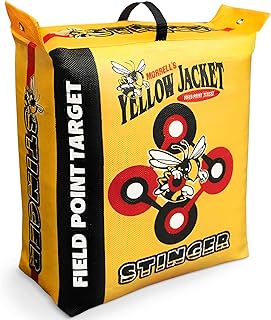
Morrell Yellow Jacket Stinger
The highest-rated bag on this list and the easiest one to recommend to a backyard shooter practicing with field points. Two shooting sides and ten bullseyes mean you can string together target drills without constantly rotating or resetting. The E-Z Tote handle makes it genuinely carryable for a range session.
- Pro: Ten bullseyes across two sides support varied practice routines
- Pro: Clean arrow removal even after a full round of shooting
- Con: Outer fabric shows scuffs and staining in wet grass
Skip it if you plan to leave it outdoors year-round without a protective cover.
Shappy Wild Boar Paper Targets
This is a scoring and visualization tool, not a stop-power target, and it fills that role at a price that makes it nearly disposable. Twenty waterproof sheets with vitals zones and grid lines let you build a realistic hog target on any backstop or over a foam block for quick-replacement practice. The vitals zone builds point-of-impact discipline on a specific kill area, which is hard to replicate with a generic bullseye.
- Pro: Realistic boar shape trains hunting-specific aiming
- Pro: Twenty sheets provide months of use for under twenty dollars
- Con: Zero stopping power; requires a separate backstop
Skip it if you need a standalone target or shoot anything heavier than a light recurve.
Morrell Double Duty 450 FPS Cube
A denser cube-format bag from Morrell that handles higher speeds than the Stinger without a massive price jump. The cube geometry gives you multiple faces to shoot into as wear accumulates, and the four-five-hundred FPS rating puts it firmly in compound-bow territory without being overkill for a recreational setup.
- Pro: Handles up to 450 FPS, covering most modern compounds
- Pro: Multiple faces extend usable life as each side wears
- Con: Cube shape is noticeably bulkier and harder to transport than elongated bags
Skip it if portability is your priority and your bow tops out under three hundred fifty FPS.
Delta McKenzie Challenger Deer 3D
The only 3D target on this list, and it serves a completely different purpose from the bags. At forty-one inches with self-healing foam and IBO scoring rings, it is built for shooting that simulates a real hunting angle and forces you to aim at a vitals zone rather than a circle. The lifelike shape changes how you think about each shot during practice.
- Pro: Realistic deer form trains hunting-specific shot placement
- Pro: Self-healing foam extends life through broadhead and field point use
- Con: Large size and weight make transport and storage difficult
Skip it if you are a range-only shooter with limited space or a tighter budget.
Delta McKenzie Speedbag 24″
The four-seventy-five FPS rating puts this at the top of the speed chart for bag targets, and it is the one we reached for whenever a shooter asked about crossbows or high-poundage compound setups. Dual-sided design extends its usable life, and easy arrow removal holds up even at speeds that would compress a lesser bag into a dense plug.
- Pro: Highest speed rating in this group at 475 FPS
- Pro: Consistent arrow release even under repeated high-energy impacts
- Con: Overkill for recreational bows that produce less kinetic energy
Skip it if your setup shoots under three fifty FPS and you can save money elsewhere.
Delta McKenzie Speedbag 20″
A smaller sibling to the twenty-four-inch Speedbag at a friendlier price, and the one we would hand to a shooter who wants Delta McKenzie build quality without paying for speed headroom they will never use. High-density material stops arrows cleanly, dual-sided aiming points extend face life, and the weatherproof shell means you can leave it outside without a tarp.
- Pro: Weatherproof design tolerates outdoor storage without a cover
- Pro: Simple twist-and-pull arrow removal protects nocks
- Con: Not rated for broadheads or crossbow speeds above four hundred FPS
Skip it if you shoot broadheads or a crossbow rated above four hundred FPS.
Delta McKenzie Speedbag Revolver 6-Sided
At thirty dollars, the six-sided cube format is the most creative low-cost option we compared. Three faces before rotating means you always have a fresh aiming point, and high-contrast field point markings support precision work at distance. The four-fifty FPS rating covers almost any recreational compound or recurve without complaint.
- Pro: Six-sided design gives you three fresh faces before rotating
- Pro: Lowest price among the Delta McKenzie options without sacrificing build quality
- Con: Twelve-inch-per-side footprint punishes wild or off-center shots
Skip it if you are a hunting-focused shooter who needs broadhead tolerance.
Buying Guide
Match Stop Power to Your Bow Speed
Every bag target carries a rated FPS that tells you the maximum speed it can safely stop. Shooting above that rating risks pass-throughs, damaged arrows, and broken limbs on your bow. Recreational recurves and light compounds typically shoot between two hundred and three fifty FPS, which the entry-level bags handle easily. High-poundage compounds and crossbows push past four hundred FPS and demand the higher-rated options in this list. Never guess your bow speed; check the manufacturer spec or measure it with a chronograph before selecting a target.
Evaluate Arrow Removal and Wear Over Time
Compressed fiber layers that stop your arrow also grab it, and the harder they grab, the more likely you are to twist your nock off when pulling. Friction-layer designs and self-healing foam solve this by holding the arrow through contact rather than compression. Over weeks of use, standard bags develop dense spots where arrows bind, while quality targets maintain a consistent pull force. Check reviews for long-term comments on this specifically, because it is the single biggest difference between a target you will still enjoy in three months and one you will replace.
Plan for Portability and Storage
A target you leave in your garage needs a different footprint than one you haul to a public range or a friend’s backyard. Weight and shape matter here: a twenty-four-inch bag weighs far less than a forty-one-inch 3D form, and a cube is harder to strap to a truck than a slim cylinder. If you shoot in rain or dew, a weatherproof shell saves you from buying a separate cover. Decide how you will move the target before deciding how much you want to spend on it.
Our Verdict
Our top pick for most shooters is the Morrell Yellow Jacket Stinger. It offers the best balance of stop power, bullseye variety, portability, and price in the entire group, and its 4.7 rating reflects how reliably it performs in real backyard conditions. For budget buyers who already own a backstop, the Shappy paper targets deliver hunting-specific practice value for twenty dollars. And if you are a dedicated bowhunter preparing for a season, the Delta McKenzie Challenger Deer is worth every extra dollar because no bag target replicates the mental rehearsal of aiming at a lifelike form.
FAQ
Can I shoot broadheads at any archery target?
No. Most bag targets are field-point only, and hitting them with a broadhead will shred the outer fabric and damage the inner layers. You need a target specifically rated for broadheads, which typically means a friction-based or layered open-face design that lets blades pass through without catching.
What happens if I shoot faster than a target’s rated FPS?
You risk pass-throughs that send arrows over the backstop, shortened target life from compressed layers failing under excess energy, and potential damage to your arrows. The rating exists because manufacturers test at that speed, and exceeding it puts stress on materials in ways the design did not account for.
Are paper targets actually useful for hunting practice?
They are useful for one specific thing: building muscle memory on a realistic vitals zone shape. Pair them with a foam backstop and you get an affordable setup that trains your eye to recognize a kill area. They will not help you evaluate stop power or arrow flight at distance, so treat them as a supplement to a primary target rather than a replacement.
How often should I rotate or replace my target face?
Rotate when you notice visible tearing, excessive density, or difficulty pulling arrows from a specific zone. A well-maintained bag target lasts one to three seasons depending on shot volume and arrow weight. Cube and multi-sided formats let you rotate to fresh faces, which effectively doubles the usable life before replacement becomes necessary.