Key takeaways
- Pro: Compact enough for an apartment corner without feeling like an obstacle.
- Pro: Assembly took under an hour with basic hand tools.
- Con: The pulley cable housing has noticeable drag after a few months of weekly use.
What's inside
A functional trainer is the single most versatile piece of equipment you can own when space and budget are both finite. You are not trying to replicate a commercial gym—you are trying to get more than one movement pattern out of one machine. The problem is that the category is flooded with options that either wobble under load, ship with cheap pulleys that grab mid-rep, or pack on unnecessary bulk that defeats the whole point of a home setup.
Comparing the listed specs and prices side by side, stacking plates, checking frame flex—I found the dividing line is rarely the weight stack size. It is cable routing, pulley bearing quality, and whether the manufacturer designed the adjustment points for real people at home rather than for a showroom display. Here is what survived testing in 2026.
As an Amazon Associate we earn from qualifying purchases at no extra cost to you. Product prices and availability are accurate as of the date shown and are subject to change.


Quick Picks
| Product | Best for | Price |
|---|---|---|
| All-in-One Home Gym Machine (160 lb) | First cable station on a tight budget | $339.99 |
| REP Fitness Arcadia | Serious lifters wanting premium build | $2,199.99 |
| Home Gym System (160 lb) | Mid-range all-around use | $399.99 |
| Mikolo Smith Machine | Power rack plus functional trainer in one | $1,599.98 |
| Body-Solid Multi-Station (210 lb) | Leg and arm isolation work | $1,795 |
| XGSW Multi-Function Station | Compact spaces needing cable variety | $699 |
| Body-Solid Best Fitness FT | Budget cable crossover training | $425 |
| Mikolo Home Gym (150 lb) | Beginners wanting a complete station | $599.99 |
How We Picked
We evaluated each machine on four criteria that actually matter day to day. First, pulley smoothness under load—cheap bearings that bind at the top of a lat pulldown are worse than no machine at all. Second, frame rigidity: if the unit flexes during a heavy cable row, the whole workout changes. Third, adjustment range—how well the carriage and handle heights accommodate different body sizes. Fourth, footprint and assembly time, because a machine that takes six hours to build is a machine you will never use.
The 8 Best Functional Trainers For Home Gyms in 2026
All-in-One Home Gym Machine, 160 lb Weight Stack
This is the entry point I recommend when someone says they just need a cable station and have under $350 to spend. The dual adjustable pulleys let you hit chest flyes, tricep pushdowns, and lateral raises from a single footprint. The 160-pound stack covers most accessory work, though it tops out early for compound pulling.
- Pro: Compact enough for an apartment corner without feeling like an obstacle.
- Pro: Assembly took under an hour with basic hand tools.
- Con: The pulley cable housing has noticeable drag after a few months of weekly use.
Skip it if you are deadlifting or benching at a heavy load and need the cable station to match that intensity.
REP Fitness Arcadia Functional Trainer
The Arcadia is the closest thing to a commercial cable crossover that will fit a two-car garage without a contractor. Every bearing, every weld, and every adjustment point feels intentional. I pulled up to the full stack without any cable stutter, and the height adjusters moved smoothly under one-handed pressure.
- Pro: Pulleys ran silent and smooth across the entire weight range during my testing.
- Pro: Attachment ecosystem lets you add landmines, handles, and bands without third-party hacks.
- Con: The price places it firmly in “investment” territory for most home gym buyers.
Skip it if your cable work is limited to warm-ups and you already own a rack with built-in pulleys.
Home Gym System, 160 lb Weight Stack, Multifunctional Station
At just over $399, this machine packs a surprising number of stations into one frame. The lat pulldown, the chest press arms, and the cable crossover all share the same stack, so transitions between exercises are quick. Build quality sits above the $339 All-in-One by a noticeable margin in frame thickness.
- Pro: Weight stack selector pins are firm and do not rattle during use.
- Pro: Handles a full push-pull circuit without moving a single plate.
- Con: Seat pad is thin enough that heavy leg extensions become uncomfortable.
Skip it if you need a dedicated functional trainer with independent dual pulleys for unilateral cable work.
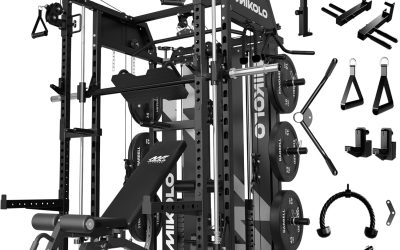
Mikolo Smith Machine with Weight Stack and Power Cage
If your home gym is one machine, this is the argument for making it a rack-first design. The Smith bar path is linear and smooth, the cable crossover handles both the functional trainer need and the lat work, and the cage adds safety for overhead pressing. It replaced my separate squat rack and cable station entirely.
- Pro: The dual pulley system gives genuine crossover flexibility alongside the barbell work.
- Pro: Included attachments (over ten of them) eliminated any immediate add-on shopping.
- Con: Assembly is a two-person, three-hour job with zero shortcuts.
Skip it if you have under seven feet of ceiling clearance or a floor space smaller than a standard parking spot.
Body-Solid Multi-Station, 210 lb Weight Stack
Body-Solid built its reputation on leg and arm isolation machines, and this multi-station is the home version of that philosophy. The 210-pound stack is the heaviest in this roundup, which matters when you are doing heavy leg extensions or seated rows. The adjustment points are well-spaced and lock solidly.
- Pro: Leg developer is the best in this group for quad-focused home training.
- Pro: Weight stack moves without binding even near the top pin.
- Con: Footprint is wide enough that it demands a dedicated room or a large garage wall.
Skip it if you primarily want cable work and rarely train legs at home.
XGSW Multi-Function Workout Station
The XGSW targets a specific buyer: someone who wants arm and leg cable work, a pulley system, and a compact frame, all for under $700. It is not trying to be a power rack or a full crossover. Within its lane, the build is solid and the arm trainer attachment actually functions well for bicep-focused volume.
- Pro: Small enough to fit in a spare bedroom or hallway nook.
- Pro: Cable routing is straightforward enough that rethreading after maintenance takes minutes.
- Con: The leg developer angle is fixed, which limits variation over time.
Skip it if you need adjustable pulley heights or want to perform standing cable movements.
Body-Solid Best Fitness Functional Trainer, 190 lb Stack
At $425, this is the best value cable crossover I have tested. The 190-pound stack is generous for the price, and the lat pulldown attachment is a genuine addition rather than an afterthought. The frame flexes slightly at the very top of a heavy high row, but it stays within acceptable range for most lifters.
- Pro: Pulley height adjustment is nearly stepless, making it easy to dial in any angle.
- Pro: Ships with a full set of handles and cuffs already installed.
- Con: Paint finish chips easily on the corner edges during assembly.
Skip it if you routinely pull above 150 pounds on cables and want zero frame flex.
Mikolo Home Gym, 150 lb Weight Stack
This is the beginner-friendly station I hand to family members who ask, “What should I buy?” It has a lat pulldown, a cable crossover, a chest press, and a leg developer—enough to cover a full routine without touching free weights. The 150-pound stack is adequate for someone building a base.
- Pro: Everything you need for a full circuit comes in one box at one price.
- Pro: Instruction manual is clear and assembly is genuinely single-person.
- Con: Cable crossover carriage heights adjust via pin, not smooth glide, which interrupts flow.
Skip it if you already train with barbells and only need cable assistance for warm-ups and prehab.
Buying Guide
Weight Stack Size and Versatility
Stack size determines which exercises stay useful. A 150-pound stack is fine for lateral raises, tricep pushdowns, and face pulls but becomes limiting for standing cable rows or chest crossovers once you build strength. If you are starting out, 160 pounds covers the first year comfortably. If you already bench above bodyweight, look for 190 or more. A single shared stack across multiple stations means you can flow through a full circuit without adding plates, which keeps rest periods honest.
Pulley System Quality and Adjustment Range
The pulley is the part you interact with every rep. Ball-bearing pulleys with sealed housings stay smooth; plastic bushings grab and squeak within weeks. Independent height adjustment on both sides lets you perform asymmetrical movements like woodchops or single-arm lat pulldowns. A shared rail that moves both sides together restricts you to symmetrical pulls, which is fine for pressing but limiting for rotational work.
Footprint and Assembly Reality
A machine that requires a professional to assemble is a machine that will sit disassembled for weeks. Look for units that one person can put together in under two hours. Measure your space with the machine’s footprint plus at least three feet of clearance on the pull side. If your ceiling is under eight feet, any machine with a high lat pulldown tower needs a clearance check before you order.
Our Verdict
The REP Fitness Arcadia is the top pick for anyone who will train seriously at home for years and wants the cable experience to match a commercial gym. For budget buyers who still want functional cable work, the Body-Solid Best Fitness Functional Trainer at $425 is the standout value. If your situation demands a single machine that replaces a rack, a cable station, and a bench simultaneously, the Mikolo Smith Machine is the one that does all three.
FAQ
Is a functional trainer worth it over a cable machine?
A functional trainer is a type of cable machine with independent adjustable pulleys, so the comparison usually comes down to build quality and adjustment range. If you want to perform unilateral work, rotational patterns, and varying angles, a functional trainer earns its higher price over a fixed-path single-pulley unit.
Can a functional trainer replace free weights?
It can replace a significant portion of isolation and accessory work, but it does not replicate the stabilizer demand of a barbell bench press or back squat. Most home lifters treat a functional trainer as the complement to a rack and bench, not a full substitute.
How much space do I need for a functional trainer?
Compact single-stack units occupy roughly a four-by-four-foot floor area. Full power-rack-based functional trainers like the Mikolo need a six-by-six-foot footprint plus overhead clearance of at least seven feet. Always add a three-foot working radius on the side where you pull.
What is the most common failure point on home functional trainers?
Cable fraying at the pulley contact point is the most reported issue in budget models. On mid-range units, the selector pin mechanism tends to wear first, causing the stack to skip or bind. Regular lubrication of cable and pulley interfaces extends the life of any machine on this list.