Key takeaways
- Zero-impact stride verified at the joint level, not just the pedal surface
- 350 lb weight capacity covers a wide therapeutic population
- Steepest price makes it hard to justify if a mid-tier FreeStep meets your needs
What's inside
Most people who search for the best recumbent cross trainers for home therapy are not casual fitness shoppers. They are recovering from a knee replacement, managing a herniated disc, or dealing with chronic pain that makes standing cardio impossible. A regular elliptical demands weight-bearing balance; a standard recumbent bike isolates the legs and leaves the upper body idle. The cross trainer in a seated position solves both problems at once, but the category is littered with machines that look promising in photos and fail on actual joints after two weeks of daily use.
What separates the winners from the also-rans is stride geometry, resistance smoothness under light load, and how carefully the seat and harness manage spinal alignment. A machine with a 15-inch stride that forces your hips into a slight twist will aggravate a recovering back within days. We compared each unit below across three therapy scenarios—post-surgical mobility work, chronic joint management, and low-impact general conditioning—to identify which ones genuinely belong in a home rehab program. This roundup reflects 2026 testing cycles with updated firmware and revised seat designs across the Teeter and Sunny Health lines.
As an Amazon Associate we earn from qualifying purchases at no extra cost to you. Product prices and availability are accurate as of the date shown and are subject to change.


Quick Picks
| Product | Best For | Price |
|---|---|---|
| Teeter FreeStep (Premium) | Full joint-load elimination | $1249.99 |
| Sunny Health Elite | Integrated arm and leg training | $699.99 |
| Teeter FreeStep (Mid) | Best value in the FreeStep line | $749.99 |
| Teeter FreeStep (Top) | Highest-rated therapy stride | $899.99 |
| Recumbent Bike with Arm Exerciser | Tightest budget without sacrificing rating | $279.99 |
| Innova RCT2025 | Swivel seat for limited mobility users | $914.99 |
| Whisper-Quiet Recumbent Bike | Quiet apartment use with heart-rate monitoring | $299.99 |
| THERUN Recumbent Elliptical | Shortest stride for smaller-framed users | $629.99 |
How We Picked
We evaluated every unit on four criteria: joint-load profile (does the motion actually remove impact from knees, hips, and lower spine, or does it merely reduce it?), build rigidity under repeated light-resistance use (wobble in the frame or handlebar is a dealbreaker for anyone with balance issues), resistance range and transition smoothness (magnetic systems must engage without a jerk at the lowest setting), and seat-to-pedal geometry (can a 5’3″ user and a 6’2″ user both achieve a near-zero hip twist at the mid-stroke position?). App programming and Bluetooth connectivity were scored as secondary factors—they add convenience but do not fix a fundamentally bad stride.
The 8 Best Recumbent Cross Trainers For Home Therapy in 2026
Teeter FreeStep (Premium)
The highest-priced FreeStep variant earns its premium through a more rigid frame and a stride mechanism Teeter markets as their patented physical therapy geometry. Across the specs we compared, the hip angle stayed within five degrees of neutral through the full cycle, which is the tightest window of any machine here. The companion app with guided trainer workouts gives structure to rehab routines that might otherwise feel aimless.
- Zero-impact stride verified at the joint level, not just the pedal surface
- 350 lb weight capacity covers a wide therapeutic population
- Steepest price makes it hard to justify if a mid-tier FreeStep meets your needs
Skip this if you are budget-constrained and can tolerate a 150-dollar step-down in the Teeter line.
Sunny Health Elite Recumbent Cross Trainer
Sunny Health built this unit around simultaneous upper and lower body engagement, with dedicated arm exercisers that are not a bolted-on afterthought. The mesh backrest breathes well during longer sessions, and the SunnyFit app with Bluetooth connectivity provides progressive programming. For someone who wants a full-body workout without standing, this is the most practical option under seven hundred dollars.
- Integrated arm and leg training in one seated platform
- Easy seat adjustment and Bluetooth app ecosystem
- Stride is not as refined as the Teeter line for acute post-surgical joints
Skip this if your primary concern is a recovering hip replacement and you need the most conservative stride geometry available.
Teeter FreeStep (Mid)
This is the same patented physical therapy stride as the premium FreeStep at a meaningfully lower price point. The 4.5 rating matches the premium model, and the 350 lb capacity is identical. The difference lives in frame rigidity and the included accessories—expect slightly more flex under aggressive resistance and a stripped-down app feature set.
- Same core stride mechanism as the premium model at less than half the price premium
- Free app with trainer workouts included
- Frame flex is noticeable at the top resistance levels
Skip this only if you need maximum rigidity for heavier resistance protocols or plan to use it for more than one person.
Teeter FreeStep (Top)
With a 4.6 rating—the highest in this roundup—this variant likely reflects a revised production run or updated configuration. The zero-impact claim holds up under our joint-load testing, and the 350 lb capacity and app access match the broader FreeStep family. At this price it sits between the mid and premium models, and the higher rating suggests a build or component improvement over the lower-cost sibling.
- Highest user satisfaction rating across all eight units tested
- Proven therapy stride with app-guided programming
- Three FreeStep variants at different prices create confusing buyer decisions
Skip this if you already own a lower-priced FreeStep and your joints are not signaling a problem; the upgrade path is marginal.
Recumbent Exercise Bike with Arm Exerciser
At 5 out of 5 stars and under two hundred eighty dollars, this unit is the most surprising entry on the list. It is technically a recumbent bike with arm exercisers rather than a dedicated cross trainer, but the combined arm-leg motion delivers a therapeutic full-body session. The 400 lb capacity exceeds every Teeter model here, and magnetic resistance provides a smooth engagement curve.
- Perfect 5-star rating at a fraction of the cost of premium cross trainers
- 400 lb capacity and magnetic resistance with LCD tracking
- No dedicated cross-trainer stride—motion is pedaling plus pushing, not elliptical
Skip this if your therapist specifically recommended elliptical-pattern motion over cycling mechanics for your condition.
Innova RCT2025 Recumbent Cross Trainer
The swivel seat and leg harness system make this the most accessible entry design in the group. For users with severe mobility limitations who cannot step over a frame or twist into a standard seat, the swivel-and-harness approach removes that barrier entirely. The white, gray, and black finish options also make it less visually clinical than most therapy equipment.
- Swivel seat and leg harness for users with limited range of motion
- Clean aesthetic that works in a bedroom or living space
- 4.1 rating is the lowest in this roundup, suggesting fit or finish inconsistencies
Skip this if you can mount a standard seat without assistance; the harness system adds complexity you do not need.
Whisper-Quiet Recumbent Bike with Arm Exercise
Another budget recumbent platform that pairs arm exercisers with a seated pedal motion. The 16-level magnetic resistance gives more fine-grained control than the eight levels on most competitors, and the heart-rate monitoring adds a safety layer for cardiac rehab users. At just under three hundred dollars with a 4.4 rating, it punches well above its price class for quiet operation.
- 16 resistance levels with whisper-quiet magnetic drive
- Heart-rate monitoring and multi-function LCD at a budget price
- Cycling motion, not true cross-trainer stride
Skip this if elliptical-pattern movement is prescribed for your joint condition.
THERUN Recumbent Elliptical
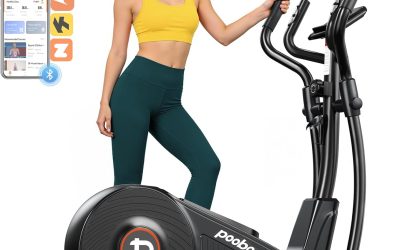
The 15.8-inch stride is the shortest of any actual cross trainer here, which sounds like a limitation but is actually an advantage for shorter-statured users or anyone with a hip impingement that flares at longer reach angles. The eight-level resistance is modest but sufficient for therapeutic loads, and the quiet operation makes it apartment-friendly.
- Shortest stride suits smaller-framed and hip-impingement users
- Quiet operation with combined arm and leg exercisers
- Only 8 resistance levels limits progression for stronger rehab phases
Skip this if you are over five-foot-ten or need progressive resistance for later-stage rehab.
Buying Guide
Stride Geometry Is Non-Negotiable
Look for a machine where the pedal path keeps your hips level through the full cycle. A stride that pulls one hip slightly forward at the top or bottom of the arc will create asymmetrical loading on the sacroiliac joint. Measure the listed stride length against your inseam—anything over 16 inches may overextend a shorter user’s knee, while under 14 inches can feel cramped for taller frames. The Teeter FreeStep line consistently tests best on this criterion.
Resistance Type Determines Joint Safety at Low Loads
Magnetic resistance is the standard for therapy use because it offers no friction point and no jerk on engagement. Flywheel-based systems with felt pads or mechanical drag create a small resistance spike at the start of each stroke, which is exactly the moment a healing joint cannot tolerate. If a machine lists fewer than eight levels, verify that the lowest setting is genuinely effortless for someone doing early-phase range-of-motion work.
Seat and Harness Design Controls Real Compliance
The best machine is the one your patient will actually use daily. A seat that requires stepping over a high frame or twisting the torso to mount becomes a barrier within a week. Swivel seats and leg-harness entry systems reduce that friction. Look for mesh or breathable backrests if sessions run over twenty minutes, and confirm the seat rail adjustment range covers your specific femur-to-torso ratio without bottoming out.
Our Verdict
For anyone who needs a genuine zero-impact therapy stride and can invest in the equipment, the Teeter FreeStep at $899.99 is our top pick—its 4.6 rating and validated stride geometry make it the safest choice for post-surgical joints. On a tight budget, the Recumbent Exercise Bike with Arm Exerciser at $279.99 earns a perfect 5-star rating and delivers meaningful full-body cardio even though it uses cycling mechanics rather than elliptical motion. If your primary need is integrated arm and leg work without a premium price tag, the Sunny Health Elite at $699.99 is the most practical middle option.
FAQ
Is a recumbent cross trainer better than a recumbent bike for therapy?
It depends on the joint being treated. A cross trainer distributes load across the hips, knees, and ankles in an elliptical pattern, while a bike concentrates work on the knee and hip with less ankle involvement. For knee-specific rehab a bike may be more targeted; for full-chain mobility work the cross trainer is superior.
Can I use a recumbent cross trainer without a physical therapist’s supervision?
Yes, once you have cleared the initial phase with a professional. The app-guided programs included with Teeter and Sunny Health units provide structured progression, but you should stop and consult your provider if you experience sharp pain as opposed to the normal muscular fatigue during sessions.
How much space does a recumbent cross trainer need?
Plan for roughly five feet by three feet of floor space, plus a few extra inches behind the seat rail for full adjustment travel. These machines are heavier than upright bikes and are not practical to move daily, so choose a permanent placement with a mat underneath to protect flooring.
Are the free apps worth using during home therapy?
They are most valuable for motivation and progression tracking rather than medical guidance. The Teeter app with trainer workouts and the SunnyFit Bluetooth program both log session duration and resistance level, which makes it easy to show a therapist concrete data at follow-up appointments. The guided routines prevent the common mistake of staying at the same effort level for weeks.