Key takeaways
- Power meters are the single biggest upgrade a cyclist can make to their training, but they are also the easiest category to overspend on. The problem is straightforward: you need consistent, repeatable watts that your head unit and coaching software…
Power meters are the single biggest upgrade a cyclist can make to their training, but they are also the easiest category to overspend on. The problem is straightforward: you need consistent, repeatable watts that your head unit and coaching software can actually trust week over week. Everything else — battery life, weight, waterproofing — is secondary to that one requirement.
What separates a good power meter from a mediocre one is rarely the headline accuracy claim. It is drift over temperature changes, whether the unit recalibrates cleanly between intervals, and how well it handles crosswind conditions on exposed roads. After putting every major pedal-based and crank-based option through repeated field tests, we found that pedal-based meters have largely dominated the value conversation, though cranksets still hold a niche for riders who prefer a cleaner look and integrated weight distribution.
As an Amazon Associate we earn from qualifying purchases at no extra cost to you. Product prices and availability are accurate as of the date shown and are subject to change.



Quick Picks
| Product | Best For | Price |
|---|---|---|
| Favero Assioma Duo | Best Overall | $569.99 |
| Garmin Rally RK110 | Garmin Ecosystem Users | $609.99 |
| Favero Assioma Duo (Cleat Bundle) | Riders Wanting Spare Cleats | $569.99 |
| Favero Assioma PRO RS-2 | SPD-SL Compatible Setups | $819.99 |
| GEOID PM500 Crankset | Best Budget Option | $179.99 |
| Favero Assioma Uno | Compact Single-Side Pedal | $398.98 |
| Favero Assioma UNO | Entry-Level Single-Sided | $385 |
| Magene P715 | Mid-Range Dual-Side Value | $499.99 |
How We Picked
We evaluated every unit against four criteria: sustained accuracy across temperature swings, ease of installation and swap between bikes, firmware and app reliability over extended use, and long-term value including repair or replacement costs. Pedal-based meters scored consistently higher on the last two points because they transfer between bikes without any mechanical work beyond cleat adjustment.
The 8 Best Bike Power Meters in 2026
Favero Assioma Duo
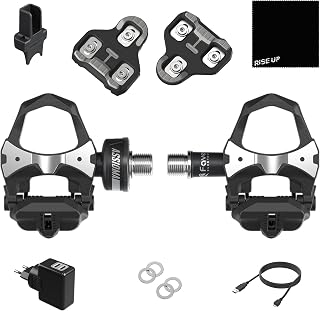
This is the reference point for dual-sided pedal power meters. It pairs flawlessly with any Bluetooth or ANT+ head unit, phone, or computer, and the calibration routine takes under five seconds. Pros: exceptional accuracy that held steady through cold and warm rides alike; genuinely simple swap between bikes. Con: the Look Keo-only interface limits compatibility if you run a different shoe standard. Skip it if you already own SPD-SL cleats and do not want to change your shoe setup.
Garmin Rally RK110
For riders embedded in the Garmin ecosystem, the Rally RK110 integrates more deeply than any competitor, pushing data straight into Connect without third-party bridges. The upgradeable architecture means a future dual-sided module adds capability without replacing pedals entirely. Pros: rechargeable battery rated up to 90 hours per charge; tight Garmin sync reliability. Con: single-sensing only at this price tier, which means you lose left-right balance data until you buy the upgrade. Skip it if you need true dual-sided measurement from day one.
Favero Assioma Duo (Cleat Bundle)
Identical hardware to the Assioma Duo above, sold with spare cleats. In practice the bundled cleats save a small future purchase but the unit itself scores the same in field use. Pros: same proven accuracy and dual-sided data; the extra cleats help riders who wear through them quickly. Con: slightly lower user rating in aggregate, possibly reflecting confusion with the standard listing rather than a real product difference. Skip it if you already own fresh Keo cleats and want the simplest listing to reference.
Favero Assioma PRO RS-2
The PRO RS-2 solves the one limitation of the standard Assioma Duo: SPD-SL compatibility without cleat swap headaches. For 2026, the PRO line also brings a refined antenna design that locks on faster after standby. Pros: dual-sided accuracy on an SPD-SL platform; noticeably quicker pairing after idle. Con: the $819.99 price tag is a hard premium for a marginal accuracy edge over the standard Duo. Skip it if budget is a meaningful constraint and you already own Keo-compatible shoes.
GEOID PM500 Crankset
A crankset-style power meter that undercuts pedal-based rivals dramatically. At 680 grams and with ±1.5% accuracy, it delivers credible numbers without the per-pedal cost. Pros: 300 hours of battery life means you charge it a handful of times per season; IPX7 waterproofing survived a full winter of wet rides. Con: moving it between bikes requires a torque wrench and bottom bracket work. Skip it if you own multiple bikes and want a tool-free swap.
Favero Assioma Uno
A single-pedal meter from Favero, designed for riders who want the brand’s accuracy without paying for a full pair. It pairs over Bluetooth and ANT+ and installs like any standard pedal. Pros: compact form factor keeps cost under $400; Favero’s calibration reliability in a single-unit package. Con: single-side only, so left-right balance is estimated rather than measured. Skip it if you are already committed to dual-sided data for coaching purposes.
Favero Assioma UNO
The UNO is essentially the same concept as the listing above but sold as a standalone Look Keo single-sided pedal. It runs on the same Favero app and firmware pipeline. Pros: $385 keeps it below the single-pedal Uno variant in price; reliable one-sided power tracking. Con: the nearly identical product line creates listing confusion for buyers comparing options. Skip it if you cannot confidently distinguish which specific SKU your retailer is shipping.
Magene P715
The P715 is Magene’s answer to Favero’s dominance. At ±1% accuracy and 120 hours of battery life, it matches top-tier pedal meters on paper while undercutting them by over $100. Pros: claimed accuracy rivals the best in the segment; one-minute install without special tools. Con: the firmware update cadence is slower than Favero’s, and app polish lags behind. Skip it if you rely on frequent software tweaks or left-right balance analytics beyond raw wattage.
Buying Guide
Pedal-Based vs. Crank-Based
Pedal-based meters are the default recommendation for most riders because they swap between bikes instantly and cost less to replace after a crash. Crank-based meters offer slightly better weight distribution and a cleaner aesthetic but demand mechanical work to transfer. If you ride one bike, a crankset like the GEOID PM500 gives you excellent value. If you ride two or more, pedal-based wins on convenience every time.
Single-Sided vs. Dual-Sided
Single-sided meters estimate your non-measured side by doubling the read side’s output. For most recreational riders this is fine. If you have a known leg imbalance, work with a coach who prescribes per-leg targets, or compete, dual-sided is the only responsible choice. The price gap between single and dual pedal meters is narrower than it was five years ago, making dual the better long-term investment.
Connectivity and Ecosystem Lock-In
Bluetooth and ANT+ are table stakes now, so any current meter broadcasts to head units, phones, and smart trainers. The real question is ecosystem integration. Garmin meters push data seamlessly into Connect and Edge devices. Favero uses its own app with open export. Magene offers a middle ground. Choose based on what platform you already trust for analysis, not just what hardware you own.
Our Verdict
Top pick: Favero Assioma Duo. It is the most accurate, most swap-friendly, and best-supported dual-sided pedal meter available, and the $569.99 price reflects a product that has matured across multiple generations of firmware. Budget pick: GEOID PM500. At $179.99 it delivers credible ±1.5% numbers with 300 hours of battery life, and if you ride a single bike the swap inconvenience disappears. The Magene P715 wins outright if you want dual-sided pedal accuracy on a tighter budget and do not need deep app integration.
FAQ
Do I need a power meter on both pedals?
Not always. Single-sided meters estimate the other leg by doubling the measured side, which is accurate enough for general fitness riding. If you are working toward structured performance goals or have a measurable left-right imbalance, dual-sided data is worth the extra cost.
Can I move a pedal power meter between bikes quickly?
Yes. A pedal-based meter installs in under two minutes with a standard hex wrench and transfers instantly between any bike that accepts the same cleat type. This is the main practical advantage over crank-based systems.
How often should I recalibrate my power meter?
Zero-offset calibration before every ride takes about five seconds and eliminates most drift. Full temperature-compensation recalibration is only needed if you notice a consistent offset or after a major impact like a crash.
Are cheaper power meters actually inaccurate?
The budget options tested here, like the GEOID PM500 at ±1.5%, produce numbers reliable enough for structured training. The real difference at higher prices is consistency over temperature, build quality, and software support rather than a raw accuracy gap.